
石化

Search documents
天津“十五五”规划建议:加快推动信创、生物医药、新能源、新材料、航空航天等成长为支柱产业
Zheng Quan Shi Bao Wang· 2025-11-27 23:59
Core Viewpoint - The Tianjin Municipal Committee emphasizes the development of advanced manufacturing, focusing on high-end, intelligent, and green directions, while promoting new industrialization and upgrading traditional industries [1] Group 1: Advanced Manufacturing Development - The plan aims to enhance competitiveness in industries such as petrochemicals, automotive, equipment manufacturing, and metallurgy through intelligent and green manufacturing [1] - There is a strong push for the large-scale application of new technologies, products, and scenarios, particularly in emerging industries like biomedicine, new energy, and aerospace [1] Group 2: Future Industry Layout - The strategy includes exploring viable business models, market regulation rules, and risk-sharing mechanisms to promote sectors like biomanufacturing, low-dimensional materials, and hydrogen energy [1] - The initiative aims to establish new economic growth points through innovations in brain-machine interfaces, embodied intelligence, and advanced computing [1] Group 3: Consumer Goods Manufacturing - The plan also focuses on actively developing the terminal consumer goods manufacturing sector and cultivating advanced manufacturing brands [1] - There is an emphasis on improving quality infrastructure and standard systems, alongside strengthening environmental and safety regulations [1]
数据点评 | 利润走低的“三重拖累”(申万宏观·赵伟团队)
赵伟宏观探索· 2025-11-27 16:04
Core Viewpoint - The significant decline in industrial enterprise profits in October is primarily attributed to a high base effect, weakened profit margins, and declining revenue, collectively referred to as the "triple drag" [2][10][79]. Revenue - In October, industrial enterprise revenue showed a notable decline, with a year-on-year growth rate of 1.8%, down from 2.4% in the previous month. The actual revenue growth rate, excluding price factors, fell by 6.8 percentage points to -1.4% [1][7][81]. - All three major industrial chains—petrochemical, metallurgy, and consumer—experienced significant revenue declines, with year-on-year reductions of 6.3, 6.6, and 6.3 percentage points, respectively [2][16][81]. Profitability - Industrial enterprise profits saw a substantial year-on-year decline of 27.1 percentage points to -5.5% in October, with the operating profit margin dropping by 20.9 percentage points to -6.1% [5][44][83]. - The profit margin decline is largely driven by increased expense ratios and other loss items, which saw significant reductions compared to the previous month [2][10][79]. Industry Analysis - Industries such as non-metallic products, rubber and plastics, and general equipment faced the most significant profit declines, with respective reductions of 2, 1.4, and 1.9 percentage points [3][19][20]. - The revenue of these industries also fell sharply, with non-metallic products, rubber and plastics, and electrical machinery experiencing year-on-year declines of 19.7%, 14.2%, and 9.5% [19][20]. Cost Structure - Industrial enterprises faced increasing cost pressures, with the cost rate reaching 85.6%, a relative high compared to recent years. The cost's impact on profit remained negative at -3.2% [3][27][28]. - The metallurgy and consumer chains reported cost rates of 86.1% and 85.1%, respectively, indicating a persistent high cost environment [27][28]. Future Outlook - The "anti-involution" policy is expected to be intensified, with improvements in underutilized capacity. However, cost pressures for industrial enterprises remain significant, necessitating further monitoring of policy effects [4][42][82]. - The ongoing profitability challenges are primarily due to rigid cost pressures stemming from downstream investment behaviors, with expectations for gradual alleviation as enterprises accelerate debt repayments [4][42][82].

工业企业效益数据点评(25.10):利润走低的三重拖累
Shenwan Hongyuan Securities· 2025-11-27 13:20
Revenue Performance - In October, industrial enterprises' cumulative revenue growth year-on-year was 1.8%, down from 2.4% in the previous month[6] - The actual revenue growth rate, excluding price factors, fell significantly by 6.8 percentage points to -1.4%[14] - Revenue from the petrochemical, metallurgy, and consumer chains decreased by 6.3, 6.6, and 6.3 percentage points respectively, resulting in year-on-year growth rates of -3.4%, -1.7%, and 1.8%[14] Profitability Analysis - Industrial enterprises' profits saw a substantial year-on-year decline of 31.3 percentage points to -8.8% in October[7] - The operating profit margin dropped by 20.9 percentage points to -6.1% compared to the previous month[34] - Profitability was negatively impacted by rising costs and other losses, with the cost rate for industrial enterprises at 85.6%, remaining at a relatively high level historically[24] Cost Structure - The cost rate for the metallurgy and consumer chains was 86.1% and 85.1%, respectively, indicating a year-on-year increase of 0.6% and stable compared to the previous year[24] - The overall cost pressure on profits remained negative, contributing -3.2% to profit year-on-year[24] Industry-Specific Insights - Industries such as non-metallic products, rubber and plastics, and general equipment experienced significant profit declines, with respective profit growth rates falling by 2, 1.4, and 1.9 percentage points[16] - The automotive, electrical machinery, and computer communication sectors also saw notable profit declines, with contributions to overall profit dropping by 3, 2.7, and 1.5 percentage points[16] Inventory Trends - By the end of October, finished goods inventory increased by 3.7% year-on-year, up from 2.8% in the previous month[6] - Actual inventory growth, excluding price factors, was 8.2% year-on-year, indicating stability in mid and downstream inventories[45]
工业企业效益数据点评:利润走低的“三重拖累”
Shenwan Hongyuan Securities· 2025-11-27 13:12
Revenue Performance - In October, industrial enterprises' cumulative revenue growth was 1.8%, down from 2.4% in the previous month[6] - The actual revenue growth rate, excluding price factors, fell significantly by 6.8 percentage points to -1.4%[14] - Revenue from the petrochemical, metallurgy, and consumer chains decreased by 6.3, 6.6, and 6.3 percentage points respectively, resulting in year-on-year changes of -3.4%, -1.7%, and 1.8%[14] Profitability Analysis - Industrial enterprises' profits dropped sharply, with a year-on-year decline of 31.3 percentage points to -8.8% in October[7] - The operating profit margin fell by 20.9 percentage points to -6.1% compared to the previous month[35] - Profit contributions from non-metallic products, rubber and plastics, and general equipment industries decreased significantly, impacting overall profits by 2, 1.4, and 1.9 percentage points respectively[16] Cost Structure - The cost rate for industrial enterprises was 85.6%, remaining at a relatively high level historically, with a negative impact on profit growth of -3.2%[24] - The metallurgy and consumer chains had cost rates of 86.1% and 85.1%, respectively, indicating persistent cost pressures[24] - The agricultural and food sectors saw significant increases in cost rates, with respective month-on-month increases of 46 basis points, 31.7 basis points, and 17.5 basis points[24] Inventory Trends - By the end of October, the inventory of finished products increased by 0.9 percentage points to 3.7% year-on-year[6] - Actual inventory growth, excluding price factors, was 8.2% year-on-year, indicating stable inventory levels in the mid and downstream sectors[46] Future Outlook - The "anti-involution" policy is expected to alleviate cost pressures gradually, but the effectiveness of these policies remains to be seen[34] - Continued monitoring of the impact of external factors, such as international oil prices and domestic industrial demand recovery, is crucial for future profitability[53]
重点关注,资金偷偷布局这个方向
Sou Hu Cai Jing· 2025-11-27 12:30
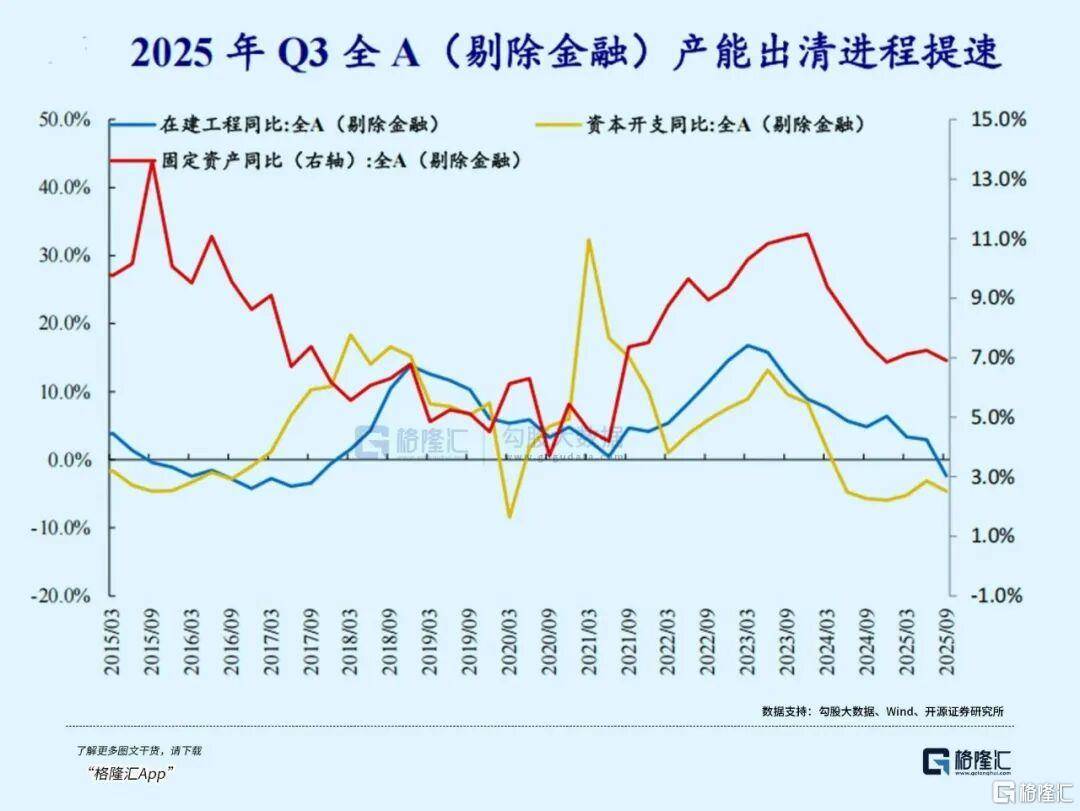
Core Viewpoint - The A-share market is at a critical point of style rebalancing by the end of 2025, with the ongoing "anti-involution" policy reshaping investment logic in cyclical industries [1][4] Group 1: Market Dynamics - Since Q3 2025, the A-share market has shown a significant "technology + cyclical" dual-driven pattern, indicating a transition from a single growth line to a balanced allocation of "growth + value" [1] - The technology sector has experienced a substantial cumulative increase, with the electronics industry rising by 45% and the communication equipment sector by over 38%, significantly outperforming the CSI 300 index's 14.7% [4] - The concentration of institutional holdings in the technology sector has reached nearly historical peaks, with TMT sector holdings exceeding 40.16%, indicating a risk of overcrowding [4] Group 2: Policy Impact - The Ministry of Industry and Information Technology has proposed three major measures for the chemical industry in 2026, signaling a shift from mere advocacy to substantial implementation of the "anti-involution" policy [4] - The "anti-involution" policy has extended to industry self-discipline, with products like long silk, PTA, and urea achieving industry collaboration through "production limits to maintain prices + price alliances + punitive agreements" [10] Group 3: Chemical Industry Insights - The chemical industry is experiencing a supply-side improvement driven by "downward capacity cycles + policy-guided elimination," with fixed asset investments in the chemical raw materials and products manufacturing sector decreasing by 5.6% year-on-year from January to September 2025 [5][6] - The demand side is supported by both domestic recovery and overseas improvement, with textile and apparel exports increasing by 8.7% year-on-year from January to October 2025 [12] Group 4: Investment Opportunities - Investment opportunities in the chemical industry under the "anti-involution" wave include selecting leading companies with strong management systems and cost advantages [14] - Specific sectors to focus on include: 1. Petrochemicals: Expected to see a turning point due to supply contraction and demand upgrades [15] 2. Coal chemicals: Benefiting from policy catalysts and cost advantages, with potential for profit recovery [16] 3. Polyester filament and PTA: Leading sectors in the implementation of the "anti-involution" policy, currently entering an inventory digestion phase [17]
福建企业“领头雁”:营收超过7200亿元,旗下拥有8家上市公司
Sou Hu Cai Jing· 2025-11-27 12:04
Core Insights - The 2025 Fujian Top 100 Enterprises list was announced, with the entry threshold reaching 10.6 billion yuan, significantly up from 10.071 billion yuan last year [1] - Total assets have seen positive growth for seven consecutive years, with an increase of over 80% and an average annual compound growth rate of nearly 9% [1] Group 1: Regional Distribution - Fuzhou leads with 41 companies, an increase of one from last year [1] - Xiamen follows with 26 companies, a decrease of one [1] - Quanzhou and Zhangzhou each have 10 companies, ranking third in the province [1] - Other cities include Ningde with 4, Putian with 3, and Longyan, Nanping, and Sanming each with 2 [1] Group 2: Company Types - The list includes 49 state-owned enterprises, 46 private enterprises, 3 foreign enterprises, and 2 joint ventures [1] Group 3: Industry Distribution - Manufacturing leads with 50 companies, followed by the service industry with 41, and construction with 7 [1] Group 4: Notable Companies - Notable companies include Yonghui Supermarket, Anta Sports, Dell (China), Pupu Technology, Sanan Optoelectronics, and Hengan Group [3] - The top ten companies saw an entry threshold increase from 103.009 billion yuan to 109.63 billion yuan, a growth of 6.4% [3] Group 5: Key Performers - Ningde Times remains fifth on the list despite a 9.7% revenue decline to 362.013 billion yuan, leading the manufacturing sector [5] - The company has maintained the highest global sales volume of power batteries for eight consecutive years and energy storage batteries for four years [5] - The global power battery installation volume increased by 34.7% to 811.7 GWh in the first three quarters of 2025, with Ningde Times holding a 36.6% market share [5] Group 6: Leading Enterprises - Jianfa Group, Guomao Holdings, and Xiangyu Group occupy the top four positions in both the overall and service industry rankings [7] - Jianfa Group, established in 1980, has a total asset scale exceeding 830 billion yuan and operates in five major sectors [7] - Jianfa Group's core subsidiary reported a revenue of 498.98 billion yuan, with a slight decline in net profit [7]


重点关注,资金偷偷布局这个方向
格隆汇APP· 2025-11-27 10:46
Core Viewpoint - The A-share market is at a critical point of style rebalancing by the end of 2025, with the ongoing "anti-involution" policy reshaping the investment logic in cyclical industries [2] Group 1: Market Dynamics - Since Q3 2025, the A-share market has shown a significant "technology + cyclical" dual-driven pattern, indicating a transition from a single growth line to a balanced allocation of "growth + value" [4] - The performance improvement in cyclical sectors is sustainable, with a 23% year-on-year increase in the exit scale of backward production capacity in industries like chemicals and non-ferrous metals as of Q3 2025 [4] Group 2: Drivers of Market Style Shift - Three main supports for the current market style switch include: 1. The technology sector's significant cumulative increase, with the electronics industry up 45% and communication equipment over 38% year-to-date as of November 2025, far exceeding the 14.7% rise of the CSI 300 index [6] 2. Institutional holdings in the technology sector nearing historical peaks, with TMT sector holdings surpassing 40.16% [6] 3. Clear policy signals from the Ministry of Industry and Information Technology regarding the chemical industry, enhancing the certainty of supply-side contraction in cyclical industries [6] Group 3: Chemical Industry Insights - The core logic for supply-side improvement in the chemical industry is driven by "downward capacity cycles + policy-guided exit," with fixed asset investment in the chemical raw materials sector decreasing by 5.6% year-on-year from January to September 2025 [8][11] - The chemical industry has significant advantages over traditional cyclical industries in capacity optimization efficiency, industry collaboration, and high-end transformation paths [12] Group 4: Demand Recovery - The recovery in demand for the chemical industry is supported by both domestic and overseas factors, with domestic engines including improved real estate conditions and a resurgence in textile exports [13][14] - China's chemical product sales have maintained the top global position, with sales amounting to approximately €2.24 trillion in 2023, accounting for 43.1% of global sales [16][17] Group 5: Investment Opportunities in the Chemical Sector - Investment opportunities in the chemical industry under the anti-involution wave include: 1. Selecting leading companies with strong management and cost control [20] 2. Focusing on three reversal areas: petrochemicals, coal chemicals, and polyester filament + PTA, with specific companies highlighted for their potential [21][22][23]





两大石化企业申请业务重组,涉及乙烯产能达195万吨/年!
Zhong Guo Hua Gong Bao· 2025-11-27 10:15
Group 1 - The core point of the article is the announcement by two major South Korean petrochemical companies, Lotte Chemical and HD Hyundai Chemical, regarding their application to the government for approval of their petrochemical business integration plan, aimed at enhancing industry competitiveness and optimizing industrial layout [1][2] - The integration plan specifically addresses the structural overcapacity issue in the naphtha cracking center (NCC) within the domestic petrochemical industry, with Lotte Chemical planning to divest its NCC operations at the Daesan Industrial Complex and merge them with HD Hyundai Chemical [1] - The restructuring involves a total ethylene production capacity of 1.95 million tons per year, with Lotte Chemical's Daesan plant contributing 1.1 million tons and HD Hyundai Chemical contributing 850,000 tons [1] Group 2 - The South Korean petrochemical industry is facing a severe survival crisis due to continuous new capacity additions leading to oversupply and significant profit margin declines [2] - In response to the crisis, ten major South Korean petrochemical companies signed an agreement in August to restructure their businesses, which includes substantial capacity reductions to fundamentally improve competitiveness [2]
全球石油需求峰值被延后,中国石化行业“绿色转型”如何加速
Di Yi Cai Jing· 2025-11-27 07:58
Core Insights - The global peak in oil demand is now expected to be delayed until after 2030, with projections indicating it may not occur until 2040, contrary to previous forecasts that suggested a peak before 2030 [2][3] - The shift in oil demand is influenced by the ongoing energy transition and the need for countries to meet climate goals, particularly the Paris Agreement's target of limiting global warming to 1.5 degrees Celsius [2][3] - The Chinese petrochemical industry is entering a new phase focused on quality and efficiency, with an emphasis on high-end, green, and intelligent transformation [2][4] Oil Demand Projections - Goldman Sachs has revised its forecast, predicting global oil demand will grow from 103.5 million barrels per day last year to 113 million barrels per day by 2040 [2] - The International Energy Agency (IEA) anticipates that oil and gas demand may continue to rise until 2050, with oil consumption expected to increase by 13% compared to 2024 levels [3] - OPEC's Secretary-General has also indicated that oil will still account for about 30% of the global energy mix by 2050, with daily consumption exceeding 120 million barrels [3] Factors Influencing Demand - Bottlenecks in low-carbon technology adoption and infrastructure development are contributing to the delay in peak oil demand [3] - The rise of artificial intelligence (AI) has led to increased electricity consumption, which is still largely dependent on traditional energy sources like coal and oil, further driving oil demand [3] Green Transition Imperatives - Traditional oil and gas companies must leverage their technological and financial advantages to diversify into green energy development [4] - China's new Energy Law emphasizes the equal importance of renewable and fossil energy, pushing petrochemical companies to adjust their capital expenditure towards clean energy projects [4] Petrochemical Industry Dynamics - The demand for petrochemical feedstocks is expected to become more resilient, with their share of oil demand projected to rise from approximately 15% to nearly 30% by 2050 [5] - China is transitioning from a chemical consumption powerhouse to a strong producer, with self-sufficiency rates for certain chemical products expected to exceed 130% to 140% by 2030 [5] - The industry must focus on eliminating outdated capacity, enhancing energy efficiency, and developing high-value products to improve resilience and international competitiveness [5] Future Outlook for China's Petrochemical Sector - During the "14th Five-Year Plan" period (2026-2030), significant changes in energy structure, technology routes, and market dynamics are anticipated in China's petrochemical industry [6] - The consumption of refined oil is expected to peak, while aviation kerosene will still have growth potential, and the share of green hydrogen will significantly increase [6] - The electrification rate is projected to rise from approximately 16%, although there will still be substantial decarbonization pressure in the heating sector [6]

对二甲苯:短期不追高, PTA:单边震荡市,不追高, MEG:供需格局改善,空单减持,多 MEG 空 PX
Guo Tai Jun An Qi Huo· 2025-11-27 02:57
Report Summary 1. Investment Ratings - PX: Short-term, avoid chasing high prices [1] - PTA: In a unilateral volatile market, avoid chasing high prices [1] - MEG: Supply-demand pattern improves, reduce short positions, go long MEG and short PX [1] 2. Core Views - PX: Close long positions, go long MEG and short PX, pay attention to calendar spread reverse arbitrage positions [6] - PTA: At a high valuation level, close long positions, go long MEG and short PTA for hedging [6] - MEG: At a low price level, supply is expected to shrink, the supply-demand balance sheet improves, close short positions and reverse arbitrage, go long MEG and short PX for hedging [6] 3. Summary by Relevant Catalogs Market Dynamics - PX: Naphtha prices fell at the end of the session. On November 26, PX prices rose, with a January Asian spot deal at $828. The PX-naphtha spread is widening. Downstream polyester demand is normal, with the overall operating rate of Chinese polyester fibers at 91.30% as of November 20, and the weaving industry's operating rate dropping from 88% to 87% [3][4] - MEG: On November 15, several units of Huajin Aramco's project achieved mechanical completion. An Anhui 300,000-ton/year syngas-to-ethylene glycol unit is restarting and expected to produce normally this weekend [4][5] - Polyester: An Indonesian company plans to build a 720,000-ton/year polyester bottle chip plant. On November 26, the sales of Jiangsu and Zhejiang polyester yarns and direct-spun polyester staple fibers declined [5] Trend Intensity - PX trend intensity: -1 - PTA trend intensity: -1 - MEG trend intensity: 0 [6] Price and Spread Data | Futures | PX | PTA | MEG | PF | SC | | --- | --- | --- | --- | --- | --- | | Yesterday's closing price | 6774 | 4684 | 3896 | 6264 | 445 | | Change | 56 | 28 | 23 | 30 | -3.6 | | Change rate | 0.83% | 0.60% | 0.59% | 0.48% | -0.80% | | Month spread | PX1 - 5 | PTA1 - 5 | MEG1 - 5 | PF12 - 1 | SC11 - 12 | | Yesterday's closing price | -30 | -44 | -73 | -116 | 1.2 | | Previous day's closing price | -34 | -50 | -88 | -60 | 0.7 | | Change | 4 | 6 | 15 | -56 | 0.5 | | Spot | PX CFR China ($/ton) | PTA East China (yuan/ton) | MEG spot | Naphtha MOPJ | Dated Brent ($/barrel) | | Yesterday's price | 829 | 4647 | 3910 | 557.62 | 63.55 | | Previous day's price | 825.67 | 4635 | 3918 | 560.88 | 62.84 | | Change | 3.33 | 12 | -8 | -3.25 | 0.71 | | Spot processing fee | PX - naphtha spread | PTA processing fee | Short fiber processing fee | Bottle chip processing fee | MOPJ naphtha - Dubai crude spread | | Yesterday's price | 261.8 | 195.49 | 203.75 | 57.31 | -4.34 | | Previous day's price | 259.7 | 174.59 | 209.88 | 67.53 | -4.34 | | Change | 2.09 | 20.9 | -6.12 | -10.22 | 0 | [2]