
地产

Search documents
高盛:略降太古A(00019)目标价至90港元 续予“买入”评级
智通财经网· 2025-08-11 08:34
Group 1 - Goldman Sachs has adjusted its earnings per share forecast for Swire Properties (00019) for the years 2023 to 2027, with revisions ranging from a 9% downgrade to a 3% upgrade, and has lowered the target price from HKD 91.6 to HKD 90, maintaining a "Buy" rating [1] - Swire Properties reported a net profit of HKD 8.15 billion for the first half of the year, with actual net profit down 1% year-on-year to HKD 47 billion, aligning with Goldman Sachs' expectations and representing 49% of the firm's full-year forecast [1] - The company has increased its interim dividend per share to HKD 1.3, with recurring profit per share (excluding Cathay Pacific (00293)) at 49%, and aims for a payout ratio of 50-60% [1] Group 2 - Management expressed cautious optimism regarding business outlook during the earnings meeting, anticipating continued macroeconomic challenges but committing to long-term strategies and seeking investment opportunities in Hong Kong and the Greater Bay Area [1] - The report noted that Swire's stock price discount to net asset value has widened from approximately 20% to 33% over the past quarter, which is in line with the historical average of 25% to 30% [1] - The stock is viewed as providing a balanced risk exposure across property, consumer-related, and aviation sectors, with valuations at 4 times book value, 10 times forecasted earnings for the year, and a dividend yield of 5.2% considered not expensive [1]

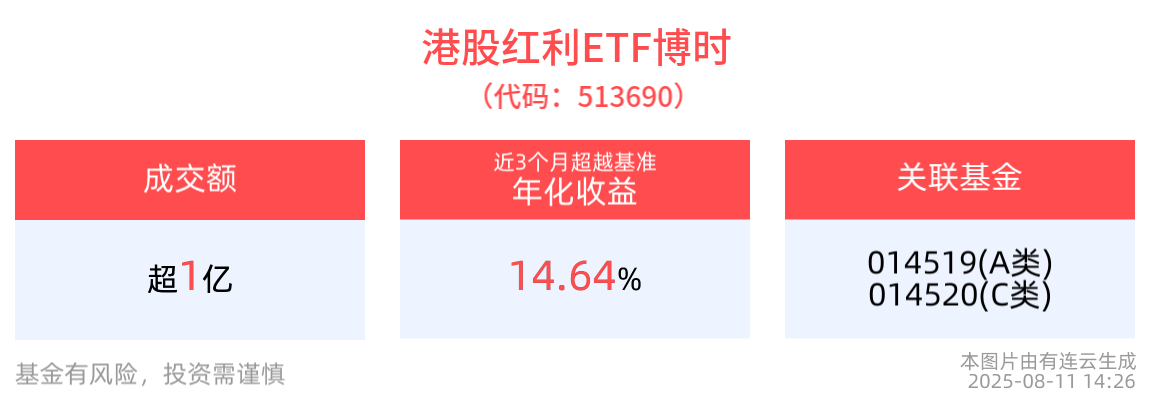
险资配置转向红利资产,港股红利ETF博时(513690)一键布局港股优质高股息资产
Xin Lang Cai Jing· 2025-08-11 06:43
Core Viewpoint - The Hang Seng High Dividend Yield Index (HSSCHKY) has experienced a slight decline of 0.11% as of August 11, 2025, with mixed performance among constituent stocks [3] Group 1: Market Performance - China Telecom (00728) led the gains with an increase of 2.31%, while China Hongqiao (01378) saw the largest decline at 2.29% [3] - The Bosera Hang Seng High Dividend ETF (513690) decreased by 0.28%, with a latest price of 1.09 yuan, but has risen by 2.64% over the past week [3] - The trading volume for the Bosera Hang Seng High Dividend ETF was 3.42%, with a turnover of 163 million yuan [3] Group 2: Institutional Insights - Recent changes in tax policy regarding interest income from newly issued government bonds may lead insurance funds to increase their allocation to high dividend equity assets [3] - The latest size of the Bosera Hang Seng High Dividend ETF reached 4.742 billion yuan [4] Group 3: Fund Performance Metrics - The Bosera Hang Seng High Dividend ETF has achieved a net value increase of 45.06% over the past three years, ranking 125 out of 1836 in its category [4] - The fund's highest monthly return since inception was 24.18%, with an average monthly return of 4.95% [4] - As of August 8, 2025, the fund's Sharpe ratio for the past year was 2.01, indicating strong risk-adjusted returns [4] Group 4: Fund Characteristics - The management fee for the Bosera Hang Seng High Dividend ETF is 0.50%, and the custody fee is 0.10% [5] - The fund closely tracks the Hang Seng High Dividend Yield Index, which reflects the performance of high dividend securities available through the Hong Kong Stock Connect [5] - The top ten weighted stocks in the index account for 29.47% of the total index weight, with notable companies including Yanzhou Coal Mining (01171) and China Petroleum (00857) [5]

“反内卷”后的分化
Haitong Securities International· 2025-08-11 03:35
Consumption Trends - Automotive retail and wholesale volumes have increased, reflecting a positive shift in consumer sentiment, with year-on-year comparisons turning from negative to positive[6] - Tourism and movie attendance have seen a resurgence, with the tourism price index in Hainan rising by 5.6% month-on-month, indicating strong demand[6] - Textile and apparel sectors are experiencing a seasonal downturn, with sales volumes declining compared to previous weeks[6] Investment Insights - As of August 9, 2025, the cumulative issuance of special bonds reached CNY 2.84 trillion, with a slowdown in issuance noted in the first week of August[17] - Real estate transactions in 30 cities have shown a month-on-month decline, with new home sales still in negative growth territory, although the rate of decline has slightly narrowed[17] - Construction progress remains slow, with asphalt construction rates falling and cement shipment rates decreasing year-on-year[17] Trade and Export Dynamics - External demand is weakening, as evidenced by the July Markit Manufacturing PMI for the US dropping to 49.8%, indicating contraction[21] - Domestic export freight rates have decreased by 2.6% week-on-week, reflecting a broader trend of declining shipping costs[21] Production and Inventory Changes - The steel industry has shown marginal improvements in production rates, with rebar and wire rod output increasing[31] - Overall inventory trends indicate a focus on destocking, particularly in the cement and asphalt sectors, while steel inventories are rising due to increased production[42] Price Movements - Consumer Price Index (CPI) has shown a marginal decline, with most categories experiencing price drops except for seasonal increases in vegetable prices[44] - Producer Price Index (PPI) has also decreased, with industrial prices falling across most categories, particularly in construction materials[44] Liquidity and Interest Rates - The 10-year government bond yield has decreased by 1.7 basis points to 1.69%, reflecting a shift towards a more accommodative monetary policy[48] - The US dollar index has fallen by 42 basis points, contributing to a slight appreciation of the RMB against the dollar, from 7.21 to 7.18[48]
市场超预期,短线能挑战3674吗?
2025-08-11 01:21
Summary of Conference Call Records Industry Overview - The conference call discusses the performance of the stock market, particularly focusing on the Shanghai Composite Index and its key resistance levels, indicating a bullish market trend [1][2][4]. Key Points and Arguments 1. **Market Status**: The Shanghai Composite Index rebounded quickly around the 3,550 level, indicating a bullish main upward trend, with key support levels at the 20-day moving average and 3,550 [1][2][4]. 2. **Bull-Bear Boundary**: The 120-day moving average serves as the bull-bear boundary, with the 20-day and 60-day moving averages indicating different market states [5]. 3. **Market Divergence**: Despite the overall market rally, there is internal divergence, as the Shanghai 50 index has broken its upward trend line, suggesting potential weakness in upward momentum [6][7]. 4. **Sector Performance**: Most industry sectors experienced a broad rally, but there was no clear leading sector. The pharmaceutical sector faced a pullback due to the decline in Hong Kong's innovative drug stocks [8][9]. 5. **Psychological Resistance**: The index faces psychological resistance at 3,674, with uncertainties arising from the expiration of the U.S. tariff suspension period [12][13]. 6. **Volume Concerns**: The recent market rebound has been accompanied by a significant reduction in trading volume, indicating insufficient selling pressure and potential risks of a market top [14][15]. 7. **Short-term Strategy**: Short-term trading strategies should be cautious, as there is a high probability of adjustment after reaching 3,674, with a need to monitor new market hotspots for further upward movement [16][17]. 8. **Long-term Outlook**: The market is expected to exhibit a systematic slow bull pattern, supported by overall market sentiment, capital flow, policy supply, and international conditions [19]. 9. **Sector Focus**: Attention should be given to cyclical recovery and value rebound sectors such as steel, non-ferrous metals, and agriculture, as well as technology sectors like communications and pharmaceuticals [29]. Additional Important Insights - **Market Dynamics**: The market is currently at a critical juncture, with potential shifts in investment styles from growth to value, influenced by previous strong performances of certain sectors [28]. - **Investment Strategy**: In the current environment, investors are advised to focus on individual stocks rather than indices, particularly in sectors showing potential for recovery [27]. - **Quantitative Models**: Utilizing quantitative models to identify stocks with favorable characteristics can be an effective strategy in the current market [26][30]. This summary encapsulates the key insights and recommendations from the conference call, providing a comprehensive overview of the current market conditions and future outlook.
投资策略周报:市场的双轮驱动:科技、PPI交易-20250809
KAIYUAN SECURITIES· 2025-08-09 15:24
Group 1 - The report emphasizes a "dual-driven" structure in the market, highlighting the importance of maintaining a "bull market mindset" while adopting a cautious trading approach in a "slowly rising oscillating market" [1][11] - The report identifies two main driving forces: the growth categories supported by global technology collaboration and the cyclical recovery driven by "anti-involution" policies [1][11] - The report notes that the current market is experiencing a healthy influx of incremental capital, with margin financing balances reaching a new high since 2016, indicating positive market sentiment [1][14][15] Group 2 - The TMT sector is highlighted as a key area for investment, driven by a "fan effect" that attracts institutional capital, with significant increases in holdings in telecommunications and information technology sectors [2][20][22] - The semiconductor cycle is expected to enter an upward phase, supported by AI demand and recovery in related sectors, with a focus on the potential for structural gains in the industry [2][28][29] - The report suggests that the TMT sector will likely experience "cohesive upward movement" rather than a zero-sum game, with strong fundamentals supporting continued investment [2][24][25] Group 3 - The report discusses the "anti-involution" policies that are expected to lead to a recovery in the Producer Price Index (PPI), with signs of marginal improvement in PPI despite current low levels [3][36][39] - It highlights the structural divergence between the CRB index and PPI, indicating a potential for price recovery driven by supply-side adjustments and demand-side policy support [3][40][41] - The report anticipates that the recovery in PPI will extend to cyclical consumer assets, providing support for the overall market index [3][44][45] Group 4 - The report provides specific investment recommendations, suggesting a diversified approach that includes technology, military, cyclical recovery, and stable dividend stocks [4][59] - It emphasizes the importance of focusing on sectors with strong growth potential, such as AI, robotics, and semiconductors, while also considering cyclical sectors that may benefit from PPI recovery [4][59] - The report encourages investors to look for structural opportunities in international trade and stable dividend-paying assets as part of a balanced investment strategy [4][59]
红利板块本周走强,恒生红利低波ETF(159545)最新规模达41亿元,创历史新高
Sou Hu Cai Jing· 2025-08-08 11:58
Core Insights - The Hang Seng High Dividend Low Volatility Index increased by 2.7% this week, while the CSI Dividend Value Index rose by 2.6%, and both the CSI Dividend Index and CSI Dividend Low Volatility Index saw a 2.4% increase [1][2]. Index Performance - The CSI Dividend Index and CSI Dividend Low Volatility Index both recorded a weekly increase of 2.4% [2]. - The Hang Seng High Dividend Low Volatility Index had the highest weekly gain at 2.7% [2]. - The CSI Dividend Value Index increased by 2.6% this week [2]. Fund Inflows - The Hang Seng Dividend Low Volatility ETF (159545) experienced a net inflow of 120 million yuan this week, bringing its total size to 4.1 billion yuan, a record high [1]. Dividend Yields and Valuation Ratios - The dividend yields for the indices are as follows: CSI Dividend Index at 4.4%, CSI Dividend Low Volatility Index at 4.1%, Hang Seng High Dividend Low Volatility Index at 5.8%, and CSI Dividend Value Index at 4.3% [2]. - The rolling price-to-earnings ratios are: CSI Dividend Index at 8.3x, CSI Dividend Low Volatility Index at 8.4x, Hang Seng High Dividend Low Volatility Index at 7.3x, and CSI Dividend Value Index at 7.8x [2]. Sector Composition - The CSI Dividend Low Volatility Index consists of 50 stocks with high liquidity and stable dividends, with banking, coal, and transportation sectors accounting for over 60% of the index [3]. - The Hang Seng High Dividend Low Volatility Index also includes 50 stocks, with financial, real estate, and energy sectors making up over 60% [3]. - The CSI Dividend Value Index is composed of 50 stocks with high dividend yields and value characteristics, with banking, coal, and transportation sectors comprising about 80% [3].

富阳(00352.HK)8月8日收盘上涨144.12%,成交3643.39万港元
Jin Rong Jie· 2025-08-08 08:32
8月8日,截至港股收盘,恒生指数下跌0.89%,报24858.82点。富阳(00352.HK)收报0.83港元/股,上 涨144.12%,成交量4976.99万股,成交额3643.39万港元,振幅254.41%。 资料显示,富阳(中国)控股有限公司自1997年创立以来,富阳(中国)控股公司凭借近30年来的行业专业 性、敏锐的市场判断力和资本运营能力,践行产业化管理与专业化经营,业务领域涵盖房地产、产业咨询 和国际贸易,为广大的中高端客户及高净值客户提供多元化及一站式的综合服务体系,致力于成为具有国 际视野、本土洞察的专业一站式综合解决方案服务商。 (以上内容为金融界基于公开消息,由程序或算法智能生成,不作为投资建议或交易依据。) 本文源自:金融界 作者:行情君 最近一个月来,富阳累计涨幅518.18%,今年来累计涨幅448.39%,跑赢恒生指数25.03%的涨幅。 财务数据显示,截至2024年12月31日,富阳实现营业总收入135万元,同比减少84.94%;归母净利 润-759.6万元,同比增长16.76%;毛利率-35.48%,资产负债率86.58%。 机构评级方面,目前暂无机构对该股做出投资评级建议。 行 ...
美国流动性是否存在隐忧?(国金宏观钟天)
雪涛宏观笔记· 2025-08-08 00:47
Core Viewpoint - The current liquidity level in the US remains healthy, but the focus should shift to the effectiveness of monetary policy stimulus, particularly the transmission of interest rate cuts to long-term rates, which is crucial for the recovery of the real economy [2][4][22] Group 1: Liquidity Status - Following the Silicon Valley Bank crisis, there has been no large-scale financial risk exposure in the US, and the stock market has recovered and reached new highs [4] - The US liquidity stock level is healthy, with concerns not stemming from insufficient liquidity but from potential mismatches and increased risk exposure due to further liquidity injections [4][11] - The current excess reserves in the US are approximately $900 billion, significantly higher than the $80 billion level during the 2019 repo market crisis [7] Group 2: Monetary Policy and Economic Impact - The effectiveness of interest rate cuts in stimulating the real economy is under scrutiny, as the transmission to long-term rates remains weak, limiting recovery in sectors like manufacturing and real estate [22] - The average duration of assets on bank balance sheets is increasing, raising concerns about interest rate sensitivity and liquidity risks [22][18] - The low supply of non-bond assets, such as commercial loans and residential mortgages, has led banks to allocate more to bond assets, further increasing average duration and interest rate risk [18] Group 3: Structural Changes in Financial System - The proportion of US Treasury securities in banks' loanable assets has increased by nearly 8 percentage points to 53%, primarily due to an increase in held-to-maturity assets [13] - The overall losses in the US banking sector amount to $410 billion, with approximately $260 billion stemming from held-to-maturity assets, which limits banks' credit supply capabilities [17] - The distribution of reserves has become more even, with the largest banks bearing the brunt of the Fed's balance sheet reduction, indicating a more resilient financial system [8][10]

国泰海通|策略:周期品价格分化,电影景气显著改善
国泰海通证券研究· 2025-08-07 14:15
Core Viewpoint - The article highlights a mixed performance in various sectors, with a decline in prices for steel, cement, and industrial metals, while float glass and thermal coal prices continue to rise. The service consumption sector shows a divergence, with tourism experiencing a decline and the film market showing significant improvement [1][2]. Group 1: Downstream Consumption - Real estate sales continue to struggle, with a 20.8% year-on-year decline in transaction area for commercial housing in 30 major cities. First, second, and third-tier cities saw declines of 17.8%, 15.7%, and 37.0% respectively [2]. - The average daily retail sales of passenger cars increased by 5.0% year-on-year during the week of July 21-27, supported by the release of the third batch of national subsidy funds [2]. - The film box office saw a significant improvement, with a 49.0% increase week-on-week and a year-on-year growth of 64.8%, attributed to the release of new films during the summer season [2]. Group 2: Midstream Manufacturing - The construction sector remains weak, impacting the construction activity and leading to a decline in steel prices, while float glass prices continue to rise [3]. - Manufacturing activity has slowed down, particularly in the automotive and chemical sectors, while the oil asphalt sector has seen a rebound, indicating some resilience in infrastructure demand [3]. - Industrial metal prices have decreased due to weak demand and the impact of U.S. tariffs, alongside a decline in sentiment regarding the "involution" phenomenon [3]. Group 3: Human Flow and Logistics - Long-distance passenger transport demand continues to grow, with a 3.3% week-on-week increase in the Baidu migration scale index and a 21.0% year-on-year increase [4]. - Freight logistics have shown a slight decline, with national highway truck traffic and railway freight volume decreasing by 0.9% and 1.4% respectively week-on-week, but still showing year-on-year growth of 2.8% and 6.5% [4]. - Sea freight prices have decreased, and domestic port cargo and container throughput have dropped by 5.0% and 8.5% respectively week-on-week, indicating a marginal decline in export activity [4].

智通港股解盘 | 美俄元首或很快举行会谈 脑机接口迎来重磅发布
Zhi Tong Cai Jing· 2025-08-07 13:03
Group 1 - The Hang Seng Index closed up 0.69%, surpassing the 25,000-point mark, indicating a positive market response to reduced uncertainty factors [1] - S&P Global Ratings maintained China's sovereign credit rating at "A+" with a stable outlook, reflecting confidence in China's economic resilience and debt management [2] - The stock market environment is favorable, with expectations of a Federal Reserve rate cut in September, leading to a decline in the US dollar and an increase in gold prices [2] Group 2 - China's trade with ASEAN reached 4.29 trillion yuan, growing by 9.4%, making ASEAN the largest trading partner, while trade with the US decreased by 11.1% [3] - Apple announced a new $100 billion investment to shift more production to the US, contributing to a significant rise in its stock and related supply chain companies [4] - The express delivery industry in Guangdong raised its base price, leading to stock price increases for major players like ZTO Express [4] Group 3 - The brain-computer interface industry is expected to see significant innovation and the emergence of leading companies by 2030, supported by government policies [5][6] - The shipping industry is experiencing price increases, with major companies like Hapag-Lloyd and Maersk raising freight rates on various routes [7] - Dongyue Group anticipates a substantial profit increase of approximately 150% due to the ongoing demand for refrigerants and its leading position in the industry [9][10]