科技

Search documents
1月7日港股收盘:恒指跌0.94% 生物医药逆市上扬
Jin Rong Jie· 2026-01-07 09:54
Market Overview - On January 7, Hong Kong's major stock indices showed a downward trend, with the Hang Seng Index closing at 26,458.95 points, down 0.94% [1] - The Hang Seng Tech Index also ended its previous week's gains, falling 1.49% to 5,738.52 points [1] - The market turnover exceeded HKD 276 billion, ending the upward momentum of the three major indices from the previous trading day [1] Sector Performance - The biopharmaceutical sector showed significant activity towards the end of the trading session, with notable gains in several stocks [1] - Rongchang Biopharmaceutical (09995.HK) rose over 12%, while 3SBio (01530.HK) and WuXi Biologics (02269.HK) closed with gains of over 7% and 5%, respectively [1] - Other sectors such as paper, non-ferrous metals, and coal also saw some individual stocks increase in value [1] Brokerages - In contrast, brokerage stocks faced pressure, with Guotai Junan International (01788.HK) declining over 5% [1] - Both China Merchants Securities (06099.HK) and Everbright Securities (06178.HK) also experienced declines of over 2% [1]

百利好丨2025年全球经济和货币政策回顾
Sou Hu Cai Jing· 2026-01-07 07:16
Group 1 - Global economic growth is expected to moderate in 2025, with increasing uncertainty and significant divergence in forecasts from various institutions [2] - The OECD and IMF both predict a global growth rate of 3.2% for 2025, citing resilience but also accumulating risks [3] - The UN forecasts a lower growth rate of 2.4% for 2025, emphasizing the negative impact of trade conflicts and policy uncertainty [3] Group 2 - Developed economies are projected to grow at 1.8% in 2025, with the U.S. showing a higher probability of a "soft landing" [2] - The U.S. is expected to have a growth rate of 2.6%, driven by consumer spending and AI-related investments, while core PCE inflation is projected to decrease to 3.5% [4] - The Eurozone's growth rate is forecasted at 1.2%, with high borrowing costs and inflationary pressures limiting consumer and investment activity [4] Group 3 - Central banks in developed economies are shifting from accommodative to a more cautious stance, while emerging economies in the Asia-Pacific are primarily maintaining accommodative policies [5] - The Federal Reserve has ended its balance sheet reduction and is cautious about further rate cuts, while the European Central Bank has signaled the end of its easing cycle [6] - The Bank of Japan faces a dilemma between managing high inflation and supporting economic growth, with core inflation at 2.8% [6] Group 4 - Trade tensions and supply chain pressures are impacting inflation and consumer costs, with gold prices rising as a hedge against uncertainty [7] - Central banks are in a dilemma of controlling inflation while stimulating economic growth, contributing to the strength of the U.S. dollar [7] - The AI boom is supporting global demand and tech stock valuations, but also increasing the risk of asset bubbles and volatility in risk assets [7] Group 5 - The global economy is transitioning from strong recovery to moderate growth, with increasing divergence between developed and emerging markets [8] - Monetary policy in developed economies is becoming more restrictive, with a shift from broad easing to targeted adjustments [8] - Key risks include persistent core inflation, geopolitical conflicts, debt pressures, and fluctuations in the U.S. dollar, with a focus on policy shifts and sustainable economic recovery in 2026 [8]


2025钱流向了哪?就藏在这十个消费关键词里
Sou Hu Cai Jing· 2026-01-07 04:47
Group 1 - The core viewpoint is that Chinese consumers are shifting from valuing simple affordability and high-end premiums to paying for tangible "value" [3] - The consumer mindset in China is characterized by ten key themes that reflect the emotional and practical needs of consumers [4] Group 2 - Emotional value is becoming a significant factor in purchasing decisions, with products like Labubu toys representing a desire for dopamine rather than just functionality [5] - By 2025, consumption is expected to transition from "functional attributes" to "emotional attributes," allowing products that provide emotional value to command higher prices [6] Group 3 - The focus is shifting from price-performance ratio to quality-price ratio, with consumers seeking "good products at low prices" rather than simply the cheapest options [9] - Brands like Luckin Coffee and Leifeng are successfully competing against established players by offering high-quality products at significantly lower prices [9] Group 4 - The demand for safety is increasing, with consumers purchasing gold as a reliable asset in uncertain times, reflecting a need for tangible security [11] - Health-conscious consumption is evolving from general wellness to more targeted, precise health products that cater to specific needs [12] Group 5 - AI is becoming integrated into everyday consumer products, transforming from a mere software concept to practical applications in various consumer scenarios [15] - Companies that can effectively incorporate AI into their products are likely to create the next big hit in the market [15] Group 6 - The emphasis on extreme experiences is growing, with companies like Pang Donglai and Hema redefining shopping as enjoyable experiences rather than mere transactions [16] - Businesses that prioritize customer experience and emotional connection are more likely to retain consumer loyalty [16] Group 7 - Instant retail is becoming a battleground for major players like JD, Meituan, and Taobao, who are investing heavily to dominate the "last mile" delivery [18] - The competition is focused on breaking down the barriers between online and offline shopping, making rapid delivery a standard expectation [19] Group 8 - Transparency in product ingredients is increasingly demanded by consumers, who are becoming more discerning about what they purchase [20] - Brands that fail to be transparent risk losing consumer trust and market share [21] Group 9 - Localization is key for brands looking to succeed in China, with a shift from imitating international brands to understanding and catering to local preferences [23] - The future of the Chinese consumer market is characterized by a "local dominance" era, where brands that resonate with local culture and needs will thrive [25] Group 10 - The collective themes indicate a consciousness awakening among Chinese consumers, who seek recognition and satisfaction of their emotional and practical needs [26] - Understanding these evolving consumer preferences is crucial for predicting future market trends [26]

中信证券|China Themes:2026年投资展望
Xin Lang Cai Jing· 2026-01-07 01:18
Macro and Policy - In 2026, China's macroeconomic growth is expected to show a mild recovery with a projected GDP growth rate of 4.9%, supported by resilient exports and gradually recovering investments, although consumer goods consumption may face short-term pressure [4][14] - The focus of policies will be on building a modern industrial system, which is anticipated to yield significant results in technological innovation and industrial upgrades [4][14] Major Asset Classes - The asset environment in 2026 is expected to exhibit marginal liquidity easing and mild economic recovery, with recommendations favoring commodities over stocks and bonds [3][13] - The expected annual increase for the Wind All A index is projected to be between 5% and 10%, while Hong Kong stocks may experience a rebound in performance and valuation recovery [3][13] - Commodity prices are anticipated to stabilize, with Brent crude oil expected to fluctuate between $58 and $70 per barrel, and gold potentially reaching $5,000 per ounce [3][13] Technology - The narrative around AI is expected to deepen, continuing to reshape the value of the technology sector, with a shift from "model iteration" to "scenario implementation" [5][15] - Domestic computing power and semiconductor equipment are expected to thrive under the trend of self-sufficiency, while AI-related sectors are projected to experience significant growth [5][15] Consumer Sector - The consumer sector is expected to stabilize due to low expectations and valuations, with a focus on wealth effect transmission and supply-side optimization driving business turning points [6][16] - Long-term investment strategies should emphasize changes in consumer structure, particularly in new products and categories driven by emotional and health-related demands [6][16] Healthcare - The healthcare sector is likely to benefit from improved payment systems and accelerated international expansion, with domestic innovative drugs entering a phase of payment improvement and market realization [7][17] Energy - The energy sector is expected to see continued price increases for copper, aluminum, gold, and battery metals, driven by supply constraints and increasing demand [7][17] - Coal companies are projected to improve performance in line with coal prices, with recommendations for selecting stocks based on low-cost positioning and capacity expansion [7][17] Infrastructure - The real estate market is showing signs of recovery, with expectations for a stabilization foundation in 2026, and companies may enter a critical year for balance sheet repair [8][18] - The public utility and environmental sectors are recommended for investment, particularly in water and gas industries, which are expected to recover as gas prices fall and demand rises [8][18] Financial Sector - The financial industry is approaching a cyclical turning point, with improved operating conditions expected as interest rates stabilize and insurance sector concerns ease [8][18] - Economic recovery is anticipated to drive demand for financial services, with a focus on high-dividend financial stocks as a stable investment choice [8][18] Manufacturing - The manufacturing sector's growth is expected to be driven by resilient overseas demand and a recovery in domestic demand, with AI continuing to be a major growth driver [9][19] - Companies are advised to focus on risk-resistant core assets while capitalizing on global expansion and technological advancements [9][19]


英伟达发布开源模型Alpamayo,首搭车型一季度上路;蔚来第100万辆量产车下线 | 汽车早参
Mei Ri Jing Ji Xin Wen· 2026-01-06 22:36
Group 1: Automotive Industry Trends - The Ministry of Commerce announced that from 2024 to 2025, the national second-hand car transactions will reach 39.686 million units, with scrapped car recoveries at 17.673 million units, reflecting a significant annual growth rate of 45.8% [1] - The push for car recycling and second-hand car transactions indicates a major transformation demand in the automotive industry, with nearly 60% of the 18.3 million cars to be replaced being new energy vehicles [1] Group 2: NVIDIA's Advancements in Autonomous Driving - NVIDIA unveiled the Alpamayo series of open-source AI models and simulation tools at the 2026 CES, aimed at enhancing the development of safe and reliable autonomous driving vehicles [2] - The first vehicle equipped with NVIDIA's autonomous driving technology is set to hit the roads in the U.S. in the first quarter of 2026, marking a significant milestone in the company's eight-year research into autonomous vehicles [2][3] Group 3: NIO's Production Milestone and Future Plans - NIO celebrated the production of its one-millionth vehicle, with CEO Li Bin expressing confidence in achieving profitability by the fourth quarter of 2025 [4] - NIO's strategic focus includes enhancing operational efficiency, expanding charging infrastructure to over 10,000 stations by 2030, and maintaining a growth rate of 40% to 50% annually while deepening its presence in the Chinese market [4] Group 4: GAC Honda's Production Delays - GAC Honda announced a two-week extension of its production halt, affecting its manufacturing schedule due to adjustments made by Honda [5][6] - The delay raises concerns about supply chain issues within the automotive industry, potentially impacting GAC Honda's short-term financial performance and market competitiveness during peak sales seasons [6]


开门红“山东套餐”上线!资金、政策、外贸三箭齐发
Sou Hu Cai Jing· 2026-01-06 18:20
Funding Initiatives - Shandong Province issued 723.81 billion yuan in local government bonds, referred to as the "New Year Red Envelope," to support major annual projects [2] - The funds will be allocated primarily to infrastructure construction in transportation, water conservancy, municipal projects, industrial upgrades, and improving people's livelihoods [2] Policy Support - Shandong Province released the first batch of the 2026 economic promotion policy list, which includes a significant subsidy of up to 600,000 yuan for local enterprises facing major patent disputes [3] - The policy aims to address challenges faced by small and medium-sized technology enterprises in innovation and rights protection, while also covering areas like anti-monopoly and standardization [3] Trade Developments - The first international container ship of the year docked at Qingdao Port, marking the launch of Shandong's first direct foreign trade route to Australia [4] - This new route reduces transportation time by approximately 10%, enhancing logistics efficiency and providing greater certainty and timeliness for trade with Australian clients [4] Overall Economic Strategy - The combined efforts in fiscal initiatives, policy support, and trade expansion represent a strategic approach by Shandong Province to ensure a strong start to 2026 and to seek new growth opportunities [4]

[1月6日]指数估值数据(大盘继续上涨,回到3星级;螺丝钉定投实盘第397期发车;养老指数估值表更新)
银行螺丝钉· 2026-01-06 14:41
Core Viewpoint - The overall market has risen, returning to a valuation of 3.9 stars, marking the first time in 2023 that it has reached this level, indicating a potential bullish trend in the market [1]. Group 1: Market Performance - The market has experienced its fourth round of 3-point valuations since 2015, with previous instances in late 2017 and early 2021 lasting several months to half a year [1]. - The Hong Kong stock market entered the 3-point valuation earlier, in Q3 2025, while A-shares experienced a slight pullback in Q4 but have shown strong performance in the last two weeks [1]. - Both large, mid, and small-cap stocks have risen, with value styles also seeing an increase, and the growth style, particularly in the STAR Market, performing strongly [1]. Group 2: Investment Strategy - Following the return to a 3.9-star valuation, the active selection portfolio has returned to normal valuation, leading to a pause in new investments [2]. - The "Yuexinbao" investment strategy remains undervalued but is close to normal valuation, indicating a potential for future growth [3][4]. - If the market continues to rise, it may reach normal valuation, prompting a pause in regular investments [5]. Group 3: Portfolio Adjustments - Recent growth in certain active selection portfolios has led to some assets reaching overvaluation, prompting a reallocation towards undervalued assets [10]. - The index enhancement portfolio may reach overvaluation soon, with a reference PE ratio of approximately 19 times [12]. - Any opportunities for profit-taking will be executed in a phased manner, ensuring a strategic approach to portfolio management [15]. Group 4: Investment Products - The "Yuexinbao" portfolio consists of 40% stocks and 60% bonds, designed for stable market participation with a built-in cash flow distribution feature [17]. - The automatic profit-taking feature has been implemented for the "Ding" series portfolios, allowing for seamless transitions to more stable investment options when necessary [19]. - The personal pension investment strategy includes a focus on classic combinations of growth and value styles, with a current emphasis on waiting for undervalued opportunities [21].

国瑞科技:截至2025年12月31日股东人数为30157户
Zheng Quan Ri Bao Wang· 2026-01-06 14:11
Group 1 - The core point of the article is that Guorui Technology (300600) has responded to investor inquiries, indicating that the number of shareholders is projected to reach 30,157 by December 31, 2025 [1]

超2.6万亿元,A股上市公司2025年分红金额创新高
Xin Lang Cai Jing· 2026-01-06 13:19
Core Viewpoint - A-share listed companies are expected to distribute over 2.6 trillion yuan in dividends in 2025, marking a historical high [1] Group 1: Dividend Trends - Multi-frequency dividends have become the norm, with over 500 companies issuing mid-term dividends [1] - The increase in dividend distribution reflects the improvement in the operational stability and financial forecasting capabilities of listed companies [1] Group 2: Sector Analysis - Major dividend-paying sectors include banking, oil and petrochemicals, and consumer goods [1] - Technology companies are also actively distributing dividends, indicating a steady improvement in their profitability [1]
大厂涨薪的面子和里子
3 6 Ke· 2026-01-06 11:37
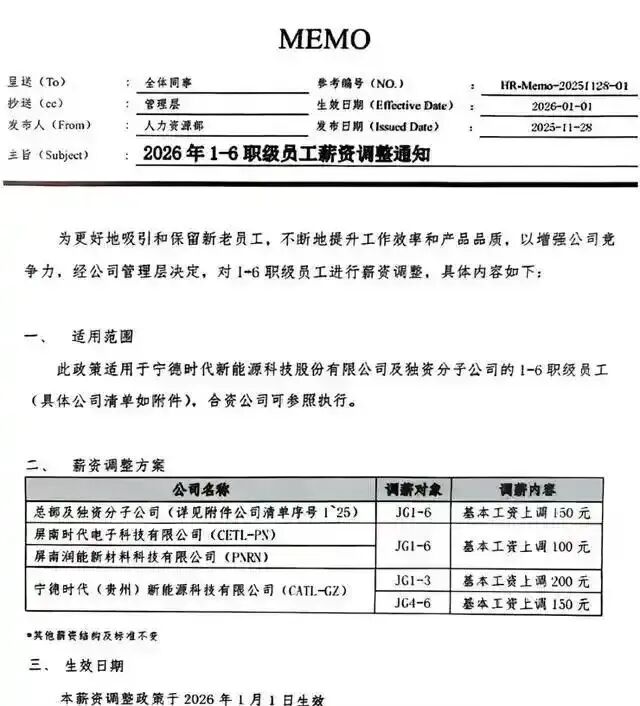
Core Viewpoint - The article discusses the recent trend of salary increases and enhanced benefits across various companies, highlighting the motivations behind these adjustments and the reactions from employees and the public [1][11]. Group 1: Salary Adjustments - Ningde Times will implement a basic salary increase of 150 RMB for levels 1-6 employees starting January 1, 2026, with specific increases of 100 RMB for certain subsidiaries and 200 RMB for others [3][6]. - ByteDance announced a 35% increase in bonus investment for the 2025 performance evaluation cycle and a 1.5 times increase in salary adjustment investment compared to the previous cycle [7][8]. - JD.com stated that 92% of its employees will receive full or excess year-end bonuses, with specific multipliers for performance ratings leading to potential bonuses of up to 24 months' salary [10][11]. Group 2: Employee Reactions - Employees at various companies, including ByteDance and Ningde Times, expressed skepticism about the actual impact of salary increases, emphasizing the need to wait for performance evaluations to understand the real benefits [2][3]. - Some employees view the salary adjustments as insufficient, with comments on social media reflecting mixed feelings about the increases being perceived as "insulting" or "better than nothing" [7][15]. - The public reaction to salary increases often overshadows the employees' more pragmatic concerns about the actual financial benefits and the context of these adjustments [2][11]. Group 3: Company Strategies - The salary increases are seen as a response to competitive pressures and the need to retain talent in a challenging market, with companies like ByteDance emphasizing the importance of maintaining competitive compensation [11][14]. - JD.com is expanding its business into new areas, necessitating a focus on attracting and retaining talent through enhanced compensation and benefits [14][15]. - Companies are navigating the balance between public perception and actual employee satisfaction, with marketing efforts often intertwined with salary announcements to shape a favorable image [15][16].