商贸零售

Search documents
【盘中播报】沪指跌1.39% 电力设备行业跌幅最大
Zheng Quan Shi Bao Wang· 2025-10-17 06:59
Core Viewpoint - The A-share market experienced a decline today, with the Shanghai Composite Index dropping by 1.39% and trading volume decreasing by 4.76% compared to the previous trading day [1] Industry Performance Summary - **Coal**: Slight increase of 0.12% with a transaction amount of 165.48 billion yuan, led by Antai Group which rose by 10.00% [1] - **Banking**: Minor decrease of 0.04% with a transaction amount of 302.99 billion yuan, led by Shanghai Bank which fell by 0.83% [1] - **Steel**: Decrease of 0.09% with a transaction amount of 133.07 billion yuan, led by Wujin Stainless Steel which dropped by 7.73% [1] - **Transportation**: Decrease of 0.11% with a transaction amount of 258.60 billion yuan, led by Pulutong which fell by 3.36% [1] - **Textiles and Apparel**: Decrease of 0.25% with a transaction amount of 119.79 billion yuan, led by Yingfeng Shares which dropped by 9.99% [1] - **Oil and Petrochemicals**: Decrease of 0.29% with a transaction amount of 83.04 billion yuan, led by Compton which fell by 3.19% [1] - **Agriculture, Forestry, Animal Husbandry, and Fishery**: Decrease of 0.45% with a transaction amount of 139.82 billion yuan, led by Aonong Biological which dropped by 4.66% [1] - **Real Estate**: Decrease of 0.52% with a transaction amount of 213.60 billion yuan, led by Wolong New Energy which fell by 7.80% [1] - **Utilities**: Decrease of 0.52% with a transaction amount of 302.04 billion yuan, led by *ST Lingda which dropped by 13.20% [1] - **Construction and Decoration**: Decrease of 0.75% with a transaction amount of 278.81 billion yuan, led by Kexin Development which fell by 8.15% [1] - **Home Appliances**: Decrease of 0.79% with a transaction amount of 217.37 billion yuan, led by Greer which dropped by 6.72% [1] - **Food and Beverage**: Decrease of 0.86% with a transaction amount of 194.67 billion yuan, led by Huaiqi Mountain which fell by 6.44% [1] - **Environmental Protection**: Decrease of 0.92% with a transaction amount of 140.79 billion yuan, led by Science which dropped by 6.68% [1] - **Retail**: Decrease of 0.97% with a transaction amount of 173.43 billion yuan, led by Ruoyu Chen which fell by 9.98% [1] - **Social Services**: Decrease of 1.07% with a transaction amount of 89.87 billion yuan, led by Chuangye Heima which dropped by 5.28% [1] - **Light Industry Manufacturing**: Decrease of 1.12% with a transaction amount of 135.66 billion yuan, led by Songyang Resources which fell by 10.02% [1] - **Pharmaceuticals and Biology**: Decrease of 1.16% with a transaction amount of 845.22 billion yuan, led by Warner Pharmaceuticals which dropped by 7.67% [1] - **Basic Chemicals**: Decrease of 1.21% with a transaction amount of 618.91 billion yuan, led by Xinong Shares which fell by 8.88% [1] - **Non-ferrous Metals**: Decrease of 1.24% with a transaction amount of 1149.11 billion yuan, led by Galaxy Magnetics which dropped by 7.14% [1] - **Telecommunications**: Decrease of 1.28% with a transaction amount of 806.90 billion yuan, led by Shijia Photon which fell by 17.59% [1] - **Non-bank Financials**: Decrease of 1.39% with a transaction amount of 491.74 billion yuan, led by Hainan Huatie which dropped by 6.17% [1] - **Building Materials**: Decrease of 1.66% with a transaction amount of 94.02 billion yuan, led by Yaopi Glass which fell by 7.82% [1] - **Media**: Decrease of 1.68% with a transaction amount of 263.96 billion yuan, led by Vision China which dropped by 9.93% [1] - **Beauty and Personal Care**: Decrease of 1.76% with a transaction amount of 33.94 billion yuan, led by Baiya Shares which fell by 4.98% [1] - **Computers**: Decrease of 2.38% with a transaction amount of 1005.18 billion yuan, led by Kaipu Cloud which dropped by 11.94% [1] - **Comprehensive**: Decrease of 2.42% with a transaction amount of 27.84 billion yuan, led by Dongyangguang which fell by 4.70% [1] - **Defense and Military Industry**: Decrease of 2.55% with a transaction amount of 387.73 billion yuan, led by Hangyu Technology which dropped by 8.38% [1] - **Machinery and Equipment**: Decrease of 2.68% with a transaction amount of 940.87 billion yuan, led by Yingweike which fell by 10.00% [1] - **Automobiles**: Decrease of 2.69% with a transaction amount of 775.95 billion yuan, led by Tianpu Shares which dropped by 10.00% [1] - **Electronics**: Decrease of 3.19% with a transaction amount of 2631.19 billion yuan, led by Nanya New Materials which fell by 16.26% [1] - **Electric Power Equipment**: Decrease of 3.79% with a transaction amount of 1881.52 billion yuan, led by Shenghong Shares which dropped by 11.80% [1]
【盘前三分钟】10月16日ETF早知道
Xin Lang Ji Jin· 2025-10-16 01:12
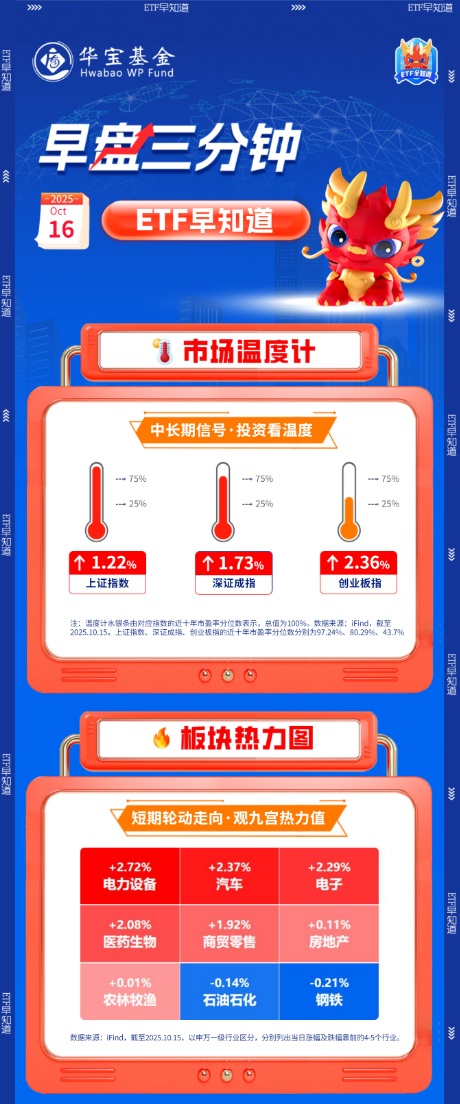
Group 1 - The article highlights a potential rebound in the Hong Kong internet sector, driven by attractive valuations and the influence of AI technology, following indications from the Federal Reserve about possible interest rate cuts [4] - The Hong Kong internet index saw a significant increase of over 2% on October 15, 2025, reflecting a positive market sentiment towards internet stocks [4] - The food and beverage sector continues to show upward momentum, with the food and beverage index recording gains for two consecutive days, indicating a recovery in domestic demand [4] Group 2 - The top three sectors for capital inflow include pharmaceuticals with 2.548 billion, home appliances with 1.591 billion, and food and beverages with 0.597 billion [2] - The sectors experiencing the most significant capital outflow are non-ferrous metals at -4.939 billion, telecommunications at -2.096 billion, and defense and military at -1.717 billion [2] - The article notes that the food and beverage sector is characterized by low base, low holdings, and low expectations, suggesting that any changes in supply and demand could significantly impact stock prices [4]

浙商早知道-20251016
ZHESHANG SECURITIES· 2025-10-15 23:30
Market Overview - The Shanghai Composite Index rose by 1.2%, the CSI 300 increased by 1.5%, the STAR 50 gained 1.4%, the CSI 1000 was up by 1.5%, the ChiNext Index surged by 2.4%, and the Hang Seng Index climbed by 1.8% [5][4] - The best-performing sectors included power equipment (+2.7%), automotive (+2.4%), electronics (+2.3%), pharmaceutical and biotechnology (+2.1%), and retail (+1.9%). The worst-performing sectors were steel (-0.2%), oil and petrochemicals (-0.1%), agriculture, forestry, animal husbandry, and fishery (+0.0%), real estate (+0.1%), and defense and military industry (+0.2%) [5][4] - The total trading volume in the Shanghai and Shenzhen markets was 20,729 billion, with a net outflow of 5.44 billion HKD from southbound funds [5][4] Automotive Industry Insights - The automotive sector report emphasizes three main investment opportunities: robotics, bus exports, and intelligent driving [6] - The market perception of technological advancements and potential profit growth in the automotive sector is considered insufficient [6] - Key drivers include significant changes in the robotics industry, strong bus export volumes, and rapid advancements in applications for autonomous vehicles [6] Agriculture, Forestry, Animal Husbandry, and Fishery Insights - The core viewpoint is that pig farming and cattle breeding remain the main focus, with an emphasis on capturing post-cycle opportunities [7] - The report notes a continuous decline in pig prices, a gradual reversal in the beef cycle, and persistent low milk prices [7] - Key drivers include rising pig prices due to policy shifts towards "anti-involution" and increasing beef prices as traditional demand peaks in Q4 [7] Macro Economic Insights - The macroeconomic report highlights a significant increase in exports to Africa, driven by Chinese companies seeking new markets amid US trade tensions [8] - The report suggests that the high growth in exports may be a result of "export grabbing" [8] - The potential for industrial layout in African economies is noted as a key differentiator from market expectations [8] Fixed Income and Credit Bond Insights - The fixed income report indicates that the positive spread between rental yields and risk-free rates could provide guidance for housing prices, with 2027 expected to be a critical year for identifying the bottom of the real estate market [9] - The report anticipates a "L-shaped" bottoming out of the real estate market rather than a V-shaped rebound, highlighting significant structural differentiation [9] - Key drivers include the rental return rate as a critical reference for when housing prices may bottom out, with expectations for rental yields to reach near a decade-high by the end of 2027 [9]
晨会纪要:开源晨会1016-20251015
KAIYUAN SECURITIES· 2025-10-15 15:40
Group 1: Macroeconomic Insights - The report discusses the potential for PPI to turn positive, with September CPI at -0.3%, PPI at -2.3%, and expectations for both being slightly negative [5][9][12] - Core CPI has shown a seasonal decline, with September's core CPI remaining at 0%, marking the first time since April 2025 that it fell below seasonal expectations [10][11] - The report anticipates that if PPI remains at 0% from October 2025 onward, the average PPI for 2026 could be around -0.7% [14] Group 2: Electronic Industry Insights - The report highlights the acceleration of commercialization in domestic AI hardware, focusing on the synergy of computing power, storage, and operational capacity [18][19] - The demand for Scaleup and Scaleout hardware is expected to grow significantly, with the global market for Scaleup exchange chips projected to reach nearly $18 billion by 2030, with a CAGR of approximately 28% from 2022 to 2030 [19] - The report identifies a low domestic production rate for operational hardware, indicating a significant opportunity for domestic replacements in the market [21] Group 3: Robotics Industry Insights - The report introduces Figure03, a humanoid robot designed for mass production, emphasizing safety and comfort in home environments [23][24] - Figure03 features advanced capabilities such as tactile sensors for stable operation in limited visibility environments and supports wireless charging for continuous operation [24][25] - The report notes that Figure aims to produce over 100,000 units within four years, with a projected valuation of nearly $40 billion, supported by significant investments from major tech companies [24][26]
粤开市场日报-20251015
Yuekai Securities· 2025-10-15 08:14
Market Overview - The A-share market saw all major indices rise today, with the Shanghai Composite Index increasing by 1.22% to close at 3912.21 points, the Shenzhen Component Index rising by 1.73% to 13118.75 points, and the ChiNext Index up by 2.36% to 3025.87 points [1] - Overall, 4332 stocks rose while 944 stocks fell, with a total trading volume of 20,729 billion yuan, a decrease of 5,034 billion yuan compared to the previous trading day [1] Industry Performance - Among the 31 first-level industries, the power equipment, automotive, electronics, pharmaceutical biology, and retail sectors led the gains, with increases of 2.72%, 2.37%, 2.29%, 2.08%, and 1.92% respectively [1] - Conversely, the steel and petroleum sectors experienced slight declines of 0.21% and 0.14% [1] Concept Sector Performance - The top-performing concept sectors today included aviation transportation, charging piles, CRO, marketing communication, automotive parts, ultra-high voltage, innovative drugs, wireless charging, smart speakers, complete vehicles, consumer electronics OEM, circuit boards, excavators, Apple, and new energy vehicles [2][11]
小商品城(600415):Q3超预期,数贸城选位与新兴业务表现优异
NORTHEAST SECURITIES· 2025-10-15 07:20
Investment Rating - The report maintains a "Buy" rating for the company, indicating a strong expectation for stock price appreciation in the next six months [5]. Core Insights - The company reported Q3 results that exceeded expectations, with revenue of 5.348 billion yuan, a year-on-year increase of 39.02%, and a net profit of 1.766 billion yuan, up 100.52% [1][2]. - The growth in revenue and profit is attributed to successful leasing strategies and the strong performance of emerging businesses, particularly Chinagoods and cross-border payment services [1][2]. - The company has seen significant cash inflow and contract liabilities, with operating net cash inflow reaching 9.605 billion yuan in the first three quarters of 2025, a year-on-year increase of over 20 times [2]. Financial Summary - For the first three quarters of 2025, the company achieved total revenue of 13.061 billion yuan, a 23.07% increase, and a net profit of 3.457 billion yuan, up 48.45% [1]. - The projected revenue for 2025-2027 is 23.146 billion yuan, 28.965 billion yuan, and 34.766 billion yuan, respectively, with net profits of 4.792 billion yuan, 6.053 billion yuan, and 6.955 billion yuan [3][4]. - The company’s net profit margin improved to 26.47%, reflecting a 4.53 percentage point increase year-on-year [1]. Emerging Business Growth - The emerging business segment, particularly the Chinagoods platform and cross-border payment services, is expected to continue its high growth trajectory, with transaction volume exceeding 27 billion yuan, a year-on-year increase of over 35% [2]. - The integration of AI capabilities and the establishment of a closed-loop ecosystem for trade and payment services are anticipated to enhance service offerings and market competitiveness [2].

今日沪指涨0.10% 美容护理行业涨幅最大
Zheng Quan Shi Bao Wang· 2025-10-15 05:56
Core Points - The Shanghai Composite Index rose by 0.10% today, with a trading volume of 827.71 million shares and a total transaction value of 1,280.495 billion yuan, a decrease of 23.83% compared to the previous trading day [1][2] - A total of 3,296 stocks increased in value, with 51 hitting the daily limit up, while 1,952 stocks declined, including 6 hitting the daily limit down [1][2] Industry Performance - The top-performing sectors included: - Beauty and Personal Care: Increased by 2.50%, with a transaction value of 45.93 billion yuan, up 57.56% from the previous day, led by Shanghai Jahwa, which rose by 10.00% [1] - Retail: Increased by 1.69%, with a transaction value of 203.51 billion yuan, up 33.09%, led by Guoguang Chain, which rose by 10.00% [1] - Pharmaceutical and Biological: Increased by 1.49%, with a transaction value of 698.26 billion yuan, up 14.92%, led by Guangsheng Tang, which rose by 20.00% [1] - The sectors with the largest declines included: - Defense and Military: Decreased by 1.49%, with a transaction value of 342.54 billion yuan, down 35.37%, led by Beifang Changlong, which fell by 10.39% [2] - Non-ferrous Metals: Decreased by 1.23%, with a transaction value of 1,244.15 billion yuan, down 24.08%, led by Shandong Gold, which fell by 6.67% [2] - Steel: Decreased by 0.74%, with a transaction value of 131.04 billion yuan, down 34.92%, led by Guangdong Mingzhu, which fell by 7.73% [2]
行业轮动模型由高切低,增配顺周期板块
GOLDEN SUN SECURITIES· 2025-10-15 05:17
Quantitative Models and Construction Methods 1. Model Name: Industry Relative Strength (RSI) Model - **Model Construction Idea**: This model identifies leading industries by calculating their relative strength (RS) based on historical price performance over different time windows [10] - **Model Construction Process**: 1. Use 29 first-level industry indices as the configuration targets [10] 2. Calculate the price change rates for the past 20, 40, and 60 trading days for each industry index [10] 3. Rank the industries based on their price change rates for each time window and normalize the rankings to obtain RS_20, RS_40, and RS_60 [10] 4. Calculate the average of the three rankings to derive the final RS value: $ RS = \frac{RS_{20} + RS_{40} + RS_{60}}{3} $ [10] 5. Industries with RS > 90% by the end of April are identified as potential leading industries for the year [10] - **Model Evaluation**: The model successfully identified key annual industry trends, such as high dividend, resource products, exports, and AI, which were validated by market performance throughout the year [10][12] 2. Model Name: Industry Sentiment-Trend-Crowding Framework - **Model Construction Idea**: This framework provides two industry rotation strategies based on market conditions: 1. High sentiment + strong trend, avoiding high crowding (aggressive strategy) 2. Strong trend + low crowding, avoiding low sentiment (conservative strategy) [6][14] - **Model Construction Process**: 1. Evaluate industries based on three dimensions: sentiment, trend, and crowding [6][14] 2. Use sentiment as the core metric for the aggressive strategy, with crowding as a risk control factor [14] 3. Use trend as the core metric for the conservative strategy, avoiding low-sentiment industries [14] 4. Allocate weights to industries based on their scores in the three dimensions [6][14] - **Model Evaluation**: The framework is effective in adapting to different market conditions and has shown strong performance in historical backtests [6][14] 3. Model Name: Left-Side Inventory Reversal Model - **Model Construction Idea**: This model identifies industries with potential for recovery by analyzing sectors in distress or those with low inventory pressure and high analyst optimism [24] - **Model Construction Process**: 1. Identify industries currently in distress or recovering from past distress [24] 2. Focus on sectors with low inventory pressure and potential for restocking [24] 3. Incorporate analyst long-term positive outlooks for these industries [24] - **Model Evaluation**: The model effectively captures recovery opportunities in industries undergoing inventory restocking cycles, providing significant absolute and relative returns [24] --- Model Backtesting Results 1. Industry Relative Strength (RSI) Model - **Annualized Return**: Not explicitly mentioned - **Excess Return**: Not explicitly mentioned - **Information Ratio (IR)**: Not explicitly mentioned - **Maximum Drawdown**: Not explicitly mentioned - **Monthly Win Rate**: Not explicitly mentioned - **Performance Highlights**: - Industries with RS > 90% by April 2024 included coal, utilities, home appliances, banking, petrochemicals, communication, non-ferrous metals, agriculture, and automotive [10] - These industries showed strong performance, with key themes being high dividends, resource products, exports, and AI [10][12] 2. Industry Sentiment-Trend-Crowding Framework - **Annualized Return**: 22.1% (long-only portfolio) [14] - **Excess Return**: 13.8% (annualized) [14] - **Information Ratio (IR)**: 1.51 [14] - **Maximum Drawdown**: -8.0% [14] - **Monthly Win Rate**: 68% [14] - **Performance Highlights**: - 2023 excess return: 7.3% [14] - 2024 excess return: 5.7% [14] - 2025 YTD excess return: 2.8% [14] 3. Left-Side Inventory Reversal Model - **Annualized Return**: Not explicitly mentioned - **Excess Return**: - 2023: 17.0% (relative to equal-weighted industry benchmark) [24] - 2024: 15.4% (relative to equal-weighted industry benchmark) [24] - 2025 YTD: 7.8% (relative to equal-weighted industry benchmark) [24] - **Information Ratio (IR)**: Not explicitly mentioned - **Maximum Drawdown**: Not explicitly mentioned - **Monthly Win Rate**: Not explicitly mentioned - **Performance Highlights**: - Absolute return: - 2023: 13.4% [24] - 2024: 26.5% [24] - 2025 YTD: 26.4% [24] --- Quantitative Factors and Construction Methods 1. Factor Name: Sentiment Factor - **Factor Construction Idea**: Measures the overall sentiment of an industry to identify high-growth opportunities [14] - **Factor Construction Process**: 1. Evaluate the sentiment of each industry based on relevant metrics (not explicitly detailed in the report) [14] 2. Rank industries by sentiment scores [14] - **Factor Evaluation**: Sentiment is a core metric in the aggressive strategy of the Industry Sentiment-Trend-Crowding Framework, providing strong signals for high-growth opportunities [14] 2. Factor Name: Trend Factor - **Factor Construction Idea**: Measures the strength of market trends to identify industries with strong momentum [14] - **Factor Construction Process**: 1. Evaluate the trend of each industry based on relevant metrics (not explicitly detailed in the report) [14] 2. Rank industries by trend scores [14] - **Factor Evaluation**: Trend is a core metric in the conservative strategy of the Industry Sentiment-Trend-Crowding Framework, offering a simple and replicable approach to industry allocation [14] 3. Factor Name: Crowding Factor - **Factor Construction Idea**: Measures the level of crowding in an industry to identify overbought or underbought sectors [14] - **Factor Construction Process**: 1. Evaluate the crowding level of each industry based on relevant metrics (not explicitly detailed in the report) [14] 2. Rank industries by crowding scores [14] - **Factor Evaluation**: Crowding is used as a risk control factor in both aggressive and conservative strategies of the Industry Sentiment-Trend-Crowding Framework [14] --- Factor Backtesting Results 1. Sentiment Factor - **Annualized Return**: Not explicitly mentioned - **Excess Return**: Not explicitly mentioned - **Information Ratio (IR)**: Not explicitly mentioned - **Maximum Drawdown**: Not explicitly mentioned - **Monthly Win Rate**: Not explicitly mentioned 2. Trend Factor - **Annualized Return**: Not explicitly mentioned - **Excess Return**: Not explicitly mentioned - **Information Ratio (IR)**: Not explicitly mentioned - **Maximum Drawdown**: Not explicitly mentioned - **Monthly Win Rate**: Not explicitly mentioned 3. Crowding Factor - **Annualized Return**: Not explicitly mentioned - **Excess Return**: Not explicitly mentioned - **Information Ratio (IR)**: Not explicitly mentioned - **Maximum Drawdown**: Not explicitly mentioned - **Monthly Win Rate**: Not explicitly mentioned
【盘中播报】42只A股封板 美容护理行业涨幅最大
Zheng Quan Shi Bao Wang· 2025-10-15 03:15
Market Overview - The Shanghai Composite Index increased by 0.44% as of 10:29 AM, with a trading volume of 599.19 million shares and a transaction value of 938.95 billion yuan, representing a decrease of 24.91% compared to the previous trading day [1]. Industry Performance - The top-performing industries included: - Beauty and Personal Care: Increased by 2.03% with a transaction value of 32.92 billion yuan, up 64.11% from the previous day, led by Shanghai Jahwa with a rise of 10.00% [1]. - Building Materials: Increased by 1.52% with a transaction value of 69.93 billion yuan, down 4.57% from the previous day, led by Yaopi Glass with a rise of 9.98% [1]. - Retail: Increased by 1.50% with a transaction value of 127.32 billion yuan, up 14.76% from the previous day, led by Ruoyu Chen with a rise of 7.41% [1]. - The worst-performing industries included: - Defense and Military: Decreased by 0.74% with a transaction value of 257.37 billion yuan, down 34.83% from the previous day, led by Beifang Changlong with a drop of 10.63% [2]. - Oil and Petrochemicals: Decreased by 0.68% with a transaction value of 45.06 billion yuan, down 14.25% from the previous day, led by Yueyang Xingchang with a drop of 5.04% [2]. - Public Utilities: Decreased by 0.21% with a transaction value of 211.38 billion yuan, down 13.46% from the previous day, led by Hongtong Gas with a drop of 6.23% [2].



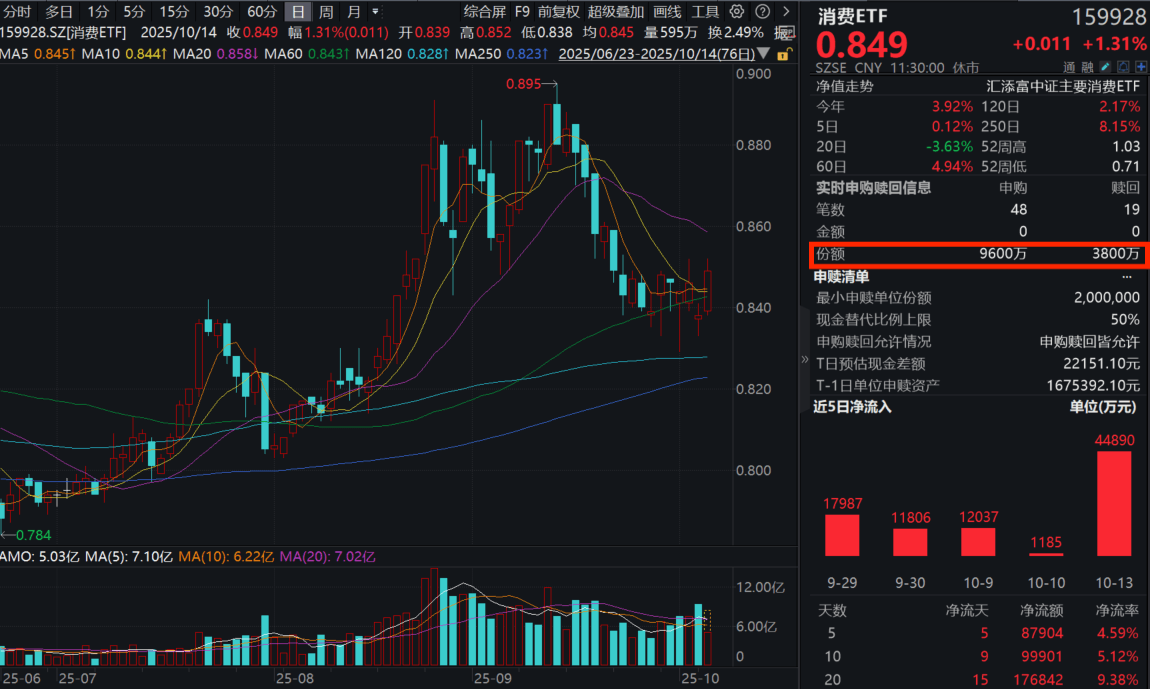
贸易摩擦再起,内需消费机会备受关注!消费ETF(159928)涨超1%,昨日获净流入超4.4亿元!机构:乐观看待消费板块补涨机会!
Xin Lang Cai Jing· 2025-10-14 05:26
Group 1: Market Performance - The consumption ETF (159928) rose over 1.3% today, with a trading volume exceeding 520 million yuan, marking a net inflow of over 440 million yuan yesterday and an additional 60 million yuan today, achieving eight consecutive days of capital inflow [1] - The latest scale of the consumption ETF (159928) has surpassed 19.9 billion yuan, nearing the 20 billion yuan mark, significantly leading its peers [1] Group 2: Hong Kong Market Insights - The Hong Kong consumption 50 ETF (159268) experienced a slight increase of 0.1%, with a trading volume exceeding 30 million yuan, accumulating over 12 million yuan in net inflow over the past 20 days [3] - Key component stocks showed mixed performance, with notable gains in brands like Bling and Pop Mart, while companies like Mixue Group and Anta Sports saw declines [3] Group 3: Consumer Trends and Opportunities - The upcoming Double 11 shopping festival is expected to boost consumer spending, with Alibaba's Taobao implementing significant subsidy measures to enhance sales [6][8] - The retail sector is anticipated to perform in line with expectations during the National Day holiday, driven by customer traffic, although average spending per customer remains under pressure [6] Group 4: Investment Outlook - The current market environment presents a rebound opportunity due to low valuations and a clean slate for companies, with expectations of improved fundamentals in sectors like beer and dairy [8] - Structural growth remains robust, particularly among younger consumers and in emerging markets, with certain stocks showing reasonable valuations and high growth potential over the next three years [8] - Four categories of investment opportunities are highlighted for the next six months, focusing on low absolute valuations, historical valuation comparisons, high growth certainty, and short-term policy-driven sectors [8] Group 5: ETF Composition - The consumption ETF (159928) has a significant concentration in its top ten holdings, with over 68% weight, including leading liquor companies and major consumer goods firms [10] - Notable stocks in the ETF include Wuliangye, Kweichow Moutai, and Yili, each holding substantial weight in the index [11]