
银行业

Search documents
广东新春第一会,传来激活县镇村资源要素“一池春水”的潮音
Nan Fang Nong Cun Bao· 2026-02-24 14:03
Core Viewpoint - The article highlights the transformation of rural areas in Guangdong, emphasizing the activation of local resources and the importance of integrating various elements to enhance county-level development [6][11][66]. Group 1: Resource Activation - A former rural school in Meizhou's Jiaoling County has been repurposed into a "Rice Aroma Center," linking local water resources and forming a cultural tourism demonstration area [3][6]. - The transformation from "sleeping assets" to "development engines" illustrates the accelerated flow of resources to counties and villages [7][8]. Group 2: Land Development - The push for resource elements to sink into counties and villages begins with land, which is seen as the spatial carrier and material foundation for development [15][16]. - Over the past three years, 4.05 million acres of new urban construction land have been allocated, with over 600,000 acres of industrial land control lines planned [17][18]. - The comprehensive land remediation has attracted investments totaling 661.375 billion yuan [19]. Group 3: Financial Support - Financial resources are crucial for stabilizing county-level industrial development, with the Agricultural Development Bank of Guangdong emphasizing its role in supporting agricultural modernization and rural integration [30][31]. - The bank offers long-term loans, with terms generally around 15 years, and has set no upper limit on funding for key projects [33][34]. Group 4: Talent Development - The "Youth Prosperity Plan" has trained nearly 100,000 young people to engage in rural development, with many becoming local rural CEOs [45][46]. - Successful case studies show that these young leaders are creating new business models in agriculture and tourism, significantly increasing local income [42][48]. Group 5: Technological Innovation - Technology is identified as a key variable in enhancing county-level development, with local universities contributing to significant agricultural and industrial advancements [52][56]. - The integration of technology in traditional sectors is leading to substantial economic growth, with the agricultural output surpassing 8.9 billion yuan [56][58]. Group 6: Overall Impact - The discussions at the forum indicate a shift in the perception of counties from being development "endpoints" to becoming new focal points for high-quality growth [66].


戴蒙敲响公司债流动性警钟:利差低位掩盖崩盘风险,美联储恐需再次出手救市
Zhi Tong Cai Jing· 2026-02-24 14:02
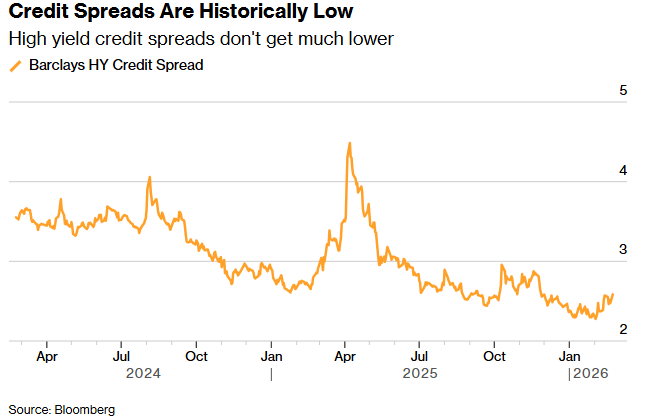
Group 1 - The core concern is that corporate bonds are facing a sharp decline risk as liquidity providers are increasingly replaced by liquidity takers, with similarities drawn to the pre-2008 financial crisis era [1][2] - JPMorgan CEO Jamie Dimon warns that the current situation, where everyone is making easy profits, is reminiscent of the years leading up to the financial crisis, urging caution [1][2] - Credit spreads are at historical lows, and there is little room for further increases, with banks and brokers significantly reducing their presence in the corporate bond market [2][5] Group 2 - The scale of corporate bonds held by brokers and dealers has drastically decreased from over $300 billion during the global financial crisis to between $70 billion and $80 billion today [2][5] - Exchange-traded funds (ETFs) have become the largest holders of corporate bonds, surpassing U.S. banks by approximately 25%, with a total holding of about $2.5 trillion [2][5] - The rise of ETFs has occurred alongside a decline in participation from banks, pension funds, and foreign investors, which has contributed to liquidity mismatches in the market [2][5] Group 3 - The private credit market, valued at $1.8 trillion, is showing signs of issues, particularly in the technology sector, where companies previously seen as attractive debtors are now facing increased competition and potential commoditization [6][7] - Private credit ETFs have seen rapid growth, increasing from nearly zero to a market value of $1.5 billion to $2 billion in just two years, despite the inherent liquidity mismatches [7] - The increase in U.S. banks' loans to non-bank financial institutions, including business development companies (BDCs), could lead to spillover effects in the listed credit market [7][9] Group 4 - The rising volatility of individual stocks and the potential for a sell-off in the credit market could lead to a rush for exits by funds and other holders seeking to avoid significant losses [9] - The lack of market makers to stabilize declines raises the risk of a sell-off turning into a crash, prompting speculation that the Federal Reserve may need to intervene again as it did in 2020 [9]

央行公告:明日操作6000亿元
Shang Hai Zheng Quan Bao· 2026-02-24 13:38
Group 1 - The central bank announced a 600 billion MLF operation on February 25, with a one-year term, to maintain ample liquidity in the banking system [1] - This operation marks the 12th consecutive month of increased MLF operations, with a net injection of 300 billion [1] - The total net liquidity injection for February reached 900 billion, indicating a continued high level of net injection [1] Group 2 - February is a month with concentrated bank credit issuance, and market demand for liquidity remains strong [1] - The central bank's actions are aimed at ensuring sufficient liquidity and stabilizing the financial market, especially after the Spring Festival [1] - The central bank has significantly increased the net injection of liquidity tools, including MLF and reverse repos, to support major project funding and stabilize macroeconomic operations [1][2]
“居民财富何处流”研究二:中国居民财富:第三次历史“大迁徙”
GUOTAI HAITONG SECURITIES· 2026-02-24 12:56
Group 1: Historical Wealth Migrations - The first historical migration occurred from 1998 to 2018, where deposits moved to real estate due to housing market reforms and rising property prices[3][14]. - The second migration from 2018 to 2023 saw wealth returning to deposits as the real estate market declined, with average annual new deposits reaching approximately 12 trillion yuan, significantly higher than the previous 4-5 trillion yuan[4][21]. - The third migration, starting in 2023, is characterized by a shift towards "deposits+" as low interest rates and inflation expectations reshape asset allocation strategies[5][28]. Group 2: Current Trends and Influencing Factors - Since 2023, new deposits have decreased to 16.7 trillion yuan, indicating a loosening of concentrated deposit allocations[28]. - The relative attractiveness of deposit yields has declined due to multiple rounds of interest rate cuts, prompting a shift towards "deposit-like" financial products[28][29]. - The recovery in bond and equity markets since 2024 has improved the relative returns of risk assets, making them more appealing compared to deposits[29][32]. Group 3: Implications of Inflation Expectations - Inflation expectations are a key variable influencing the direction and intensity of the current wealth migration, with low inflation leading to a preference for capital preservation products[11][32]. - The concept of "deposits+" emphasizes a wealth allocation philosophy that prioritizes stable returns while controlling for capital drawdown risks[33]. - If inflation expectations rise significantly, the flow of resident wealth may shift again, necessitating close monitoring of economic indicators[33].
美股盘前要点 | 特朗普10%全球关税生效!AMD与Meta官宣重磅战略合作
Ge Long Hui· 2026-02-24 12:36
Group 1 - US stock index futures are all up, with Nasdaq futures rising by 0.32%, S&P 500 futures up by 0.12%, and Dow futures increasing by 0.21% [1] - European stock indices show mixed results, with Germany's DAX down by 0.08%, UK's FTSE 100 down by 0.09%, France's CAC up by 0.03%, and the Euro Stoxx 50 down by 0.07% [2] - JPMorgan CEO Jamie Dimon indicates that the US banking sector is similar to the period before the 2008 financial crisis, predicting a deterioration in the credit cycle [4] - AMD expands its strategic partnership with Meta, selling AI chips worth up to $60 billion, with Meta able to purchase up to 160 million shares of AMD common stock [5] - Apple has officially entered the small-scale trial production phase for its high-end flagship phone, iPhone 18 Pro [6] - Apple plans to procure over 100 million advanced chips produced at TSMC's Arizona factory this year [7] - ASML announces progress on EUV light sources, with chip production expected to increase by up to 50% before 2030 [8] - Hims & Hers Health reports a 59% year-over-year revenue growth to $2.348 billion, with over 2.5 million subscription users [15] Group 2 - JPMorgan raises its net interest income forecast for the year to approximately $104.5 billion, anticipating strong growth in investment banking and trading business for Q1 [10] - Eli Lilly launches a multi-dose weight loss drug, Zepbound, with a starting price of $299 per month [11] - Paramount increases its offer for the acquisition of Warner Bros. Discovery, with industry expectations of a bid at $32 per share [12] - OpenAI establishes long-term partnerships with consulting firms including Accenture to promote the deployment of Frontier [13] - Citigroup reportedly plans to sell a 24% stake in its Mexican retail bank to a consortium including Blackstone [14]
央行宣布:明天,6000亿元
Zhong Guo Zheng Quan Bao· 2026-02-24 12:30
Core Viewpoint - The People's Bank of China (PBOC) is set to conduct a 600 billion MLF operation on February 25, maintaining liquidity in the banking system, with a net injection of 300 billion due to the maturity of 300 billion MLF in February [1][4]. Group 1: MLF Operations - On February 25, the PBOC will conduct a 600 billion MLF operation with a one-year term, using a fixed quantity, interest rate bidding, and multiple price bidding method [1]. - The MLF operation marks the 12th consecutive month of increased liquidity provision, although the scale is smaller than the previous month's 700 billion [1]. Group 2: Reverse Repo Operations - Prior to the MLF operation, the PBOC conducted reverse repos of 800 billion and 1 trillion on February 4 and February 13, resulting in net injections of 100 billion and 500 billion, respectively, exceeding expectations [3]. Group 3: Market Analysis - February is characterized by concentrated bank credit issuance, with strong market demand for liquidity, influenced by the Spring Festival holiday and tax deadlines [4]. - The continuation of MLF operations is expected to stabilize liquidity and maintain financial market stability, especially with significant amounts of reverse repos maturing [4]. - Analysts predict that future liquidity fluctuations may depend on government bond supply, with the possibility of reserve requirement ratio cuts if pressure on government bond supply increases [4].

马年首期LPR维持不变,货币政策进入观察期
Jin Rong Jie· 2026-02-24 12:27
Core Viewpoint - The Loan Prime Rate (LPR) remains stable for the ninth consecutive month, with the one-year rate at 3.0% and the five-year rate at 3.5%, reflecting a solid pricing foundation and macroeconomic resilience [1][2]. Group 1: LPR Stability - The LPR's stability was anticipated by the market, as the Medium-term Lending Facility (MLF) rate remained unchanged, which directly influences the LPR's pricing mechanism [2]. - The macroeconomic environment shows resilience, with strong exports and growth in high-tech manufacturing, supporting the current monetary policy stance [2]. Group 2: Banking Sector Challenges - The net interest margin for commercial banks is at a historical low of 1.42%, below the threshold for stable operations, limiting the motivation for banks to lower LPR quotes [3]. - The average weighted interest rate for general loans has decreased to 3.55%, with corporate loans at approximately 3.2% and personal housing loans at about 3.1%, indicating that financing costs are already low [3]. Group 3: External and Policy Considerations - The external environment is expected to improve, with the U.S. Federal Reserve likely to continue its rate cuts, reducing the pressure from the U.S.-China interest rate differential [4]. - There is still room for a reduction in the reserve requirement ratio, currently at about 6.3%, which could facilitate future LPR adjustments [4]. - The current monetary policy is in a "consolidation phase" after previous aggressive measures, with a focus on maintaining low financing costs rather than further reductions [4].
“AI颠覆一切”席卷股票市场 何处是安全避风港? 高盛给出关键词:HALO
Zhi Tong Cai Jing· 2026-02-24 12:14
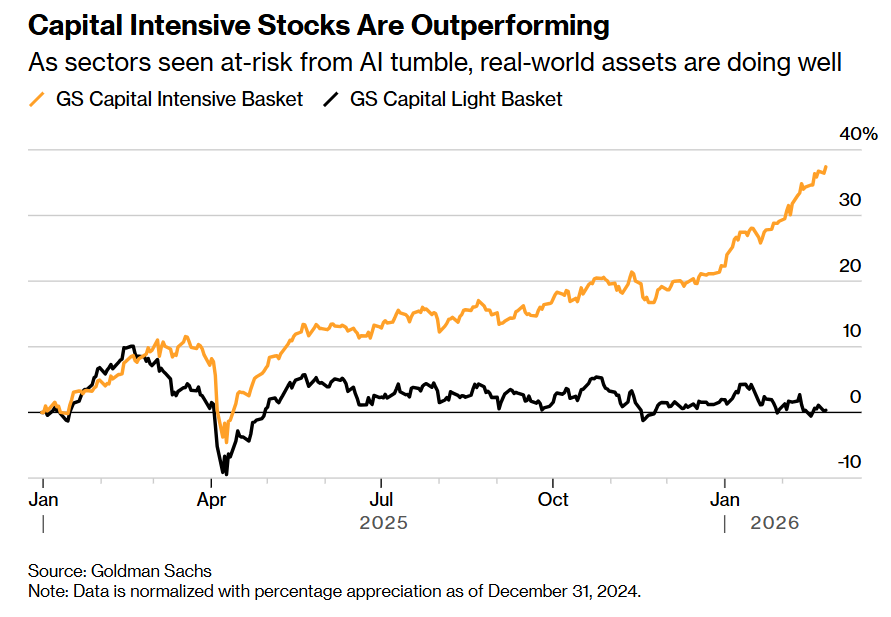
Core Viewpoint - Heavy asset companies are significantly outperforming the global stock market as investors seek safe havens from the "AI disruption" sell-off, focusing on HALO (Heavy Assets, Low Obsolescence) stocks [1][3] Group 1: Performance of Heavy Asset Stocks - Heavy asset stocks have outperformed a control group of light capital stocks by approximately 35% since the beginning of 2025 [1] - The HALO effect refers to companies with high-value, long-lasting physical assets that are less likely to be quickly replaced by AI, making them attractive during periods of AI-related anxiety [3][6] Group 2: Characteristics of HALO Stocks - HALO stocks are characterized by high barriers to entry in heavy asset production, such as utilities, mining, oil and gas assets, and critical AI infrastructure manufacturers, where AI replication costs are extremely high [2] - These stocks also exhibit low technological obsolescence rates, meaning core production capabilities are difficult to replace with AI in the short term, such as in semiconductor equipment supply chains [2] Group 3: Market Dynamics and Investment Trends - The anxiety surrounding AI's potential to disrupt traditional business models has led to irrational sell-offs across various sectors, including those seemingly unaffected by AI risks [7] - Heavy asset companies are benefiting from increased capital expenditures driven by AI infrastructure investments, with major cloud providers expected to invest around $1.5 trillion from 2023 to 2026 [8] Group 4: Financial Metrics and Investor Sentiment - Higher actual yield rates and geopolitical factors supporting fiscal spending are driving funds toward capital-intensive market segments, with earnings momentum shifting towards heavy asset stocks [9] - Market expectations for stronger earnings per share (EPS) growth and return on equity (ROE) are now significantly higher in capital-intensive companies compared to light capital companies [9]

流动性跟踪与地方债策略专题:2026年地方债提前批额度逐步披露
Guolian Minsheng Securities· 2026-02-24 11:26
Group 1 - The central viewpoint of the report emphasizes the importance of maintaining ample liquidity and relatively loose social financing conditions, as stated in the central bank's monetary policy report for Q4 2025 [9][10] - The report indicates that the anticipated early quota for local government bonds in 2026 is projected to be 3.12 trillion yuan, based on 60% of the new local bond quota for 2025, which is 5.20 trillion yuan [16][44] - The report highlights that the total issuance of local government bonds is expected to reach 20.216 trillion yuan by February 28, 2026, with a significant portion being long-term bonds [17][45] Group 2 - The report notes that the net financing scale of local government bonds in March is expected to decrease to around 500 billion yuan unless the new bond quota announced during the two sessions exceeds market expectations [18][45] - It is mentioned that the implied tax rates for various bond maturities are around 4% for 10Y, 4% for 15Y, 5% for 20Y, and 4.5% for 30Y, indicating a favorable value proposition for these bonds [19][47] - The report discusses the behavior of institutions, noting that various entities, excluding insurance, have shifted to net buying of local bonds before the Spring Festival, with a focus on longer maturities [18][47]
央行将开展6000亿元MLF操作,期限为1年期
Xin Lang Cai Jing· 2026-02-24 11:05
Group 1 - The People's Bank of China will conduct a 600 billion MLF operation on February 25, 2026, to maintain liquidity in the banking system [1] - The operation will be conducted using a fixed quantity, interest rate bidding, and multiple price bidding methods [1] - The term of the MLF operation will be for one year [1]