
国债

Search documents
国投期货综合晨报-20251125
Guo Tou Qi Huo· 2025-11-25 05:17
Group 1: Energy and Metals Crude Oil - Overnight international oil prices rebounded, with the Brent 01 contract rising 1.41%. The Russia-Ukraine geopolitical risk is entangled between sanctions and peace talks. Supply and demand face greater inventory accumulation expectations in Q4 and Q1 next year, and the downward drive for oil prices remains. Focus on the progress of the Russia-Ukraine peace plan negotiation and the Venezuelan geopolitical risk [1] Precious Metals - Overnight precious metals rose. As several Fed officials advocated a December rate cut, the implied rate cut probability in the interest rate market rose to 80%. The market is uncertain, and precious metals are oscillating at high levels waiting for a directional breakthrough [2] Copper - Overnight copper prices oscillated. LME copper rose with precious metals at the end of the session. The domestic spot market has a certain bullish sentiment, and the SMM social inventory decreased by 1.39 million tons to 18.06 million tons [3] Aluminum - Overnight SHFE aluminum fluctuated narrowly. The social inventory of aluminum ingots and bars decreased by 0.8 million tons on Monday. The aluminum price may continue to adjust, with support around 21,100 yuan [4] Alumina - Alumina's operating capacity is at a historical high, and the supply surplus pattern remains unchanged. It will operate weakly before large-scale production cuts [5] Cast Aluminum Alloy - The spot price of Baotai ADC12 remained at 20,700 yuan. The supply of scrap aluminum is tight, and it will continue to follow the aluminum price, with the possibility of a narrowing spread with AL [6] Zinc - Domestic and overseas mine TC continued to decline. SHFE zinc oscillated in the range of 22,200 - 23,000 yuan/ton. The external demand supports zinc consumption, but the domestic demand is expected to weaken [7] Lead - SHFE lead oscillated in the range of 17,000 - 17,500 yuan/ton. The export of lead-acid batteries is expected to remain under pressure [8] Nickel and Stainless Steel - SHFE nickel rebounded, and stainless steel inventory decreased. However, the short-term contradiction lies in the macro level, and it is advisable to short on rebounds [9] Tin - LME tin closed higher, and SHFE tin oscillated at high levels. It is still advisable to short, and at the same time, match with out-of-the-money call options to hedge risks [10] Lithium Carbonate - The futures price of lithium carbonate opened low and moved lower. The market is highly divergent, and risk control should be prioritized [11] Polysilicon - The fundamentals of polysilicon are weak. The futures price will maintain an oscillating pattern [12] Industrial Silicon - The industrial silicon futures closed slightly lower. It will maintain an oscillating pattern in the short term [13] Iron Ore - The iron ore futures oscillated strongly overnight. The fundamentals are marginally looser, and the price is expected to oscillate [15] Coke - The coke price oscillated. It may oscillate weakly [16] Coking Coal - The coking coal price oscillated weakly. It may oscillate weakly [17] Manganese Silicon - The manganese silicon price oscillated. The bottom support is expected to move down [18] Silicon Ferrosilicon - The silicon ferrosilicon price oscillated. The bottom support will be tested [19] Fuel Oil and Low-Sulfur Fuel Oil - Both high-sulfur and low-sulfur fuel oils face pressure from abundant supply and weak demand [21] Asphalt - The asphalt price is expected to oscillate weakly under pressure [22] Group 2: Chemicals Urea - Urea supply remains sufficient. The market may return to a stalemate [23] Methanol - The methanol futures rose sharply. It is advisable to try to go long on the 5 - 9 spread at low prices [24] Pure Benzene - It is advisable to continue the idea of shorting on rebounds and consider option allocation [25] Styrene - The supply and demand of styrene are in a tight balance, but the support from the cost and demand sides is questionable [26] Polypropylene, Plastic, and Propylene - The market lacks guidance. Polyethylene supply pressure increases, and polypropylene supply is expected to increase slightly [27] PVC and Caustic Soda - PVC may follow the cost. Caustic soda will operate weakly [28] PX and PTA - PX is still strong before new capacity is put into production. PTA is driven by cost [29] Ethylene Glycol - The ethylene glycol price has a short-term rebound expectation, but the rebound space is limited [30] Short Fiber and Bottle Chip - Short fiber prices fluctuate with raw materials. Bottle chip is cost-driven [31] Group 3: Agricultural Products Soybean and Soybean Meal - The soybean meal futures rebounded. Pay attention to the impact of La Niña on South American soybean production [35] Soybean Oil and Palm Oil - Soybean oil and palm oil will oscillate in the short term. Palm oil is weaker [36] Rapeseed Meal and Rapeseed Oil - The rapeseed market focuses on Australian seeds. It is advisable to wait and see in the short term [37] Domestic Soybeans - Domestic soybeans rebounded strongly. Pay attention to the spot market and policy guidance [38] Corn - The corn futures oscillated at a high level. Pay attention to the sales progress of new corn in the Northeast [39] Live Hogs - The far-month hog futures rose, and the near-month is weak. The price may form a double bottom [40] Eggs - The number of newly laid hens is expected to decrease in December. Pay attention to the spot price [41] Cotton - The cotton futures may oscillate in the short term. It is advisable to wait and see [42] Sugar - The international sugar supply is sufficient. Pay attention to the production in India, Thailand, and Guangxi [43] Apples - The apple futures oscillated at a high level. Pay attention to the inventory removal [44] Wood - The wood futures oscillated. It is advisable to wait and see [45] Pulp - The pulp futures fell slightly. It is advisable to wait and see [46] Group 4: Financial Futures Stock Index Futures - A-shares rose in a shrinking volume. The short-term macro liquidity is uncertain. It is advisable to wait and see [47] Treasury Bond Futures - The treasury bond futures oscillated upward. The yield curve may flatten slightly [48] Group 5: Shipping Container Freight Index (European Line) - The SCFIS European route index rose sharply. The 02 contract may maintain a discount [20]
高市早苗,日债摧毁者:日本将要为国债多付2倍利息,占财政收入的1/4
Sou Hu Cai Jing· 2025-11-24 06:11
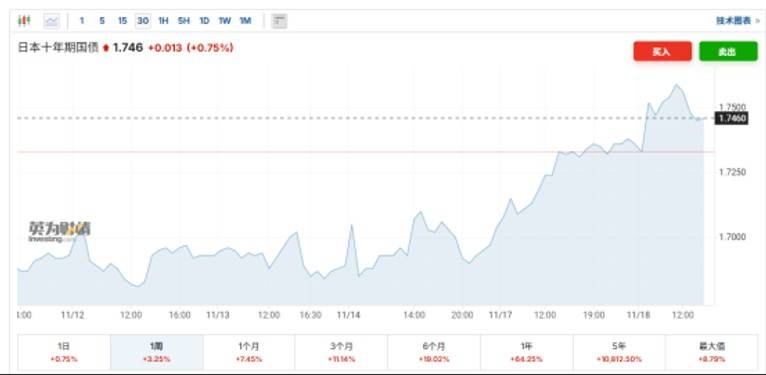
不断飙升的收益率会造成什么后果呢? 1.日本要为债务支付更高的利息。23年,日本还在实行负利率时,当年为国债付了8.5万亿日元利息(占 该年财政收入的11%),除以约1200万亿债务余额,平均借款利息0.7%。 而目前,基准利率已来到0.5%,再加上投资者要求更高的风险补偿,今年借款利息可能要较23年翻一 倍,来到1. 日本国债正在被疯狂抛售。 当前十年期国债收益率已经飙升到1.78%,08年金融危机以来最高,20年期2.79%,新世纪以来最高, 30年期3.3%,历史最高。 债券价格与利率成反比,因此抛售导致的价格下跌,会造成收益率上升。笼统理解,收益率是对风险的 补偿,风险越高,投资者要求的回报就越高。 ...
全球暴跌背后:机构震仓的7次机会
Sou Hu Cai Jing· 2025-11-18 07:29
Group 1 - The article discusses the recent market turmoil, highlighting the significant drop in major indices and cryptocurrencies, indicating a familiar yet unique crisis scenario [1][3] - It emphasizes the importance of understanding market dynamics beyond surface-level price movements, suggesting that true investment opportunities lie in comprehending institutional behaviors [4][6] - The concept of "震仓" (shakeout) is introduced, illustrating how large funds manipulate stock prices to induce panic selling and acquire shares at lower prices [6][12] Group 2 - The article presents a quantitative perspective on institutional trading behaviors, noting that a well-developed quantitative system can reveal underlying market patterns and signals [7][10] - It highlights the correlation between the frequency of shakeouts and a stock's potential, suggesting that more shakeouts indicate stronger institutional interest and capability [12][16] - The piece concludes by asserting that while macroeconomic events serve as a backdrop, the real narrative is driven by institutional actions, with quantitative data providing the clearest insights into market sentiment [19]

日度策略参考-20251114
Guo Mao Qi Huo· 2025-11-14 08:40
Report Industry Investment Ratings - Not provided in the given content Core Views of the Report - The current macro - level is in a relatively vacuous period, A - shares lack a clear upward main line, market trading volume remains low, and stock indices continue to fluctuate, accumulating momentum for the next upward movement. With policy support and abundant macro - liquidity, there is still strong support below the stock indices [1] - Asset shortage and weak economy are beneficial to bond futures, but the central bank has recently warned of interest - rate risks, suppressing the upward space [1] Summary by Industry Categories Macro - Finance - A - shares lack a clear upward main line, trading volume is low, and stock indices fluctuate while accumulating upward momentum. There is strong support below the stock indices due to policy and liquidity [1] - Asset shortage and weak economy are favorable for bond futures, but short - term interest - rate risks are a concern [1] National Debt - Asset shortage and weak economy are beneficial to bond futures, but short - term central bank warnings on interest - rate risks suppress the upward space [1] Non - Ferrous Metals - High copper prices inhibit downstream demand, but improved macro sentiment may lead to a stronger copper price [1] - Limited industrial drivers but improved macro market sentiment lead to a stronger aluminum price [1] - Domestic alumina production capacity is continuously released, with both production and inventory increasing, and the price fluctuates around the cost line [1] - There is still a risk of LME zinc squeeze, and the zinc price is expected to remain high. However, due to domestic oversupply, caution is needed when chasing high prices, and low - buying opportunities can be focused on [1] - The Indonesian government has restricted nickel - related smelting project approvals again, but approved projects are currently unaffected. In the fourth quarter, attention should be paid to the nickel ore quota approval in 2026. The nickel price may fluctuate in the short term, and high inventory pressure should be noted [1] - Stainless steel social inventory has slightly decreased, and steel mills' production schedules in November have declined. Attention should be paid to actual production [1] - The tin raw material end has not recovered, and there are good expectations for new - quality demand. Long - term, attention can be paid to low - buying opportunities [1] Precious Metals and New Energy - The short - term upward trend of precious metal prices may slow down. When the government shutdown ends and missing economic data is released, it may affect precious metal prices [1] - For industrial silicon, northwest production capacity is being restored, southwest start - up is weaker than usual, and the impact of the dry season is weakening [1] - For polysilicon, production schedules in November are decreasing, the anti - involution policy has not been implemented for a long time, and market sentiment has faded [1] - For lithium carbonate, the traditional peak season for new energy vehicles is approaching, energy - storage demand is strong, but hedging pressure is high [1] Black Metals - For rebar, there are concerns about potential weakening of industrial demand in the off - season. After the macro sentiment is realized, attention should be paid to upward pressure, and the virtual value accumulated put strategy can be appropriately participated in [1] - For hot - rolled coils, the off - season effect is not obvious, but the industrial structure is still loose. Attention should be paid to the upward price pressure after the macro sentiment is realized [1] - For iron ore, the near - month is restricted by production cuts, but the commodity sentiment is good, and the far - month still has upward opportunities [1] - For activated carbon, short - term production profit is poor, cost support is strengthening, direct demand is okay, but supply is high, and the price rebound is limited [1] - For coking coal, the price is in a dilemma near the previous high. It is necessary to repeatedly test the support. The coke futures price has factored in the expectation of five rounds of price increases, but downstream steel mill profits are being squeezed, and the steel - coke game is intense. The short - term strategy is to wait and see, and the long - term strategy is to buy at low prices. Industrial customers can consider selling hedging [1] - For coke, the logic is the same as that of coking coal. The futures price is at a premium, and industrial customers can consider selling hedging when the futures price rises [1] Agricultural Products - For soybean oil, China's commitment to purchase US soybeans has no substantial impact on soybean oil, and domestic inventory is decreasing. It is more resistant to decline among the three oils and can be over - allocated in arbitrage. Attention should be paid to the USDA supply - demand report [1] - For cotton, the domestic new crop has a strong harvest expectation, and the purchase price of seed cotton supports the cost of lint. Downstream start - up is low, but there is rigid restocking demand. The cotton market is currently in a situation of "support but no driver", and future policies and demand situations should be noted [1] - For sugar, the global sugar supply has shifted from shortage to surplus, and the domestic new - crop supply pressure has increased year - on - year. The Zhengzhou sugar price is expected to follow the decline of the raw - sugar price [1] - For corn, short - term farmers are reluctant to sell, and some purchasers have restocking demand for high - quality corn. The spot price is firm, and the futures price rebounds. However, before the supply pressure is fully released, the upward drive is weak, and attention should be paid to farmers' selling rhythm [1] - For soybeans, the near - month purchase and crushing profit of both Brazilian and US soybeans in China is poor. Before the USDA report is released, the futures price is expected to fluctuate and adjust [1] Energy - Chemicals - For crude oil, OPEC + plans to maintain a small increase in production in December, short - term geopolitical tensions have cooled down, and Sino - US trade tariff policies have been temporarily suspended, easing market sentiment [1] - For fuel oil, similar to crude oil, short - term geopolitical tensions have cooled down, and Sino - US trade tariff policies have been temporarily suspended, easing market sentiment [1] - For asphalt, short - term supply - demand contradictions are not prominent, the "14th Five - Year Plan" construction demand is likely to be false, and the supply of raw - material Ma Rui crude oil is sufficient, with high profits [1] - For BR rubber, the cost - end butadiene support is insufficient, the supply of synthetic rubber is loose, and the high - inventory situation has not been the main suppressing factor. The short - term price has stopped falling, and attention should be paid to the subsequent rebound [1] - For PTA, gasoline profit and low benzene price support PX. Overseas device failures and domestic device maintenance have led to a decline in PTA production [1] - For ethylene glycol, the decline in crude - oil price leads to a decline in ethylene - glycol price, while the increase in coal price strengthens the cost support. The "Golden September and Silver October" peak season for polyester is ending, and domestic demand has not significantly declined [1] - For short - fiber, gasoline profit and low benzene price support PX, the PTA price has rebounded, and the short - fiber basis has strengthened. The short - fiber price closely follows the cost [1] - For pure benzene, the Asian benzene price is weak, the US pure - benzene price has increased, and there are more benzene - ethylene maintenance projects [1] - For urea, export sentiment has eased, domestic demand is insufficient, and there is support from anti - involution policies and the cost end [1] - For PVC, new production capacity is being released, the intensity of maintenance has weakened, downstream demand has declined, and orders are poor [1] - For caustic soda, there is a risk of squeeze due to pre - delivery of Guangxi alumina, reduced subsequent maintenance concentration, inventory reduction, and limited near - month warehouse receipts [1] - For LPG, the international oil - gas fundamentals are continuously loose, the CP/FEI price has weakened, the futures price has been re - valued, and the domestic spot fundamentals are stable [1] Others - For the container shipping European line, the macro - positive sentiment has been digested, the peak - season price - increase expectation has been priced in advance, and the shipping capacity supply in November is relatively loose [1]
宏观金融数据日报-20251114
Guo Mao Qi Huo· 2025-11-14 08:20
Report Summary 1. Report Industry Investment Rating - No information provided on the industry investment rating. 2. Core Viewpoints - The US government's potential reopening boosted the capital market, increasing expectations of further overseas liquidity release, leading to a stronger performance of stock indices with the Shanghai Composite Index slightly breaking through a new high [7]. - After the cooling of AI and chip sectors since October, the lithium - battery sector took over and led the rally, supporting the strong performance of stock indices [7]. - The current macro - level situation is a mix of bullish and bearish factors, lacking a core driving force. There are disagreements in the market about whether the valuation of technology stocks will further increase and whether the market can shift from a structural to a full - fledged slow - bull market. Short - term market disagreements are expected to be digested through index fluctuations, and new driving factors are needed for further upward movement [7]. 3. Summary by Related Content Money Market - DRO01 closed at 1.32 with a - 9.93bp change, DR007 at 1.48 with a - 1.22bp change, GC001 at 0.98 with a - 56.50bp change, GC007 at 1.47 with a - 3.00bp change, SHBOR 3M at 1.58 with no change, LPR 5 - year at 3.50 with no change, 1 - year treasury at 1.41 with a 0.26bp change, 5 - year treasury at 1.58 with a 1.54bp change, 10 - year treasury at 1.81 with a 0.46bp change, and 10 - year US treasury at 4.09 with a 2.00bp change [4]. - The central bank conducted 190 billion yuan of 7 - day reverse repurchase operations yesterday, with 92.8 billion yuan of reverse repurchases maturing, resulting in a net injection of 97.2 billion yuan. This week, 495.8 billion yuan of reverse repurchases will mature, with 78.3 billion, 117.5 billion, 65.5 billion, 92.8 billion, and 141.7 billion maturing from Monday to Friday respectively [4]. - The central bank's Q3 2025 China Monetary Policy Implementation Report stated that it will maintain a moderately loose monetary policy, use various tools to keep social financing conditions relatively loose, improve the monetary policy framework, and strengthen policy implementation and transmission. It also aims to promote a reasonable recovery of prices [4]. Stock Index Market - The CSI 300 rose 1.21% to 4702.1, the SSE 50 rose 0.96% to 3073.7, the CSI 500 rose 1.55% to 7355.3, and the CSI 1000 rose 1.39% to 7590.6. The trading volume of the Shanghai and Shenzhen stock markets was 2.042 trillion yuan, an increase of 96.9 billion yuan from the previous day [6]. - Most industry sectors rose, with energy metals, batteries, fertilizers, precious metals, power equipment, non - metallic materials, non - ferrous metals, chemical raw materials, chemical products, and small metals leading the gains. Only railway and highway, banking, and power sectors declined [6]. - The trading volume and open interest of stock index futures contracts generally decreased. For example, IF trading volume decreased by 7.3% and open interest by 5.1%, IH trading volume by 2.2% and open interest by 1.2%, IC trading volume by 9.2% and open interest by 7.4%, and IM trading volume by 11.9% and open interest by 5.5% [6]. Stock Index Futures Premium and Discount - IF premium rates for the current - month, next - month, current - quarter, and next - quarter contracts were 8.22%, 5.41%, 3.44%, and 3.58% respectively [8]. - IH premium rates for different contracts were 1.58%, 1.60%, 0.90%, and 0.77% respectively [8]. - IC premium rate for the current - month contract was 12.34% [8]. - IM premium rates for different contracts were 14.77%, 14.98%, 13.05%, and 12.76% respectively [8].
光大期货金融类日报11.10
Sou Hu Cai Jing· 2025-11-10 01:28
Group 1: A-Share Market Performance - A-shares' Q3 operating performance is strong, with a cumulative revenue growth of 0.74% year-on-year, marking the end of a continuous decline since 2023 [1] - Q3 net profit growth for A-shares, excluding financials, is 1.89%, higher than Q2's 0.83% but lower than Q1's 3.45% [1] - There is a notable disparity in performance, with technology sectors expanding significantly while traditional industries, especially consumer-related sectors, remain under pressure [1] Group 2: Market Trends and Indices - The A-share market experienced high-level fluctuations, with the Wind All A index rising by 0.63% and average daily trading volume at 2.01 trillion yuan [2] - The CSI 1000 index increased by 0.47%, while the CSI 500 index saw a slight decline of 0.04% [2] - The liquidity indicators showed a slight decrease in financing balance, with a weekly reduction of 700 million yuan [2] Group 3: Bond Market Dynamics - The central bank's announcement of a net purchase of 20 billion yuan in government bonds in October has led to a weak and fluctuating bond market [3][4] - As of November 7, the yields on various government bonds showed slight changes, with the 10-year bond yield at 1.81% [3] - The bond issuance for the week totaled 387.5 billion yuan, with a net issuance of 192.2 billion yuan [5] Group 4: Inflation and Economic Indicators - October's CPI showed a year-on-year increase of 0.2%, reversing the previous month's decline of 0.3% [6] - The core CPI, excluding food and energy, rose by 1.2%, marking the highest increase since March 2024 [6] - PPI showed a month-on-month increase of 0.1%, the first rise of the year, with a year-on-year decline of 2.1% [6] Group 5: Precious Metals Market - London spot gold experienced a slight weekly decline of 0.06%, while silver fell by 0.68% [8] - The gold and silver holdings data indicated an increase in speculative positions, with total gold holdings rising to 528,789 contracts [8] - The market outlook for gold remains uncertain, with potential for further fluctuations as investors await clearer signals [10]
日度策略参考-20251107
Guo Mao Qi Huo· 2025-11-07 06:35
Report Industry Investment Rating No relevant content provided. Core Viewpoints of the Report - The current macro - level is in a relatively vacuum period, A - shares lack a clear upward main line, market trading volume remains low, and the stock index continues to fluctuate, accumulating momentum for the next round of upward movement. Meanwhile, with policy support and abundant macro - liquidity, there is still strong support below the stock index [1]. Summary by Related Catalogs Macro Finance - **Treasury Bonds**: Asset shortage and weak economy are beneficial to bond futures, but the central bank has recently warned of interest - rate risks, suppressing the upward space, showing an oscillating trend [1]. - **Copper**: The tight pattern of US dollar liquidity has eased, market risk appetite has recovered, and copper prices have stopped falling [1]. - **Aluminum**: Recently, the industrial - side driving force is limited, and the macro - level benefits have been digested, so aluminum prices are oscillating [1]. - **Alumina**: With still a small profit in production, domestic alumina production capacity is continuously released, and both production and inventory are increasing, putting pressure on the spot price. Recently, attention should be paid to the cost support [1]. - **Zinc**: The US government shutdown has reached the longest historical record, and market risk - aversion sentiment has increased. The LME zinc inventory has been continuously decreasing, and the short - squeeze movement has driven zinc prices higher. However, considering the domestic oversupply, caution is needed when chasing high prices [1]. Non - ferrous Metals - **Nickel**: The better - than - expected US ADP data has alleviated concerns about the US economic recession, but the expectation of the Fed's interest - rate cut has been suppressed, and market risk appetite has fluctuated. Indonesia has recently restricted the approval of nickel - related smelting projects again, but the approved projects are not affected. In the fourth quarter, attention should be paid to the approval of nickel - ore quotas in 2026. Nickel prices may oscillate in the short term, and high inventory pressure should be watched out for. It is recommended to trade within a short - term range, and the long - term surplus pattern of primary nickel will continue [1]. - **Stainless Steel**: The better - than - expected US ADP data has alleviated concerns about the US economic recession, but the expectation of the Fed's interest - rate cut has been suppressed, and market risk appetite has fluctuated. Indonesia has restricted the approval of nickel - related smelting projects again, but the approved projects are not affected. In the fourth quarter, attention should be paid to the progress of the approval of Indonesian nickel - ore quotas, and the premium at the ore end is currently stable. The price of raw - material ferronickel has weakened slightly, the social inventory of stainless steel has decreased slightly, and the steel mills' production plan for October is stable. Macro - sentiment is fluctuating, steel mills have recently lifted price limits, and stainless - steel futures are oscillating at the bottom. It is recommended to trade short - term and look for opportunities to sell on rallies [1]. - **Tin**: Recently, the positive macro - sentiment has been digested. Considering that the raw - material end of tin has not recovered and the new - quality demand is expected to be good, it is still recommended to pay attention to the opportunity of going long on dips in the long - term [1]. Precious Metals and New Energy - **Precious Metals (Gold and Silver)**: Judges of the high - court generally question the legitimacy of tariffs, increasing market uncertainty and supporting precious - metal prices. However, the resilience of US economic data has disrupted the interest - rate cut expectation. Precious metals are expected to oscillate within a range in the short term [1]. - **Industrial Silicon**: The production capacity in the northwest is continuously resuming, the start - up in the southwest is weaker than in previous years, and the impact of the dry season is weakened [1]. - **Polysilicon**: In the long - term, there is an expectation of production - capacity reduction. In the fourth quarter, the terminal installation will increase marginally. The anti - involution policy has not been implemented for a long time, and market sentiment has faded [1]. - **Lithium Carbonate**: The traditional peak season for new - energy vehicles is approaching, the energy - storage demand is strong, but the hedging pressure is large [1]. Ferrous Metals - **Rebar**: There are concerns about the potential weakening of industrial demand in the off - season. After the macro - sentiment is realized, attention should be paid to the upward pressure. It is advisable to participate in the out - of - the - money accumulative put option strategy [1]. - **Hot - Rolled Coil**: The off - season effect of the industry is not obvious, but the industrial structure is still loose. Similarly, attention should be paid to the upward pressure on prices after the macro - sentiment is realized [1]. - **Iron Ore**: Near - month production is restricted, but the commodity sentiment is good, and there is still an upward opportunity for far - month contracts [1]. - **Sulfur**: The direct demand is good, and there is cost support, but the supply is high, inventory is accumulating, and the sector is under pressure, with limited price rebound space [1]. - **Coke and Coking Coal**: Coking coal is struggling near the previous high, repeatedly testing the support. The high point of the coke futures price has included the expectation of five rounds of price increases, but the actual three - round price increase has been delayed, and the game is intense. Based on the tight supply, coke and coking coal are relatively strong, but considering the weakening of steel prices and the potential weakening of steel demand in November, the futures prices of coke and coking coal are likely to return to the oscillating range after a false breakout. In the short - term, it is advisable to wait and see, and in the long - term, it is still advisable to go long at low prices. Industrial customers can consider selling hedging [1]. Agricultural Products - **Palm Oil**: In the short term, palm oil still faces the dual pressures of seasonal production increase and weak exports. However, starting from November, Malaysia enters the traditional production - reduction cycle. If export data improve significantly, it may trigger a staged rebound [1]. - **Soybean Oil**: According to the China - US negotiation agreement, China will purchase 12 million tons of US soybeans in the next two months, which may bring a loose expectation for soybean oil in the fourth quarter, and the rebound momentum is insufficient. The actual impact needs to be observed [1]. - **Rapeseed Oil**: The meeting between Chinese and Canadian leaders has brought the expectation of Sino - Canadian relaxation, and the bumper harvest of Canadian rapeseed has put pressure on the futures price [1]. - **Cotton**: Although the production capacity in Xinjiang is expanding, the production capacity in the inland may decrease marginally. At the same time, due to the thinning of spinning profits in Xinjiang, the operating rate may also be affected. The contradiction between the expansion of Xinjiang's production capacity and the reduction of spinning profits makes the cotton demand in the new year highly uncertain. The current futures price has fully priced in the selling pressure of new crops, and the downward space is limited, but under the background of a record - high production of new crops, the basis and futures price may continue to be under pressure [1]. - **Sugar**: Typhoons before and after the National Day have had an adverse impact on the sugar - cane harvest and production in South China. There is a seasonal upward impetus for sugar prices in the short term. In the medium - term, considering the good growth of sugar cane this year, the rebound space after the new - sugar listing is expected to be limited [1]. - **Soybeans and Soybean Meal**: The domestic soybean purchase and crushing profit is poor, and the domestic futures price is undervalued. With the expectation of China's purchase of US soybeans, the import cost of US soybeans is expected to rise, and the domestic futures price is expected to rebound in the short term to repair the crushing profit. However, the current loose supply of domestic soybean - meal spot and the expected loose global soybean supply in the long - term limit the rebound height [1]. - **Paper Pulp**: The current trading logic of paper pulp is related to the trading of old warehouse receipts for the November contract. With weak downstream demand, the futures price is under great pressure. It is recommended to conduct a reverse spread between the November and January contracts [1]. - **Log**: The fundamentals of logs have declined, but the spot price is firm. After a sharp decline in the futures price, the risk - return ratio of short - selling is low. It is recommended to wait and see [1]. - **Live Pigs**: In the past half - month, the spot price has risen alternately in the north and south due to secondary fattening, frozen - product storage, and reluctance to sell, which has postponed the production capacity. There is still pressure on the November slaughter. In the short term, the futures price is at the same level as the spot price, and the futures price will follow the spot price to stabilize and then weaken [1]. Energy and Chemicals - **Crude Oil**: OPEC+ plans to continue a small - scale production increase in December, the short - term geopolitical speculation has cooled down, and the suspension of some China - US trade - tariff policies has eased market sentiment [1]. - **Fuel Oil**: Similar to crude oil, the short - term supply - demand contradiction is not prominent, and it follows the trend of crude oil. The demand for the 14th Five - Year Plan construction rush is likely to be falsified, and the supply of Venezuelan crude oil is sufficient. The profit of asphalt is high [1]. - **Natural Rubber**: There is strong support from raw - material costs, the mid - stream inventory is continuously decreasing, and the commodity - market atmosphere is positive [1]. - **BR Rubber**: The decline of crude - oil prices has reduced the cost support of butadiene, and the supply of synthetic rubber is loose. High - production and high - inventory have not suppressed the price, and the mainstream supply price has been continuously reduced [1]. - **PTA**: Gasoline profit and low benzene price support PX. The gasoline cracking price has risen above $15, prompting refineries to increase gasoline production and reduce the feed of aromatic - hydrocarbon units. Overseas device failures and the decline of the operating load of some domestic reforming units, as well as the rotation inspection of large domestic PTA devices, have led to a decline in domestic PTA production [1]. - **Ethylene Glycol**: The decline of crude - oil prices has led to a decline in ethylene - glycol prices, while the rise of coal prices has slightly strengthened the cost support of domestic ethylene glycol. The "Golden September and Silver October" of the polyester industry is coming to an end, and the domestic demand has not significantly declined [1]. - **Short - Fiber**: Gasoline profit and low benzene price support PX. The rebound of PTA prices has strengthened the basis of short - fiber. Short - fiber prices continue to fluctuate closely with costs [1]. - **Styrene**: The Asian benzene price is still weak, the operating rates of STDP and reforming units have declined, the arbitrage window from Northeast Asia to the US is still closed, the profit of domestic styrene has decreased, the number of styrene - device overhauls has gradually increased, and crude - oil prices have continued to fall [1]. - **Urea**: The export sentiment has eased slightly, and the limited domestic demand restricts the upward space. There is support from anti - involution and cost - end factors [1]. - **PE**: Under high - supply, the inventory pressure is large, the intensity of overhauls has weakened, and the downstream demand is slowly increasing, but the peak season is not prosperous [1]. - **PP**: The support from overhauls is limited, and the new - device production has increased the supply pressure. The downstream improvement is less than expected, and the futures price has returned to the fundamentals, showing a weak - oscillating trend [1]. - **PVC**: The overhauls have decreased compared with the previous period, and the new production capacity has been released, increasing the supply pressure. The rise of coal prices has strengthened the cost support of PVC [1]. - **Caustic Soda**: Many alumina projects in Guangxi are planned to be put into production, the subsequent concentration of overhauls will decrease, the high - concentration caustic soda is at a negative premium, the absolute price is low, and the near - month warehouse receipts are limited, so there is a risk of short - squeeze [1]. - **LPG**: The international oil - gas fundamentals are continuously loose, the CP/FEI prices have weakened, the valuation of the domestic LPG futures price has been repaired, and the domestic spot fundamentals are stable due to short - term cooling and chemical rigid demand [1]. Others - **Container Shipping (European Route)**: The positive macro - sentiment has been gradually digested, the expectation of price increases in the peak season has been priced in advance, and the shipping capacity supply in November is relatively loose [1].
11月4日大盘简评
Mei Ri Jing Ji Xin Wen· 2025-11-04 09:12
Group 1: A-Share Market Overview - The A-share market experienced fluctuations with the three major indices declining, where the Shanghai Composite Index fell by 0.41%, the Shenzhen Component Index dropped by 1.71%, and the ChiNext Index decreased by 1.96% [1] - The total trading volume in the Shanghai and Shenzhen markets was 1.94 trillion yuan, down from 2.13 trillion yuan in the previous trading day, indicating a decrease in market activity [1] - Over 3,600 stocks in the market saw declines, reflecting a broad-based sell-off [1] Group 2: Sector Performance - The sectors that performed well included Fujian, banking, and ice and snow economy, while sectors such as precious metals, lithium mining, and robotics faced significant declines [1] - There is a noticeable shift in market style, with dividend stocks continuing to strengthen [1] Group 3: Market Outlook - Short-term outlook suggests a decline in equity risk appetite as the market may continue to experience fluctuations and sector rotation [1] - The long-term outlook for A-shares remains bullish, with a slow bull market trend expected to persist, and technology growth is anticipated to be the core focus [1] - A "dumbbell" structure of investment, focusing on both technology growth and dividend stocks, is recommended for current market conditions [1] Group 4: Storage and Bond Market Insights - The storage sector is expected to benefit from AI demand, with DRAM prices projected to rise by 8-13% quarter-on-quarter by Q4 2025 due to limited allocation of advanced process capacity by major manufacturers [2] - The bond market sentiment is expected to improve following the central bank's unexpected announcement to restart government bond trading, which may lead to better performance in Q4 compared to Q3 [2] - Investors are encouraged to consider various ETFs related to semiconductor equipment and government bonds as potential investment opportunities [2]
国债月报:11月债市环境改善-20251103
Jian Xin Qi Huo· 2025-11-03 11:53
Report Information - Report Title: Treasury Bond Monthly Report [1] - Date: November 3, 2025 [2] - Research Team: Macro Financial Research Team [4] - Researchers: He Zhuoqiao, Huang Wenxin, Nie Jiayi [3] Report Industry Investment Rating No relevant information provided. Core Viewpoints - With the clearing of negatives such as the A - share market re - entering a high - volatility range and the passing of the fastest economic growth stage, and the emergence of positives like the central bank's restart of treasury bond trading, the bond market stabilized and strengthened in October. In November, the bond market environment has improved, and it has entered a stage of accumulating positives. If there are phased disturbances leading to market over - adjustment, it is recommended to actively seize allocation opportunities [9][62]. - The recommended arbitrage strategies include: for the cash - and - carry strategy, there are positive arbitrage opportunities and reverse arbitrage should be participated in cautiously; for the basis strategy, focus on shorting the contract basis; for the inter - delivery strategy, focus on shorting the current - quarter contract and going long on the next - quarter contract; for the inter - variety strategy, recommend the flattening strategy [8]. Summary by Directory 1. October Market Review (1) Domestic Bond Market - In October, treasury bond futures fluctuated and strengthened, mainly stimulated by the resurgence of Sino - US trade disputes and the central bank's restart of treasury bond trading. The 10 - year treasury bond yield fell to below 1.7944% at the end of the month, down 6.72bp from the beginning of the month. Treasury bond futures of all varieties closed up, with the 5 - year treasury bond futures having a relatively smaller increase after duration adjustment. The yield curve showed a bull - flattening feature, and the basis of treasury bond futures further narrowed [11][13][18]. (2) Overseas Market - In October, US Treasury yields first declined and then rose, with a slight decline for the whole month. The US federal government shutdown at the beginning of the month triggered a US dollar credit crisis, leading to the selling of US Treasuries and an increase in yields. Later, the resurgence of Sino - US trade frictions and weak employment data led to a decline in yields. At the end of the month, Powell's hawkish signal caused yields to rebound [20]. (3) Funding Situation - In October, although it was a tax - payment month, the government bond payment pressure was not large. The central bank continued to actively inject funds and announced the restart of treasury bond trading. Inter - bank liquidity was stable and loose, and funding rates fluctuated within a narrow range. DR007 basically fluctuated around 1.4 - 1.43%, and the 1 - year inter - bank certificate of deposit basically remained around 1.67% and further dropped to around 1.64% at the end of the month [24]. 2. Bond Market Environment Analysis (1) Fundamental Situation - Domestic economic indicators have been weakening since June. In the third quarter, GDP grew by 4.8% year - on - year as expected. Exports and consumption were the main supports, while investment demand was the main drag. In October, manufacturing PMI declined seasonally, non - manufacturing PMI improved slightly, and high - frequency indicators showed that the economy continued to repair weakly [31][45][50]. (2) Policy Aspect - In October, both fiscal and monetary policies were strengthened. The government allocated 500 billion yuan from the local government debt balance limit to support projects. The central bank announced the resumption of treasury bond trading in the open market, which is a direct liquidity injection in the short term, but in the long term, there is potential pressure on the bond market if the fiscal tools drive economic improvement [57]. (3) Funding Aspect - In November, the main pressure on the funding side lies in government bond issuance and payment. Although there are large - scale maturities in the open market, the central bank is expected to continue to actively inject funds, and the liquidity pressure should be controllable [58][61]. 3. Next - Month Market Outlook (1) Market Logic and Outlook - The negatives in the bond market have basically been released, and in November, it enters a stage of accumulating positives. However, there are still uncertain disturbances such as the official release of the new regulations on fund sales fees, the stock - bond seesaw effect, and the unexpected increase in government bond supply [62]. (2) Arbitrage Strategy Outlook - Cash - and - carry Strategy: There are positive arbitrage opportunities, and reverse arbitrage should be participated in cautiously. - Basis Strategy: Focus on shorting the contract basis. - Inter - delivery Strategy: Focus on shorting the current - quarter contract and going long on the next - quarter contract. - Inter - variety Strategy: Recommend the flattening strategy [8][64][66].
广发期货日评-20251031
Guang Fa Qi Huo· 2025-10-31 05:33
Report Summary 1. Investment Ratings The report does not explicitly provide an overall industry investment rating. However, it offers specific trading suggestions for different sectors and varieties: - **Financial Sector** - **Equity Index Futures**: Try to lightly sell put options at the support level or construct a bull call spread for follow - up upside potential [3]. - **Treasury Bond Futures**: Go long on pullbacks for the unilateral strategy and pay attention to the positive arbitrage strategy for the cash - futures strategy [3]. - **Precious Metals**: For gold, there is pressure for a further decline; for silver, it is in a volatile consolidation. Trading suggestions are based on price trends [3]. - **Black Metals Sector** - **Steel**: Reduce long positions appropriately and hold the long - coking coal and short - hot - rolled coil arbitrage [3]. - **Iron Ore**: Close long positions and observe, and consider the 1 - 5 positive arbitrage [3]. - **Coking Coal and Coke**: Go long on pullbacks and hold the long - coking coal and short - coke arbitrage [3]. - **Non - ferrous Metals Sector** - **Copper**: Pay attention to the support around 87,000 [3]. - **Tin**: Adopt a low - buying strategy on pullbacks [3]. - **Energy and Chemical Sector** - **Crude Oil**: Go short in the short term [3]. - **Urea, PX, PTA, etc.**: Adopt different strategies such as reducing long positions, short - selling on rallies, and spread trading according to different varieties [3]. - **Agricultural Products Sector** - **Soybeans**: Hold long positions in the 2601 contract [3]. - **Palm Oil**: The main contract may test the support at 8,800 yuan [3]. - **Sugar**: It is in a bottom - oscillating state around 5,400 [3]. - **Cotton**: It is in a range - bound and upward - trending state, paying attention to the pressure around 13,800 [3]. - **Special and New Energy Sectors** - **Glass**: Look for short - term long opportunities based on the spot market [3]. - **Carbonate Lithium**: It is in a relatively strong state, with the main contract reference range of 83,000 - 87,000 [3]. 2. Core Views - **Market Environment**: Key factors such as the meeting between Chinese and US leaders, the release of the 15th Five - Year Plan draft, and the clarification of bond - fund redemption fees have an impact on the market. Risk - preference - enhancing factors are gradually materializing, and uncertainties in the market are decreasing [3]. - **Sector - specific Views** - **Financial Sector**: Stock index futures are affected by market sentiment and policy expectations; treasury bond futures are on an upward trend as negative factors are gradually digested; precious metals are affected by geopolitical and trade factors [3]. - **Black Metals Sector**: Supply and demand factors such as production, transportation, and inventory levels affect the price trends of steel, iron ore, coking coal, and coke [3]. - **Non - ferrous Metals Sector**: Prices are affected by factors such as macro - environment, supply - demand relationship, and technical levels [3]. - **Energy and Chemical Sector**: Supply - demand expectations, cost support, and inventory levels are the main factors affecting prices [3]. - **Agricultural Products Sector**: Factors such as procurement, supply pressure, and seasonal characteristics affect the price trends of various agricultural products [3]. - **Special and New Energy Sectors**: Macro - events and fundamental factors affect the price trends of glass, rubber, and new - energy products [3]. 3. Summary by Related Catalogs - **Financial Sector** - **Equity Index Futures**: After the meeting between Chinese and US leaders and the release of the 15th Five - Year Plan draft, the market has a short - term pullback after reaching a high. It is recommended to try light - selling put options or constructing a bull call spread [3]. - **Treasury Bond Futures**: As negative factors such as bond - fund redemption fees and central - bank bond - buying uncertainties are gradually digested, the bond market sentiment is improving. It is recommended to go long on pullbacks and consider the positive arbitrage strategy [3]. - **Precious Metals**: Gold is under pressure to decline due to factors such as the meeting between Chinese and US leaders and geopolitical concerns; silver is in a volatile consolidation [3]. - **Black Metals Sector** - **Steel**: The increase in apparent demand and the alleviation of inventory pressure lead to suggestions of reducing long positions and holding arbitrage positions [3]. - **Iron Ore**: The decline in shipping and arrivals, the increase in port inventory, and the sharp drop in molten - iron production lead to suggestions of closing long positions and considering arbitrage [3]. - **Coking Coal and Coke**: The strength of coking - coal prices and the cost support provided by coking coal lead to suggestions of going long on pullbacks and holding arbitrage positions [3]. - **Non - ferrous Metals Sector** - **Copper**: After the realization of positive expectations, the price is in a high - level oscillation. Pay attention to the support level [3]. - **Tin**: Affected by the Fed's interest - rate outlook, it is recommended to buy on pullbacks [3]. - **Energy and Chemical Sector** - **Crude Oil**: Although the macro - sentiment has eased and inventory has decreased, the increase in OPEC production limits the rebound height. It is recommended to go short in the short term [3]. - **Urea, PX, PTA, etc.**: Due to weak supply - demand expectations and limited cost support, different trading strategies are recommended for different varieties [3]. - **Agricultural Products Sector** - **Soybeans**: Supported by China's increased confidence in purchasing US soybeans, hold long positions [3]. - **Palm Oil**: The main contract may test the support level [3]. - **Sugar**: It is in a bottom - oscillating state due to abundant overseas supply [3]. - **Cotton**: With the solidification of new - cotton costs, it is in a range - bound and upward - trending state [3]. - **Special and New Energy Sectors** - **Glass**: Affected by macro - events, pay attention to short - term long opportunities based on the spot market [3]. - **Carbonate Lithium**: With the upward shift of the price center and the realization of demand benefits, it is in a relatively strong state [3].