
高技术制造业

Search documents
国家统计局:10月份制造业PMI有所回落,非制造业商务活动指数略有回升
Di Yi Cai Jing· 2025-10-31 01:45
(三)三大重点行业保持扩张。高技术制造业、装备制造业和消费品行业PMI分别为50.5%、50.2%和 50.1%,继续位于扩张区间,且明显高于制造业总体水平,行业支撑作用持续显现。高耗能行业PMI为 47.3%,比上月下降0.2个百分点,景气水平有所回落。 10月份,制造业采购经理指数为49.0%,比上月下降0.8个百分点;非制造业商务活动指数为50.1%,比 上月上升0.1个百分点;综合PMI产出指数为50.0%,比上月下降0.6个百分点,我国经济总体产出保持总 体稳定。 一、制造业采购经理指数有所回落 10月份,受"十一"假期前部分需求提前释放及国际环境更趋复杂等因素影响,制造业生产活动较上月放 缓,PMI降至49.0%。 (一)供需两端有所放缓。生产指数和新订单指数分别为49.7%和48.8%,比上月下降2.2个和0.9个百分 点,制造业企业生产和市场需求均有所回落。从行业看,农副食品加工、汽车、铁路船舶航空航天设备 等行业生产指数和新订单指数均位于52.0%及以上,产需两端较为活跃;纺织服装服饰、化学纤维及橡 胶塑料制品、非金属矿物制品等行业两个指数均低于临界点,行业供需偏弱。 (二)大型企业产需指数 ...
10月PMI数据解读|宏观经济
清华金融评论· 2025-10-31 01:39
Group 1: Manufacturing PMI Analysis - In October, the Manufacturing Purchasing Managers' Index (PMI) decreased to 49.0%, down 0.8 percentage points from the previous month, indicating a slowdown in manufacturing activity [4] - Both production index and new orders index fell to 49.7% and 48.8%, respectively, reflecting a decline in production and market demand [4] - Large enterprises maintained a PMI above the critical point, with indices at 50.9% for production and 50.1% for new orders, indicating sustained demand in this segment [4] Group 2: Key Industry Performance - High-tech manufacturing, equipment manufacturing, and consumer goods industries continued to expand, with PMIs of 50.5%, 50.2%, and 50.1%, respectively, all above the overall manufacturing level [5] - Conversely, high-energy-consuming industries saw a PMI of 47.3%, indicating a decline in economic activity [5] - Market expectations remain optimistic, with a production and business activity expectation index of 52.8%, suggesting confidence among manufacturers [5] Group 3: Non-Manufacturing PMI Insights - The Non-Manufacturing Business Activity Index rose to 50.1%, up 0.1 percentage points, indicating a slight recovery in the non-manufacturing sector [6] - The service sector's business activity index increased to 50.2%, with significant growth in sectors related to consumer travel and spending, such as rail and air transport [6][7] - The construction sector's business activity index fell to 49.1%, indicating a slight decline, but the business activity expectation index improved to 56.0%, reflecting better future outlooks [7] Group 4: Composite PMI Overview - The Composite PMI Output Index stood at 50.0%, indicating overall stability in production and business activities across sectors [8] - The manufacturing production index was recorded at 49.7%, while the non-manufacturing business activity index was at 50.1%, contributing to the composite figure [8]


工业利润高增:低基数是主因,高技术制造业发力多重支撑
Di Yi Cai Jing· 2025-10-30 12:01
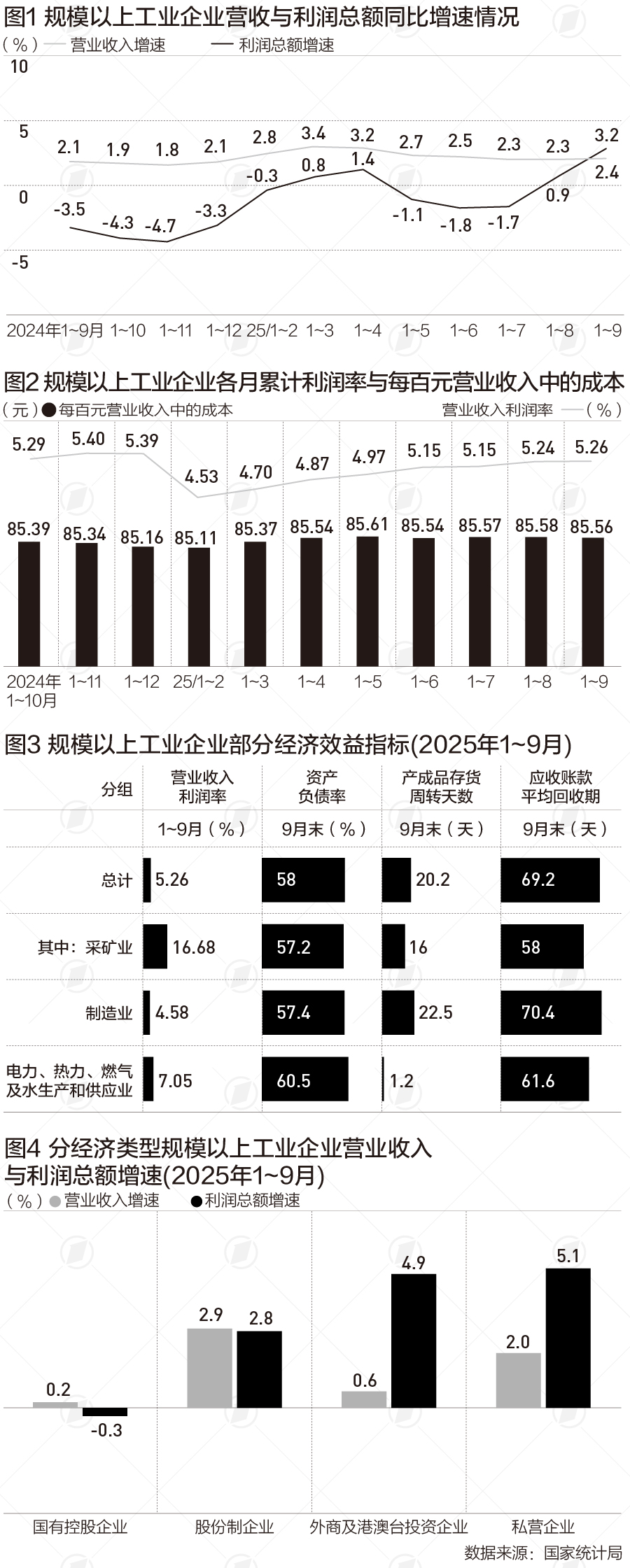
Core Insights - The profit growth of industrial enterprises has accelerated for two consecutive months, driven by proactive macro policies and a low base effect, with a year-on-year increase of 3.2% from January to September, marking the highest cumulative growth since August of the previous year [1][3]. Revenue and Profit Trends - In September, the profit of industrial enterprises increased by 21.6% year-on-year, accelerating by 1.2 percentage points compared to August, primarily due to low base effects, unexpected production increases, and price recoveries [2][3]. - From January to September, the revenue of industrial enterprises grew by 2.4% year-on-year, with September's revenue growth reaching 2.7%, an increase of 0.8 percentage points from August [4]. Profitability Metrics - The profit margin for industrial enterprises from January to September was 5.26%, up by 0.04 percentage points year-on-year, while in September, the profit margin was 5.49%, reflecting a significant increase of 0.85 percentage points year-on-year [4][11]. - The average collection period for accounts receivable was 69.2 days, indicating a slight improvement in the receivables situation, although it remains at historically high levels [11]. Sector Performance - High-tech manufacturing has shown significant growth, with profits increasing by 8.7% year-on-year from January to September, contributing 1.6 percentage points to the overall profit growth of industrial enterprises [12]. - Among 41 industrial sectors, 23 reported profit growth in the first three quarters, with 30 sectors experiencing profit increases in September, indicating a broad recovery across industries [12][13]. Future Outlook - The profit growth is expected to show a "front high, back low" trend in the fourth quarter due to the impact of last year's low profit levels and rising bases, although cumulative growth is anticipated to steadily improve [15][16]. - Continuous efforts to expand domestic demand and optimize supply-side structures are crucial for sustaining profit improvements in the industrial sector [16].
今年前三季度全国企业设备更新加快推进
Ke Ji Ri Bao· 2025-10-30 01:05
Group 1 - The core viewpoint of the articles highlights the significant growth in equipment procurement across various sectors, particularly in information technology and high-tech manufacturing, indicating increased investment in new productive forces [1][2] - In the first three quarters of this year, the procurement amount for machinery and equipment in the information transmission software and IT services industry increased by 26.8%, while the scientific research and technical services sector saw a 32.5% rise [1] - The overall machinery equipment procurement by industrial enterprises grew by 9.4%, with high-tech manufacturing showing a robust growth of 14% [1] - The implementation of policies aimed at boosting investment and consumption has played a crucial role in promoting equipment updates, particularly in the digitalization of enterprises, which saw an 18.6% increase in procurement [1] - Private enterprises have shown a significant role in equipment updates, with a 13% increase in machinery procurement, and specific sectors like internet and intelligent unmanned aerial vehicles experiencing growth rates of 32.8% and 70.5%, respectively [1] Group 2 - The sales data for motor vehicle invoices indicates a 30.1% year-on-year increase in new energy vehicle sales, reflecting the ongoing vitality of China's new energy vehicle industry [2] - The implementation of the vehicle trade-in policy has effectively stimulated consumer potential in the automotive sector [2]
A股沸腾!十年等待终破4000点,北证50单日上涨超8%
Sou Hu Cai Jing· 2025-10-29 16:32
Core Insights - The A-share market has reached a significant milestone with the Shanghai Composite Index surpassing the 4000-point mark for the first time in ten years, signaling a positive market sentiment despite closing below this level [1][6] - The North Exchange 50 Index experienced a remarkable single-day increase of over 8%, drawing attention to the potential impact of the upcoming North Exchange 50 ETF launch [1][4] Market Structure Changes - The current market environment is fundamentally different from previous instances of the index reaching 4000 points, with a shift from traditional industries to a technology-driven "structural slow bull" market [3][11] - The contribution of the information technology sector to the index's rise has been substantial, accounting for 455 points, contrasting with the reliance on industrial and financial sectors in the past [3] Fund Flows and Policy Support - The recent market rally is attributed to a combination of favorable policies, increased foreign capital inflows, and a stable margin trading balance, indicating heightened market activity [6][11] - The "14th Five-Year Plan" emphasizes technological innovation, providing a long-term rationale for investments in the tech sector [6] Stock Market Divergence - Despite the strong index performance, there is significant internal market divergence, with over 2900 stocks declining and many stocks showing minimal gains, indicating a concentration of funds in technology leaders and high-dividend blue-chip stocks [7] - The extreme valuation disparity between sectors, such as the 174 times P/E ratio for the Sci-Tech 50 compared to a P/B ratio of 1.3 for the banking sector, suggests caution regarding high-flying stocks [7] Future Strategies - Investment strategies should focus on avoiding overvalued technology stocks and instead consider low-valuation sectors such as high-dividend assets, consumer goods, and cyclical products benefiting from improved supply-demand dynamics [9] - Maintaining a balanced portfolio and exercising patience in a volatile market environment is recommended for long-term gains [9]

国信证券荀玉根:中国经济稳健前行 高质量发展彰显光明前景
Xin Hua Wang· 2025-10-29 03:32
Core Viewpoint - The analysis by Xun Yugen, Chief Economist at Guosen Securities, highlights that China's economy is showing steady progress and high-quality development, with a GDP growth of 4.8% year-on-year in Q3 2025, indicating resilience amid various challenges [1] Economic Performance - In Q3 2025, China's GDP reached 35.45 trillion yuan, with a year-on-year growth of 4.8% and a quarter-on-quarter increase of 1.1%, surpassing the global third-largest economy's total for the entire year of 2024 [1] - The GDP growth rate for the first three quarters of 2025 was 5.2%, exceeding the government's target of around 5% [1] New Productive Forces - The formation of new productive forces is accelerating, with high-quality development becoming more pronounced. The industrial capacity utilization rate rose to 74.6%, and the value added of high-tech manufacturing increased by 9.6% year-on-year [2] - Key industries such as integrated circuits, industrial robots, and new energy vehicles are experiencing rapid growth, contributing significantly to the economy [2] Domestic Demand and Consumption - Domestic consumption is increasingly becoming the main engine of economic growth, with retail sales of consumer goods growing by 4.5% year-on-year in the first three quarters, and final consumption expenditure contributing 53.5% to economic growth [3] - The trend towards green, intelligent, and health-oriented consumption is evident, with significant growth in sectors like home appliances and furniture [3] Trade and Exports - China's imports and exports have shown stable growth, with high-tech product exports increasing by 11.9% year-on-year in the first three quarters of 2025 [4] - The resilience of China's trade is supported by a diversified foreign trade market and the emergence of new business models such as cross-border e-commerce [4] Future Outlook - The fourth quarter is crucial for completing the annual economic goals and setting the stage for the next five-year plan. Continued recovery in the real economy is expected to support high-quality development [5] - With ongoing macroeconomic policies and reforms, China's economy is poised to maintain its momentum and contribute significantly to global economic recovery [5]

前三季度成都工业投资增长18% 位居副省级城市第二
Sou Hu Cai Jing· 2025-10-29 01:46
Core Insights - Chengdu's industrial economy is experiencing rapid growth, with industrial investment increasing by 18% and overall investment rising by 19.9% in the first three quarters of 2023 [2][3][4] Group 1: Industrial Growth - The city's GDP reached 18,226.9 billion yuan, reflecting a year-on-year growth of 5.8% [2] - The added value of large-scale industrial enterprises grew by 7.5% year-on-year [2] - The five major advanced manufacturing industries saw an increase in added value of 8.9% [4] Group 2: High-Tech Manufacturing - The added value of high-tech manufacturing industries increased by 11.2% [2][3] - Investment in high-tech manufacturing grew by 21.6% year-on-year [3] - Chengdu has established 67 national-level enterprise technology centers, with 5 new centers added this year [4] Group 3: Project Development - A total of 1,060 reserve projects with a total investment of 3,849.3 billion yuan have been identified, with 73 projects approved [3] - Major industrial and information technology projects worth over 672 billion yuan are accelerating construction, with investments reaching 1,154.7 billion yuan [3] Group 4: Future Focus - The city plans to focus on key industries and strengthen growth support, implementing tailored strategies for each of the five major advanced manufacturing sectors [4] - Efforts will be made to enhance market expansion and support local products in international markets [5]
20cm速递|科创创业ETF(588360)涨超1.6%,科技自立自强成"十五五"规划主线
Mei Ri Jing Ji Xin Wen· 2025-10-28 07:52
Group 1 - The core viewpoint emphasizes the importance of technological independence and original innovation in China's "14th Five-Year Plan," highlighting the need to rebuild a high-tech industry in the face of greater uncertainties over the next five years [1] - The Ministry of Science and Technology will focus on developing new model algorithms and high-performance computing, enhancing the efficient supply of computing power, algorithms, and data to empower various industries with artificial intelligence [1] - The "14th Five-Year Plan" prioritizes the construction of a modern industrial system, with high-tech manufacturing and equipment manufacturing as core driving forces, expecting to create a scale equivalent to rebuilding China's high-tech industry over the next decade [1] Group 2 - The Science and Technology Innovation and Entrepreneurship ETF (588360) tracks the Science and Technology Innovation and Entrepreneurship 50 Index (931643), which saw a daily fluctuation of 20%, selecting 50 emerging industry stocks with large market capitalization and good liquidity from the Sci-Tech Board and the ChiNext [1] - The index focuses on hard technology and mature innovative enterprises, reflecting the technological barriers and growth performance of China's frontier industries, with a high industry concentration and leading effect [1] - The index's performance in the third quarter exceeded 65%, significantly outperforming the Sci-Tech 50 (49.02%) and ChiNext 50 (59.45%) [1]

广东连续7年位列第一生育大省
2 1 Shi Ji Jing Ji Bao Dao· 2025-10-28 06:25
Core Insights - Guangdong has maintained its position as the top province for birth rates in China for seven consecutive years, with a birth population of 1.13 million in 2024, an increase of 100,000 from the previous year [1][6] - The province's population growth is driven by both natural increase and migration, with a total population increase of 740,000 in 2024, comprising 470,000 from natural growth and 270,000 from migration [3][6] - Guangdong's strong population growth is attributed to its robust industrial foundation, favorable talent policies, and regional cultural factors that encourage higher birth rates [3][4] Population Dynamics - In 2024, Guangdong's permanent population reached 128 million, contributing 11.8% of the national birth population while accounting for 8.9% of the total national population [6][7] - The province's labor force is predominantly young, with 66.38% of the population aged 16-59, which is higher than the national average [7] - Cultural factors, such as strong family values in regions like Chaoshan, contribute to higher birth rates, with these areas consistently outperforming the provincial average [7][8] Economic Implications - The continuous population growth in Guangdong is expected to positively impact industrial development and consumer markets, creating a virtuous cycle that stimulates economic growth [4][14] - The province's diverse industrial system and emerging industries, such as artificial intelligence and new energy vehicles, create significant demand for high-quality labor, attracting more migrants [9][13] - In the first half of the year, Guangdong's retail sales reached 22,932.66 billion yuan, reflecting a 3.5% year-on-year growth, supported by a strong consumer base driven by population dynamics [14] Talent and Industry Development - Guangdong's large and youthful labor force is crucial for industrial upgrades, providing a substantial reserve of skilled workers and engineers [13] - The province has implemented various talent attraction policies, such as the "Million Talents Gather in South Guangdong" initiative, successfully attracting over 1 million college graduates to work and start businesses in the region [9][15] - The focus on aligning talent development with industrial needs is essential for maintaining competitive advantages in advanced manufacturing and high-tech industries [15]

中国盈利系列十五:盈利加速改善
Hua Tai Qi Huo· 2025-10-28 01:38
Report Industry Investment Rating No relevant content provided. Core Viewpoints - Total profit is accelerating improvement, with emerging manufacturing leading the growth. From January to September 2025, the total profit of industrial enterprises above designated size reached 537.32 billion yuan, a year-on-year increase of 3.2%. In September, the profit of industrial enterprises above designated size showed an accelerating recovery trend, with a year-on-year increase of 21.6%, 1.2 percentage points faster than in August. The revenue increased by 2.7% year-on-year, 0.8 percentage points faster than in August, and the monthly growth rate accelerated for two consecutive months [3]. - In terms of structure, emerging manufacturing leads the growth rate. Driven by policies, the profits of the midstream are gradually recovering. High-tech manufacturing and equipment manufacturing are the core driving forces, with profits increasing by 8.7% and 9.4% respectively, jointly driving the overall profit growth by 5 percentage points. More than half of the industries achieved profit growth, and the profits of private and foreign-funded enterprises increased by 5.1% and 4.9% respectively, indicating a general recovery of market vitality. In addition, the operating profit margin of enterprises increased by 0.04 percentage points year-on-year, indicating a steady improvement in profitability quality [4]. Summary by Relevant Catalog 2025 January - September National Industrial Enterprises Above Designated Size Profit - Profit growth: The total profit of industrial enterprises above designated size reached 537.32 billion yuan, a year-on-year increase of 3.2%. Among them, state-owned holding enterprises' profit was 170.218 billion yuan, a year-on-year decrease of 0.3%; joint-stock enterprises' profit was 399.235 billion yuan, an increase of 2.8%; foreign and Hong Kong, Macao and Taiwan-invested enterprises' profit was 135.097 billion yuan, an increase of 4.9%; private enterprises' profit was 151.317 billion yuan, an increase of 5.1%. The mining industry's profit was 63.692 billion yuan, a year-on-year decrease of 29.3%; the manufacturing industry's profit was 406.718 billion yuan, an increase of 9.9%; the production and supply of electricity, heat, gas and water industry's profit was 66.91 billion yuan, an increase of 10.3% [31]. - Revenue and cost: The operating revenue was 102.08 trillion yuan, a year-on-year increase of 2.4%; the operating cost was 87.34 trillion yuan, an increase of 2.6%; the operating profit margin was 5.26%, a year-on-year increase of 0.04 percentage points. The cost per 100 yuan of operating revenue was 85.56 yuan, a year-on-year increase of 0.18 yuan; the expense per 100 yuan of operating revenue was 8.36 yuan, a year-on-year decrease of 0.16 yuan [32]. - Asset and liability: At the end of September, the total assets were 186.27 trillion yuan, a year-on-year increase of 5.0%; the total liabilities were 107.96 trillion yuan, an increase of 5.2%; the owner's equity was 78.31 trillion yuan, an increase of 4.7%; the asset-liability ratio was 58.0%, a year-on-year increase of 0.1 percentage point. The accounts receivable were 27.22 trillion yuan, a year-on-year increase of 5.7%; the finished product inventory was 6.71 trillion yuan, an increase of 2.8% [32][33]. - Other indicators: The operating revenue per 100 yuan of assets was 74.7 yuan, a year-on-year decrease of 1.9 yuan; the per capita operating revenue was 1.856 million yuan, a year-on-year increase of 62,000 yuan; the turnover days of finished product inventory were 20.2 days, a year-on-year increase of 0.2 days; the average collection period of accounts receivable was 69.2 days, a year-on-year increase of 3.3 days [35]. Interpretation of Industrial Enterprises' Profit Data by Yu Weining, Statistician of the Industrial Department of the National Bureau of Statistics - Profit recovery: From January to September, the profit of industrial enterprises above designated size accelerated recovery, with a year-on-year increase of 3.2%, the highest cumulative growth rate since August last year; 2.3 percentage points faster than from January to August. In September, the profit increased by 21.6% year-on-year, 1.2 percentage points faster than in August [37]. - Revenue growth: From January to September, the operating revenue of industrial enterprises above designated size increased by 2.4% year-on-year, 0.1 percentage point faster than from January to August. Among them, in September, the revenue increased by 2.7%, 0.8 percentage points faster than in August, and the monthly growth rate accelerated for two consecutive months [38]. - Industry performance: More than half of the industries achieved profit growth, and more than 60% of the industries saw an increase in growth rate. High-tech manufacturing and equipment manufacturing played a significant driving and supporting role. The profit of high-tech manufacturing increased by 8.7% year-on-year, and in September, it increased by 26.8%, driving the profit growth of all industrial enterprises above designated size by 6.1 percentage points. The profit of equipment manufacturing increased by 9.4% year-on-year, and in September, it increased by 25.6%, driving the profit growth of all industrial enterprises above designated size by 10.5 percentage points [38][39][40]. - Enterprise performance: The profits of enterprises of different scales and types have improved. The profits of large, medium and small enterprises increased by 2.5%, 5.3% and 2.7% respectively year-on-year. The profits of private and foreign-funded enterprises increased by 5.1% and 4.9% respectively, 1.8 and 4.0 percentage points faster than from January to August [40]. - Profit margin: From January to September, the operating profit margin of industrial enterprises above designated size was 5.26%, a year-on-year increase of 0.04 percentage points; in September, it was 5.49%, a year-on-year increase of 0.85 percentage points, and it has increased for two consecutive months [41].