
非银金融

Search documents
浙商证券王大霁:2026年关注消费与财富效应、景气方向、传统产业、红利压舱石四条主线机会
Zhong Zheng Wang· 2025-12-04 13:37
Core Viewpoint - The A-share market in 2026 is expected to exhibit characteristics of "multiple lines of attack and blooming at multiple points" from an industry allocation perspective, according to Wang Daji, Chief Strategy Analyst at Zheshang Securities [1] Investment Opportunities - **Consumption and Wealth Effect Line**: The "14th Five-Year Plan" emphasizes high importance on "domestic demand." In the context of a systematic market uptrend and the wealth effect of the stock market, attention should be given to relatively lagging sectors such as consumer services, food and beverage, and agriculture, forestry, animal husbandry, and fishery [1] - **Prosperity Direction Line**: Focus on industries such as automobiles, pharmaceuticals, electronics, power equipment, and non-bank financials [1] - **Traditional Industry Line**: The "14th Five-Year Plan" prioritizes the "optimization and upgrading of traditional industries." Key areas to watch include basic chemicals, machinery, construction (state-owned infrastructure), coal, and steel [1] - **Dividend Stabilizer Line**: The year 2026 will mark the implementation of new public fund regulations. Considering factors like dividend yield and under-allocation in public funds, sectors such as banking and transportation should be monitored [1]

【4日资金路线图】两市主力资金净流出超210亿元 电子等行业实现净流入
Zheng Quan Shi Bao· 2025-12-04 12:21
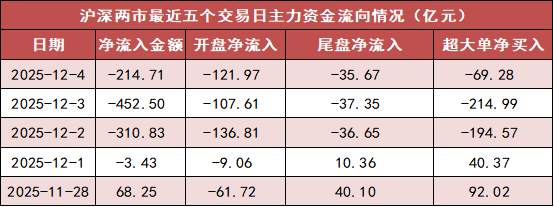
Market Overview - The A-share market showed mixed performance with the Shanghai Composite Index closing at 3875.79 points, down 0.06%, while the Shenzhen Component Index rose 0.4% to 13006.72 points, and the ChiNext Index increased by 1.01% to 3067.48 points. The total trading volume for both markets was 15489.6 billion yuan, a decrease of 1210.02 billion yuan from the previous trading day [1]. Capital Flow - The net outflow of main funds from the Shanghai and Shenzhen markets exceeded 210 billion yuan, with an opening net outflow of 121.97 billion yuan and a closing net outflow of 35.67 billion yuan, totaling 214.71 billion yuan for the day [2]. - In the last five trading days, the main funds showed a consistent outflow trend, with the highest outflow recorded on December 3 at 452.50 billion yuan [3]. Sector Performance - The ChiNext market experienced a significant net outflow of 93.48 billion yuan, while the CSI 300 index saw a net outflow of 31.92 billion yuan [4]. - The electronic industry achieved a net inflow of 35.80 billion yuan despite a slight decline of 0.21%, followed by the home appliance sector with a net inflow of 24.62 billion yuan [6]. Institutional Activity - The top stocks with net inflows from institutions included Heertai, which saw a rise of 10.01% with a net institutional purchase of 32.99 million yuan, and Chuling Information, which increased by 20.00% with a net purchase of 8.26 million yuan [9]. - Conversely, stocks like Guizhou Moutai and Dahua Intelligent experienced significant net outflows, with declines of 2.45% and 0.92%, respectively [6]. Institutional Focus - Recent institutional ratings highlighted stocks such as Zhend Medical with a strong buy rating and a target price of 101 yuan, indicating a potential upside of 37.21% from its latest closing price of 73.61 yuan [11].

CPO概念延续涨势,创业板指涨超1%,创业板ETF(159915)等产品受资金关注
Sou Hu Cai Jing· 2025-12-04 10:41
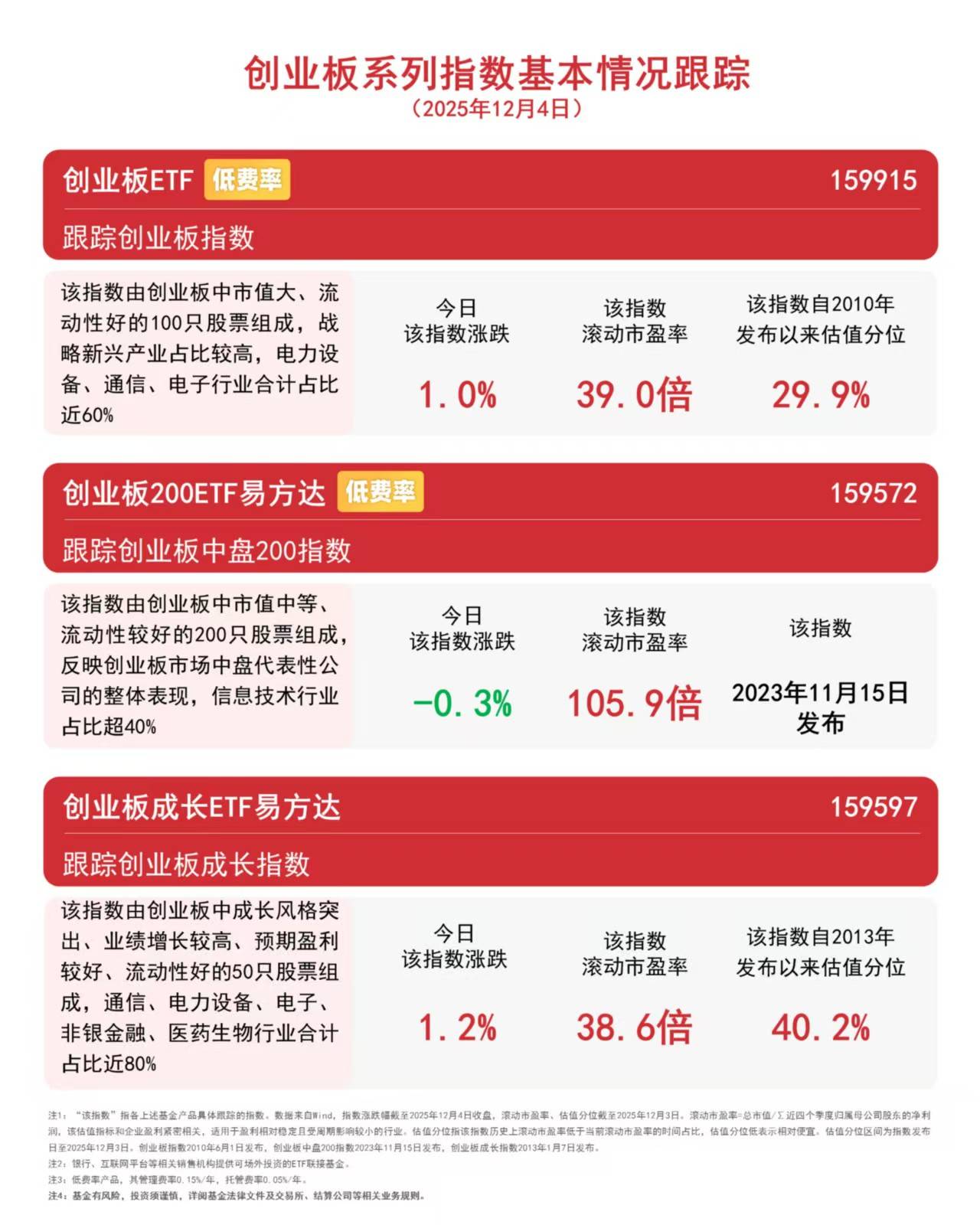
Core Viewpoint - The article discusses various ETFs tracking the ChiNext Index, focusing on their low fee rates and the composition of the underlying indices, which include high market capitalization and liquidity stocks from emerging industries. Group 1: ChiNext ETF Overview - The ChiNext Index consists of 100 stocks with high market capitalization and liquidity, primarily from emerging industries, with nearly 60% of the index represented by the power equipment, communication, and electronics sectors [2]. - The rolling price-to-earnings (P/E) ratio of the ChiNext Index is reported at 39.0 times, with an estimated increase since its inception [2]. Group 2: ChiNext 200 ETF - The E Fund ChiNext 200 ETF tracks the ChiNext Mid-Cap 200 Index, which includes 200 stocks with medium market capitalization and good liquidity, reflecting the overall performance of mid-cap companies in the ChiNext market [2]. - The information technology sector accounts for over 40% of this index, and the rolling P/E ratio is noted at 105.9 times, with a slight decline of 0.3% reported [2]. Group 3: ChiNext Growth ETF - The E Fund ChiNext Growth ETF tracks the ChiNext Growth Index, composed of 50 stocks characterized by strong growth potential, good liquidity, and favorable earnings expectations [2]. - The sectors of communication, power equipment, electronics, non-bank financials, and pharmaceuticals make up nearly 80% of this index, with a rolling P/E ratio of 38.6 times and an increase of 1.2% noted [2].

12月4日深证国企股东回报(970064)指数跌0.18%,成份股泸州老窖(000568)领跌
Sou Hu Cai Jing· 2025-12-04 10:24
证券之星消息,12月4日,深证国企股东回报(970064)指数报收于1636.34点,跌0.18%,成交229.34亿 元,换手率0.99%。当日该指数成份股中,上涨的有17家,徐工机械以2.19%的涨幅领涨,下跌的有31 家,泸州老窖以3.76%的跌幅领跌。 深证国企股东回报(970064)指数十大成份股详情如下: | 证券代码 | 股票简称 | 权重 | 最新价 | 涨跌幅 | 总市值(亿元) | | 所属行业 | | --- | --- | --- | --- | --- | --- | --- | --- | | sz000725 | 京东方A | 9.31% | 4.05 | 0.50% | | 1515.26 | 电子 | | sz002415 | 海康威视 | 7.97% | 30.35 | 0.03% | | 2781.54 | 十算机 | | sz000858 | 五粮液 | 7.71% | 114.45 | -0.99% | | 4442.50 | 食品饮料 | | sz000568 | 泸州老窖 | 6.59% | 127.71 | -3.76% | 1 | 1879.82 | 食品饮料 ...


严格限购、密集分红,年底临近基金经理为何纷纷严控规模?
Sou Hu Cai Jing· 2025-12-04 03:17
Group 1 - The core point of the article highlights the recent changes in public fund operations, particularly the trend of limiting large subscriptions and implementing dividend distributions as a strategy to protect existing investors' interests [1][8] - On December 2, E Fund announced the suspension of subscription and conversion for institutional clients before its dividend distribution, which is a common practice to prevent dilution of existing shareholders' interests [1] - As of December 4, a total of 3,364 funds have implemented dividends this year, with a total distribution amounting to approximately 2,155.17 billion yuan [2] Group 2 - Twelve funds have distributed over 1 billion yuan in dividends this year, with seven being passive index equity funds, indicating a significant trend in the market [7] - Some high-performing funds have also limited daily subscription amounts, reflecting a shift from a focus on scale to prioritizing performance and investor interests [8] - Fund managers express concerns about rapid scale expansion due to large inflows, which complicates management and trading, emphasizing the importance of maintaining effective strategies over merely increasing fund size [8] Group 3 - The end of the year is seen as a critical period for asset rebalancing, with institutions potentially shifting towards high-dividend stocks to lock in annual returns [9] - Market analysts suggest that the current market conditions may favor sectors such as non-bank financials, metals, machinery, construction materials, banking, and tourism [8][10] - There is a focus on technology sectors, with expectations of adjustments and potential rebounds, particularly in areas supported by strong performance and favorable policies [10]

AMC与险资的投资交集: 银行股何以成为“核心锚点”
Zhong Guo Zheng Quan Bao· 2025-12-03 22:22
Core Viewpoint - AMC has increased its stake in China Everbright Bank, with CITIC Financial Assets raising its shareholding to 9% as part of a strategic investment plan aimed at enhancing financial performance and achieving strategic synergy [1][2]. Group 1: AMC's Investment Actions - From July 24 to November 27, CITIC Financial Assets acquired 275 million A-shares and 315 million H-shares of Everbright Bank, raising its total shareholding from 8% to 9% [2]. - As of the end of Q3 2025, CITIC Financial Assets holds a total of 4.739 billion shares in Everbright Bank, with the bank's total assets reported at 7.2 trillion yuan, showing steady growth since the beginning of the year [2]. - This is not the first increase in stake by CITIC Financial Assets, which previously raised its holdings from 7.08% to 8% earlier in July 2025 [2]. Group 2: Broader Investment Strategy - CITIC Financial Assets is also planning to invest up to 26 billion yuan in China Bank, indicating a broader strategy in the banking sector [3]. - As of mid-2025, CITIC Financial Assets held 4.71% of China Bank and 7.93% of Everbright Bank, with respective market values of 63.174 billion yuan and 19.313 billion yuan [3]. Group 3: Insurance Capital Involvement - Insurance capital has been actively increasing its holdings in bank stocks, with a reported increase of 2.689 billion shares in Q3, bringing total holdings to over 47 billion shares valued at over 400 billion yuan [5]. - The average dividend yield for A-share listed banks exceeds 4%, with some banks like Industrial Bank and Changsha Bank yielding over 6%, making them attractive to institutional investors [6]. Group 4: Market Dynamics and Investment Appeal - In a low-interest-rate environment, insurance capital is shifting towards equity markets, with banks being favored due to their stable operations and attractive dividend returns [7]. - The banking sector is generally undervalued, with most banks trading below a price-to-book ratio of 1, indicating a "broken net" status, which enhances their investment appeal [7]. - Despite challenges such as narrowing interest margins, banks are maintaining stable profitability through improved asset management and risk control, supported by positive policy signals aimed at stabilizing the banking sector [7].

创业板成长ETF领涨宽基指数,近期显著跑赢创业板指
Mei Ri Jing Ji Xin Wen· 2025-12-03 14:23
Core Insights - The A-share market showed mixed performance with the Shanghai Composite Index down by 0.11%, while the Shenzhen Component Index rose by 0.24% and the ChiNext Index increased by 0.66% [1] - The ChiNext Growth ETF (159967) outperformed the ChiNext Index, with a significant excess return of over 4 percentage points in the last 7 trading days [1] Performance Summary - The ChiNext Growth ETF (159967) recorded a 9.54% increase over the past 7 days, with an annualized return of 9.17% and a maximum drawdown of -4.65% [2] - The ChiNext Index (399006) saw a 5.15% increase during the same period, with an annualized return of 5.17% and a maximum drawdown of -3.21% [2] Valuation Insights - The latest price-to-earnings ratio (PE-TTM) for the ChiNext Growth ETF is 38.05, which is below the 10-year average of 38.51%, indicating a moderate valuation [2] - The ETF's index weight is concentrated in sectors such as Communication (39.82%), Power Equipment (19.62%), Electronics (11.94%), Non-Bank Financials (10.33%), and Computers (8.21%) [2]

大类资产月度策略(2025.12):股债岁末盘整,原油寒意未消-20251203
Guoxin Securities· 2025-12-03 10:59
Group 1 - The report indicates a combination of "loose monetary policy + credit easing," with a low risk of tightening in the funding environment, which continues to support macroeconomic and asset performance [1][13][19] - In November, the A-share market is expected to stabilize as liquidity disturbances and risk appetite weaken, with major indices experiencing a general pullback [2][31] - The report highlights that the bond market remains resilient despite weak fundamentals, with a slight increase in credit bond indices and a decline in government bond yields [3][38] Group 2 - The report emphasizes the importance of large-cap growth stocks in the current market environment, supported by China's manufacturing PMI and industrial output growth [19][20][21] - It suggests a quantitative asset allocation model for domestic assets, recommending 30% in stocks, 35% in bonds, 23.3% in crude oil, and 11.7% in gold under an aggressive allocation scenario [24][26] - The report notes a divergence in global central bank policies, with a trend towards easing but with varying degrees among different economies, impacting investment strategies [56][57]
16个行业获融资净买入,汽车行业净买入金额最多
Zheng Quan Shi Bao Wang· 2025-12-03 02:21
Summary of Key Points Core Viewpoint - As of December 2, the market's latest financing balance reached 24,689.03 billion yuan, showing a day-on-day increase of 21.94 billion yuan, with 16 industries experiencing an increase in financing balance, particularly the automotive sector which saw the largest increase of 9.53 billion yuan [1]. Industry Analysis - **Industries with Increased Financing Balance**: - Automotive: 1,191.25 billion yuan, increased by 9.53 billion yuan, growth of 0.81% [1] - Communication: 1,135.14 billion yuan, increased by 6.03 billion yuan, growth of 0.53% [1] - National Defense and Military Industry: 818.49 billion yuan, increased by 5.98 billion yuan, growth of 0.74% [1] - Computer: 1,789.87 billion yuan, increased by 3.90 billion yuan, growth of 0.22% [1] - Environmental Protection: 192.18 billion yuan, increased by 1.79 billion yuan, growth of 0.94% [1] - **Industries with Decreased Financing Balance**: - Non-banking Financial: 1,859.55 billion yuan, decreased by 3.55 billion yuan, decline of 0.19% [2] - Public Utilities: 516.79 billion yuan, decreased by 3.55 billion yuan, decline of 0.68% [2] - Retail: 271.60 billion yuan, decreased by 2.15 billion yuan, decline of 0.79% [2] - Textile and Apparel: 80.87 billion yuan, decreased by 0.64 billion yuan, decline of 0.79% [2] - **Highest Growth Rates**: - Environmental Protection industry had the highest growth rate at 0.94% [1] - Other notable growth rates include Automotive (0.81%), Coal (0.77%), and National Defense and Military Industry (0.74%) [1] - **Significant Declines**: - The Textile and Apparel, Retail, and Public Utilities sectors experienced the most significant declines in financing balance, with respective decreases of 0.79%, 0.79%, and 0.68% [1][2]
港股投资价值深度解析:价值趋合理 稀缺资产成关注焦点
Zhong Guo Zheng Quan Bao· 2025-12-02 20:22
Market Overview - As of November 28, 2025, the Hong Kong Stock Exchange has 2,664 listed companies with a total market capitalization of approximately HKD 48 trillion [1] - The Hang Seng Index and the Hang Seng Tech Index have increased by 29% and 25% respectively this year, indicating significant market rotation [2][3] - The overall valuation of Hong Kong stocks is currently within a reasonable range, with a focus on scarce assets such as internet leaders and innovative pharmaceuticals [1][8] Market Structure - The market is characterized by a high concentration of value in large-cap companies, with 65% of companies having a market cap of HKD 0-20 billion, but only accounting for 1.80% of the total market capitalization [2] - Institutional investors dominate trading, contributing 85% of the transaction volume, with international investors making up 60% of the market [1][2] Valuation Insights - The AH premium index is currently at 121, which is historically low, indicating that Hong Kong stocks are not significantly overvalued nor is there substantial room for valuation recovery [3] - The valuation of the Hang Seng Index is at a historically high level compared to the CSI 300, while the Hang Seng Tech Index remains relatively low in absolute valuation terms [3] Asset Highlights - Key scarce assets in the Hong Kong market include internet leaders, innovative pharmaceuticals, new consumption, and dividend stocks, while high-end manufacturing is relatively weak [4][7] - Internet leaders like Tencent and Alibaba are seen as core highlights, with significant capital expenditures and a strong user ecosystem [4][5] - The innovative pharmaceutical sector is viewed as a "first-tier market" with a higher "innovation content" compared to A-shares, benefiting from favorable listing rules for biotech companies [5][6] Investment Dynamics - The investor structure is increasingly international, with a notable inflow of southbound funds, which have reached a cumulative net inflow of HKD 13,820 billion this year, a 90% increase year-on-year [7][8] - Despite the presence of quality assets, the market has passed the high-return investment phase, and the uncertainty of incremental capital inflows suggests a mixed outlook for future market performance [8]


