
教育

Search documents
隔夜欧美·11月25日
Sou Hu Cai Jing· 2025-11-25 00:31
①美国三大股指全线收涨,道指涨0.44%报46448.27点,标普500指数涨1.55%报6705.12点,纳指涨 2.69%报22872.01点; ④欧洲三大股指收盘涨跌不一,德国DAX指数涨0.71%报23255.92点,法国CAC40指数跌0.29%报 7959.67点,英国富时100指数跌0.05%报9534.91点; ⑧伦敦基本金属全线上涨,LME期镍涨1.90%报14730.00美元/吨,LME期锡涨1.44%报37425.00美元/ 吨,LME期铝涨0.97%报2813.00美元/吨,LME期锌涨0.47%报3003.00美元/吨,LME期铅涨0.33%报 1992.00美元/吨,LME期铜涨0.04%报10781.50美元/吨; ⑨美债收益率集体下跌,2年期美债收益率跌1.06个基点报3.495%,3年期美债收益率跌1.68个基点报 3.480%,5年期美债收益率跌2.62个基点报3.593%,10年期美债收益率跌3.66个基点报4.027%,30年期 美债收益率跌4.13个基点报4.670%; ⑩欧债收益率集体下跌,英国10年期国债收益率跌0.8个基点报4.536%,法国10年期国债收益率跌 ...
消费者服务行业周报(20251117-20251121):看好经营改善的酒店、免税行业-20251124
Huachuang Securities· 2025-11-24 11:20
Investment Rating - The report maintains a "Recommended" rating for the hotel and duty-free industries, indicating a positive outlook for operational improvements in these sectors [1]. Core Viewpoints - Despite the overall pressure on consumption in the current macro environment, a structural recovery trend in certain consumer service sectors is becoming increasingly evident. Operational improvements are being observed, suggesting a gradual exit from the bottom range [4]. - The hotel industry is experiencing an optimization in supply-demand dynamics, with core operational data showing marginal improvements, indicating a mild upward trend in industry prosperity supported by sustained travel demand [4]. - The duty-free industry is expected to benefit from policy incentives, particularly with the upcoming operational phase in Hainan and the continued rollout of related policies, which are anticipated to catalyze new growth opportunities [4]. Industry Basic Data - The consumer services industry comprises 55 listed companies with a total market capitalization of 498.804 billion yuan and a circulating market capitalization of 457.081 billion yuan [1]. Market Performance - The consumer services sector experienced a decline of 4.86% this week, while the overall A-share market fell by 5.14%. The CSI 300 index decreased by 3.77% [7][23]. - Notable stocks in the consumer services sector that performed well include Dalian Shengya, Chuangye Heima, and Shangri-La (Asia) [4]. Important Announcements - Huazhu Group reported a 17.5% year-on-year increase in hotel revenue for Q3 2025, reaching 30.6 billion yuan, with net profit of 1.5 billion yuan [30]. - Ctrip Group's Q3 net operating revenue was approximately 18.3 billion yuan, reflecting a 16% year-on-year growth, with a net profit increase of 192.6% [30]. - Wanwu Xingsheng achieved a total revenue of 5.15 billion yuan in Q3 2025, marking a 27.1% year-on-year increase [30]. Upcoming Shareholder Meetings - Several companies in the consumer services sector have scheduled shareholder meetings in the coming month, including Bubu Gao on December 11, Guilin Tourism on December 5, and Guangzhou Restaurant on November 28 [31].




卓越教育集团(03978.HK):根据受限制股份单位计划购买5万股
Ge Long Hui· 2025-11-24 09:18
Core Viewpoint -卓越教育集团 announced the purchase of a total of 50,000 shares on the open market by the trustee of its restricted share unit plan on November 24, 2025 [1] Group 1 - The company is engaging in a share buyback as part of its restricted share unit plan [1] - The transaction is set to take place on November 24, 2025 [1]
开源证券:维持网易-S(09999)“买入”评级 看好出海及新游驱动成长
智通财经网· 2025-11-24 09:16
Core Viewpoint - The report from Open Source Securities maintains a "Buy" rating for NetEase-S (09999), highlighting robust third-quarter performance with both revenue and net profit showing year-on-year growth, particularly a significant net profit increase of 31.8% driven by core games and AI technology applications [1] Group 1: Performance Overview - In Q3 2025, the company achieved revenue of 28.4 billion yuan, representing an 8.2% year-on-year increase and a 1.7% quarter-on-quarter increase, with net profit reaching 8.6 billion yuan, up 31.8% year-on-year and 0.2% quarter-on-quarter [1] - The gross margin for Q3 was 64.1%, an increase of 1.2 percentage points year-on-year, while the net margin was 31.0%, up 5.4 percentage points year-on-year, indicating improved profitability driven by fair value changes in stock investments and lower foreign exchange losses [1] - The company forecasts net profits for 2025-2027 to be 35.7 billion, 38.3 billion, and 42.9 billion yuan respectively, with current price-to-earnings ratios of 16.6, 15.5, and 13.8 times [1] Group 2: Gaming and New Releases - Revenue from games and related value-added services in Q3 reached 23.3 billion yuan, reflecting an 11.8% year-on-year increase and a 2.3% quarter-on-quarter increase, driven by titles like "Dream of the Red Chamber" and new games [2] - The gross margin for this segment was 69.3%, up 0.5 percentage points year-on-year, with "Dream of the Red Chamber" achieving record high concurrent users [2] - The company is expanding its overseas product offerings, with "Destiny: Stars" topping iOS download charts in multiple regions and new titles like "Yanyun Sixteen Sounds" performing well internationally [2] Group 3: AI and Music Business - Cloud Music reported a revenue of 1.96 billion yuan in Q3, with a gross margin increase of 2.6 percentage points to 35.4%, driven by the launch of the "AI Tuning Master" [3] - Youdao's revenue reached 1.63 billion yuan in Q3, primarily due to over 40% growth in online marketing services, with a user retention rate exceeding 75% [3] - AI-driven subscription service revenue reached approximately 100 million yuan, marking a year-on-year increase of over 40%, indicating strong growth potential in music and education sectors [3]

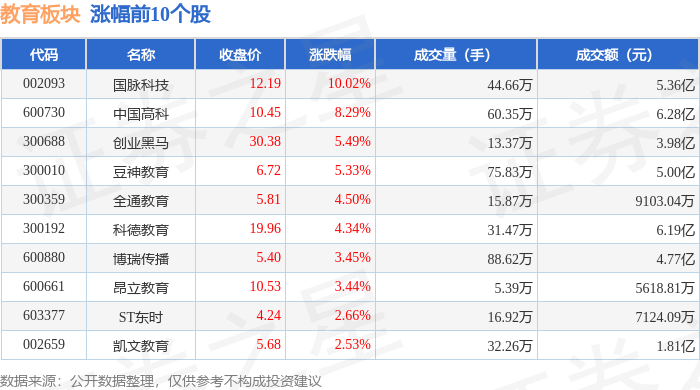
教育板块11月24日涨4.23%,国脉科技领涨,主力资金净流入3.2亿元
Zheng Xing Xing Ye Ri Bao· 2025-11-24 09:13
Core Insights - The education sector experienced a significant increase of 4.23% on November 24, with Guomai Technology leading the gains [1] - The Shanghai Composite Index closed at 3836.77, up 0.05%, while the Shenzhen Component Index closed at 12585.08, up 0.37% [1] Stock Performance - Guomai Technology (002093) saw a closing price of 12.19, with a rise of 10.02% and a trading volume of 446,600 shares, amounting to 536 million yuan [1] - China High-Tech (600730) closed at 10.45, up 8.29%, with a trading volume of 603,500 shares and a turnover of 628 million yuan [1] - Other notable performers included Chuangye Technology (300688) with a 5.49% increase, closing at 30.38, and Dou Shen Education (300010) with a 5.33% rise, closing at 6.72 [1] Capital Flow - The education sector saw a net inflow of 320 million yuan from institutional investors, while retail investors experienced a net outflow of 135 million yuan [2] - The main capital inflow was concentrated in Guomai Technology, which had a net inflow of 241 million yuan, accounting for 45.03% of the total [3] - Other companies like Kede Education (300192) and China High-Tech (600730) also experienced net inflows, but retail investors withdrew funds from these stocks [3]


传媒互联网教育行业2026年度策略
2025-11-24 01:46
Summary of Key Points from Conference Call Records Industry Overview - **Industry Focus**: Media, Internet, and Education sectors are highlighted for 2026 strategies, with significant emphasis on AI-driven advancements and market dynamics [1][2]. Core Insights and Arguments Advertising Sector - **AI Impact**: AI has significantly improved advertising efficiency, with Tencent's advertising revenue growing by 20% year-over-year in Q2 and continuing to rise in Q3. Kuaishou has made notable progress in user profiling and targeted advertising, while Bilibili achieved over 20% growth through AI enhancements [6][4]. - **Competition**: Third-party programmatic advertising platforms like Huishuangzang Technology and Yidian Tianxia are gaining competitiveness, driving transformation in the advertising industry [1][5]. Gaming Industry - **Regulatory Environment**: The normalization of game license issuance ensures a steady supply of content, supported by a resilient consumer environment. Major companies like Century Huatong and Giant Network are expected to benefit from a concentrated release of new products [7][9]. - **Market Dynamics**: The gaming sector is projected to maintain a high level of activity, driven by product innovation and commercial efficiency. Key players include Tencent, Century Huatong, and Giant Network [14][9]. Instant Retail Market - **Market Growth**: The instant retail market is expected to reach 1.175 trillion yuan by 2026, with a year-on-year growth rate of 28%. Major players like Alibaba, Meituan, and JD.com are heavily investing in this space, although profitability is under pressure due to intense competition [11][8]. - **Consumer Trends**: The county-level market is emerging as a new growth point, supported by the increasing number of rural internet users and their consumption habits [11][10]. Autonomous Driving Sector - **Competitive Landscape**: The autonomous driving sector is entering a price competition phase, with companies like Xpeng and Li Auto differentiating themselves through chip technology and self-driving capabilities. This trend is expected to enhance user experience and drive further development in the electric vehicle industry [12][10]. Short Drama and AI Animation - **Market Expansion**: The short drama market is rapidly growing, with approximately 700 million users in China. The market share of Hongguo exceeds 50%, while companies like China Online and Kunlun Wanwei are performing well in overseas markets, particularly targeting the U.S. [18][1]. - **AI Animation Growth**: The supply of AI animation (dynamic comics) has surged, with a compound monthly growth rate of about 83% in the first half of the year, resulting in over 3,000 works produced and a revenue scale that has increased twelvefold [19][3]. Education Sector - **AI Integration**: AI is increasingly penetrating the education sector, with companies like Dou Shen Education expected to achieve full AI integration by 2026, with AI revenue accounting for 90% of total income. Fenbi Education's AI interview courses are projected to enhance profit margins significantly [20][21]. - **Valuation Appeal**: Dou Shen Education's valuation metrics, such as a PS ratio of around 7 and a PE ratio in the 30s, are considered attractive compared to other sectors, which often see PE ratios of 60-70 [21][20]. Additional Important Insights - **Consumer Resilience**: The macroeconomic environment is supporting consumer resilience, with trends like the "lipstick effect" maintaining consumption levels [9][8]. - **Content Supply Recovery**: The film and television sectors are experiencing a recovery in content supply, with stable growth in box office revenues and favorable policies aiding the industry [17][7]. This summary encapsulates the key points from the conference call records, providing a comprehensive overview of the current trends and future outlooks across various sectors.




早报|俞敏洪长文再回应并道歉;钟睒睒向一中学捐款一亿元;多地否认试点“老头乐”C7驾照;小米汽车未交车却催尾款,法院判返双倍定金
虎嗅APP· 2025-11-23 23:56
Group 1 - The founder of Nongfu Spring, Zhong Shanshan, donated 100 million yuan to establish the Zhong Ziyi Education Fund at Zhuji Middle School in Zhejiang Province, which has a history dating back to 1912 and has produced over 40,000 outstanding students [2][3] - The fund aims to support educational initiatives and is recognized as a 5A-level foundation by the Hangzhou Civil Affairs Bureau [3] Group 2 - Trump criticized the Ukrainian leadership for showing no gratitude towards the U.S. efforts, while Europe continues to purchase oil from Russia [4] Group 3 - Wentech Technology urged Nexperia Netherlands to respond constructively to resolve control issues, emphasizing the importance of global supply chain stability [5][6] Group 4 - In the first three quarters of this year, marriage registrations in China increased by 405,000 pairs compared to the same period last year, totaling 5.152 million pairs [7] - 29 provinces have extended marriage leave, with Shanxi and Gansu offering the longest at 30 days [7] Group 5 - A collaborative research team from Heilongjiang University, Tsinghua University, and the National University of Singapore published a breakthrough in the field of rare earth materials, addressing the challenge of efficient electroluminescence in insulating rare earth nanocrystals [8] Group 6 - Xibei restaurant chain has reduced prices on nearly 40 menu items by 5% to 20% as part of a nationwide adjustment [9] Group 7 - A fire incident occurred at Xiaomi's battery production line due to operational errors during equipment debugging, but it was quickly extinguished without affecting personnel safety [23][24][25] Group 8 - The German government will impose a 23% VAT on cross-border packages from China starting November 24, significantly increasing costs for cross-border e-commerce [34]




A股分析师前瞻:更多是短期扰动,中国资产已调整出性价比?
Xuan Gu Bao· 2025-11-23 13:49
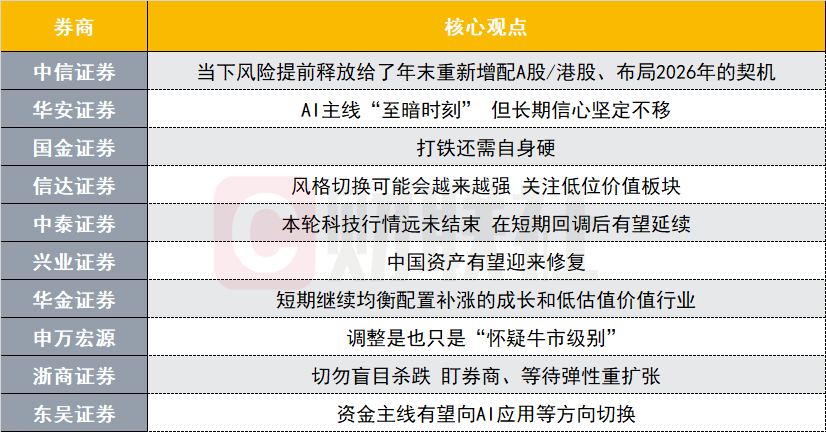
Core Viewpoint - The consensus among brokerage strategy analysts indicates a rebound in the market, as multiple factors that led to last week's stock index adjustments have improved over the weekend [1] Group 1: Market Sentiment and Economic Indicators - The market's perception of the Federal Reserve's potential interest rate cuts has shifted significantly, with the probability of a rate cut in December rising from 30% to 71%, alleviating global risk aversion [1] - The expectation of liquidity improvement and the ongoing iteration of global AI applications are likely to ease concerns regarding an "AI bubble" [2] - The internal logic supporting the rise of Chinese assets remains strong, driven by enhanced national competitiveness, the release of new economic momentum, clear policy transformation, and stable economic fundamentals [2][3] Group 2: Sector Focus and Investment Opportunities - Analysts suggest focusing on sectors that are expected to outperform in the coming year, particularly those benefiting from high growth forecasts, such as AI, advanced manufacturing, and structural recovery in domestic demand [3] - The approval of 16 technology ETFs, including those focused on AI, is expected to guide capital towards high-quality technology companies in the A-share market, providing a positive regulatory signal [2][3] - The technology sector's recent adjustments are attributed to the influence of U.S. AI leaders and year-end institutional fund strategies, but the overall tech market is expected to continue its upward trajectory post-correction [2][4] Group 3: Long-term Market Outlook - The current market adjustments are viewed as short-term disturbances that do not alter the underlying bull market logic, with expectations of continued capital inflow and improved earnings across sectors [3][4] - The potential for a significant reversal in the fundamentals of the AI industry in the U.S. is considered low, which should provide substantial valuation growth opportunities for comparable companies in China [4] - The overall sentiment indicates that the market is not lacking in liquidity, and the concerns regarding long-tail risks in the Chinese economy are gradually easing [3][4]
年末重新增配A股迎来契机?投资主线有哪些?十大券商策略来了
Feng Huang Wang· 2025-11-23 13:21
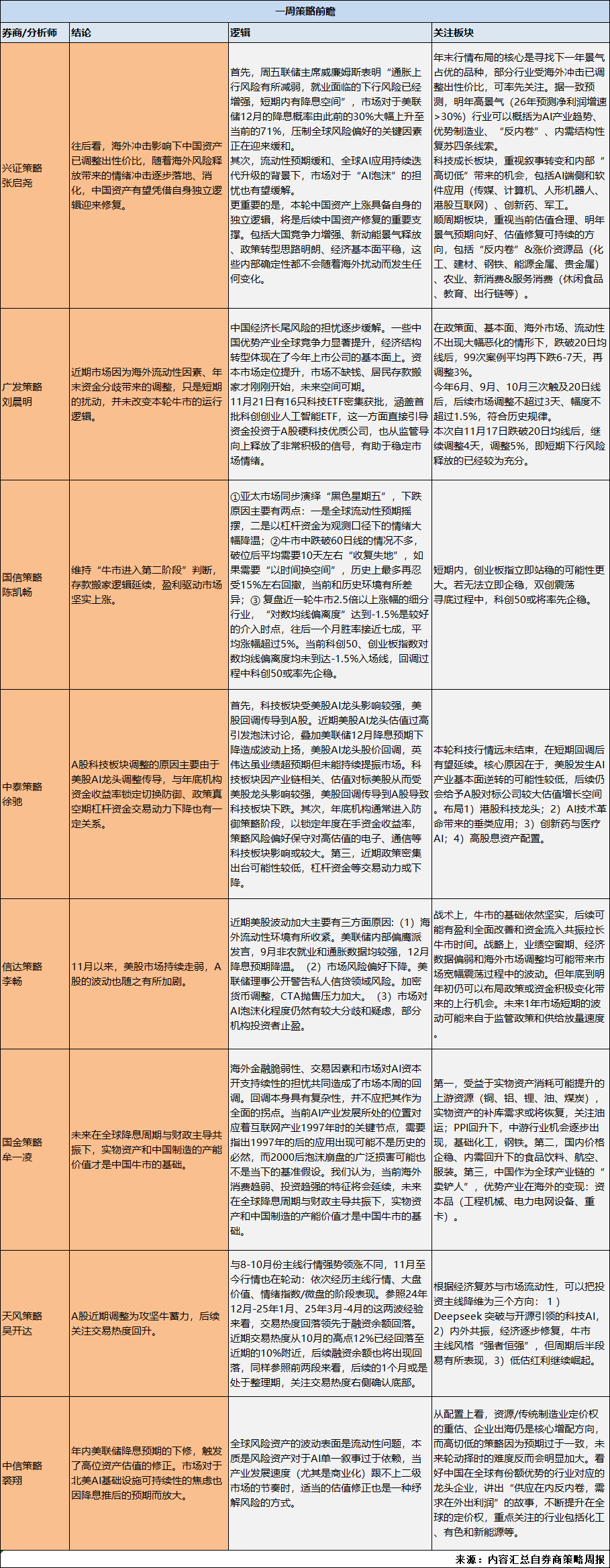
Core Viewpoints - Current risk release provides an opportunity for reallocating A-shares and Hong Kong stocks by year-end and planning for 2026 [2] - The AI sector is experiencing a "darkest hour," but long-term confidence remains unwavering [4] - The adjustment phase is merely a "doubtful bull market level" [11] Industry Insights - Focus on resource and traditional manufacturing opportunities, particularly in chemicals, non-ferrous metals, and new energy [3] - The AI industry is expected to continue its growth trajectory, with significant valuation growth potential for A-share companies [8] - The market is likely to experience a style switch, with increasing attention on low-valued sectors [6] Investment Recommendations - Emphasize sectors benefiting from physical asset consumption, such as upstream resources (copper, aluminum, lithium, oil, coal) and midstream industries [5] - Maintain a balanced allocation between growth sectors and undervalued value industries, particularly in the consumer sector as year-end approaches [10] - Focus on AI applications and sectors closely related to the "14th Five-Year Plan," such as hydrogen energy, nuclear energy, and quantum technology [14]



回调之后的选择
SINOLINK SECURITIES· 2025-11-23 11:37
Investment Rating - The report maintains a cautious outlook on high-risk assets, particularly cryptocurrencies, while expressing optimism for AI technology and the Macau tourism sector [3]. Core Views - The market is currently under pressure due to the Federal Reserve's interest rate discussions and ongoing debates about AI, leading to significant declines in high-risk assets like cryptocurrencies. Concerns are rising regarding the sustainability of AI's commercial applications despite its recognized efficiency improvements. The report emphasizes the importance of focusing on technology leaders with strong cash flows, such as Google, META, Microsoft, Alibaba, and Tencent, while also monitoring the application of AI in various sectors [3]. - The Macau tourism industry is highlighted as a valuable investment opportunity, benefiting from a favorable supply-demand dynamic and expected growth during the upcoming holiday periods [3]. - The report suggests that trading platforms remain attractive, with potential for accumulation following market corrections [3]. Summary by Sections 1.1 Consumer & Internet 1.1.1 Education - The Chinese education index fell by 4.60%, outperforming the Hang Seng Index but underperforming major indices like the Shanghai Composite [11]. - New Oriental launched an AI education product, SureChinese, aimed at a broader audience, with 160,000 users across 138 countries [19]. 1.1.2 Luxury Goods & Gambling - The S&P Global Luxury Goods Index decreased by 1.49%, with notable declines in major gambling stocks like Sands China and Wynn Macau [21]. - The upcoming sports events in Macau are expected to attract over 2 million tourists, boosting the local tourism sector [3]. 1.1.3 Coffee & Tea - The coffee sector remains robust, while the tea segment faces challenges due to reduced promotional activities from delivery platforms [30]. 1.1.4 E-commerce & Internet - The Hang Seng Internet Technology Index fell by 5.90%, with mixed performances among major e-commerce players [36]. - Pinduoduo reported a 9% year-on-year revenue increase, reaching 108.3 billion yuan [41]. 1.2 Platforms & Technology 1.2.1 Streaming Platforms - The Hang Seng Media Index dropped by 6.86%, with mixed results among key players like iQIYI and Spotify [45]. - iQIYI reported a revenue decline of 8% year-on-year for Q3 [53]. 1.2.2 Virtual Assets & Internet Brokers - The global cryptocurrency market capitalization fell to $305.32 billion, with Bitcoin and Ethereum prices decreasing by 10% and 11% respectively [49]. - Futu Holdings reported a significant revenue increase of 86% year-on-year for Q3 [56]. 1.2.3 Automotive Services - The automotive sector saw a mixed performance, with some companies like AutoZone and O'Reilly Auto Parts showing gains while others faced declines [60].