
油气

Search documents
2026年可能的惊喜与惊吓
2025-12-01 16:03
Summary of Conference Call Records Industry Overview - The market outlook for 2026 is generally optimistic, with expectations of increased capital expenditure (capex) in hardware and a tightening supply chain due to slow overseas production [1][5] - The AI industry is viewed as a revolutionary technology, but concerns about credit risks, potential price wars, and the sustainability of computational power accumulation are highlighted [1][9][11] Key Points and Arguments Market Trends - The market in 2025 is expected to outperform 2024, showing characteristics of a local bull market with rapid sector rotation [1][4] - Investors need to react quickly to market changes, as strong sector performance can reverse rapidly [1][8] - The consensus among investors is that the market is in a stable phase, with a positive outlook for the first half of 2026 due to anticipated monetary policy easing [2][7] AI Industry Risks - The AI sector faces several risks, including: 1. Credit risk, which historically has been a precursor to market bubbles [9] 2. The potential disruption of GPU monopolies by Google Gemini 3, which could lead to price wars affecting companies like NVIDIA [11] 3. Concerns about the sustainability of computational power accumulation [9] 4. Risks associated with private credit markets, particularly the reliance on low-interest environments [12][13] Economic and Policy Environment - The U.S. private credit market is experiencing a carry trade phenomenon, which is unsustainable in a changing interest rate environment [10][12] - Global supply chains are shifting towards a dual-track system, emphasizing self-sufficiency to mitigate risks [26] - Resource assets like gold and oil are viewed as safe investments, with gold prices rising due to various factors including central bank purchases and geopolitical instability [26] Investment Strategies - Some investment managers are increasing their positions in Chinese consumer stocks, focusing on high-dividend, stable ROE assets [25] - The performance of resource assets is expected to influence market dynamics, with potential implications for oil prices in 2026 [26][30] Additional Important Insights - Japan's economy faces significant challenges, including inflation, interest rate, and currency issues, which could lead to global market instability [16][20] - The U.S. economy is grappling with widening wealth gaps and inflation pressures, impacting consumer behavior and market dynamics [17] - The potential for synchronized recovery in China's PPI and CPI could enhance corporate ROE and attract investment [27] - The overall macroeconomic environment is less volatile than in previous years, with ongoing fiscal stimulus expected to support growth [15] This summary encapsulates the key insights and trends discussed in the conference call, providing a comprehensive overview of the current market landscape and future expectations.
资源税政策执行口径正式施行 首次明确两类不征税情形
Zhong Guo Jing Ying Bao· 2025-12-01 15:44
Core Viewpoint - The announcement by the Ministry of Finance and the State Taxation Administration marks a significant improvement in the practical implementation of the resource tax system in China, providing clearer guidelines for both taxpayers and tax authorities, thereby promoting green development and efficient resource utilization [1][3]. Group 1: Policy Implementation - The new announcement addresses key issues that have arisen since the implementation of the Resource Tax Law, including disputes over taxable product classifications and unclear definitions, thus providing precise guidance for tax collection [1][2]. - The announcement clarifies that certain products, such as confiscated taxable products and minerals used for backfilling in construction projects, will not be subject to resource tax, which helps delineate the boundaries of tax applicability [1][2]. Group 2: Tax Classification - The announcement specifies that condensate oil will be taxed under the crude oil category, while oil and gas field mixed light hydrocarbons will be taxed according to both crude oil and natural gas categories, based on the defined standards [2]. - For tailings utilization products, the announcement distinguishes between two scenarios: specific mineral components will be taxed according to their respective mineral categories, while sand and gravel products will be taxed under the sand and gravel category [2]. Group 3: Impact on Industry - The clarification of tax regulations is expected to unify tax collection standards across regions, reducing disputes arising from differing interpretations and significantly enhancing tax collection efficiency [3]. - The implementation of these policies is anticipated to further highlight the role of resource tax in regulating resource development and promoting green production practices [3].
温室气体自愿减排交易市场再扩容
中国能源报· 2025-12-01 12:23
Core Viewpoint - The article discusses the recent developments in China's voluntary greenhouse gas emission reduction trading market (CCER), highlighting the introduction of new methodologies that expand the market's coverage and emphasize China's innovative approach in the oil and gas sector [3][5]. Group 1: New Methodologies and Market Expansion - The Ministry of Ecology and Environment and the National Energy Administration have released three new methodologies for voluntary emission reduction projects, focusing on oil and gas recovery [3][5]. - This marks the first time methodologies related to the oil and gas industry have been introduced, which is significant as there is currently no market-based incentive mechanism for gas recovery projects globally [5][6]. - The new methodologies aim to enhance the CCER market's scope and support China's commitment to reducing greenhouse gas emissions by 7%-10% from peak levels by 2035 [5][6]. Group 2: Market Dynamics and Challenges - The CCER market is experiencing a recovery and expansion, with an increasing number of projects being registered and a growing demand driven by compliance needs and green finance [8][10]. - However, the price of CCER has been consistently higher than that of carbon allowances, leading to low trading activity and creating challenges for companies in lower carbon price regions [10][12]. - Suggestions for improving the market include enhancing collaboration with allowance trading, introducing new trading entities, and promoting carbon futures to increase liquidity [10][12]. Group 3: Future Directions and International Integration - The CCER market is expected to play a crucial role in achieving China's dual carbon goals by encouraging diverse participation in emission reduction efforts [12][13]. - There is a need for methodologies in the transportation sector, particularly for green fuels like green methanol and sustainable aviation fuel, to facilitate decarbonization in hard-to-abate industries [12][13]. - Long-term projections indicate that the CCER market will not only support domestic emission reduction goals but also contribute to international emission reduction efforts, enhancing China's influence in global carbon pricing [12][13].


埃尼、马国油组建油气上游合资企业
Zhong Guo Hua Gong Bao· 2025-12-01 04:12
埃尼公司预计交易将在2026年完成,目前正等待印尼和马来西亚政府及相关监管机构的许可。 埃尼公司目前在东南亚地区实行"卫星战略",一方面剥离资产,另一方面与国际油气公司组建合资企 业,并对旗下新能源项目进行整合或拆分。其他在东南亚地区开展油气业务的能源公司,如挪威沃尔能 源公司、安哥拉Azule公司等均实行类似战略。 合资企业将作为独立的、自给自足的财务实体运营,计划未来5年投资150亿美元,以支持至少8个新项 目的开发和15口勘探井的钻探。此外,该合资企业还将整合马来西亚和印尼的天然气资产,初期产量将 达到30万桶油当量/日,中期产量将达到50万桶油当量/日。 中化新网讯 近日,埃尼公司表示,已与马来西亚国家石油公司将各自在印尼和马来西亚的上游业务整 合在一起,组建一家双方持股各半的新合资企业。 ...

IEA:能源服务需求将持续增长
Zhong Guo Hua Gong Bao· 2025-12-01 04:12
报告预测,短期内全球油气供应将较为充裕,油价会稳定在60美元至65美元区间,随着液化天然气出口 新项目陆续投产,天然气市场供需矛盾同样呈现缓和态势。但国际油气市场近期的平衡态势仍面临地缘 政治风险的考验,若全球能源转型政策放缓或油气价格走低刺激需求增长,现有缓冲空间可能将快速收 窄。 中化新网讯 近日,国际能源署(IEA)发布《2025年世界能源展望》报告强调,未来几十年,全球对能源 服务特别是电力需求将持续增长,同时,数据和人工智能相关服务需要的能源供应也将大幅上扬。 IEA表示,电力是当代工业和数字经济的命脉。在可预见的时间内,全球电力需求增速将远高于能源消 费总量增速。这在当前全球能源投资中已有明显体现,对电力供应与终端电气化投资已占全球能源投资 总量的50%。 IEA多年来的分析持续凸显电力在全球经济中日益重要的地位。IEA署长法提赫·比罗尔指出,与过去10 年的趋势不同,电力消费增长不再局限于新兴经济体和发展中经济体。数据中心和人工智能带来的电力 需求迅猛增长,同样大幅推升了全球发达经济体的用电量。2025年全球数据中心投资预计将达5800亿美 元,已超过全球石油供应投资的5400亿美元,体现出全球 ...
石油ETF(561360)涨超1.7%,供需格局或支撑油价韧性
Sou Hu Cai Jing· 2025-12-01 03:27
Core Viewpoint - The ongoing geopolitical risks from the Russia-Ukraine conflict are expected to support oil prices, despite the lack of progress in negotiations between the U.S. and Ukraine. The long-term trend of the Russia-Ukraine conflict may continue, impacting oil supply and demand dynamics [1]. Group 1: Oil Market Dynamics - The International Energy Agency (IEA) projects an increase in global oil demand by 770,000 barrels per day by 2026, while supply is expected to grow by 2.5 million barrels per day. This discrepancy highlights the need to monitor changes in demand expectations and their potential impact on oil prices [1]. - Major oil companies are adopting strategies focused on increasing production and reducing costs to manage oil price volatility. This approach emphasizes the resilience of their performance and significant long-term investment value [1]. Group 2: Refining and Chemical Sector - The recovery of the macroeconomic environment is boosting demand for chemical products. In the long term, the clearing of chemical production capacity is favorable for leading enterprises in the sector, with profitability in large-scale refining, coal chemical, and ethylene expected to improve [1]. Group 3: Oil and Gas Industry Index - The oil ETF (561360) tracks the oil and gas industry index (H30198), which selects publicly traded companies involved in oil and gas exploration, extraction, refining, and sales. This index reflects the overall performance of listed companies in the oil and gas sector, characterized by high capital intensity and cyclical volatility [1].
警惕!A股成交缩量近千亿,资金正密集抱团这三个方向!
Sou Hu Cai Jing· 2025-11-29 03:38
Market Overview - A-shares experienced a low opening followed by a narrow range of fluctuations, with three major indices showing slight increases, reflecting cautious market sentiment and a wait-and-see approach [1] - The Shanghai Composite Index rose by 0.21% to 3883.46 points, while the Shenzhen Component increased by 0.72%, and the ChiNext Index gained 0.71% [1] - The half-day trading volume was 983.64 billion, indicating a significant decrease in trading activity, highlighting reduced willingness to invest at the end of the month and the impact of overseas market adjustments [1] Sector Performance - The market showed accelerated rotation, with funds quickly switching between thematic stocks; the Fujian sector was notably active, with stocks like Xiamen Construction and Fujian Cement hitting the daily limit, likely due to regional policy expectations [1] - The Hainan sector also rebounded, with Hainan Ruize achieving three consecutive daily limits, demonstrating the resilience of regional themes [1] - Lithium mining stocks rebounded, with major companies like Dazhong Mining and Shengxin Lithium Energy seeing significant gains, driven by a reassessment of value in upstream materials for new energy amid improving supply and demand [1] Consumer and Technology Sectors - The consumer sector saw a rebound, led by Hai Xin Food's strong performance, with the dairy industry showing notable gains; Yantang Dairy hit the daily limit, and Panda Dairy rose over 7% [1] - The semiconductor sector was active, particularly in equipment and third-generation semiconductor branches, with Qianzhao Optoelectronics hitting a 20% limit, indicating sustained attractiveness of tech growth stocks under policy support [1] Oil and Gas Sector - Oil and gas stocks opened high and continued to rise, with Jereh Holdings hitting the daily limit due to a large order from North America, boosting sector sentiment [2] - The CPO concept saw midday fluctuations, with stocks like Tongyu Communication and Changxin Bochuang experiencing significant gains, indicating a resurgence of interest in niche areas [2] Declining Sectors - Banking stocks collectively adjusted, with Postal Savings Bank dropping nearly 2%, reflecting a shift of funds away from low-elasticity assets [2] - Pharmaceutical stocks faced a pullback, with Guangji Pharmaceutical hitting the daily limit down, and Yue Wannianqing dropping over 10%, likely due to uncertainties in industry policies [2] - AI application stocks were sluggish, with companies like Yaowang Technology and Yidian Tianxia declining over 4%, indicating a cooling off of previous hot spots [2] Satellite Internet Sector - The satellite internet concept emerged as a market highlight, with significant gains in component stocks like Aiguang Technology and Aerospace Hanyu, driven by clear policy pathways for commercial space [2] - The Beijing Municipal Science and Technology Commission's plan for a "Space Data Center" aims to deploy AI computing centers, indicating a technological breakthrough and a restructuring of computing distribution [2] - This policy, if implemented, could create opportunities across the entire industry chain from satellite manufacturing to data services, with institutional funds net inflow exceeding 1.3 billion, reflecting market recognition of long-term logic [2] Future Outlook - The A-share market may continue to exhibit structural trends supported by policy and valuation bottoms, with new productivity sectors like satellite internet, humanoid robots, and embodied intelligence expected to become core investment themes next year [3] - Caution is advised as some concept stocks may be overheated; investors should identify companies with real orders and technological barriers [3] - In market fluctuations, rationality is emphasized over emotion, focusing on participation in China's economic transformation and upgrading through fundamental research [3]
油价跌至60美元对阿尔及利亚有何影响?
Shang Wu Bu Wang Zhan· 2025-11-28 16:25
Core Insights - The Algerian President Tebboune commented on the impact of international oil prices dropping to around $60 per barrel, emphasizing that the government has taken measures to mitigate the effects of declining revenues [1] - Algeria's current foreign exchange reserves are sufficient to support the economy for about a year and a half without external borrowing, providing a buffer against falling oil and gas prices [1] - The country is advancing in diversifying its economy, with increased investments and exploration activities in non-oil sectors, which is expected to reduce reliance on oil and gas revenue fluctuations [1][2] Economic Outlook - Despite the short-term decline in oil and gas prices, Algeria's economy has room for improvement, driven by accelerated non-oil projects [2] - The ongoing diversification efforts are expected to make the economy less sensitive to oil price changes compared to the past [2]
重庆:研究推动油气期货现货市场联动 发布并推广中国陆上天然气价格指数
Xin Hua Cai Jing· 2025-11-28 06:49
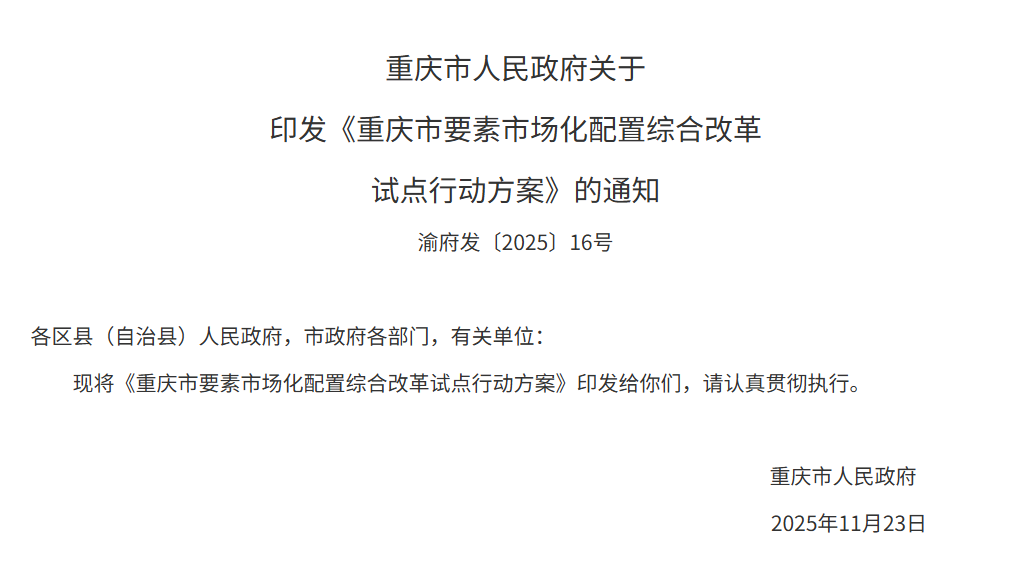
新华财经北京11月28日电据重庆市人民政府网站28日消息,重庆市人民政府日前印发《重庆市要素市场化配置综合改革试点行动方案》。其中 提到,深化天然气体制改革。支持重庆石油天然气交易中心扩大交易规模,建立油气产业链相关产品上线交易绿色通道,研究推动油气期货现 货市场联动。探索海外油气资源直接销售,开展油气大宗商品人民币跨境结算,发布并推广中国陆上天然气价格指数。支持年用量在1000万立 方米以上的天然气大用户自主选择供气路径,支持天然气(页岩气)勘探开发企业开展天然气销售业务。加快天然气管网设施独立运营和公平 开放,推动管输业务和销售业务分离,完善市内天然气管道运输价格机制。 深化电力市场改革。深化售电侧改革,建立保底售电公司运行机制,完善增量配网准入和退出机制。深化新能源上网电价市场化改革,构建绿 电直连政策体系并开展试点。在川渝毗邻地区探索"电力跨省域办理"一站式服务。完善"中长期+现货""电能量+辅助服务"体系,推动电力现货 市场转入正式运行。 推动碳市场提质增效。主动参与全国碳市场政策标准制定,建成温室气体全品类交易的地方碳市场,构建非二氧化碳温室气体市场化管控机 制。完善企业碳账户系统,集成建立碳金融 ...
ETF午评 | 半导体设备板块领涨,科创半导体ETF涨3.21%
Ge Long Hui· 2025-11-28 06:00
Market Overview - The A-share market opened lower but rebounded, with the Shanghai Composite Index up 0.21%, the Shenzhen Component Index up 0.72%, and the ChiNext Index up 0.71 [1] - Total market turnover reached 983.6 billion yuan, a decrease of 113.4 billion yuan compared to the previous day [1] - Over 3,500 stocks in the market experienced gains [1] Sector Performance - The lithium mining sector continued to rebound, while the consumer sectors in Fujian and Hainan remained active [1] - Semiconductor equipment and oil & gas stocks performed well, with the CPO concept recovering in the morning session [1] - The pharmaceutical and banking sectors experienced corrections, and AI application sectors remained sluggish [1] ETF Performance - The semiconductor equipment sector led the gains in ETFs, with several funds such as Huaxia Fund's Sci-Tech Semiconductor ETF and Haitai Baipin Fund's Sci-Tech Semiconductor Equipment ETF rising over 3% [1] - The rare metals sector also saw a rebound, with ICBC Credit Suisse's Rare Metals ETF and GF Fund's Rare Metals ETF increasing by 2% and 1.99%, respectively [1] - Oil & gas stocks showed strong performance, with the Yinhua Fund's Oil & Gas Resources ETF rising by 1.84% [1] - The traditional Chinese medicine sector lagged, with both the Chinese Medicine 50 ETF and the Chinese Medicine ETF declining by 1% [1] - The Hong Kong innovative drug sector fell, with the Hang Seng Medical ETF and the Hong Kong Innovative Drug 50 ETF both down by 1% [1]