
贵金属

Search documents
大宗商品价格指数创三年半新高!金银价格涨幅收窄
Qi Huo Ri Bao· 2026-02-04 23:40
Group 1: Commodity Price Index - The China Commodity Price Index reached a three-and-a-half-year high in January 2026, standing at 125.3 points, with a month-on-month increase of 6.3% [1] - Among the 50 monitored commodities, 33 saw price increases in January, with lithium carbonate, refined tin, and refined nickel leading the gains at 48.4%, 20.2%, and 19.5% respectively [1] Group 2: Gold and Silver Prices - Gold and silver prices experienced a rebound, with London gold spot prices surpassing $5000 per ounce and silver prices breaking the $91 per ounce mark [2] - However, by the end of trading, the gains in gold and silver prices narrowed, with the Shanghai gold futures main contract turning from gains to losses [3] Group 3: Analyst Predictions for Gold Prices - A Reuters survey indicated that analysts have significantly raised their gold price forecasts for 2026, with a median expected average price of $4746.50 per ounce, marking the highest annual prediction since the survey began in 2012 [4] - This forecast represents a substantial increase from $4275 per ounce in October 2025 and a dramatic rise from $2700 per ounce in a similar survey a year prior [4] Group 4: Market Insights and Future Expectations - Analysts suggest that gold prices could reach $6000 per ounce by the end of the year, driven by factors such as previous price declines, easing overseas liquidity risks, and ongoing strong fundamentals [5] - The market is currently experiencing cautious sentiment due to a temporary U.S. government shutdown affecting economic data releases, while geopolitical tensions in the Middle East are increasing demand for safe-haven assets [5] - Silver prices may face volatility, with potential supply and inventory tightness, but new demand from sectors like AI could provide support [6]


金银股最忌讳追涨杀跌
Xin Lang Cai Jing· 2026-02-04 17:29
Group 1 - The core viewpoint emphasizes the volatility of gold and silver futures prices, which leads to significant fluctuations in gold and silver stocks, increasing the risk for investors engaging in short-term trading strategies [1][2] - Investors are advised to adopt a long-term investment mindset, focusing on the broader trends rather than short-term price movements, as gold and silver prices are influenced by macroeconomic conditions, global political situations, and monetary policies [2][3] - The article highlights that short-term price fluctuations are often driven by market sentiment and temporary supply-demand factors, making them unpredictable and potentially harmful to investors who focus too much on these movements [2][3] Group 2 - Long-term value investing requires investors to have a strong belief in their understanding of the long-term trends of gold and silver prices, and they should not be swayed by short-term market fluctuations [2][3] - The article suggests that if investors cannot make informed judgments about global macroeconomic conditions and geopolitical factors, they should avoid long-term holdings in gold and silver stocks, as these are more challenging to predict compared to consumer and high-tech companies [3]
国际贵金属继续走低,现货黄金跌1.43%
Jin Rong Jie· 2026-02-04 17:16
Core Viewpoint - The international precious metals market continues to decline, with spot gold and silver prices experiencing notable decreases [1] Group 1: Price Movements - Spot gold has dropped by 1.43%, now priced at $4,874.42 per ounce [1] - Spot silver has decreased by 1.38%, currently valued at $83.84 per ounce [1]
资产配置日报:三种交易思路-20260204
HUAXI Securities· 2026-02-04 15:27
Market Overview - On February 4, gold prices rose over 2%, nearing $5100 per ounce, while silver prices increased by over 5%, surpassing $90 per ounce[1] - The Shanghai Composite Index rose by 0.85%, closing above 4100 points, with A-share trading volume maintaining a high level of CNY 2.5 trillion[1] - The Hong Kong Hang Seng Index saw a slight increase of 0.05%, while the Hang Seng Tech Index fell by 1.84%[1] Trading Strategies - High-position speculative trading focuses on high-growth sectors like computing hardware, which are already at high levels but supported by the AI industry's strong performance[3] - Valuation recovery trading seeks to identify low-position sectors such as liquor, real estate, and coal, attracting trend-following funds for potential rebounds[3] - Theme-driven trading centers on sectors like AI applications and cloud computing, which are expected to attract sustained funding due to their long-term growth potential[3] Bond Market Insights - The bond market remains quiet, with limited trading activity in long-term bonds, and slight upward movement in long-term interest rates[1] - The People's Bank of China (PBOC) conducted a net withdrawal of CNY 302.5 billion, maintaining a neutral liquidity stance[5] - Recent data indicates a shift in fund preferences, with mixed results in bond fund subscriptions, highlighting ongoing challenges in the bond market[7] Commodity Market Trends - The commodity market shows a significant recovery in risk appetite, with precious metals leading the gains; silver surged by 11.22% and gold by 7.29%[8] - The market experienced a net inflow of CNY 95 billion into commodities, with precious metals attracting the most interest, totaling CNY 144 billion[9] - Coal prices rebounded due to sentiment driven by Indonesia's production cuts, although the fundamental supply-demand balance remains weak[10]
金丰来:贵金属深蹲后开启强力反弹
Xin Lang Cai Jing· 2026-02-04 14:09
Core Viewpoint - The precious metals market is undergoing a valuation reshaping driven by a "super rebound" as risk aversion fluctuates and macro policy signals become clearer [1][2] Group 1: Market Dynamics - Gold and silver have shown strong resilience, with bullish funds demonstrating a strong bottom-fishing intent after previous volatility [1][2] - The approval of government funding bills and the resolution of the shutdown crisis have positively impacted gold and silver prices, lifting them out of a downturn [1][2] - The improvement in policy expectations has led to a recovery in risk appetite, halting irrational price declines and establishing a solid short-term bottom technically [1][2] Group 2: External Factors and Opportunities - The recent weakness of the US dollar index and stable crude oil prices around $62.75 per barrel serve as clear bullish signals for precious metals as anti-inflation assets [3] - The government shutdown has delayed the release of key economic data, creating a brief "information vacuum" that makes market flows more reliant on technical guidance and sudden news [3] - In this environment, April gold futures recorded a single-day increase of over $300, closing at $4959.00, highlighting the appeal of physical assets amid uncertainty [3] Group 3: Technical Analysis and Future Outlook - Despite the rapid short-term rebound, the long-term battle between bulls and bears remains intense [3] - The previous bearish reversal pattern in gold suggests a potential top, but support levels at $4750.00 and $4690.20 remain solid [3] - Silver has successfully reclaimed the $88.17 level and is gearing up to challenge the $90.00 resistance [3] - If gold can effectively hold above the $5000.00 mark, it may initiate a new upward trend; otherwise, the market could enter a phase of wide fluctuations [3][4] Group 4: Investment Strategy - The current rise in gold and silver is a result of both macro fundamentals and technical oversold corrections [4] - Investors are advised to remain flexible in their strategies due to the absence of key inflation data [4] - Monitoring the performance of the 10-year US Treasury yield around 4.28% and whether silver can break the psychological barrier of $100.00 will be crucial indicators for the continuation of the precious metals bull market [4]

每日投行/机构观点梳理(2026-02-04)
Jin Shi Shu Ju· 2026-02-04 12:31
Group 1: Precious Metals and Currency Predictions - Goldman Sachs maintains a significant upward risk for its 2026 gold price forecast of $5,400 per ounce, attributing January's price fluctuations primarily to Western capital flows rather than speculative behavior, with silver experiencing larger adjustments due to tight liquidity in the London market [1] - Danske Bank indicates that the nomination of Waller as Fed Chair has shifted short-term risks favorably for the US dollar, alleviating concerns about the Fed's independence and allowing for a tactical window for dollar rebound [2] - RHB Retail Research suggests that unless gold closes above $5,090 per ounce, the bearish technical outlook remains intact, with strong selling pressure expected at this resistance level [3] Group 2: Interest Rate Expectations and Currency Risks - ING notes that the Australian dollar faces a risk of weakening due to overly aggressive market expectations for further interest rate hikes, despite the RBA's projected inflation rate of 3.7% for June [4] - Eastern Wealth Management anticipates that the European Central Bank may lower interest rates later this year due to lower-than-expected inflation, with current deposit rates at 2.00% [5] Group 3: Domestic Economic Insights - CICC asserts that the choice of Fed Chair is unlikely to significantly impact the normalization of the balance sheet expansion, as current liquidity conditions remain tight, contributing to market panic selling [6] - CITIC Securities predicts a high probability of a reserve requirement ratio cut in Q2 2026, driven by the need to support banks amid narrowing net interest margins and significant government debt issuance [7] - CITIC Securities highlights a continuing price increase in the electronic components industry, driven by supply-demand tightness and rising upstream metal prices, recommending focus on sectors benefiting from this trend [8] Group 4: Technology and Market Trends - CITIC Securities reports that OpenAI will launch its first ads in early February 2026, indicating a shift towards monetization strategies for large models, balancing user experience with revenue generation [9] - CITIC Securities expresses optimism about the solid-state battery sector, anticipating significant developments in 2026 as multiple manufacturers prepare for testing and small-scale production [10] - CITIC Securities notes that the global commercial space industry is entering a new phase focused on large-scale deployment and ecosystem building, with significant advancements driven by both US and Chinese companies [11] Group 5: Consumer and Market Behavior - Galaxy Securities highlights the strong demand for travel during the 2026 Spring Festival, benefiting OTA platforms and the duty-free sector, with significant revenue growth expected [12] - Tianfeng Securities suggests that the "Spring Rally" may be more sustained this year due to solid foundations, including policy expectations and increased consumer spending [13] - Huatai Securities indicates that the recent VAT adjustment for telecom operators may have a lower-than-expected impact on profits, as companies adapt through technological upgrades [14]
黄金价格反弹至5000美元上方 投资者在贵金属大跌后逢低买入
Xin Lang Cai Jing· 2026-02-04 12:07
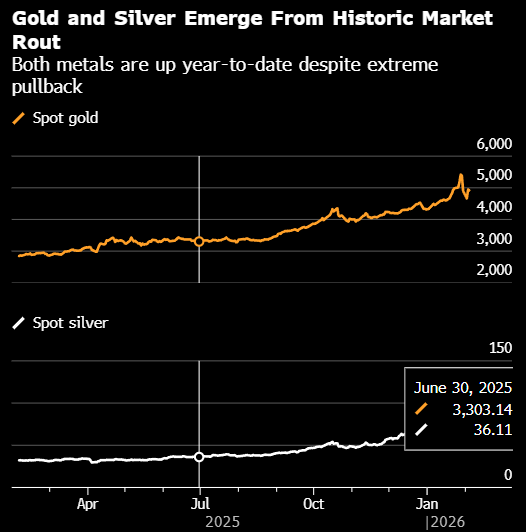
Core Viewpoint - Gold prices have rebounded above $5,000 per ounce for the second consecutive day as investors buy on dips following a historic drop from record highs [1][10] Group 1: Price Movements - On Wednesday, gold prices rose by 2.9%, following a previous day's increase of over 6% [1] - Despite being more than $500 below the previous record high, gold has maintained a year-to-date increase of approximately 17% [1] - Silver prices also experienced an upward trend [1] Group 2: Market Dynamics - The forced sell-off in precious metals may have ended, according to Daniel Ghali, a senior commodity strategist at TD Securities [3][7] - Recent volatility has led retail investors to remain cautious, reducing a significant buyer group [3] - The surge in precious metal prices last month was driven by speculative momentum, geopolitical tensions, and concerns over the independence of the Federal Reserve [8] Group 3: Investor Behavior - Chinese and Western retail investors have built substantial positions in precious metals, with a surge in leveraged trading and call options further fueling the market [8] - A sudden crash during Asian trading hours last Friday continued into the early part of this week [8] - Bloomberg data indicated that four major gold ETFs in mainland China experienced a combined outflow of nearly $1 billion on Tuesday, marking the largest single-day outflow [8] Group 4: Future Outlook - Despite recent price drops, the fundamentals supporting gold's rise to historical highs remain intact [4] - Deutsche Bank reiterated its forecast for gold prices to rebound to $6,000 per ounce [9] - Goldman Sachs noted a "significant upside risk" to its year-end gold price forecast of $5,400 [9] - Bank of America stated that volatility in precious metal prices will likely remain high [10]
十四年老董秘股神级操作:三个跌停抄底自家股票,此前五次增持浮盈超5倍
Mei Ri Jing Ji Xin Wen· 2026-02-04 10:33
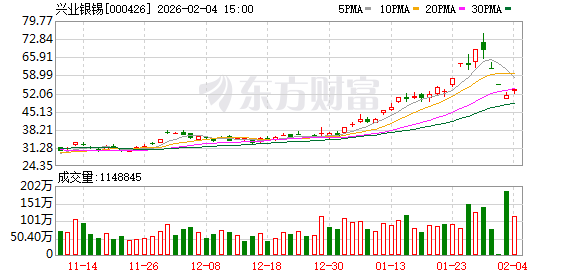
近日,国际黄金白银上演罕见的史诗级暴跌,A股贵金属股票连续跌停,投资者损失惨重,但是一家贵 金属上市公司的董秘敢于逆势操作,在自家公司股票第三个跌停时大胆抄底,并且他此前一直增持公司 股票,获得了丰厚的回报,他就是兴业银锡的董秘孙凯。 (文章来源:每日经济新闻) 1月30日和2月2日,兴业银锡股价连续两个跌停。在2月3日开盘后,公司股价继续跌停,兴业银锡董秘 孙凯在当日跌停板位置第六次增持公司股份。目前持股数量达到24万股,持股市值超过1200万元。相较 于孙凯的买入总金额,其目前浮盈超过800万元。孙凯自2011年开始担任兴业银锡董秘,但2011年至 2024年,公司的信息披露评价不如人意,最近6年连续为C。截至2月4日收盘,兴业银锡股价收于53.40 元,市值达948亿元。 ...
懒人财知道:2月4日复盘笔记 市场情绪好转 围绕最强品种看多
Xin Lang Cai Jing· 2026-02-04 09:31
Group 1 - The overall trend in the commodity market is upward, with strong performance in precious metals, black metals (coal and construction materials), crude oil, and non-ferrous metals [2][15] - Key commodities showing strength include gold, silver, tin, coking coal, fuel oil, glass, and PVC, suggesting a preference for bullish operations around these top-performing products [2][15] - Global market dynamics are influenced by inflation expectations supporting commodities, geopolitical conflicts, and energy supply disruptions, with precious metals leading due to safe-haven and anti-inflation demand [2][15] Group 2 - The real estate sector in Hong Kong showed a rebound, driven by bullish sentiment from some private equity firms, although this does not necessarily indicate a rise in real estate prices [3][16] - Policies in cities like Shanghai may not support upward expectations for real estate prices, indicating that a recovery in the sector is premature [3][17] - The A-share market saw brokerage and liquor stocks supporting the market, suggesting potential issues with previously overheated stocks [4][18] Group 3 - For the glass futures (2605), a bullish strategy is recommended with a buying range of 1100-1115 points, an initial stop-loss of 1070-1082 points, and a target profit range of 1132-1142 points [19] - For PVC futures (2605), a similar bullish strategy is advised with a buying range of 5120-5160 points, a stop-loss of 5000-5050 points, and a target profit range of 5230-5280 points [20] - The overall trading results indicate an 8% profit for glass futures, achieving a phase-specific profit target, while PVC futures continue to show a clear bullish trend [22][23] Group 4 - The effectiveness of strategies is based on supply contraction, inventory reduction, and strong expectations driven by capital, with successful risk management practices in place [25] - Highlights of risk control include timely adjustments to stop-loss levels and advising investors on reducing positions to mitigate potential risks [25] - The current commodity market is experiencing high volatility, necessitating close monitoring of global macro data and domestic policy changes for dynamic strategy adjustments [25]
尾盘,突然拉升!伊朗,突发威胁!
Xin Lang Cai Jing· 2026-02-04 09:13
Group 1: Core Insights - The situation in the Middle East remains volatile, with Iran's military actions against U.S. vessels indicating heightened tensions despite ongoing negotiations [1][4][5] - Iran's military has conducted aggressive actions, including attempts to board a U.S. flagged commercial ship and the downing of an Iranian drone near the USS Lincoln, suggesting internal divisions regarding negotiations [4][5][6] - The market has reacted to these developments, with significant increases in commodity prices, including silver rising over 4% and oil prices also experiencing upward movement [1][6] Group 2: Negotiation Developments - The U.S. government has agreed to hold negotiations with Iran in Oman, responding to Iran's request to change the location from Turkey [2] - Iranian officials have indicated a willingness to lower uranium enrichment levels but refuse to transfer enriched uranium abroad, emphasizing the peaceful nature of their nuclear program [2] - The U.S. remains committed to diplomatic solutions while retaining military options, indicating a complex balance between negotiation and potential conflict [3][6]