
造船

Search documents
美国造船的衰落,早在中国造船崛起之前
3 6 Ke· 2025-05-12 03:31
美国港口费重锤先砸碎的是自家供应链。中国国际海事和船舶工业的崛起,并非"非市场手 段"产物,而是全球化浪潮下要素优化配置与技术迭代的必然结果 近年来,美国对中国的国际海事行业关注热度超乎想象,专门针对中国的国际海事相关产业链开展了 301调查,各项海事制裁连环叠加。 通过立法、关税、港口并购等一系列手段,尤以对停靠美国港口的中国制造船舶以及中国航运企业征收 的天价港口费为代表,美国试图削弱中国企业竞争力、破坏全球港航布局,并限制中美贸易,重塑其主 导的供应链秩序。 美国在制定相关政策过程中,强化了对中国企业的限制措施,这种做法与全球自由市场规则存在一定偏 离,并引发对公平竞争原则的质疑。 历史早已证明,将经济问题政治化,既无法掩盖美国《琼斯法案》、货载保留等造成的本国船舶和海运 成本黑洞,也不能通过保护主义来振兴其船舶和海运经济,更难以逆转中国船舶制造和海运服务业依托 技术和产业优势形成的创新发展势能。 美国对华海事制裁的终局会走向何方,本文提出三个预言。 针对中国的海事制裁连环叠加 美国频繁对中国实施海事制裁,核心在于遏制中国在全球海运和造船业的主导地位,维护其自身及盟友 利益。美国针对中国施展了多重海事制 ...
中国船舶“超级重组”背后:打造国有资本改革典范
Xin Lang Zheng Quan· 2025-05-09 10:11
Core Viewpoint - The merger of China Shipbuilding and China Heavy Industry marks the largest restructuring in the global shipbuilding industry, with a transaction value of 115.15 billion yuan, signifying a major step towards high-end and international development in China's shipbuilding sector [1] Group 1: Strategic Synergy - The merger aims to eliminate historical competition between the two companies, enhancing the overall industry chain synergy [2] - Post-merger, the new entity will integrate key shipyards, optimizing production capacity and potentially increasing utilization rates from 72% and 53% to over 85%, reducing unit costs by approximately 12% [3] Group 2: Technological Collaboration - The merger will leverage the complementary technological strengths of both companies, accelerating the commercialization of advanced technologies such as smart ships and green power systems [4] - Shared R&D resources will enhance capabilities in high-value ship types, with significant improvements in production processes [4] Group 3: Management Efficiency - Unified management will reduce redundant investments and optimize order management, potentially decreasing production switching costs by about 15% and shortening delivery times by 10-20% [5] - The merger is expected to lower the total debt ratio from 69% to 58%, with annual interest savings exceeding 1 billion yuan [5] Group 4: Global Competitive Landscape - The merger positions the new company as the largest shipbuilding entity globally, with total assets of 401.5 billion yuan and a market share increase from 11% to 18% [7] - The company is set to dominate high-end ship types, capturing over 50% of global LNG dual-fuel orders and leading in the delivery of large vessels [9] Group 5: National Strategy Alignment - The merger exemplifies a significant case of state-owned enterprise reform, focusing on strategic security and high-end industrial development [10] - The new company will play a crucial role in national defense, handling over 90% of military shipbuilding tasks and enhancing domestic production capabilities [11] Group 6: Future Development - A 20 billion yuan technology fund will be established to focus on advanced technologies, with expectations for smart ships to increase from 5% to 30% by 2030 [12] - The restructuring is anticipated to improve the return on equity from 8.34% to 12%, aligning with international standards for leading shipbuilding firms [13] Conclusion - The restructuring is a systematic transformation aimed at enhancing global competitiveness, eliminating internal inefficiencies, and positioning the new company as a key player in China's transition from a shipbuilding power to a shipbuilding stronghold [14]


千亿级“中国神船”启航,中国船舶吸并中国重工获交易所受理
Ge Long Hui· 2025-05-08 15:54
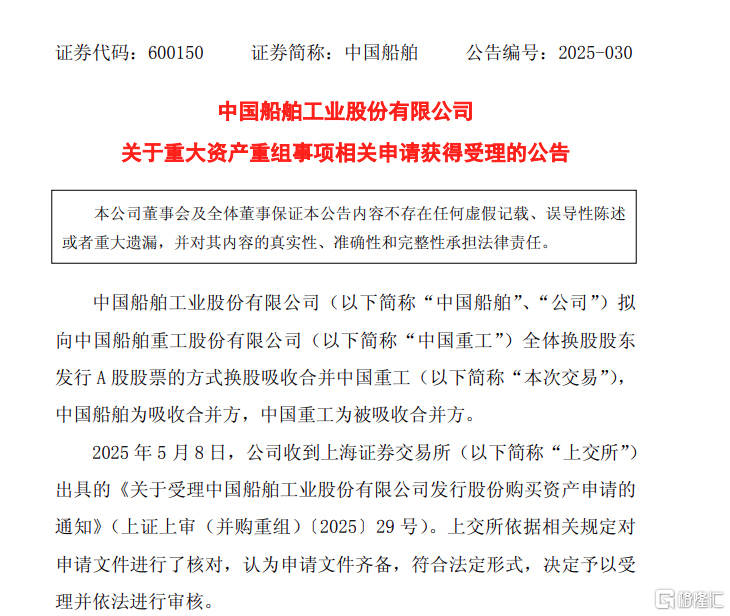
Core Viewpoint - The merger between China Shipbuilding (600150) and China State Shipbuilding Corporation (601989) marks a significant step in the consolidation of state-owned enterprises, with a transaction value of 115.15 billion yuan, representing the largest merger in A-share history over the past decade [3][5][8]. Company Overview - As of May 8, 2024, China Shipbuilding has a market capitalization of 134.8 billion yuan, while China State Shipbuilding's market cap stands at 98.96 billion yuan [3]. - The merger will result in China State Shipbuilding being delisted, with the surviving company projected to have total assets exceeding 400 billion yuan and combined revenues of 134 billion yuan in 2024, alongside a net profit of 4.925 billion yuan [6][7]. Merger Details - The merger will be executed through a share exchange ratio of 1 share of China State Shipbuilding for 0.1335 shares of China Shipbuilding, with adjusted share prices of 37.59 yuan and 5.032 yuan respectively [5]. - Post-merger, the total share capital of the combined entity will reach 7.516 billion shares, with significant changes in shareholder structure [6]. Industry Context - The merger addresses long-standing competition between the two companies and aims to create a complete industrial chain covering ship research, design, core components, and assembly [7]. - The combined entity is expected to capture over 20% of the global market share, enhancing its technological advantages and pricing power in high-value ship types such as LNG carriers and ultra-large container ships [7]. Market Dynamics - The global shipbuilding industry is currently experiencing an upward cycle, with new ship price indices rebounding nearly 50% from the 2020 low [7]. - Both companies have reported significant profit growth, with China Shipbuilding's net profit expected to rise by 22.21% to 3.614 billion yuan, and China State Shipbuilding's net profit surging by 266.6% to 1.311 billion yuan [7]. Strategic Implications - The merger reflects a shift in state-owned enterprise reform from "physical mergers" to "chemical reactions," emphasizing professional integration and value creation [8]. - The innovative "dynamic share exchange mechanism" allows for adjustments in share ratios based on profit distribution, demonstrating a focus on minority shareholder rights [8]. Broader Economic Impact - The merger is seen as a necessary response to global supply chain restructuring, with China’s shipbuilding industry capturing 57% of new global orders in 2024, while facing challenges from South Korean technology and U.S. trade investigations [9]. - The consolidation aims to eliminate internal competition and concentrate resources to build competitive advantages in green shipping and smart manufacturing [9].

美国人万没料到,中国刚出手,2国就跳反,彻底揭穿美国的谣言
Sou Hu Cai Jing· 2025-05-08 03:40
美国财政部长斯科特·贝森特(资料图) 据金融界报道,韩国产业部副部长Park Sung-taek日前表示,由于所涉及问题的复杂性和政治不确定性,韩国认为在6月3日总统大选之前不可能与美国达成 全面贸易协议。Park表示,韩国政府本周将派代表团前往华盛顿进行工作组级别会谈,以推进上周的进展,但6月初之前就任何一揽子措施达成协议"在理论 上是不可能的"。美国财政部长Scott Bessent上周表示,继上周在华盛顿举行贸易谈判后,两国可能最快在本周达成"谅解协议"。Bessent表示,谈判进展比预 期更快,有望在7月8日关税生效的最后期限前完成。 特朗普上台100天,美国就出现了"债股汇"三杀,经济衰退已经成为了一个极大概率事件。然而,美国一向缺乏解决内部矛盾的智慧,他们惯于向外转移压 力。随着美国认清了我国的现有实力,特朗普政府决定从盟友身上开刀,最大程度地从盟友国家手中攫取利益。特朗普此前要求韩国开放汽车市场,并限制 钢铁出口,而韩方坚持要求特朗普豁免25%汽车关税,和10%铝制品关税。值得注意的是,韩国代表团在首次正式关税会谈后,特意向美方强调了当前"代 总统执政"的特殊政治状态。 据北晚在线报道,日前,日 ...

出口链有哪些短期超跌及中长期机会?
2025-05-07 15:20
Summary of Conference Call Notes Industry or Company Involved - The discussion primarily revolves around the impact of U.S.-China trade tariffs on various industries, particularly focusing on consumer electronics, kitchen appliances, industrial metals, and energy metals. Core Points and Arguments - **Tariff Elasticity and Profit Impact**: A static estimate indicates a tariff elasticity of 1.7, meaning a 10% increase in tariffs leads to a 17% decline in U.S.-China trade volume. This is used to assess the net profit impact across industries based on their revenue exposure to the U.S. market [1][4]. - **Overreaction in Stock Prices**: Industries such as consumer electronics, kitchen appliances, industrial metals, and energy metals have experienced significant stock price declines that exceed the actual net profit damage, indicating a need for valuation adjustments due to long-term revenue shortages [1][5]. - **Ongoing Risks Under Current Tariff Scenarios**: Maintaining the current 145% equivalent tariff or a worse scenario of 125% equivalent tariff plus a 20% offset could lead to continued risks of stock price declines across various sectors [1][6]. - **Impact of Tariff Increases**: Under the 232 investigation results, a 25% tariff (totaling 45%) will significantly affect kitchen appliances, industrial metals, and energy metals, while consumer electronics have been excluded from this category [1][7]. - **Potential for Negotiation Progress**: If U.S.-China negotiations yield positive results, tariffs could revert to a 54% level, allowing for some industries to rebound from their current depressed state [1][8]. - **Optimistic Scenario**: In the most favorable scenario, if the 125% equivalent tariff is removed and only a 20% anti-dumping tariff is applied without introducing new products subject to a 25% tariff, industries such as small appliances, kitchen appliances, consumer electronics, batteries, communication equipment, textile manufacturing, and certain industrial metal sectors could see significant recovery [1][9]. Other Important but Possibly Overlooked Content - **Long-term Opportunities**: The focus should also be on emerging export categories with low global penetration and potential for growth, such as automotive parts, shipbuilding, machinery, medical devices, and chemical products. Companies with sufficient overseas production capacity in these sectors are better positioned to withstand risks [2][10]. - **Traditional Advantage Industries**: Industries where China holds a significant share of global production and market power, such as fast-moving consumer goods (FMCG), electronic components, and chemicals, are likely to maintain their competitive edge despite high tariffs due to supply chain and cost advantages [10].
收到中方警告后,韩国外长当着美方表态,对外释放信息量大
Sou Hu Cai Jing· 2025-05-07 07:10
韩国外长(资料图) 中国有句老话,听其言而观其行。作为美国的盟友,韩国政府的外交政策深受美国的影响。韩国外交部长虽然这样表态,我们还是要关注接下来的一系列 举动。果不其然,赵兑烈认为韩国的外交政策需要优先定位于韩美同盟等基础性问题,至于跟中国接触也是为了"防止21世纪强国之间爆发战争",更是为 了韩国自身利益。但是,从美国对韩国政治、经济的影响以及驻韩美军的存在,这就决定了韩国想完全制定独立自主的外交政策是不现实。 韩国等小国的"表态中立",本质是在大国夹缝中求生存的无奈选择。它们既不愿放弃美国的安全保护,又无法承受与中国经济脱钩的代价。中国的反制措 施和美国的胁迫,共同塑造了小国"口头上不选边、行动上找平衡"的策略。正如新加坡前总理李显龙所言:"在中美之间,小国不是在选边,而是在选怎么 活"。这种困境短期内难以突破,而大国博弈的烈度,将最终决定这些国家能否在"惊涛骇浪"中守住航向。 据智通财经报道,韩国要求与美国就贸易问题进行"冷静有序"的磋商。据报道,这个亚洲第四大经济体正寻求在7月前与美国达成协议以避免加征关税。在 华盛顿举行的"2+2"会谈中,韩国经济副总理兼企划财政部长官崔相穆和产业通商资源部长官D ...
中国船舶(600150):盈利持续释放 造船龙头合并重组未来可期
Xin Lang Cai Jing· 2025-05-06 10:32
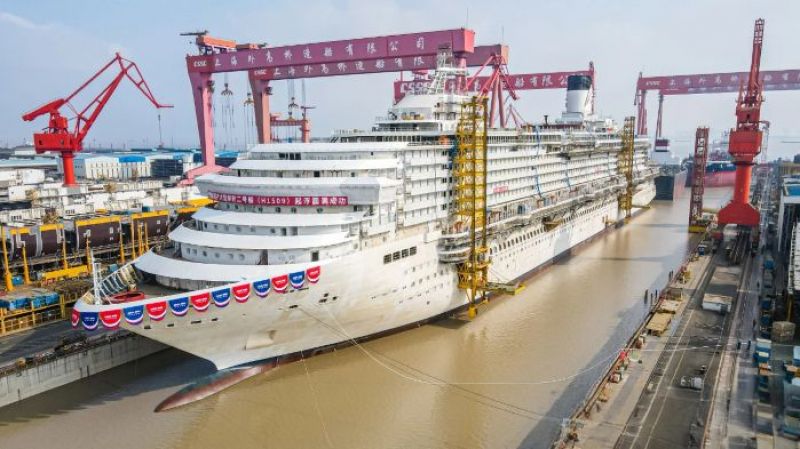
Core Insights - The company reported a revenue of 78.584 billion yuan in 2024, a year-on-year increase of 5.01%, and a net profit attributable to shareholders of 3.614 billion yuan, up 22.21% [1] - In Q1 2025, the company achieved a revenue of 15.858 billion yuan, a year-on-year increase of 3.85%, and a net profit of 1.127 billion yuan, significantly up by 180.99% compared to the previous year [1] Financial Performance - The company's gross profit margin for its main business reached 9.94% in 2024, an increase of 0.43 percentage points year-on-year, with the shipbuilding and marine engineering segment's margin at 9.57%, up 0.29 percentage points [2] - In Q1 2025, the gross profit margin surged to 12.84%, a substantial increase of 6.16 percentage points year-on-year [2] - The growth in performance is attributed to an increase in the volume and price of ships delivered in 2024, alongside improvements in production efficiency through smart manufacturing and lean management [2] Order and Delivery Performance - In 2024, the company signed 154 new ship orders totaling 1,039 billion yuan, an increase of 26 orders year-on-year, and delivered 93 ships, completing 112.74% of its annual tonnage target [3] - The company had a backlog of 322 ship orders by the end of 2024, with a total weight of 24.6107 million tons and a value of 216.962 billion yuan, indicating a strong order book extending production schedules to 2028 [3] Industry Outlook - The shipbuilding industry is experiencing a continuous supply-demand gap, with China's shipbuilding completion volume in 2024 reaching 50.7631 million tons, a year-on-year increase of 9.63%, and new ship orders rising by 62.38% [4] - The demand for green ships is increasing, driven by environmental requirements, with the proportion of green ship orders on the rise [4] - The company is expected to benefit from synergies following the merger with China Shipbuilding Industry Corporation, leading to improved efficiency and accelerated deliveries, with projected net profits of 7.35 billion yuan and 10.08 billion yuan for 2025 and 2026, respectively [4]
验证中国制造2025(上)造船份额70%,EV掌握主导权
日经中文网· 2025-05-06 03:27
Core Viewpoint - The article discusses the advancements in China's manufacturing capabilities under the "Made in China 2025" policy, highlighting its impact on various industries and the resulting international competition, particularly with the United States. Shipbuilding - China has become a global leader in shipbuilding, with 2024 orders reaching a historical high of 46.5 million CGT, accounting for 70% of global orders, while South Korea holds only about one-fifth of that amount [2][4]. - The U.S. shipbuilding industry has weakened, unable to meet the demands for new ship construction and maintenance, reflecting a decline in American manufacturing [6]. Space Development - China has made significant strides in space development, achieving independent manned spaceflight and becoming the only country with a fully operational manned space station [7][8]. - In contrast, the U.S. has faced delays in its Artemis program, which aims for manned lunar exploration, indicating a stagnation in its space initiatives [8]. Automotive Industry - China has emerged as the world's largest producer of electric vehicles (EVs), with one in every two EVs globally being a Chinese brand by 2024 [12]. - In the battery sector, CATL holds a 38% market share, with the top three Chinese companies capturing about 60% of the global market [12]. Semiconductor Industry - China's self-sufficiency in semiconductors is currently at about 20%, falling short of its 70% target, but it holds a 24% share of the global capacity for mature semiconductor products [13]. - Companies like SMIC and YMTC are rising in prominence, focusing on domestic production of critical technologies [13]. Overview of "Made in China 2025" - The "Made in China 2025" policy aims to elevate China's manufacturing capabilities by 2049, selecting ten key sectors and serving as a foundation for various industrial support policies [14].
扭亏为盈,中国船舶2024年净利同比增长二成,今年营收目标805亿元
Hua Xia Shi Bao· 2025-05-01 22:29
Core Viewpoint - China Shipbuilding Industry Company (China Shipbuilding) reported a successful turnaround in 2024, achieving a net profit of 30.72 billion yuan, compared to a loss of 2.91 billion yuan in the previous year, driven by improved order structure and market conditions [1][2][3] Financial Performance - In 2024, China Shipbuilding achieved revenue of 78.584 billion yuan, a year-on-year increase of 5.01% [2] - The company's main business revenue reached 77.667 billion yuan, up 5.60% year-on-year, with a gross margin of 9.94%, an increase of 0.43 percentage points [2] - The net profit attributable to shareholders was 36.14 billion yuan, compared to 29.57 billion yuan in the previous year, with a net profit of 30.72 billion yuan after excluding non-recurring gains and losses [2][3] Order and Delivery Status - As of the end of 2024, China Shipbuilding had a robust order backlog, with 322 civil ship orders totaling 216.962 billion yuan [3][4] - The company delivered 93 civil ships with a total deadweight tonnage of 721.34 thousand tons, exceeding the annual plan by 112.74% [4] - The company is also progressing with a share swap merger with China Shipbuilding Industry Corporation, pending regulatory approvals [4] Market Outlook - China Shipbuilding has set a revenue target of 80.5 billion yuan for 2025, with expectations to complete 89 civil ships and 270 repair ships [5] - The global shipbuilding market is entering a new development cycle, with China maintaining a leading position in international market share [6] - The company acknowledges potential external risks due to increasing global trade protectionism and economic instability, but sees opportunities in green ship development and technological advancements [6]
Huntington Ingalls Industries(HII) - 2025 FY - Earnings Call Transcript
2025-04-30 15:00
Financial Data and Key Metrics Changes - The total number of shares outstanding and entitled to vote at the close of business on the record date was 39,235,593 shares of common stock [10] - Each of the 12 nominees for director received more than 87% of the shares voted and has been elected to serve until the 2026 annual meeting [19] Business Line Data and Key Metrics Changes - The proposal to approve on an advisory basis the compensation of named executive officers received 30,456,940 votes and has passed [19] - The proposal to ratify the appointment of Deloitte and Touche as the company's auditor for 2025 received 34,005,499 votes and has passed [19] Market Data and Key Metrics Changes - The proposal to eliminate the personal liability of officers for monetary damages for breach of certain fiduciary duties received 26,048,180 votes and has passed [19] - The proposal to amend the company's restated certificate of incorporation to conform with the company's special meeting bylaws received 31,294,405 votes and has passed [20] Company Strategy and Development Direction and Industry Competition - The company did not make a formal presentation about its strategy during the meeting but indicated that stockholders received copies of the 2024 annual report and proxy statement [21] Management's Comments on Operating Environment and Future Outlook - Management did not provide specific comments on the operating environment or future outlook during the meeting [21] Other Important Information - The meeting was conducted virtually, and stockholders were able to submit questions through the meeting website [8] - The meeting was adjourned without further business to discuss, indicating a lack of additional inquiries from stockholders [22] Q&A Session All Questions and Answers Question: Were there any questions submitted during the meeting? - There were no questions submitted during the meeting [16][22]
