
能源

Search documents
2025年世界品牌500强榜单发布 中国50个品牌上榜
Xin Hua Cai Jing· 2025-12-17 14:25
Core Insights - The 2025 World Brand 500 list was released, featuring 50 Chinese brands, highlighting China's growing global brand influence [1] Industry Summary - The ranking evaluates brands based on their global influence, focusing on market share, brand loyalty, and global leadership [1] - A total of 33 automotive and parts brands topped the list, followed by 30 energy and food & beverage brands, and 29 banking brands [1] - The retail, computer, and communications sectors each had 27 brands represented [1] - There has been a significant increase in AI-related technology brands on the list, reflecting the impact of the AI era [1] - Overall, there is a noted decline in rankings for food & beverage and luxury brands due to sluggish consumer growth globally [1] Company Summary - A total of 23 new brands were added to the list this year, with three new Chinese entrants: CATL, China Unicom, and Tongding, showcasing advancements in new energy, infrastructure, and information communication sectors [1]



中央财办十问十答,一起来学习!
Xin Lang Cai Jing· 2025-12-17 14:25
Economic Outlook - The central economic work conference indicates that 2025 will be a significant year, with China's economy showing strong resilience and vitality while facing challenges [3][38] - The expected annual economic growth is around 5%, maintaining China's position among the world's major economies, with the total economic output projected to reach approximately 140 trillion yuan [4][39] - Active flows of factors and innovation are expected to inject new momentum into development, with investment and consumption growth anticipated to recover next year [4][41] Macro Policy Implementation - The central economic work conference has decided to continue implementing a more proactive macro policy next year, focusing on stability and quality improvement [6][42] - A more active fiscal policy will be maintained, ensuring necessary fiscal deficits and total debt levels while leaving room to address future risks [6][44] - An appropriately loose monetary policy will be continued, with a focus on stabilizing economic growth and allowing for reasonable price recovery [7][44] Key Tasks for Economic Work - Expanding domestic demand is prioritized as the key task for next year, focusing on structural changes in consumption and boosting investment [9][45] - Investment in both physical and human resources will be combined to stimulate consumption and expand investment, with an emphasis on building consumer infrastructure [9][47] International Technology Innovation Centers - Significant achievements have been made in the construction of international technology innovation centers in Beijing, Shanghai, and the Guangdong-Hong Kong-Macao Greater Bay Area, which support China's innovation capabilities [12][48] - The expansion of these centers aims to enhance their global influence and competitiveness [12][49] Unified National Market - Targeted measures will be taken to enhance the effectiveness of the unified national market, ensuring efficient allocation of resources [15][52] - Continuous improvement of market operation rules and the establishment of a foundational institutional framework for the unified market will be prioritized [15][53] High-Level Opening Up - The focus will be on steadily advancing institutional opening up, expanding service sector autonomy, and promoting diverse open platforms [18][59] - Efforts will be made to achieve a basic balance in international payments and to hold numerous import promotion activities [18][60] Regional Coordinated Development - Implementation of regional development strategies will be guided to promote urban-rural integration and regional linkage [20][63] - Support for major economic provinces and coordinated regional development will be emphasized to create a complementary and interconnected development pattern [20][63] Green Transition - Collaborative efforts will be made to reduce carbon emissions, pollution, and enhance green growth [23][66] - The first year of transitioning to dual control of carbon emissions will focus on solidifying statistical foundations and implementing control measures [23][66] High-Quality Employment - Employment policies will prioritize stability and quality, focusing on promoting employment for key groups such as graduates and migrant workers [29][70] - Support for flexible employment and new employment forms will be strengthened, including labor rights protection [29][71] Real Estate Development - There is significant potential for high-quality development in the real estate sector, with a focus on new models to drive growth [32][72] - Measures will be taken to control new supply, revitalize existing stock, and encourage the acquisition of existing properties for reasonable uses [32][73]


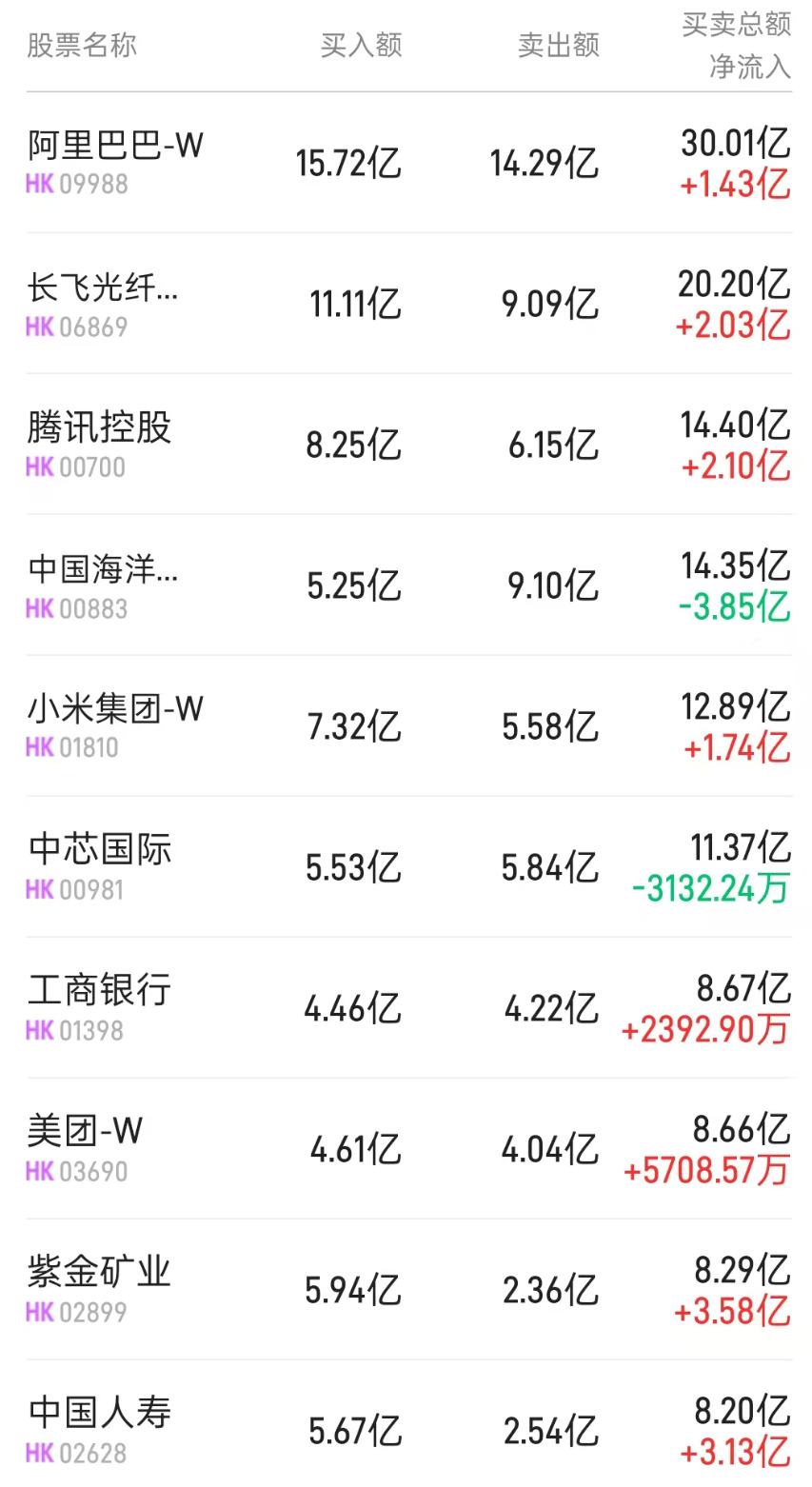
北水成交净买入79.09亿 内资全天抢筹科网股 加仓南方恒生科技超7亿港元
Zhi Tong Cai Jing· 2025-12-17 13:19
工商银行 中国人寿 紫金矿业 中国移动 中国海油 长飞光纤 分时图 日K线 周K线 月K线 7.81 0.02 0.26% 1.03% 0.64% 0.39% 0.00% 0.39% 0.64% 1.03% 7.71 7.74 7.76 7.79 7.82 7.84 7.87 09:30 10:30 11:30/13:00 14:00 15:00 0 195万 391万 586万 | 股票名称 | 买入额 | 卖出额 | 买卖总额 | | --- | --- | --- | --- | | | | | 净流入 | | 阿里巴巴-W | 15.72 乙 | 14.29 乙 | 30.01亿 | | HK 09988 | | | +1.43 乙 | | 长飞光纤 ... | 11.11亿 | 9.09亿 | 20.20亿 | | HK 06869 | | | +2.031Z+ | | 腾讯控股 | 8.25 亿 | 6.15 亿 | 14.40 乙 | | HK 00700 | | | +2.10 乙 | | :: | 5.25亿 | 9.10亿 | 14.35 乙 | | HK 00883 | | | -3.8 ...

权益市场走强,成交量回升
Tebon Securities· 2025-12-17 11:40
Market Overview - The A-share market showed strength with a rebound in trading volume, with major indices rising significantly on December 17, 2025. The Shanghai Composite Index increased by 1.19% to close at 3870.28 points, while the ChiNext Index surged by 3.39% [5] - The total trading volume for A-shares reached 1.83 trillion yuan, up from 1.75 trillion yuan the previous day, indicating a strong profit-making effect with 3623 stocks rising and 1634 stocks falling [5] Stock Market Analysis - The listing of Muxi Co., the second domestic GPU stock, significantly boosted the technology sector, with its stock price soaring by 693% to 829.90 yuan per share, resulting in a market capitalization exceeding 330 billion yuan [6] - The technology and consumer sectors are recommended for balanced allocation, supported by the central government's emphasis on expanding domestic demand as a priority for 2026 [6] Bond Market Analysis - The government bond futures market experienced a comprehensive rise, with the 30-year main contract increasing by 0.63% to 112.140 yuan [11] - The central bank's reverse repos resulted in a net withdrawal of 143 billion yuan, maintaining a loose liquidity environment, with Shibor rates for short-term maturities mostly declining [11] Commodity Market Analysis - The commodity market saw most prices rise, with lithium carbonate leading the gains at 7.61%. The price of lithium carbonate reached 108,620 yuan per ton due to supply constraints [11] - Precious metals experienced a broad increase, with platinum and palladium prices hitting the limit up, driven by global liquidity expectations and domestic gold reserve increases [11] Trading Hotspots - The report highlights several key sectors for investment, including commercial aerospace, nuclear fusion, AI applications, and consumer sectors, with a focus on their growth potential and market dynamics [12][14] - The central economic work conference's direction and the Federal Reserve's interest rate cuts are expected to enhance liquidity and support investment in consumer and technology sectors [12]
巴西政府批准新版国家气候计划
中国能源报· 2025-12-17 11:04
Core Viewpoint - The Brazilian government has approved a new national climate plan to implement the goals of the Paris Agreement and promote a low-carbon transition, providing a clear roadmap for action [1]. Group 1: Emission Reduction Targets - The new plan sets specific emission reduction targets across eight sectors, aiming to reduce greenhouse gas emissions from 2.04 billion tons of CO2 equivalent in 2022 to 1.2 billion tons by 2030, and further down to between 850 million and 1.05 billion tons by 2035 [2]. - The overall goal is to achieve net-zero emissions by 2050, while also emphasizing the need to enhance resilience to climate change [2]. Group 2: Adaptation and Action Plans - The plan includes 16 sectors and thematic action plans for adapting to climate change, covering areas such as public health, tourism, energy, transportation, disaster risk reduction, water resources, food security, and biodiversity, with over 800 specific actions proposed [2]. - The Brazilian government will continuously improve the national climate plan through biennial assessments and systematic revisions every four years to ensure alignment with climate science advancements and international commitments [2].

广东建工(002060.SZ):清洁能源项目投产运营
Ge Long Hui A P P· 2025-12-17 09:51
格隆汇12月17日丨广东建工(002060.SZ)公布,近日,广东省建筑工程集团股份有限公司全资子公司广 东水电二局集团有限公司下属广东粤水电能源投资集团有限公司投资建设的布尔津县电化学 200MW/800MWh独立储能电站项目全容量并网运营;粤水电巴楚县5MW 分布式光伏制储加氢一体化 (试验示范)项目制储氢600Nm³/h 投产运营。上述项目的投产运营对公司未来经营业绩有一定的提升 作用。截至目前,公司累计已投产发电的清洁能源项目总装机5084.52MW,其中水力发电 380.50MW, 风力发电790.36MW,光伏发电 3613.66MW,独立储能 300MW;制储氢600Nm³/h。 ...

CBAM 重塑竞争规则,欧盟钢铁进口商的成本管控与供应链重构策略
科尔尼管理咨询· 2025-12-17 09:38
Core Viewpoint - The article discusses the implementation of the Carbon Border Adjustment Mechanism (CBAM) by the EU to address carbon leakage and its implications for steel importers, highlighting the need for strategic adjustments in procurement and production methods to mitigate potential cost impacts [1][9]. Group 1: CBAM Implementation and Challenges - The CBAM was introduced to combat carbon leakage by imposing carbon pricing on imports linked to the EU Emissions Trading System (ETS) [1]. - The mechanism will be implemented in two phases: a transitional phase from October 2023 to December 2025, where reporting is required but no taxes are imposed, followed by a full implementation phase starting January 2026 [1]. - During the transitional phase, challenges have emerged, particularly for small importers, leading to the introduction of a minimum threshold of 50 tons to exempt approximately 90% of importers from detailed reporting requirements [1]. Group 2: EU Steel Import Dependency - The EU is the largest importer of semi-finished and finished steel, accounting for 35% of global steel imports, with dependency on imports rising from 17% in 2020 to an expected 21% in 2024 [4]. - Steel import volumes are projected to grow at an annual rate of approximately 0.63% from 2026 to 2030 [4]. Group 3: Impact of CBAM on Steel Importers - CBAM is forcing EU steel importers to reassess their procurement strategies and the production technologies used by suppliers to manage cost impacts [6]. - The top ten countries supplying steel to the EU account for 69% of total imports, with China, Turkey, Russia, and India contributing over 60% [6]. - The two main production pathways for steel are the Blast Furnace-Basic Oxygen Furnace (BF-BOF) and Electric Arc Furnace (EAF) methods, with EAF having significantly lower CO2 emissions [6]. Group 4: Expected Cost Implications of CBAM - Although the fixed carbon price for 2026 has not been announced, it is expected to be linked to the EU ETS carbon price, projected to rise to €85 per ton in 2026 and drop to €65 in 2027 due to potential oversupply [10]. - The implementation of CBAM could lead to an additional carbon tax of €2.21 billion to €2.7 billion for EU steel imports in 2026, with BF-BOF steel imports contributing the majority of this cost [12]. Group 5: Strategies for Mitigating Financial Impact - EU steel importers need to act quickly to mitigate potential cost impacts from CBAM by evaluating the specific effects on their supply chains and the maturity of suppliers' emissions reporting [14]. - Short-term strategies include close communication with suppliers to encourage cleaner steel production and incorporating carbon metrics into procurement processes [14]. - Long-term strategies may involve reconfiguring supply chains to prioritize regions with lower carbon production methods, potentially reducing CBAM-related costs significantly [14]. Group 6: Global Exporters' Response - Global exporters supplying the EU are also taking measures to decarbonize their production methods to remain competitive, with initiatives in countries like India and China aimed at improving energy efficiency and reducing emissions [17][18]. Group 7: Opportunities During the Transition Period - The transition period provided by CBAM offers time for proactive supplier collaboration, investment in cleaner production, and integrating carbon considerations into procurement decisions, which can help manage financial risks [20].

从“末梢”到“枢纽”:广湛高铁引领粤西迈入湾区同城时代
Nan Fang Du Shi Bao· 2025-12-17 06:41
Core Viewpoint - The opening of the Guangzhan High-Speed Railway is set to transform Zhanjiang into a key development hub within the Guangdong-Hong Kong-Macao Greater Bay Area, significantly enhancing its economic dynamics and regional role [1][2][3]. Group 1: Economic Impact - The Guangzhan High-Speed Railway will connect Zhanjiang to the Greater Bay Area in just 90 minutes, facilitating the flow of capital, technology, talent, and information [1][3]. - Zhanjiang's economic development is expected to accelerate, with a projected GDP growth rate of approximately 10% in the first three quarters of this year, driven by significant industrial projects [4]. - The high-speed railway is anticipated to catalyze the growth of a "billion-level industrial forest," enhancing Zhanjiang's position as a modern coastal economic hub [1][4]. Group 2: Infrastructure Development - The Guangzhan High-Speed Railway spans 401 kilometers and is a crucial part of the national high-speed rail network, linking the Greater Bay Area with Hainan Free Trade Port and the Beibu Gulf city cluster [2][3]. - Zhanjiang North Station, with a total area of 105,000 square meters, is designed to become a new urban center, integrating green and intelligent design concepts [5]. - The ongoing construction of additional railways, such as the He-Zhan High-Speed Railway, is expected to further enhance Zhanjiang's transportation capabilities [5][6]. Group 3: Talent and Industry Transformation - The high-speed railway is expected to create a "same-city effect," allowing Zhanjiang to attract high-level talent and facilitate the return of local professionals, thereby enhancing its labor market [3][4]. - Zhanjiang aims to evolve from a traditional industrial base to a modern industrial community, focusing on advanced service industries such as industrial design and supply chain services [3][4]. - The railway's impact on supply chains is significant, as it will improve the stability and efficiency of logistics for high-value-added enterprises [5]. Group 4: Regional Integration - The Guangzhan High-Speed Railway will integrate Zhanjiang into the Greater Bay Area's "90-minute living circle," enhancing regional connectivity and economic collaboration [8][9]. - The development of Zhanjiang's green industries, including green petrochemicals and steel, is expected to be supported by the railway, contributing to a robust industrial ecosystem [8][9]. - The opening of international routes from Zhanjiang Wuchuan International Airport will further enhance its global connectivity, particularly with ASEAN countries [7][9].
银河期货每日早盘观察-20251217
Yin He Qi Huo· 2025-12-17 02:24
Report Industry Investment Rating The document does not provide information on the industry investment rating. Core Viewpoints of the Report The report offers a comprehensive analysis of various futures markets, including financial derivatives, agricultural products, black metals, non - ferrous metals, shipping, and energy chemicals. It assesses the current market situation, influencing factors, and provides corresponding trading strategies for each sector. [17][24][56] Summary by Relevant Catalogs Financial Derivatives - **Stock Index Futures**: After a significant decline, there may be a technical rebound, but the rebound without news support may have limited height. The trading strategy is to adopt a high - selling and low - buying approach in a volatile market, wait for the spread of the discount to widen for the IM/IC long 2603 + short ETF cash - and - carry arbitrage, and use the double - buying option strategy. [20][21] - **Treasury Bond Futures**: Different maturities show differentiated performance. In the short term, it is difficult to determine whether the bond market will turn bearish. The trading strategy is to stop the short positions of TS and TF contracts at low prices and wait and see for arbitrage. [22][23] Agricultural Products - **Protein Meal**: With large supply pressure from new crops, the price of US soybeans continues to decline. The international soybean market is in a pattern of abundant supply. The trading strategy is to wait and see, narrow the MRM spread, and sell the wide - straddle option strategy. [25][26] - **Sugar**: International sugar prices are oscillating at a low level, and domestic sugar prices are weak. The Brazilian sugar supply pressure will gradually ease, and the international sugar price may bottom - out and oscillate. The domestic sugar market may still maintain a weak trend in the short term. The trading strategy is to go long on the January contract and short on the May contract, and wait and see for options. [28][32] - **Oilseeds and Oils**: The overall trend is weakly oscillating. The trading strategy is to buy on dips after the price stops falling and stabilizes, and conduct high - selling and low - buying band operations, and wait and see for arbitrage and options. [34][35] - **Corn/Corn Starch**: The spot price has declined, and the futures price is oscillating at a high level. The trading strategy is to go long on the 03 contract on dips and establish long positions on the 07 contract at low prices, and wait and see for arbitrage and options. [37][38] - **Hogs**: The spot price is under pressure, and the futures price is oscillating. The trading strategy is to adopt a short - selling strategy, and wait and see for arbitrage and sell the wide - straddle option strategy. [39][40] - **Peanuts**: The spot price has declined, and the futures price is oscillating downward. The trading strategy is to short the 03 contract lightly at high prices, wait and see for arbitrage, and sell the pk603 - C - 8200 option. [41][43] - **Eggs**: The demand is average, and the price is stable with a slight decline. The trading strategy is to go long on the far - month contracts at low prices, wait and see for arbitrage and options. [44][46] - **Apples**: The demand is average, and the price is mainly stable. The trading strategy is to wait and see, go long on the January contract and short on the October contract, and wait and see for options. [48][50] - **Cotton - Cotton Yarn**: The sales of new cotton are good, and the price is oscillating strongly. The trading strategy is to go long on dips, wait and see for arbitrage and options. [52][54] Black Metals - **Steel**: The raw materials have stopped falling and stabilized, and the steel price is oscillating. The trading strategy is to expect the price to oscillate in a range and may rebound from the bottom in the short term, short the coil - coal ratio and the coil - rebar spread at high prices, and wait and see for options. [57][58] - **Coking Coal and Coke**: They are oscillating at the bottom. The trading strategy is to wait and see, as the current situation has priced in most of the negative factors, and pay attention to the change of trading logic. [60][61] - **Iron Ore**: Adopt a bearish approach. The current supply of iron ore is abundant, and the demand is weak, so the price is expected to run weakly at a high level. [62][65] - **Ferroalloys**: The cost is supported, but the demand is suppressed. The trading strategy is to expect the price to oscillate at the bottom, wait and see for arbitrage, and sell the out - of - the - money straddle option combination. [66][67] Non - Ferrous Metals - **Gold and Silver**: The US employment market is cooling down, but under the situation of multiple factors, they are oscillating at a high level. The trading strategy is to hold long positions for Shanghai gold and Shanghai silver, wait and see for arbitrage, and buy the out - of - the - money call option. [69][72] - **Platinum and Palladium**: The non - farm payroll data is lower than expected, and they are oscillating strongly. The trading strategy is to go long on platinum and palladium at low prices, and consider the long - platinum and short - palladium arbitrage. [74][76] - **Copper**: Buy after a full correction. The US employment data shows that the labor market is cooling down, and the copper price is expected to rise in the long term. [77][80] - **Alumina**: Be vigilant against the resurgence of the "anti - involution" sentiment. The fundamental situation is still under pressure. The trading strategy is to expect the price to oscillate at a low level, wait and see for arbitrage and options. [80][83] - **Electrolytic Aluminum**: There is uncertainty in the macro - economic outlook, and the price is oscillating with a reduction in positions. The trading strategy is to expect the price to oscillate after a correction, wait and see for arbitrage and options. [84][85] - **Cast Aluminum Alloy**: There is uncertainty in the macro - economic outlook this week. The trading strategy is to oscillate with the decline of the aluminum price, conduct the AD - AL spread convergence arbitrage during the decline of the aluminum price, and wait and see for options. [87][88] - **Zinc**: Pay attention to the magnitude of overseas warehouse delivery. The trading strategy is to wait and see, as the overseas delivery has put pressure on the price, and consider the long - domestic and short - overseas strategy when the export window may open intermittently. [89][92] - **Lead**: Pay attention to the change of inventory. The trading strategy is to partially stop the profit of the short positions and hold the rest, wait and see for arbitrage and options. [93][96] - **Nickel**: As a short - position variety, it continues to decline. The trading strategy is to expect the price to decline oscillatingly, wait and see for arbitrage, and sell the out - of - the - money call option. [97][98] - **Stainless Steel**: It follows the decline of the nickel price and oscillates weakly. The trading strategy is to expect the price to decline oscillatingly, and wait and see for arbitrage. [100][101] - **Industrial Silicon**: Sell on rallies. The trading strategy is to sell on rallies, go long on polysilicon and short on industrial silicon for arbitrage, and sell the out - of - the - money call option. [102][103] - **Polysilicon**: Buy on dips. The trading strategy is to hold long positions and buy on dips, go long on polysilicon and short on industrial silicon for arbitrage, and sell the put option. [104][104] - **Lithium Carbonate**: The impact of the mining license is limited, and pay attention to the inventory data. The trading strategy is to operate cautiously at a high level, wait and see for arbitrage, and sell the out - of - the - money call option of the 2605 contract when the price rises. [105][107] - **Tin**: Pay attention to the export data of Myanmar in November. The trading strategy is to pay attention to the export data of Myanmar in November and be vigilant against the change of macro - economic sentiment, and wait and see for options. [108][111] Shipping - **Container Shipping**: MSK tested the price of 2800 in the first week. The trading strategy is to partially stop the profit of the long positions of the EC2602 contract and hold the rest, and wait and see for arbitrage. [112][114] Energy and Chemicals - **Crude Oil**: The price is close to the annual low, and the geopolitical factor is still the focus. The trading strategy is to expect the price to oscillate, the domestic gasoline is neutral, the diesel is weak, and the oil price spread is weak, and wait and see for options. [116][117] - **Bitumen**: The oil price has dropped significantly, and there are still concerns about the raw materials. The trading strategy is to expect the price to oscillate and stabilize, and sell the out - of - the - money call option of the BU2602 contract. [119][121] - **Fuel Oil**: The high - sulfur fuel oil remains weak, and the supply of low - sulfur fuel oil is frequently disturbed by the change of devices. The trading strategy is to be bearish, the low - sulfur cracking spread is weak, the high - sulfur cracking spread is weak, and wait and see for options. [121][122] - **Natural Gas**: The downward trend of LNG remains unchanged, and HH continues to correct. The trading strategy is to buy the HH2602 contract, wait and see for arbitrage, and sell the TTF call option. [124][126] - **LPG**: It is slightly stronger than oil. The trading strategy is to short the 03 contract at high prices, wait and see for arbitrage and options. [127][128] - **PX and PTA**: The PX operating rate remains high, and there is still an expectation of PTA inventory accumulation. The trading strategy is to expect the price to oscillate weakly, conduct the reverse arbitrage for the PX3, 5 & PTA1, 5 contracts, and wait and see for options. [130][131] - **Benzene and Styrene**: The supply and demand of pure benzene are loose, and the basis of styrene is loosening. The trading strategy is to expect the price to oscillate weakly, wait and see for arbitrage, and sell the out - of - the - money call option. [133][134] - **Ethylene Glycol**: Some enterprises have reduced the operating load, and the price has rebounded slightly. The trading strategy is to expect the price to oscillate weakly, wait and see for arbitrage, and sell the out - of - the - money call option. [136][137] - **Short - Fiber**: The supply and demand are weak, and the price has declined. The trading strategy is to expect the price to oscillate, wait and see for arbitrage, and sell the out - of - the - money call option. [138][140] - **Bottle Chips**: The supply and demand are relatively loose. The trading strategy is to expect the price to oscillate weakly, wait and see for arbitrage, and sell the out - of - the - money call option. [141][142] - **Propylene**: The operating rate is rising, and the inventory is at a high level. The trading strategy is to short at high prices, wait and see for arbitrage, and sell the call option. [143][144] - **Plastic PP**: The electricity consumption of the rubber and plastic industry has decreased slightly month - on - month. The trading strategy is to hold long positions for the L main 2605 contract and try to go long on the PP main 2605 contract, wait and see for arbitrage, and wait and see for options. [146][148] - **Caustic Soda**: It shows an oscillating trend. The trading strategy is to expect the price to oscillate, wait and see for arbitrage, and wait and see for options. [149][151] - **PVC**: It rebounds from the bottom. The trading strategy is to expect the price to rebound from the bottom, wait and see for arbitrage, and wait and see for options. [152][153] - **Soda Ash**: The price oscillates after the contract roll - over. The trading strategy is to wait and see, as the short - term price is expected to be stable. [155][159] - **Glass**: The price oscillates. The trading strategy is to expect the price to oscillate, wait and see for arbitrage, and wait and see for options. [157][160] - **Methanol**: It oscillates widely. The trading strategy is to expect the price to oscillate, wait and see for arbitrage, and wait and see for options. [162][163] - **Urea**: India has tendered again. The trading strategy is to expect the price to oscillate in the short term and run weakly in the medium term, and wait and see for options. [165][166] - **Pulp**: The reality is weak, but the expectation is strong. Pay attention to the registration of warehouse receipts and the change of port inventory. The trading strategy is to hold the previous short positions, wait and see for arbitrage, and wait and see for options. [169][170] - **Logs**: The fundamental situation is weakening, the futures price is inverted, and pay attention to the registration of warehouse receipts. The trading strategy is to pay attention to the opportunity of going long on the 03 contract, gradually stop the profit of the 1 - 3 reverse arbitrage, and wait and see for options. [171][175] - **Offset Printing Paper**: The supply pressure remains high, and the transmission of high pulp price is less than expected. The trading strategy is to be bearish, wait and see for arbitrage, and sell the OP2602 - C - 4100 option. [176][178] - **Natural Rubber**: The accumulation of the main visible inventory has slowed down. The trading strategy is to try to short the RU main 05 contract lightly and hold long positions for the NR main 02 contract, wait and see for arbitrage, and wait and see for options. [179][182] - **Butadiene Rubber**: The fixed - asset investment in the domestic rubber and plastic industry continues to slow down. The trading strategy is to hold long positions for the BR main 02 contract, hold the BR2602 - NR2602 spread, and wait and see for options. [183][185]
能源化工期权:能源化工期权策略早报-20251217
Wu Kuang Qi Huo· 2025-12-17 00:35
Group 1: Report Summary - The report focuses on energy and chemical options, covering energy, polyolefins, polyesters, alkali chemicals, and other related sectors [4]. - It provides strategies such as constructing option combinations mainly for sellers and spot hedging or covered call strategies to enhance returns [4]. Group 2: Underlying Futures Market Overview - The report presents the latest prices, price changes, trading volumes, and open interest of various underlying futures contracts, including crude oil, LPG, methanol, and others [5]. Group 3: Option Factors Volume and Open Interest PCR - The volume and open interest PCR data for different option varieties are provided, which are used to describe the strength of the option underlying market and the turning points of the underlying market [6]. Pressure and Support Levels - The pressure and support levels of each option variety are analyzed based on the strike prices with the largest open interest of call and put options [7]. Implied Volatility - The implied volatility data of each option variety are presented, including at - the - money implied volatility, weighted implied volatility, and historical volatility differences [8]. Group 4: Option Strategies and Recommendations Crude Oil Options - Fundamental analysis shows that US refinery demand has stabilized and recovered, and OPEC's short - term supply is flat [9]. - The market trend has been weak recently. Option strategies include constructing bearish spread combinations, selling call + put option combinations, and long collar strategies for spot hedging [9]. LPG Options - The warehouse receipt volume has increased slightly, and the market shows a weakening trend. Strategies include bearish spread combinations, selling bearish call + put option combinations, and long collar strategies [10][11]. Methanol Options - Inventory has decreased, and the market is in a weak state. Strategies include bearish spread combinations, selling bearish call + put option combinations, and long collar strategies [10][11]. Ethylene Glycol Options - Polyester load has declined, and the market is weak. Strategies include bearish spread combinations, short - volatility strategies, and long collar strategies [12]. PVC Options - Inventory has increased, and the market is bearish. Strategies include bearish spread combinations and long collar strategies [12]. Rubber Options - Tire factory开工率 and demand have changed, and the market is in a weak consolidation state. Strategies include selling neutral call + put option combinations [13]. PTA Options - PTA load is low, and the market shows a slight decline after a rebound. Strategies include selling neutral call + put option combinations [13]. Caustic Soda Options - The capacity utilization rate has increased slightly, and the market is bearish. Strategies include bearish spread combinations and long collar strategies [14]. Soda Ash Options - Factory inventory has decreased, and the market is in a low - level weak shock state. Strategies include bearish spread combinations, short - volatility combinations, and long collar strategies [14]. Urea Options - Enterprise inventory has decreased, and the market is short - term weak. Strategies include selling neutral call + put option combinations and long collar strategies [15]. Group 5: Option Charts - The report includes price trend charts, trading volume and open interest charts, PCR charts, implied volatility charts, historical volatility cone charts, and pressure and support level charts for various option varieties such as crude oil, LPG, and methanol [17][35][54].