商贸零售

Search documents
【盘中播报】4只A股跌停 公用事业行业跌幅最大
Zheng Quan Shi Bao Wang· 2025-07-17 03:18
Market Overview - As of 10:29 AM, the Shanghai Composite Index decreased by 0.05% with a trading volume of 464.51 million shares and a turnover of 631.45 billion yuan, representing a 10.61% decrease compared to the previous trading day [1]. Industry Performance - The top-performing sectors included: - Comprehensive: +1.26% with a turnover of 9.93 billion yuan, led by Tianchen Co., which rose by 10.00% [1]. - Steel: +1.09% with a turnover of 47.44 billion yuan, led by Liugang Co., which increased by 10.08% [1]. - Retail: +0.93% with a turnover of 108.41 billion yuan, led by Guoguang Chain, which rose by 9.98% [1]. - The sectors with the largest declines included: - Public Utilities: -1.00% with a turnover of 141.00 billion yuan, led by C Huaxin, which fell by 8.36% [2]. - Banking: -0.66% with a turnover of 85.43 billion yuan, led by CITIC Bank, which decreased by 1.29% [2]. - Oil and Petrochemicals: -0.62% with a turnover of 33.82 billion yuan, led by China Petroleum, which dropped by 1.11% [2]. Notable Stocks - Chengdu Xian Dao in the pharmaceutical sector saw a significant increase of 20.02% with a turnover of 632.76 billion yuan [1]. - Wuxin Tunnel Equipment in the machinery sector rose by 19.31% with a turnover of 487.80 billion yuan [1]. - Anning Co. in the non-ferrous metals sector experienced a decline of 5.85% with a turnover of 194.00 billion yuan [1].
国新证券每日晨报-20250716
Guoxin Securities Co., Ltd· 2025-07-16 09:25
Domestic Market Overview - The domestic market showed a mixed performance with the Shanghai Composite Index closing at 3505 points, down 0.42%, while the Shenzhen Component Index rose to 10744.56 points, up 0.56% [5][10] - The total trading volume of the A-share market reached 16,350 billion, an increase from the previous day [10] - Among the 30 sectors tracked, 6 sectors saw gains, with telecommunications, computers, and electronics leading the increases, while coal, agriculture, forestry, animal husbandry, and retail sectors experienced significant declines [10][11] Overseas Market Overview - The three major U.S. stock indices closed mixed, with the Dow Jones down 0.98% and the S&P 500 down 0.4%, while the Nasdaq rose by 0.18% [2][5] - The U.S. technology index increased by 0.8%, with Nvidia rising over 4% to set a new closing high [2][5] Economic Data - The GDP for the first half of the year was reported at 66.05 trillion, with a year-on-year growth of 5.3%. The first quarter saw a growth of 5.4%, while the second quarter recorded a growth of 5.2% [11][18] - Fixed asset investment grew by 2.8%, with real estate development investment declining by 11.2% [11][18] - In June, the industrial added value increased by 6.8% year-on-year, and retail sales of consumer goods grew by 4.8% [11][18] Key News Highlights - The Central Urban Work Conference was held in Beijing, focusing on seven key tasks for urban development [19][20] - The Financial Regulatory Bureau is strengthening supervision over local asset management companies, prohibiting certain risky financial practices [21][22] - A significant trade agreement was reached between the U.S. and Indonesia, with the U.S. imposing a 19% tariff on Indonesian imports while providing favorable terms for U.S. exports [23]
聚焦一刻系列电话会:节后和5月A股市场展望
2025-07-16 06:13
Summary of Conference Call Industry or Company Involved - The discussion primarily revolves around the A-share market and various sectors including technology, consumer goods, and home furnishings. Core Points and Arguments 1. **Market Trends for May**: The A-share market is expected to maintain a balanced trend with a focus on technology and certain consumer sectors, particularly in May [1] 2. **US-China Relations**: There are no significant negative developments in US-China relations, with increasing possibilities for negotiations, which is seen as a positive sign for the home furnishings sector [2][3] 3. **Fiscal Policy Outlook**: The Chinese Ministry of Finance indicates that fiscal stimulus and monetary easing may accelerate in May, which is crucial for market performance [3][4] 4. **US Economic Data**: Recent US economic indicators show a downward trend, with April's non-farm employment numbers falling short of expectations, suggesting a potential negative impact on the A-share market [4][5] 5. **Consumer Behavior During Holidays**: Data from the May Day holiday indicates a growth in travel and consumption compared to last year, which aligns with expectations for domestic consumption [5][6] 6. **Market Sentiment Post-Holidays**: There is a concern about whether the A-share market will open high and then decline, but the current sentiment suggests a stable outlook without significant negative pressures [6][7] 7. **Historical Performance in May**: Historically, May has shown weak performance in the A-share market, with only 6 out of the last 15 years seeing gains, influenced by external events and policies [9][10] 8. **Key Influencing Factors**: The performance in May is heavily influenced by policies, external events, and liquidity conditions, with a focus on real estate sales and consumer data being critical [11][12] 9. **Positive Policy Environment**: The outlook for May is deemed positive due to proactive policy measures and potential industry-specific policies, particularly in technology and consumption [13][14] 10. **External Events**: The potential for US-China negotiations and other external events is expected to have a limited negative impact on the market, with a focus on domestic policy developments [15][16] 11. **Economic Data Expectations**: Economic data for May is expected to show stability, with a focus on consumption and investment growth, particularly in infrastructure and manufacturing [16][17] 12. **Liquidity Conditions**: The liquidity environment is expected to remain accommodative, with potential interest rate cuts from the central bank, supporting market stability [17][18] 13. **Sector Focus for May**: Key sectors to watch include technology, consumer goods, and industries benefiting from policy support, with technology expected to outperform due to industry trends and policy catalysts [20][21] 14. **Investment Recommendations**: Investors are advised to focus on technology, certain consumer sectors, and media related to AI applications, with a particular emphasis on telecommunications and semiconductors [22][23] Other Important but Possibly Overlooked Content - The discussion highlights the importance of monitoring external economic conditions, particularly the US Federal Reserve's actions, which could influence liquidity and market sentiment [18][19] - The potential for significant policy announcements in May related to technology innovation and consumer support is emphasized as a driver for market performance [14][21]
民生策略周论:暗藏的变化
2025-07-16 06:13
Summary of Conference Call Notes Industry or Company Involved - The discussion primarily revolves around the Chinese and American stock markets, with a focus on the economic conditions and investment opportunities in China and the U.S. Core Points and Arguments 1. **Market Sentiment and Asset Performance** - The Chinese market is currently underperforming due to a lack of pricing in the demand recovery and the ongoing search for non-U.S. demand. The U.S. market, however, is showing signs of recovery with positive economic signals and recent job data indicating potential for growth [1][2][3] 2. **Valuation and Support in Chinese Stocks** - There is a stabilizing force in the Chinese stock market, particularly when the ERP (Equity Risk Premium) reaches a certain threshold, indicating that stocks are undervalued and attracting supportive capital [2] 3. **Trade Negotiations and Economic Data** - The U.S. may adopt a tougher stance in trade negotiations due to relatively stable economic data, which could lead to increased volatility in the U.S. market. The Chinese economy is also showing signs of softening, with manufacturing PMI data indicating a significant decline [3][4] 4. **Profit Distribution Trends** - There is a noticeable trend in profit distribution favoring the downstream sectors, with signs of recovery in profitability for previously weaker assets. This trend is expected to continue, particularly in the context of domestic demand [5] 5. **Gold and Currency Dynamics** - The shift in capital flows from gold back to RMB assets is highlighted, suggesting that the previous trend of capital moving towards gold may reverse as the stability of RMB assets improves [6] 6. **Small and Mid-Cap Growth Stocks** - There is a rebound in small and mid-cap growth stocks, driven by factors such as high valuations and significant overseas revenue. However, caution is advised regarding the sustainability of this trend [7][10] 7. **AI and Industry Trends** - The discussion touches on the AI sector as a major industry trend, but there are concerns about the lack of significant breakthroughs in operational efficiency among Chinese companies, indicating potential limitations in growth [8] 8. **Consumer and External Demand** - The potential for consumer demand and external demand construction is emphasized, with a gradual recovery expected in both areas. The focus is on capital goods and intermediate products as key components of this recovery [9] 9. **Market Outlook** - The overall market outlook is characterized as oscillating with a structural shift, favoring heavyweight stocks while maintaining a cautious stance on small and mid-cap growth stocks due to their lower volatility resilience [10] Other Important but Possibly Overlooked Content - The potential mispricing in the market regarding the relationship between Chinese and global demand is noted, suggesting that the market may not fully appreciate the recovery trajectory [2][9] - The implications of U.S. monetary policy and its impact on market dynamics are discussed, particularly in relation to manufacturing and economic recovery strategies [3][4]
商贸零售行业点评报告:6月社零同比+4.8%,618线上渠道表现强劲
KAIYUAN SECURITIES· 2025-07-16 05:31
Investment Rating - The industry investment rating is "Positive" (maintained) [1] Core Insights - The retail sector is experiencing a steady recovery in consumer spending, with a year-on-year increase of 5.0% in retail sales for the first half of 2025, amounting to 245,458 billion yuan [5] - Online retail continues to grow, with a 6.0% year-on-year increase in physical goods online retail sales, reaching 61,191 billion yuan [7] - The report highlights the importance of "emotional consumption" themes, recommending high-quality companies in sectors such as gold jewelry, offline retail, cosmetics, and medical aesthetics [8] Summary by Sections Retail Sales Performance - In June 2025, retail sales increased by 4.8%, with total sales reaching 42,287 billion yuan [5] - The performance of essential goods like grain and oil showed resilience, while discretionary categories like home appliances and jewelry performed better [6] Online and Offline Channels - Online retail sales for the first half of 2025 reached 74,295 billion yuan, growing by 8.5% [7] - Offline retail channels, including supermarkets and specialty stores, showed marginal recovery, with supermarkets and convenience stores growing by 5.4% and 7.5% respectively [7] Investment Recommendations - Focus on companies that align with the "emotional consumption" theme, particularly in high-growth sectors [8] - Key recommendations include brands with differentiated product offerings in gold jewelry, innovative retail companies, and high-quality domestic cosmetics brands [8]
6月社零数据如何?
China Post Securities· 2025-07-16 01:54
Industry Investment Rating - The industry investment rating is "Outperform" [2] Core Viewpoints - The report highlights that the retail sales of consumer goods in June reached 42,287 billion yuan, with a year-on-year growth of 4.8%. Excluding automobiles, the retail sales amounted to 37,649 billion yuan, also growing by 4.8%. For the first half of the year, the total retail sales reached 245,458 billion yuan, marking a 5.0% increase, with non-automobile retail sales growing by 5.5% [5][6] Summary by Relevant Sections Industry Overview - The closing index for the industry is 2,179.44, with a 52-week high of 2,501.51 and a low of 1,442.73 [2] Recent Performance - The report indicates a decline in retail sales growth in June, attributed to the impact of the "ban on alcohol" and the "618" shopping festival, resulting in a month-on-month decrease of 1.6 percentage points [6][9] Consumer Behavior Analysis - The report categorizes retail sales into goods and services, noting that the ban on alcohol significantly affected restaurant sales, which grew by only 0.9% year-on-year [6][8] - The report further breaks down retail sales into optional and essential categories, indicating that optional goods like home appliances and furniture performed well, while essential goods like food and beverages saw a slowdown [7][8] Investment Recommendations - The report suggests that the process of consumer recovery is gradual, with the worst period likely behind. It recommends focusing on new consumption opportunities such as trendy toys and gold jewelry, as well as cyclical sectors like liquor and hospitality if consumption policies continue to stimulate the economy [10]
中报季如何“掘金”?
Guo Ji Jin Rong Bao· 2025-07-15 14:20
Core Viewpoint - The A-share market is expected to experience a period of consolidation during the mid-year report disclosure phase, with a focus on defensive stocks with high earnings certainty, while also considering opportunities in AI, semiconductors, and state-owned enterprise reforms [1][15]. Market Performance - On July 14, the A-share market showed mild performance with the Shanghai Composite Index slightly up and the ChiNext Index slightly down, while trading volume decreased significantly to 1.48 trillion yuan [3]. - The market is currently in a phase of differentiation between large-cap and growth stocks, with main funds shifting from high-position thematic stocks to policy-driven sectors [3][12]. Sector Performance - The mechanical equipment, utilities, and home appliance sectors all saw gains exceeding 1%, driven by factors such as the acceleration of solid-state battery industrialization and increased engineering machinery exports [5][6]. - The real estate sector experienced a decline of 1.29%, reflecting market skepticism about the effectiveness of recent policy stimuli [8][7]. Investment Strategies - Companies are advised to adopt a balanced investment strategy, focusing on defensive sectors like banking and utilities for risk-averse investors, while higher-risk investors may consider technology growth sectors such as semiconductors and AI [15][12]. - The current market environment is characterized by a rotation of sectors, with opportunities across various industries, including those benefiting from policy support and industrial trends [12][15]. Earnings and Policy Impact - The mid-year earnings reports are expected to catalyze interest in sectors such as AI, military industry, and chemicals, with a focus on companies that exceed earnings expectations [12][15]. - The market is likely to remain active, with a structural market characteristic where individual stocks are performing well despite overall index fluctuations [11][15].

当下市场的风险大吗
雪球· 2025-07-15 08:30
Core Viewpoint - The article argues that while there are concerns about high risks in the A-share market, particularly with 90% of concept stocks exceeding last year's peak prices, there are still investment opportunities in underperforming sectors and the overall market is not as bleak as portrayed [4][5]. Group 1: Market Valuation - The article acknowledges that there are objective risks in already overheated sectors, but emphasizes that the presence of many underperforming sectors indicates ongoing investment opportunities [5]. - It critiques the reliance on PE ratios for evaluating market valuation, noting that during poor economic conditions, low profit bases can inflate PE ratios, making them misleading [6]. - The current PE ratio of the CSI 300 is 13.34, which is at the 54.41 percentile historically, suggesting it is not particularly low but rather in a reasonable range due to the poor economic environment [6]. - In contrast, the PB ratio is only 1.39, at the 23.45 percentile historically, indicating that the market is still undervalued [7]. Group 2: Market Sentiment and Future Outlook - The article argues that using last year's peak on October 8 as a benchmark is flawed, as that rally was short-lived and not indicative of long-term market health [8]. - Despite the rise in bank stocks and small-cap stocks, sectors with historically high equity returns, such as food and beverage, oil and petrochemicals, and renewable energy, have not seen significant movement this year, suggesting potential investment value [8]. - The article expresses optimism for the future, stating that the most critical indicator of market risk is not individual valuation interpretations but rather the overall market sentiment [9]. - It concludes that the current market sentiment has not reached a level of euphoria that would signal high risk, indicating that the market is not overheating yet [10].

浙商证券浙商早知道-20250715
ZHESHANG SECURITIES· 2025-07-14 23:30
Market Overview - On July 14, the Shanghai Composite Index rose by 0.27%, the CSI 300 increased by 0.07%, the STAR 50 fell by 0.21%, the CSI 1000 rose by 0.02%, and the ChiNext Index decreased by 0.45% [4] - The best-performing sectors on July 14 were machinery equipment (+1.23%), comprehensive (+1.04%), public utilities (+1.04%), household appliances (+1.02%), and oil and petrochemicals (+0.86%). The worst-performing sectors were real estate (-1.29%), media (-1.24%), non-bank financials (-1.03%), retail (-0.94%), and computers (-0.88%) [4][3] - The total trading volume for the entire A-share market on July 14 was 1,480.9 billion yuan, with a net inflow of 8.243 billion Hong Kong dollars from southbound funds [4][3] Industry Insights - The report highlights the dual opportunities presented by HVDC (High Voltage Direct Current) and the AI wave, indicating a new investment trend in AIDC (Artificial Intelligence Data Center) [5] - HVDC is expected to open up growth opportunities, while the demand for backup power sources in the generator segment is on the rise due to supply shortages [5] - Investment opportunities include the high value of power supply systems and the increasing density of AI computing chips driving HVDC iterations, alongside the upward trend in generator backup power demand [5]
数据复盘丨PEEK材料、人形机器人等概念走强 37股获主力资金净流入超1亿元
Zheng Quan Shi Bao Wang· 2025-07-14 10:52
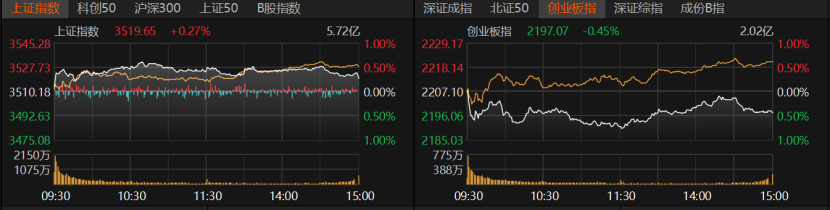
Market Overview - The Shanghai Composite Index closed at 3519.65 points, up 0.27%, with a trading volume of 623.1 billion yuan [1] - The Shenzhen Component Index closed at 10684.52 points, down 0.11%, with a trading volume of 835.6 billion yuan [1] - The ChiNext Index closed at 2197.07 points, down 0.45%, with a trading volume of 387.28 billion yuan [1] - The STAR Market 50 Index closed at 992.39 points, down 0.21%, with a trading volume of 22.92 billion yuan [1] - Total trading volume for both markets was 1458.75 billion yuan, a decrease of 253.38 billion yuan from the previous trading day [1] Sector Performance - Strong sectors included machinery, public utilities, oil and petrochemicals, textiles, chemicals, non-ferrous metals, and pharmaceuticals [2] - Active concepts included PEEK materials, humanoid robots, geothermal energy, and innovative drugs [2] - Weak sectors included real estate, media, securities, education, insurance, and retail [2] Fund Flow - The net outflow of main funds from the Shanghai and Shenzhen markets was 26.576 billion yuan [3] - The net outflow from the ChiNext was 12.112 billion yuan, and from the CSI 300 was 6.366 billion yuan [4] - Only four sectors saw net inflows: machinery (394 million yuan), home appliances (117 million yuan), coal (38 million yuan), and oil and petrochemicals (37 million yuan) [4] Individual Stock Performance - A total of 2089 stocks saw net inflows, with 37 stocks receiving over 100 million yuan in net inflows [5] - The stock with the highest net inflow was Zhongji Xuchuang, with 497 million yuan [6] - Conversely, 3048 stocks experienced net outflows, with 92 stocks seeing over 100 million yuan in net outflows [7] - BYD had the highest net outflow at 1.308 billion yuan [8] Institutional Activity - Institutions had a net buy of approximately 33.89 million yuan, with 17 stocks being net bought and 14 stocks net sold [9] - The stock with the highest institutional net buy was Xiangyang Bearing, with about 111 million yuan [10]