
有色金属

Search documents
有色金属日报-20260225
Guo Tou Qi Huo· 2026-02-25 12:52
Report Industry Investment Ratings - Copper: Not clearly specified [2] - Aluminum: Not clearly specified [3][6] - Alumina: Not clearly specified [3] - Cast Aluminum Alloy: Not clearly specified [3] - Zinc: Not clearly specified [4] - Nickel and Stainless Steel: Slightly bullish [7] - Tin: Not clearly specified [8] - Lithium Carbonate: Not clearly specified [9] - Industrial Silicon: Not clearly specified [10] - Polysilicon: Bearish [11] Core Views - The market is weighing the strength of post - holiday peak - season consumption in China and assessing the risk of US tariff changes, and the global exchange's visible copper inventory is high. Copper prices may adjust to the MA60 moving average [2] - Aluminum inventory has increased seasonally, and short - term aluminum prices are expected to oscillate between 23,000 - 24,000 yuan. Cast aluminum alloy's spread with Shanghai aluminum will be weaker than in previous years. Alumina is in range - bound trading [3] - Glencore's 2026 zinc concentrate production is expected to be cut by nearly 200,000 tons, and the export window of domestic zinc ingots is approaching. Short - term zinc prices are expected to oscillate between 24,200 - 25,600 yuan per ton [4] - Aluminum prices are at a low level, with cost support but insufficient consumption recovery. The import window is open, and aluminum prices are expected to oscillate between 16,500 - 17,000 yuan per ton [6] - Nickel is influenced by the rebound of the metal periphery and the expected reduction of Indonesian ore production, but high inventory is a concern. Short - term trend is slightly bullish [7] - Tin prices have risen significantly, and in the traditional off - season, Indonesian supply is stable. It is recommended to observe the change of out - of - the - money call option premiums [8] - Lithium carbonate is in a strong shock, but downstream trading willingness is weak. Technical analysis shows a strong - shock trend [9] - Industrial silicon demand is weak, and the market is expected to continue to oscillate. Attention should be paid to the resumption and start - up rhythm of large factories in March [10] - Polysilicon production has decreased in February, but downstream silicon wafer production cuts exceed expectations, inventory accumulates, and prices are expected to be weak [11] Summaries by Metal Copper - Wednesday, Shanghai copper closed up in shock, and the spot price was 102,065 yuan. The spread in Shanghai was - 180 yuan, and in Guangdong it was - 220 yuan. It is recommended to continue the inter - period reverse arbitrage of near - month contracts, and copper prices may adjust to the MA60 moving average [2] Aluminum & Alumina & Aluminum Alloy - Shanghai aluminum followed the non - ferrous metals to oscillate strongly. The spot spreads in East China, Central China, and Foshan expanded. Aluminum ingot social inventory increased by 211,000 tons to 1.125 million tons, and aluminum rod inventory increased by 74,000 tons to 383,000 tons. Cast aluminum alloy follows Shanghai aluminum, and the spread with Shanghai aluminum is weaker than in previous years. Alumina's over - supply situation has improved, but the upward driving force is limited, and it is in range - bound trading [3] Zinc - Glencore's 2026 zinc concentrate production is expected to be cut by nearly 200,000 tons. The export window of domestic zinc ingots is approaching, and short - term zinc prices are expected to oscillate between 24,200 - 25,600 yuan per ton [4] Aluminum - The average price of SMM 1 aluminum is 16,525 yuan per ton, with a spread of - 150 yuan per ton against the near - month contract. The import window is open, and aluminum prices are expected to oscillate between 16,500 - 17,000 yuan per ton [6] Nickel and Stainless Steel - Shanghai nickel continued to rebound. It is affected by the rebound of the metal periphery and the expected reduction of Indonesian ore production, but high inventory is a concern. Short - term trend is slightly bullish [7] Tin - Shanghai tin increased significantly with increased positions, breaking through the 400,000 - yuan mark. In January, Indonesia's tin ingot exports increased year - on - year, and in February, the tin ingot exchange in the country completed 3,030 tons of transactions. It is recommended to observe the change of out - of - the - money call option premiums [8] Lithium Carbonate - Lithium carbonate is in a strong shock. There are concerns about the supply side, but downstream trading willingness is weak. Technical analysis shows a strong - shock trend [9] Industrial Silicon - Industrial silicon futures closed slightly up. The downstream silicone开工率 is about 60%, and the demand is weak. The market is expected to continue to oscillate, and attention should be paid to the resumption and start - up rhythm of large factories in March [10] Polysilicon - Polysilicon futures closed slightly down. The acquisition announcement of leading enterprises has limited impact on market sentiment. Production has decreased in February, but downstream silicon wafer production cuts exceed expectations, inventory accumulates, and prices are expected to be weak [11]
春节后资金回流分化
Di Yi Cai Jing Zi Xun· 2026-02-25 12:51
Group 1 - A-shares have seen a significant capital inflow after the Spring Festival, with margin financing returning 346 billion yuan on the first trading day after the holiday, indicating a shift in market sentiment [2][3] - The preference for leveraged funds has changed dramatically, with sectors that were previously sold off seeing substantial buying, particularly in technology-related stocks [4][5] - Despite the inflow of margin funds, main capital has continued to flow out, indicating a shift from high valuation sectors to cyclical and undervalued sectors [7][8] Group 2 - On February 24, 26 sectors received capital replenishment from leveraged funds, with significant inflows into electronics, computers, and defense industries, while sectors like utilities and oil & gas saw reductions [5][6] - The overall market sentiment has improved, with major indices showing gains, yet main capital has been net outflowing, particularly from high valuation sectors like media and computing [7][8] - Analysts suggest that the liquidity environment may remain loose post-holiday, with multiple factors such as household savings moving into the market and increased foreign investment potentially benefiting A-shares [9]

近半主动权益基金净值新高 200多只“毛基”上岸 谁带来了开年“钱途”?
Di Yi Cai Jing· 2026-02-25 12:17
Core Viewpoint - The A-share market has experienced a significant surge, with public equity funds seeing a strong start to the year, as nearly half of these products have reached historical net asset value highs, and over 90% have achieved positive returns [1][2]. Group 1: Market Performance - The A-share market has shown a strong upward trend, with over 3,700 stocks rising and more than 100 hitting the daily limit in the last two days [6]. - The trading volume has increased significantly, surpassing 2 trillion yuan, reaching 2.48 trillion yuan [6]. - The performance of the non-ferrous metal sector has been particularly strong, with a year-to-date increase of 21.94%, and 18 constituent stocks within this sector have seen gains exceeding 50% [3]. Group 2: Fund Performance - Among 4,780 comparable active equity funds, 2,347 have achieved historical net asset value highs this year, representing 49.1% of the total [2]. - Over 90% of active equity funds have recorded positive returns since the beginning of the year, with 149 funds showing gains of over 20% [2]. - The top-performing funds, managed by the same fund manager, have achieved returns of 52.64%, 51.95%, and 46.61% respectively [2]. Group 3: Investment Strategies - Investment strategies are shifting from liquidity-driven to profit-driven, with a recommendation for investors to maintain a contrarian mindset as market leadership may rotate quickly [1]. - The focus on resource-related sectors has provided significant advantages in the current market environment, with many top-performing funds heavily invested in non-ferrous metals and technology stocks [3][4]. - Analysts suggest that the market may stabilize and recover post-Spring Festival, with emerging technologies and value stocks expected to perform well [7].





春节后资金回流分化:杠杆资金 “回血”,主力持续净流出
Di Yi Cai Jing· 2026-02-25 11:35
Group 1 - The core point of the article highlights a significant return of leveraged funds to the A-share market, with a total inflow of 34.6 billion yuan on the first trading day after the Spring Festival, indicating a shift in market sentiment and investment preferences [1][2][3]. Group 2 - After a substantial outflow of margin financing funds before the Spring Festival, which saw a net outflow of 755.35 billion yuan, the first trading day post-holiday marked a notable recovery with a net inflow of 346.32 billion yuan [2][3]. - The preference for leveraged funds has shifted dramatically, with significant buying in technology sectors such as electronics, computers, and defense, contrasting with the previous trend of selling in these areas [3][4]. - The main funds have continued to experience net outflows, with over 100 billion yuan leaving the market in the past two trading days, indicating a shift from high-value sectors to undervalued, cyclical sectors [6][7]. Group 3 - Specific stocks that attracted significant margin buying include Zhongji Xuchuang, with a net inflow of 1 billion yuan, and several others like Kingsoft Office and Guizhou Moutai, which also saw substantial interest [4][5]. - Conversely, stocks like Light Media and CATL faced heavy selling pressure, resulting in notable declines over the same period [5]. Group 4 - The overall market sentiment has improved, with A-share trading volume reaching 2.48 trillion yuan, reflecting a recovery in trading activity and investor confidence [6][7]. - Analysts predict that liquidity conditions may remain favorable post-holiday, driven by factors such as the relocation of household savings and increased inflows from various investment vehicles [7].
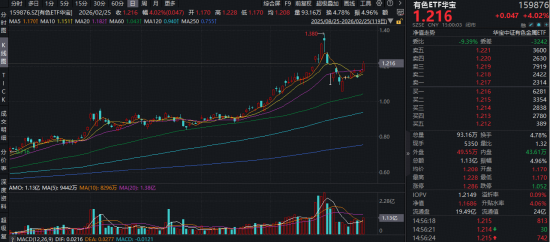
超245亿主力资金狂涌!有色ETF(159876)猛拉4%!“工业牙齿”钨一年暴涨220%,机构:后市还可能接着涨!
Xin Lang Cai Jing· 2026-02-25 11:26
Core Viewpoint - The non-ferrous metal sector has seen a significant inflow of over 24.5 billion in main funds, leading the market in capital absorption, with Northern Rare Earth topping the A-share capital absorption list [1][8]. Group 1: Macro Perspective - The U.S. government is utilizing the Pentagon's AI project to establish "reference prices" for critical minerals and build a global metal trading group, indicating a shift in the global metal market from "cost efficiency first" to "safety premium first" [3][10]. - According to Galaxy Securities, the prices of key mineral resources such as copper, tungsten, and rare earths are expected to rise due to the "safety premium" [3][10]. Group 2: Industry Perspective - Spot gold has approached 5,200 USD per ounce, while tungsten, known as the "industrial tooth," has experienced a strong upward trend since last year, with prices increasing over 220% throughout the year [3][10]. - Five Mining Securities believes that China's dominant position in the tungsten industry chain will remain unchallenged for the next 5-10 years [3][10]. - According to CICC, the global tungsten supply-demand gap is expected to continue to widen from 2026 to 2028, supporting a sustained increase in tungsten price levels [3][10]. Group 3: Performance Perspective - The non-ferrous ETF (159876) has seen over half of its constituent stocks disclose performance forecasts, with more than 80% of stocks expecting earnings growth and over 30% anticipating a doubling of earnings [3][10]. - Bank of China Securities suggests that as the market enters the second phase of a bull market—driven by profit growth—there will be opportunities for revaluation in the non-ferrous metal sector, supported by financial attributes and industry trends [3][10]. - The non-ferrous ETF covers a wide range of metals, including copper, aluminum, gold, rare earths, and lithium, allowing for effective exposure to the sector's beta trends [3][10].
近半主动权益基金净值新高,200多只“毛基”上岸,谁带来了开年“钱途”?
Di Yi Cai Jing Zi Xun· 2026-02-25 11:25
Core Viewpoint - The A-share market has experienced a significant surge, with public equity funds seeing a strong start to the year, as nearly half of these products have reached historical net asset value highs, and over 90% have achieved positive returns [1][2]. Group 1: Market Performance - The A-share market has shown a robust performance with over 3,700 stocks rising and more than 100 stocks hitting the daily limit up [6]. - The trading volume has increased significantly, surpassing 2 trillion yuan, reaching 2.48 trillion yuan [6]. - The metals sector has been a key driver, with the sector rising 21.94% year-to-date, and 18 constituent stocks gaining over 50% [3]. Group 2: Fund Performance - Among 4,780 comparable active equity funds, 2,347 have achieved historical net asset value highs, representing 49.1% of the total [2]. - Over 90% of active equity funds have recorded positive returns since the beginning of the year, with 149 funds increasing by over 20% [2]. - The top-performing funds, managed by the same fund manager, have reported year-to-date returns of 52.64%, 51.95%, and 46.61% respectively [2]. Group 3: Investment Strategies - Investment strategies are shifting from liquidity-driven to profit-driven, with a recommendation for investors to maintain a contrarian mindset as market leadership may rotate quickly [1]. - Focus areas for future investments include semiconductor chips and AI applications, with an emphasis on maintaining a balanced portfolio [6][7]. - The outlook for the market remains optimistic, with expectations for stabilization and recovery, particularly in emerging technologies and value stocks [7].
铜价延续涨势 受节后需求增加预期推动
Wen Hua Cai Jing· 2026-02-25 11:22
Group 1: Copper Market Insights - LME copper prices continued to rise, with three-month copper increasing by 0.93% to $13,288.50 per ton, reaching a peak of $13,308.50, the highest since February 12 [1] - Citigroup expressed a bullish outlook on copper prices, predicting they will reach $14,000 per ton in the next three months, citing limited short-term downside risks due to strong buying interest [1] - Chinese demand expectations were reinforced by a 60% surge in Yangshan copper premiums to $53 per ton, indicating a rebound in market demand [1] Group 2: Investment Plans and Projects - Vale, a Brazilian mining company, disclosed plans to invest $3.5 billion in its Carajas copper project from 2026 to 2030 [1] - First Quantum outlined a potential $5 billion development plan for its wholly-owned Taca-Taca copper project, positioning it as a key growth project for attracting foreign investment in Argentina [1] Group 3: Other Base Metals Performance - Three-month tin prices jumped over 5% to $52,950 per ton [2] - Three-month aluminum prices rose by 0.68% to $3,110.5 per ton [3] - Three-month zinc prices increased by 0.98% to $3,387.5 per ton [4] - Three-month lead prices went up by 0.44% to $1,959.5 per ton [5] - Three-month nickel prices surged by 3.66% to $17,915 per ton [6]
港股的分化,均衡的启发
Xin Lang Cai Jing· 2026-02-25 11:09
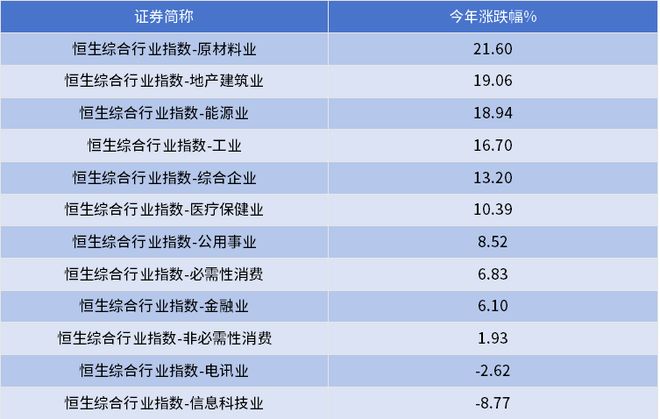
Market Performance - The Hong Kong stock market showed a positive performance during the Spring Festival, with the Hang Seng Technology Index rising over 3% and the overall Hang Seng Index increasing by 1.4% [1] - The A-share market also experienced a "New Year opening red," with the Shanghai Composite Index surpassing 4100 points [1] - Despite the initial positive performance, the Hong Kong market faced a downturn post-holiday, particularly in internet stocks, while sectors like materials, real estate, energy, and healthcare supported the market [1] Sector Performance - The performance of various sectors in the Hong Kong market is as follows: - Materials: +21.60% - Real Estate and Construction: +19.06% - Energy: +18.94% - Industrial: +16.70% - Healthcare: +10.39% - Financials: +6.10% - Information Technology: -8.77% [2] Investment Opportunities - There are significant investment opportunities in the Hong Kong market, particularly in sectors like industrial metals, high-end manufacturing, and innovative pharmaceuticals [3][16] - The influx of southbound capital has led to a change in pricing logic for Hong Kong stocks, making them more sensitive to changes in risk appetite from mainland investors [4] - The appreciation of the Renminbi since December 2024 has increased the attractiveness of Chinese assets, benefiting companies listed in Hong Kong that report earnings in Renminbi [5] Economic Factors - The Federal Reserve is in a rate-cutting cycle, and the expected changes in liquidity are limited, indicating a stable environment for the Hong Kong market [9] - The correlation between Hong Kong stocks and A-shares has strengthened, suggesting that Hong Kong stocks may experience passive increases alongside A-shares [4] Fund Management Insights - Fund manager Zhou Hanying, with extensive experience in global investments, is optimistic about sectors such as non-ferrous metals, AI, and innovative pharmaceuticals [3][16] - The upcoming fund, 景顺长城衡瑞精选混合, will focus on a balanced investment strategy, allowing for a maximum of 50% allocation to Hong Kong stocks to leverage Zhou's expertise [11]
基金投资价值分析:一键布局有色全赛道:南方中证申万有色金属ETF投资价值分析
Guoxin Securities· 2026-02-25 11:02
Quantitative Models and Construction Methods 1. Model Name: CSI SWS Non-ferrous Metal Index (000819.SH) - **Model Construction Idea**: The index is designed to reflect the overall performance of listed companies in the non-ferrous metal industry on the Shanghai and Shenzhen markets. It includes 50 securities from the SWS non-ferrous metal and non-metal material industries[31][32] - **Model Construction Process**: - **Sample Space**: Securities from the CSI All Share Index sample space listed on the Shanghai and Shenzhen markets[32] - **Selection Method**: 1. Rank securities by average daily trading volume over the past year and exclude the bottom 20%[32] 2. Select securities from the SWS non-ferrous metal and non-metal material industries[32] 3. Rank the remaining securities by average daily total market capitalization over the past year and select the top 50 as index samples[32] - **Sample Adjustment**: If the free-float market capitalization of the index samples is less than 70% of the SWS non-ferrous metal industry, the number of samples can be increased to improve industry representation[32] - **Periodic Adjustment**: The index samples are adjusted semi-annually, implemented on the second Friday of June and December[32] - **Model Evaluation**: The index comprehensively covers all subcategories of the non-ferrous metal field, including precious metals (gold, silver), industrial metals (copper, aluminum), and minor metals (tin, indium), providing broad industry representation[33] --- Model Backtesting Results CSI SWS Non-ferrous Metal Index - **P/E Ratio**: 30.79, at the 41.26% percentile as of February 11, 2026[37][40] - **P/B Ratio**: 4.33, at a historically high percentile[37] - **Net Profit Growth**: - 2024: -1.12% - 2025E: 55.23% - 2026E: 27.81%[40] - **Revenue Growth**: - 2024: 7.38% - 2025E: 8.61% - 2026E: 5.02%[40] - **Average Market Cap**: 1,017.31 billion RMB as of February 11, 2026[43] - **Top 10 Constituents Weight**: 47.89%, with major holdings such as Zijin Mining and CMOC showcasing strong profitability and resource reserves[46] - **Performance Comparison**: - Outperformed the CSI 300 Index in most periods since 2020 - Past 6 months return: 98.55% - Past 3 months return: 30.05% - Past 1 month return: 8.12% - 5-year annualized volatility: 30.63% - 5-year maximum drawdown: -54.27%[50][51] --- Quantitative Factors and Construction Methods 1. Factor Name: Industry Representation Factor - **Factor Construction Idea**: Ensure comprehensive representation of the non-ferrous metal industry by including all subcategories such as industrial metals, rare metals, and precious metals[33] - **Factor Construction Process**: - Weight distribution by industry: - Industrial metals: 52.42% - Rare metals: 29.59% - Precious metals: 14.75%[33] - **Factor Evaluation**: The factor ensures balanced exposure across key sub-industries, enhancing the index's representativeness and diversification[33] --- Factor Backtesting Results Industry Representation Factor - **Weight Distribution**: - Industrial metals: 52.42% - Rare metals: 29.59% - Precious metals: 14.75%[33]




策略点评:周期股领涨市场
Tebon Securities· 2026-02-25 11:00
Market Overview - The A-share market continues to show a strong upward trend, with the three major indices collectively rising. The cyclical sectors, including real estate services, non-ferrous metals, and steel, lead the market, while the technology growth sector shows mixed performance [3][6] - As of the market close, the Shanghai Composite Index rose by 0.72% to 4147.23 points, the Shenzhen Component Index increased by 1.29% to 14475.87 points, and the ChiNext Index climbed by 1.41% to 3354.82 points. The total market turnover reached approximately 2.48 trillion, indicating a good profit effect with 3742 stocks rising and 1609 falling [2][3] Sector Performance - The cyclical stocks have shown significant strength, with steel, non-ferrous metals, real estate, building materials, and basic chemicals rising by 4.26%, 3.53%, 2.51%, 2.41%, and 2.37% respectively. The recent policy adjustments in Shanghai's real estate sector have further boosted these sectors [6][8] - The rare earth sector also experienced a surge, with prices for various rare earth products increasing significantly post-holiday. For instance, the average price of praseodymium and neodymium oxide rose by 4.16 million yuan/ton, while neodymium metal increased by 8 million yuan/ton [6][8] Investment Themes - The report identifies several key investment themes, including AI applications, commercial aerospace, nuclear fusion, quantum technology, brain-machine interfaces, robotics, consumer sectors, brokerage firms, precious metals, and non-ferrous metals. Each theme has specific core logic and follow-up points for future monitoring [9][10] - The AI application sector is highlighted for its potential growth driven by product application acceleration and technological upgrades. The commercial aerospace sector is supported by the establishment of a commercial aerospace office, while nuclear fusion and quantum technology are gaining traction due to industrialization and policy support [9][10] Market Sentiment and Future Outlook - The report suggests a shift in market sentiment from "concept-driven" to "price-driven" profit enhancement, indicating a balanced allocation between technology and consumer sectors. The upcoming "Two Sessions" may further influence the cyclical sectors, particularly in real estate policy implementation and commodity prices [8][11] - The bond market is experiencing adjustments, with the long-end bonds leading the decline. The report notes that the LPR rates remain unchanged, and the market is expected to maintain a stable liquidity environment in the short term [8][11]