
商贸零售

Search documents
商贸零售行业5月社零报告专题:5月社零同比亮眼,国补叠加大促助发展
Donghai Securities· 2025-06-17 09:43
Investment Rating - The industry investment rating is "Overweight" [1] Core Viewpoints - In May 2025, the total retail sales of consumer goods reached 41,326 billion yuan, with a year-on-year growth of 6.4%, exceeding the consensus expectation of 4.85% [10][12] - Urban retail sales growth has outpaced rural markets for three consecutive months, with urban sales increasing by 6.5% and rural sales by 5.4% in May [12] - Offline retail performance is stronger than online, with offline retail sales growing by 10.50% year-on-year in May, while online sales saw a decline of 4.25% [15][24] Summary by Sections Overall Retail Sales - The total retail sales in May 2025 grew by 6.4% year-on-year, reaching 41,326 billion yuan, which is higher than the expected growth rate [10][12] Regional Performance - Urban retail sales amounted to 36,057 billion yuan, growing by 6.5%, while rural retail sales were 5,269 billion yuan, with a growth of 5.4% [12] Channel Performance - Offline retail sales increased by 10.50% year-on-year, while online retail sales decreased by 4.25% in May [15] Category Performance - The restaurant sector saw stable growth, with a total revenue of 4,578 billion yuan, up 5.9% year-on-year. The total retail sales of goods reached 36,748 billion yuan, growing by 6.5% [24] - Essential and discretionary categories showed strong performance, with year-on-year growth rates of 11.38% for essentials and 7.87% for discretionary items in May [30][31] Price Trends - Both CPI and PPI showed a year-on-year decline, with CPI at -0.1% and PPI at -3.3% in May [37][39] Employment Situation - The urban unemployment rate in May 2025 was 5.0%, marking a continuous decline for three months [46][48] Investment Recommendations - The report suggests focusing on high-end liquor and regional leaders in the liquor industry due to competitive dynamics. It also recommends attention to the restaurant supply chain as consumer spending in dining is expected to recover [54]
商贸零售行业:5月社零环比提速,消费品以旧换新政策持续显效
Dongxing Securities· 2025-06-17 07:21
Investment Rating - The industry investment rating is "Positive" [6] Core Viewpoints - In May 2025, the total retail sales of consumer goods increased by 6.4% year-on-year, with a month-on-month acceleration primarily due to the early timing of the "6·18" promotional event [1] - Essential consumption categories showed steady growth, while discretionary categories continued to recover, with significant increases in sales for home appliances and furniture driven by government policies [2][3] - Online retail channels experienced robust growth, while offline channels showed structural differentiation, with a continued preference for high-cost performance products among consumers [4] Summary by Sections Retail Sales Performance - In May 2025, the total retail sales of consumer goods reached a year-on-year growth of 6.4%, with a month-on-month increase of 1.3 percentage points compared to April [1] - Cumulative retail sales from January to May 2025 showed a year-on-year growth of 5.0%, indicating a steady recovery in consumption [1] Consumption Types - Essential consumption maintained steady growth, with food, beverages, and daily necessities showing year-on-year sales increases of 14.6%, 0.1%, and 8.0% respectively [2] - Discretionary consumption categories, such as cosmetics and apparel, showed signs of recovery, with notable performance in gold and jewelry sales due to rising gold prices [2][3] Policy Impact - High-growth categories benefited from supportive consumption policies, with home appliances sales increasing by 53.0% year-on-year, furniture by 25.6%, and gold and silver jewelry by 21.8% [3] - The impact of government subsidies on consumer purchases was significant, particularly in the home improvement sector [3] Retail Channel Dynamics - Online retail sales grew by 8.5% year-on-year in the first five months of 2025, with physical goods online retail accounting for 24.5% of total retail sales [4] - Offline retail channels showed a mixed performance, with convenience stores and specialty stores growing at 8.5% and 6.3% respectively, while department stores lagged behind [4] Investment Strategy - The report suggests focusing on durable goods sectors benefiting from policy support and companies with strong channel integration and product competitiveness [4]



“申”挖数据 | 资金血氧仪
申万宏源证券上海北京西路营业部· 2025-06-17 01:36
Group 1 - The main viewpoint indicates that the market is experiencing a net outflow of capital, with a total of 117.607 billion yuan in the last two weeks, while the coal industry is seeing net inflows [2] - The financing and securities lending data shows a current balance of 1.821325 trillion yuan, an increase of 0.66% from the previous period, with the financing balance at 1.808988 trillion yuan and the securities lending balance at 12.337 billion yuan [2] - The market has seen more declining stocks than rising ones in the last two weeks, with the top three sectors in terms of gains being non-ferrous metals, oil and petrochemicals, and telecommunications, while the sectors with the largest declines are food and beverage, household appliances, and commercial building materials [2] Group 2 - The overall strength analysis score for all A-shares is 5.39, indicating a neutral zone, with the CSI 300 score at 5.43, the ChiNext score at 5.60, and the Sci-Tech Innovation Board score at 5.42 [2] - The article notes that due to escalating geopolitical conflicts, global risk appetite is declining, leading to a drop in the Shanghai Composite Index below the 5-day moving average, with market focus shifting towards defensive sectors [3] - It is suggested that the A-share market is likely to continue a structural trend in the second half of the year, with a need to monitor whether capital returns to previous hot sectors, while mid-to-long-term attention should be given to technology and Hong Kong stock market trends [3]


上周公募基金调研明显升温,天孚通信最受关注
Xin Hua Cai Jing· 2025-06-17 01:35
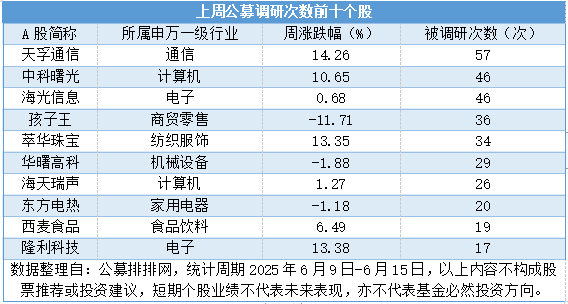
Group 1 - Public fund research has shown a significant increase, with 129 public fund institutions conducting 780 research sessions on 135 stocks across 22 industries from June 9 to June 15, 2025, marking a 17.82% increase from the previous week [1][2] - Tianfu Communication emerged as the most favored stock among public fund institutions, attracting nearly 40% of public funds with a total of 57 research sessions [1][2] - The computer industry saw Zhongke Shuguang and Haitan Ruisheng being researched 46 times and 26 times respectively, while in the electronics sector, Haiguang Information and Longli Technology were researched 46 times and 17 times respectively [1][2] Group 2 - The electronics industry led the research interest with 160 sessions, followed by the computer industry with 104 sessions, indicating a strong focus on technology sectors [2][3] - Other popular industries among public fund institutions included communication, textile and apparel, defense and military, machinery, pharmaceuticals, retail, basic chemicals, and food and beverage [3] - 63 public fund institutions maintained a high-frequency research pace, averaging over 5 sessions per week, with Penghua Fund leading with 23 sessions [3]

5月社会零售品消费数据点评:5月社零同比+6.4%,国补相关品类及金银增速领先
Shenwan Hongyuan Securities· 2025-06-16 14:26
Investment Rating - The industry investment rating is "Overweight," indicating that the industry is expected to outperform the overall market [11]. Core Insights - In May 2025, the total retail sales in China reached 4.1 trillion yuan, showing a year-on-year growth of 6.4%, exceeding market expectations of 4.9% [5][6]. - The online retail sales growth for the first five months of 2025 was 8.5%, which is 3.5% higher than the overall retail sales growth [5]. - The "old-for-new" policy has significantly boosted consumption in various categories, with the sales of consumer electronics and gold jewelry showing remarkable growth [5]. Summary by Sections Retail Sales Performance - May 2025 retail sales grew by 6.4% year-on-year, with a month-on-month increase of 1.3 percentage points [5]. - Excluding automobiles, retail sales of consumer goods increased by 7.0% year-on-year [5]. - The "May Day" holiday and the preemptive "618" shopping festival contributed to the growth in both online and offline retail [5]. Online and Offline Retail Trends - Online retail sales in May reached 1,061.3 billion yuan, growing by 8.19% year-on-year [5]. - The online penetration rate increased to 25.7% in May, up from 25.3% in the same month last year [5]. - Offline retail continues to focus on supply chain optimization and enhancing consumer experience [5]. Consumption Categories - In May, the retail sales of goods grew by 6.5%, driven by government subsidies and the "old-for-new" policy [5]. - The restaurant sector also saw improvements, with a year-on-year growth of 5.9% in May [5]. - Various categories experienced significant growth, such as communication equipment (+33.0%) and gold jewelry (+21.8%) [5]. Investment Recommendations - The report suggests a positive outlook for e-commerce and instant retail sectors, highlighting companies like Alibaba, JD.com, and Meituan [5]. - It also recommends investing in quality gold jewelry brands and the travel industry, anticipating growth in consumer demand during the summer [5]. - The report emphasizes the importance of enhancing product offerings and store experiences in the department store and supermarket sectors [5].
A股平均股价11.60元 47股股价不足2元
Zheng Quan Shi Bao Wang· 2025-06-16 10:39
Core Points - The average stock price of A-shares is 11.60 yuan, with 47 stocks priced below 2 yuan, the lowest being退市鹏博 at 0.20 yuan [1][2] - As of June 16, the Shanghai Composite Index closed at 3388.73 points, indicating a relatively low proportion of both high-priced and low-priced stocks in the A-share market [1][2] - Among the low-priced stocks, 15 are ST stocks, accounting for 31.91% of the total [1] Low-Priced Stocks Summary - The lowest priced stock is退市鹏博 at 0.20 yuan, followed by人乐退 at 0.50 yuan and龙津退 at 0.62 yuan [1] - In terms of market performance, 26 of the low-priced stocks increased in price, with美邦服饰, ST中珠, and ST易购 showing the highest gains of 10.17%, 4.85%, and 3.26% respectively [1][2] - Conversely, 6 stocks experienced declines, with退市海越, 人乐退, and龙津退 showing the largest drops of 27.34%, 9.09%, and 7.46% respectively [1][2] Stock Performance Data - A detailed table lists various low-priced stocks, their latest closing prices, daily price changes, turnover rates, and industry classifications [1][2] - Notable stocks include美邦服饰 with a significant daily increase of 10.17% and退市海越 with a notable decline of 27.34% [1][2]


行业点评报告:2025年5月社零同比+6.4%,社会消费趋势向上
KAIYUAN SECURITIES· 2025-06-16 08:47
Investment Rating - The industry investment rating is "Positive" (maintained) [1] Core Viewpoints - The social retail sales (社零) for May 2025 increased by 6.4%, indicating an upward trend in social consumption [5] - The total retail sales from January to May 2025 reached 20,317.1 billion yuan, with a year-on-year growth of 5.0% [5] - The online retail sales for the same period amounted to 6,040.2 billion yuan, reflecting an 8.5% increase [7] - The report emphasizes the recovery of consumer sentiment and the importance of high-quality companies in sectors aligned with "emotional consumption" [8] Summary by Sections Social Consumption Trends - The retail sales in May 2025 were 41,326 billion yuan, surpassing the Wind consensus forecast of 4.9% [5] - Urban and rural retail sales from January to May grew by 5.1% and 4.9%, respectively [5] Retail Performance - In May, the overall retail sales increased by 6.5%, with essential consumption categories like food and beverages showing strong growth [6] - The sales of home appliances and audio-visual products surged by 53.0% year-on-year, benefiting from government subsidies [6] Online and Offline Channels - Online retail sales of physical goods grew by 6.3%, accounting for 24.5% of total retail sales [7] - Offline retail channels, including supermarkets and convenience stores, showed positive growth, with supermarkets increasing by 5.7% [7] Investment Recommendations - The report suggests focusing on high-quality companies in sectors benefiting from emotional consumption, including: 1. Gold and jewelry brands with differentiated product offerings [8] 2. Retail enterprises adapting to market trends [8] 3. High-quality domestic beauty brands [8] 4. Medical beauty product manufacturers with unique pipelines [8]
新消费板块再梳理
2025-06-15 16:03
Summary of Key Points from Conference Call Records Industry Overview - **New Consumption Sector**: The new consumption sector is expected to show strong growth in 2025, contrasting with the sluggish performance of traditional consumption. Key drivers include product innovation, marketing transformation, and policy support. Investors should focus on companies with sustainable innovation capabilities and stable high growth [1][2][3]. Key Insights and Arguments - **Home Appliance Industry**: The home appliance sector is affected by adjustments in national subsidy policies, but overall subsidies will not cease. Offline consumption guidance policies will impact the competitive landscape, favoring companies with offline sales networks. Leading white goods companies like Midea are seen as good investment opportunities after valuation adjustments [1][4][5]. - **Small Home Appliances**: Competition in the small appliance sector is easing, leading to improved profit margins. Companies like Beiding are gaining attention due to governance improvements and channel expansion, aligning with the trend of aesthetic economy [1][9]. - **Light Industry**: The new consumption landscape includes promising areas such as e-cigarettes, AR glasses, trendy blind boxes, and personal care products. Leading companies like Pop Mart are performing well, and domestic brands are rapidly increasing market share through new channels like Douyin [1][10]. - **Pet Industry**: The pet sector showed strong performance during the 618 shopping festival, with domestic brands like Guibao Pet and Zhongchong Co. gaining attention. Companies like Ruipubio and Petty Co. are also noteworthy, while the pig farming sector may face profit declines due to falling pig prices and slowing production capacity [1][15][16]. Additional Important Content - **Investment Directions**: Future investment directions focus on companies with continuous changes, stable high growth, and those that can tell new stories to gain market recognition. Recommended companies include Ru Yuchen and Jinbo Biological in the personal care sector, and emerging beverage and snack companies like Yanjin, Weilong, and Bailong Chuangyuan, which are expected to maintain around 40% growth in 2025 [2][3]. - **Subsidy Policy Impact**: The subsidy policy will continue in the second half of the year, although some regions may temporarily pause it due to rapid progress. The aim is to stimulate the economy rather than directly increase profits for platforms or companies. New subsidy policies may emerge to guide offline consumption [5][6]. - **High Tariffs on Exports**: The U.S. tariffs on imported steel and aluminum negatively impact white goods that rely heavily on these materials. Leading white goods companies may face pressure in the second half of the year, but if valuations adjust to around 10 to 12 times, companies like Midea could present good investment opportunities [7][8]. - **E-cigarette Market**: The e-cigarette market is a rapidly growing sector globally, with harm-reduction products gradually replacing traditional cigarettes. Companies like British American Tobacco and their contract manufacturers are expected to perform well [11]. - **AR Glasses**: AR glasses are seen as a significant product in the new consumption field, with several new products being launched. Companies like Inpax and Mingyue are recommended for investment [12]. - **Retail Sector Recommendations**: The retail sector's investment focus is on new consumption areas like gold jewelry and tea drinks, with leading companies like Laopu Gold showing strong performance. The education sector, particularly private high schools and training institutions, is also highlighted for potential growth [17]. Catalysts and Events - **Upcoming Catalysts**: Notable upcoming events include the launch of new products in the AI glasses industry and other AI products, which could create investment opportunities. Companies like Kangnait Optical are expected to perform well due to their competitive advantages [18][19].




金融工程市场跟踪周报:市场风格或有切换-20250615
EBSCN· 2025-06-15 15:21
- The report discusses the **Volume Timing Signal** for broad-based indices, indicating a bullish view across all indices as of June 13, 2025[24][25] - The **HS300 Upward Stock Count Ratio Sentiment Indicator** is introduced, calculated as the proportion of HS300 constituent stocks with positive returns over the past N days. This indicator is effective in capturing upward opportunities but has limitations in predicting market downturns. As of June 13, 2025, the indicator shows a slight decline but remains above 60%, reflecting positive market sentiment[25][26] - The **HS300 Upward Stock Count Ratio Timing Strategy** applies two smoothing windows (N1=50, N2=35) to the sentiment indicator. When the short-term line exceeds the long-term line, it signals a bullish market view. As of June 13, 2025, both lines are trending downward, with the short-term line below the long-term line, suggesting a cautious market outlook[27][29] - The **Moving Average Sentiment Indicator** uses eight moving averages (8, 13, 21, 34, 55, 89, 144, 233) to assess the HS300 index's trend. The indicator assigns values of -1, 0, or 1 based on the position of the index within predefined ranges. As of June 13, 2025, the HS300 index is in a positive sentiment zone, indicating a bullish trend[33][37] - **Cross-sectional Volatility** is analyzed for HS300, CSI500, and CSI1000 indices. Over the past week, HS300's cross-sectional volatility increased, improving the short-term alpha environment, while CSI500 and CSI1000 saw declines, weakening their alpha environments. Over the last quarter, HS300's volatility is in the upper half of its six-month range, indicating a favorable alpha environment, while CSI500 and CSI1000 are in the lower and middle ranges, respectively[38][40] - **Time-series Volatility** is also examined for the same indices. Over the past week, HS300's time-series volatility increased, enhancing its alpha environment, while CSI500 and CSI1000 experienced declines, worsening their alpha environments. Over the last quarter, HS300's volatility is in the upper half of its six-month range, while CSI500 and CSI1000 are in the middle ranges, indicating a generally stable alpha environment[40][43]


筹码新动向:202股筹码趋向集中
Zheng Quan Shi Bao Wang· 2025-06-13 09:39
Summary of Key Points Core Viewpoint - A total of 479 stocks reported their latest shareholder numbers as of June 10, with 202 stocks showing a decline in shareholder numbers compared to the previous period, indicating a trend of decreasing investor interest in certain companies [1][3]. Group 1: Shareholder Numbers and Changes - Among the 479 stocks, 202 experienced a decline in shareholder numbers, with 9 stocks seeing a decrease of over 10% [3]. - The stock with the largest decline in shareholder numbers was Shanshui Bide, which reported 4,744 shareholders, a decrease of 22.00% from the previous period [3]. - Dongshan Precision followed with 79,831 shareholders, down 17.81%, while Guoguang Chain saw a decline of 14.45% [3]. Group 2: Stock Performance - The average performance of concentrated stocks since May 21 showed a 0.46% increase, outperforming the Shanghai Composite Index, which fell by 0.10% [2]. - Among the stocks with a decline in shareholder numbers, Yuanlong Yatu had the highest increase of 60.74% since May 21 [2]. - Other notable performers included Tianfu Communication and Hasan Lian, with increases of 39.72% and 30.01%, respectively [2]. Group 3: Industry Concentration - The concentrated stocks were primarily found in the machinery, basic chemicals, and electronics sectors, with 24, 20, and 19 stocks respectively [3]. - The data indicates a significant concentration of investor interest in these industries, suggesting potential investment opportunities [3].

