
铜

Search documents
回归基本面,反内卷期待下半场
2025-08-05 03:15
Summary of Conference Call Records Industry Overview - The steel industry is experiencing a phase of "anti-involution," which shows improvement but relies on demand support and self-driven supply-demand turning points [1][3][5] - The copper market is facing supply disruptions, with a global supply decrease of over 100,000 tons in the first half of the year, leading to a weak supply-demand balance [10][17] Key Points and Arguments Steel Industry - The steel sector performed well in the first half of 2025 due to self-driven profit points, coking coal concessions, and policy expectations [1][5] - The second half of 2025 is expected to enter a phase of anti-involution execution and production cuts, leading to a new round of profit improvement [5][6] - Current macro conditions are similar to 2021, with a demand downturn and policy speculation, but the market has found a bottom, reducing reliance on policy support [1][6] - The average daily pig iron output has not significantly decreased, indicating that production cuts have not yet been effectively implemented [6] Copper Market - The 232 tariff policy has led to high copper inventories in the U.S., resulting in a proactive destocking cycle and weakening global demand [9] - Short-term copper prices are expected to fluctuate between $9,000 and $9,500, with a potential for a new upward cycle in 2026 if major economies experience liquidity easing [11][17] Aluminum Market - Significant increases in aluminum rod and electrolytic aluminum inventories, with weekly production nearing peak levels, may lead to price corrections, but prices are unlikely to fall below 20,000 RMB/ton [12] - High-dividend companies in the aluminum sector remain attractive for investment [12][18] Small Metals Market - Cobalt is entering a supply contraction and price increase phase, while rare earth materials are in short supply, leading to expected price increases [15][19] - Lithium carbonate and nickel are at cost support bottoms, requiring attention to supply-side changes for potential recovery [20] Other Important Insights - The current market environment is characterized as a "mid-game pause," with expectations for a turnaround in fundamentals in the second half of the year [5][7] - Investors are advised to focus on asset allocation opportunities, particularly during the economic bottoming process and under significant PPI pressure [7] - The overall sentiment in the gold market is cautious, with prices expected to remain in a range due to macroeconomic conditions [13][14] This summary encapsulates the key insights from the conference call, highlighting the dynamics within the steel, copper, aluminum, and small metals markets, along with investment strategies and macroeconomic considerations.
国泰君安期货商品研究晨报-20250805
Guo Tai Jun An Qi Huo· 2025-08-05 02:38
Report Industry Investment Ratings No specific industry investment ratings are provided in the report. Core Views of the Report The report provides trend analyses and investment suggestions for various commodities in the futures market, including precious metals, base metals, energy, chemicals, agricultural products, etc. Different commodities show different trends such as upward, downward, and oscillatory movements, influenced by factors like macro - economic news, supply - demand relationships, and policy changes [3][6]. Summaries by Commodity Precious Metals - **Gold**: Non - farm payroll data is weak, with positive price trends. For example, the closing price of沪金2510 was 781.42 with a daily increase of 1.39%, and the night - session closing price was 784.50 with a 0.52% increase [7][8]. - **Silver**: Shows a slight rebound [7]. Base Metals - **Copper**: Spot prices are firm, supporting the price. However, Trump's tariff policy on semi - finished copper products may impact the market. The trend strength is neutral [12][14]. - **Zinc**: Ranges within an oscillatory band. Trump's plan to fill Fed理事 vacancies may affect the market, with a neutral trend strength [15]. - **Lead**: Continuous reduction in inventory limits price decline, with a neutral trend strength [18]. - **Tin**: Moves within an oscillatory range, with a slightly bearish trend strength [20][23]. - **Aluminum**: Ranges within an oscillatory band; Alumina shows a weakening oscillatory trend; Casting aluminum alloy follows the trend of electrolytic aluminum, all with neutral trend strengths [24][26]. - **Nickel**: Intensified multi - short competition leads to narrow - range oscillations; Stainless steel returns to fundamentals after the macro - factor fades, with steel prices oscillating at a low level, both with neutral trend strengths [27][28][32]. Energy and Chemicals - **Carbonate Lithium**: Warehouse receipts increase significantly, and the price oscillates, with a neutral trend strength [33][35]. - **Industrial Silicon**: In a weak pattern, with a bearish trend strength [36][39]. - **Polysilicon**: Short - term sentiment cools down, and it's necessary to pay attention to news stimuli, with a neutral trend strength [37][39]. - **Iron Ore**: Oscillates repeatedly, with a neutral trend strength [40]. - **Rebar and Hot - Rolled Coil**: Market sentiment cools down, and prices oscillate in a wide range, both with neutral trend strengths [43][44][46]. - **Silicon Ferrosilicon and Manganese Silicide**: Market sentiment cools down, and prices oscillate in a wide range, both with neutral trend strengths [48][50]. - **Coke and Coking Coal**: Oscillate in a wide range, both with neutral trend strengths [51][54]. - **Log**: Oscillates repeatedly, with a neutral trend strength [55][58]. - **Para - Xylene**: Unilaterally oscillates weakly and gives downward concessions; PTA shows a weakening trend, and attention should be paid to positive spreads in monthly differences; MEG oscillates unilaterally [61]. Agricultural Products - **Palm Oil**: With repeated macro - sentiment, it's advisable to mainly build long positions at low levels [62]. - **Soybean Oil**: Oscillates at a high level, and attention should be paid to the Sino - US trade agreement [62]. - **Soybean Meal**: Overnight US soybeans closed slightly higher, and domestic soybean meal oscillates strongly [64]. - **Soybean**: Rebounds and oscillates [64]. - **Corn**: Runs weakly [66]. - **Sugar**: Narrowly consolidates [67]. - **Cotton**: Attention should be paid to the impact of external markets [68]. - **Egg**: The bullish expectation for the spot price is dashed, and market sentiment collapses [70]. - **Live Pig**: Maintains a pattern of near - term weakness and far - term strength [71]. - **Peanut**: Attention should be paid to the weather in the production area [72].
帮主郑重:大宗商品上演“三岔口”!油铜金各走各路,中长线布局盯准这三条道
Sou Hu Cai Jing· 2025-08-04 23:37
Group 1: Oil Market Dynamics - WTI crude oil prices fell to $65.76 and Brent to $68.28, both down over 2% due to OPEC+ increasing production by 550,000 barrels per day, completing its reduction exit plan a year early, leading to a historical oversupply of 800,000 barrels per day [3] - Geopolitical tensions, such as potential U.S. tariffs on Russian oil purchased by India, are seen as ineffective in significantly impacting oil supply, with analysts skeptical about the actual enforcement of sanctions [3] - The oil price is expected to stabilize between $65-$70 in Q3, with a potential drop to $55 in Q4 due to cumulative effects of OPEC production increases and seasonal demand decline [3] Group 2: Copper Market Surge - LME copper prices increased by 0.6% following a tariff exemption from Trump, leading to a surge in inventory in New York by 400,000 tons, while Asian stocks dwindled to a 10-day warning level [4] - A mining accident in Chile has eliminated 25% of a major company's production capacity, contributing to a global copper inventory drop to 350,000 tons, creating a potential short squeeze in the market [4] - Long-term demand for copper is expected to rise significantly due to electric vehicles and renewable energy, with Goldman Sachs predicting copper prices to exceed $10,050 per ton by August and a supply gap of 3 million tons by 2030 [4] Group 3: Gold Price Stability - Spot gold prices rose by 0.4%, with futures reaching $3,426, supported by expectations of interest rate cuts from the Federal Reserve due to disappointing U.S. employment data [5] - The probability of a rate cut in September has surged to 94%, which typically drives investment towards safe-haven assets like gold [5] - The Federal Reserve's internal changes and signals of accelerated rate cuts have reinforced bullish sentiment for gold, with technical support seen at $3,400-$3,450 [5] Group 4: Investment Strategies - For oil, a strategy is to target upstream oil service companies and refining leaders if prices hit $55 in Q4, capitalizing on equipment upgrades and margin expansion [6] - In copper, focus on resource companies like Zijin Mining and Luoyang Molybdenum, which are less volatile than pure futures trading [7] - For gold, a dollar-cost averaging strategy into gold ETFs and mining stocks is recommended, increasing positions by 3% on price dips before the Fed's rate cut [8]


贵金属有色金属产业日报-20250804
Dong Ya Qi Huo· 2025-08-04 10:41
Report Industry Investment Rating There is no information provided in the report regarding the industry investment rating. Core Viewpoints - **Precious Metals**: The unexpectedly low US non - farm payroll data in July and the downward revision of the previous value have strengthened the market's expectation of a Fed rate cut in September. With the weakening of the US dollar and the decline in US Treasury yields, the cost of holding gold has decreased. Global central bank gold - buying demand, fiscal and monetary easing expectations, geopolitical and trade policy uncertainties are all factors driving the return of gold prices to fundamental strength [3]. - **Copper**: The recent decline in copper prices is due to the US adjustment of copper tariff policies. Although the tariff does not cover core upstream products, the high copper inventory in the US COMEX market may affect the price difference between LME and COMEX. The price of Shanghai copper is still closely linked to LME copper, and weak downstream demand is expected to emerge this week [16]. - **Aluminum and Related Products**: Macro factors have a negative impact on aluminum. Aluminum prices are expected to fluctuate under pressure. Alumina is expected to be weak in the short - term, while cast aluminum alloy has a relatively good fundamental situation, and its futures price generally follows the trend of Shanghai aluminum [37]. - **Zinc**: The supply side of zinc is gradually shifting from tight to surplus, and the processing fee is expected to increase this month. The demand side is weak during the traditional off - season. In the short term, attention should be paid to macro data, market sentiment, and supply - side disturbances [61]. - **Nickel and Its Industry Chain**: Anti - involution sentiment has declined, and factors such as the US dollar index, US copper tariffs, and Sino - US economic and trade talks are suppressing the market. The price of nickel ore in the Philippines has loosened, and the downstream demand has improved. Nickel sulfate prices are firm, and nickel iron prices have adjusted. Stainless steel has limited decline due to multiple factors [77]. - **Tin**: The resumption of tin mining in Myanmar is expected to start in late August at the earliest, which will have the greatest impact on the tin fundamentals, but may not affect short - term supply and demand. Tin prices are expected to fluctuate in the future [92]. - **Lithium Carbonate**: There are still short - term supply - side disturbances, and the production schedule in August is expected to be positive. It is expected to maintain a wide - range shock state [108]. - **Silicon Industry Chain**: The current macro - sentiment continues to affect the market, and the fundamentals remain unchanged. The industrial silicon market is expected to fluctuate, and the polysilicon market is expected to have a wide - range shock [118]. Summary by Related Catalogs Precious Metals - **Price Influencing Factors**: The unexpectedly low US non - farm payroll data in July (73,000 new jobs) and the downward revision of the previous value have increased the probability of a Fed rate cut in September to 89.1%. The weakening of the US dollar and the decline in US Treasury yields have reduced the cost of holding gold, while long - term support comes from central bank gold - buying demand and fiscal and monetary easing expectations [3]. - **Price Data**: Various price data of SHFE and COMEX gold and silver futures, including prices, price differences, and long - term trends, are presented [4][12][13]. Copper - **Price Influencing Factors**: The US tariff adjustment on copper products has affected copper prices. Although core upstream products are excluded, the high inventory in the US COMEX market may impact the price relationship between different markets. Downstream demand is expected to weaken [16]. - **Price Data**: The latest prices, daily changes, and daily change rates of Shanghai copper and London copper futures and spot are provided, including data such as the main contract, continuous contracts, and spot premiums and discounts [17][22][25]. Aluminum and Related Products - **Aluminum**: Macro factors are negative for aluminum. Although domestic demand is in the off - season and social inventory is accumulating, the low absolute inventory provides some support, and prices are expected to fluctuate under pressure [37]. - **Alumina**: The operating capacity of alumina is high and in surplus, and inventory is rising. The warehouse receipt problem may be resolved in August, and prices may be weak in the short - term [37]. - **Cast Aluminum Alloy**: The price of scrap aluminum is high, and the supply of scrap aluminum may decline in the future, providing strong support for alloy prices. The demand from exchange - listed brands is good, and the futures price generally follows the trend of Shanghai aluminum [37]. - **Price Data**: The latest prices, daily changes, and daily change rates of aluminum, alumina, and cast aluminum alloy futures and spot, as well as price differences between different contracts, are presented [38][42][48]. Zinc - **Price Influencing Factors**: The supply side is gradually changing from tight to surplus, and the processing fee is expected to increase this month. The demand side is weak during the off - season. Short - term attention should be paid to macro data and supply - side disturbances [61]. - **Price Data**: The latest prices, daily changes, and daily change rates of Shanghai zinc and LME zinc futures and spot, including price differences between different contracts and spot premiums and discounts, are provided [62][70]. Nickel and Its Industry Chain - **Price Influencing Factors**: Anti - involution sentiment has declined, and factors such as the US dollar index and US copper tariffs are suppressing the market. The price of nickel ore in the Philippines has loosened, and downstream demand has improved. Nickel sulfate prices are firm, and nickel iron prices have adjusted [77]. - **Price Data**: The latest prices, daily changes, and daily change rates of Shanghai nickel and LME nickel futures, as well as prices of related products such as nickel ore, nickel sulfate, and stainless steel, are presented [78][83][91]. Tin - **Price Influencing Factors**: The resumption of tin mining in Myanmar is expected to start in late August at the earliest, which will have the greatest impact on the tin fundamentals, but may not affect short - term supply and demand. Tin prices are expected to fluctuate [92]. - **Price Data**: The latest prices, daily changes, and daily change rates of Shanghai tin and LME tin futures and spot, as well as prices of related products such as tin concentrate and solder, are provided [93][99][101]. Lithium Carbonate - **Price Influencing Factors**: There are still short - term supply - side disturbances, and the production schedule in August is expected to be positive. It is expected to maintain a wide - range shock state [108]. - **Price Data**: The latest prices, daily changes, and daily change rates of lithium carbonate futures and spot, as well as inventory data, are presented [108][111][116]. Silicon Industry Chain - **Price Influencing Factors**: The current macro - sentiment continues to affect the market, and the fundamentals remain unchanged. The industrial silicon market is expected to fluctuate, and the polysilicon market is expected to have a wide - range shock [118]. - **Price Data**: The latest prices, daily changes, and daily change rates of industrial silicon and polysilicon spot and futures, as well as prices of related products such as silicon wafers, battery cells, and components, are provided [119][120][127].
非农数据大幅低于预期,贵金属上行动力再次增强 | 投研报告
Zhong Guo Neng Yuan Wang· 2025-08-04 03:07
Group 1: Copper Market - LME copper closing price is $9592/ton, down $247/ton from July 25, a decrease of -2.51% [1][4] - SHFE copper closing price is 78390 CNY/ton, down 780 CNY/ton from July 25, a decrease of -0.99% [1][4] - LME copper inventory is 141750 tons, up 13275 tons from July 25, but down 103400 tons year-on-year [1][4] - COMEX copper inventory is 259681 tons, up 11822 tons from July 25, and up 244655 tons year-on-year [1][4] - SHFE copper inventory is 72543 tons, down 880 tons from July 25 [1][4] Group 2: Aluminum Market - Domestic electrolytic aluminum price is 20490 CNY/ton, down 310 CNY from July 25 [5][6] - LME aluminum inventory is 462800 tons, up 11975 tons from July 25, and down 466525 tons year-on-year [5][6] - Domestic SHFE inventory is 117527 tons, up 1737 tons from July 25, and down 156666 tons year-on-year [5][6] Group 3: Precious Metals - London gold price is $3346.85/oz, up $3.35/oz from July 25, an increase of 0.10% [2] - London silver price is $36.49/oz, down $2.25/oz from July 25, a decrease of -5.80% [2] - Non-farm payroll data for July shows an increase of 73000 jobs, significantly below the expected 104000 [3][2] Group 4: Tin and Antimony - Domestic refined tin price is 264070 CNY/ton, down 7290 CNY from July 25, a decrease of -2.69% [8] - Domestic antimony ingot price is 184500 CNY/ton, unchanged from July 25 [9] - Domestic tin market shows tight supply with reduced output from major production areas [8][9] Group 5: Investment Recommendations - Gold industry maintains a "recommended" investment rating due to ongoing Fed rate cuts [10] - Copper industry maintains a "recommended" investment rating despite short-term demand weakness [11] - Aluminum industry maintains a "recommended" investment rating with expectations of tight supply in the long term [12]
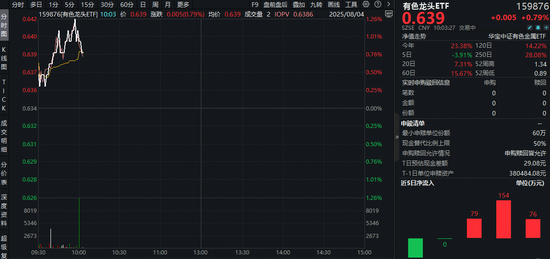
金价暴力反弹!或系非农数据不及预期,山东黄金涨逾4%,有色龙头ETF(159876)盘中拉升1.2%
Xin Lang Ji Jin· 2025-08-04 02:15
Group 1 - The U.S. non-farm payrolls added 73,000 jobs in July, significantly below the market expectation of 110,000, with May and June's job additions revised down by a total of 258,000 [1] - Following the disappointing employment data, expectations for interest rate cuts increased, leading to a surge in gold prices, with COMEX gold futures surpassing $3,400 [1] - The gold sector saw significant gains, with Chifeng Jilong Gold Mining rising over 6% and other leading companies in the non-ferrous metals sector also experiencing substantial increases [1] Group 2 - The non-ferrous metal sector has shown strong performance, with the sector index up over 22% year-to-date, significantly outperforming major market indices [3][5] - A fund split for the non-ferrous metal ETF (159876) was implemented on August 1, with a 1:2 split ratio, aimed at lowering the trading threshold while maintaining total asset value [3] - The non-ferrous metal index has seen a cumulative increase of 22.68% from January 1, 2025, to July 31, 2025, outperforming other major indices [5] Group 3 - Key drivers for the strong performance of the non-ferrous metal sector include supportive government policies, positive earnings forecasts from listed companies, and a low valuation environment [6][8] - The sector is expected to benefit from a weaker U.S. dollar and increased demand for metals, particularly copper and rare earth elements, as supply constraints persist [8][9] - The non-ferrous metal ETF (159876) and its associated funds are well-positioned for investment, providing exposure to a diversified range of metals, including copper, aluminum, gold, and rare earths [8]

中辉有色观点-20250804
Zhong Hui Qi Huo· 2025-08-04 01:41
Report Summary 1. Industry Investment Ratings - Gold: Cautiously long [1] - Silver: Stabilize and test long [1] - Copper: Buy on dips [1] - Zinc: Sell on rallies [1] - Lead: Resistance on rallies [1] - Tin: Resistance on rallies [1] - Aluminum: Under pressure [1] - Nickel: Under pressure [1] - Industrial Silicon: Cautiously bearish [1] - Polysilicon: Cautiously bearish [1] - Lithium Carbonate: Cautiously long [1] 2. Core Views - The weak US data has increased the expectation of interest rate cuts and the risk of stagflation, leading to an inflow of safe - haven funds and a significant increase in gold prices. The long - bull logic of gold remains unchanged in the long term [3][4]. - For copper, short - term supply - demand contradictions are due to seasonal factors and inventory pressure, while long - term contradictions lie in demand uncertainty and potential demand growth. After the non - farm payroll data was disappointing, the dollar index weakened, and copper prices rebounded [8][9]. - Zinc supply is abundant, and demand is weak during the off - season. It is recommended to hold short positions and seize opportunities to short on rallies [10][12]. - Aluminum prices are under pressure due to downstream weakness and inventory accumulation [13][15]. - Nickel prices face pressure due to weak supply - demand and inventory accumulation, and stainless steel also faces over - supply in the off - season [17][19]. - Lithium carbonate inventory has decreased, and with potential supply risks and improved demand, it is recommended to go long on dips [21][23]. 3. Summary by Directory Gold and Silver - **Market Review**: Weak US data increased the expectation of interest rate cuts, and the risk of stagflation reappeared. Safe - haven funds flowed in, causing a significant increase in gold prices [3]. - **Basic Logic**: US data increased the expectation of interest rate cuts; "reciprocal tariffs" are about to take effect; global gold demand is growing strongly. The long - bull logic of gold remains unchanged in the long term [4]. - **Strategy Recommendation**: Pay attention to the support around 770 for gold in the short term. For silver, it has fallen back to the previous range, and it is recommended to enter long positions after stabilization [5]. Copper - **Market Review**: Shanghai copper stopped falling and fluctuated narrowly [8]. - **Industry Logic**: Short - term supply - demand contradictions are related to seasonal factors and inventory pressure. Medium - term contradictions are the coexistence of tight copper concentrate supply and high electrolytic copper production. Long - term contradictions are between demand uncertainty and potential demand growth [8]. - **Strategy Recommendation**: After the non - farm payroll data was disappointing, the dollar index weakened, and copper prices rebounded. It is recommended to buy on dips in the short term and be bullish on copper in the long term. Pay attention to the price range of Shanghai copper [77500, 79500] and LME copper [9650, 9850] [9]. Zinc - **Market Review**: Shanghai zinc fluctuated weakly [11]. - **Industry Logic**: Zinc concentrate supply is abundant, processing fees are rising, and demand is weak during the off - season [11]. - **Strategy Recommendation**: It is recommended to hold previous short positions and take partial profits. Seize opportunities to short on rallies in the long term. Pay attention to the price range of Shanghai zinc [21800, 22600] and LME zinc [2650, 2850] [12]. Aluminum - **Market Review**: Aluminum prices were under pressure, and alumina also showed a downward trend [14]. - **Industry Logic**: For electrolytic aluminum, costs have decreased, inventory has increased, and downstream demand is weak. For alumina, supply is abundant, and inventory is accumulating [15]. - **Strategy Recommendation**: It is recommended to sell on rallies for Shanghai aluminum in the short term and pay attention to inventory changes. The main operating range is [20000 - 20700] [16]. Nickel - **Market Review**: Nickel prices were under pressure, and stainless steel rebounded and then fell [18]. - **Industry Logic**: Nickel supply - demand is weak, and inventory is accumulating. Stainless steel has over - supply issues in the off - season [19]. - **Strategy Recommendation**: It is recommended to sell on rallies for nickel and stainless steel and pay attention to downstream inventory changes. The main operating range for nickel is [118000 - 121000] [20]. Lithium Carbonate - **Market Review**: The main contract LC2509 reduced positions for five consecutive days, with a significant decline in trading volume and a gain of over 1% [22]. - **Industry Logic**: The inventory has stopped increasing, and the supply - demand situation may improve. The compliance risk of mining licenses is a key factor [23]. - **Strategy Recommendation**: There are still expectations of supply speculation. It is recommended to go long on dips in the range of [68000 - 71500] [24].
有色金属大宗金属周报:铜232关税范围不包含精炼铜,美铜大跌-20250803
Hua Yuan Zheng Quan· 2025-08-03 11:56
Investment Rating - The investment rating for the non-ferrous metals industry is "Positive" (maintained) [4] Core Views - The report highlights the impact of the recent 232 tariffs on copper, which do not include refined copper, leading to a significant drop in US copper prices. The week saw a decline in copper prices with LME copper down 2.51%, SHFE copper down 1.07%, and US copper down 23.45% [5][10]. - The report emphasizes the recovery in downstream copper demand, with the copper rod operating rate increasing by 2.36 percentage points to 71.73% [5]. - The report suggests monitoring the supply disruptions in Chile and the potential impact of the Federal Reserve's interest rate cuts in September [5]. Summary by Sections 1. Industry Overview - Important macroeconomic information includes lower-than-expected job vacancies in the US and mixed employment data, indicating a cautious economic outlook [9]. - The non-ferrous metals sector underperformed, with the Shenwan non-ferrous index down 4.62%, lagging behind the Shanghai Composite Index by 3.68 percentage points [12]. 2. Industrial Metals Copper - LME copper prices fell by 2.51%, while SHFE copper prices decreased by 1.07%. LME copper inventory increased by 10.33% [26]. - The report notes a copper smelting profit of -2408 CNY/ton, indicating a narrowing loss [26]. Aluminum - LME aluminum prices dropped by 4.12%, and SHFE aluminum prices fell by 1.33%. The report indicates a decrease in aluminum smelting profit to 4116 CNY/ton, down 7.71% [37]. Lead and Zinc - LME lead prices decreased by 3.30%, and SHFE lead prices fell by 1.48%. LME zinc prices dropped by 4.59%, while SHFE zinc prices decreased by 2.19% [52]. - The report highlights a smelting profit of 346 CNY/ton for zinc, with mining profits down 6.47% to 6884 CNY/ton [52]. Tin and Nickel - LME tin prices fell by 5.10%, and SHFE tin prices decreased by 2.47%. LME nickel prices dropped by 4.08%, while SHFE nickel prices fell by 2.83% [66]. 3. Energy Metals Lithium - Lithium carbonate prices decreased by 2.13% to 71350 CNY/ton, while lithium hydroxide prices increased by 4.04% to 65670 CNY/ton [83]. - The report indicates a smelting profit of 862 CNY/ton for lithium from spodumene, while the profit from lithium from lepidolite was -4608 CNY/ton [83]. Cobalt - Domestic cobalt prices surged by 11.29% to 276000 CNY/ton, with significant increases in cobalt smelting profits [96]. 4. Market Performance - The report provides a detailed analysis of the performance of various non-ferrous metal stocks, highlighting the top gainers and losers in the market [12]. 5. Valuation Changes - The report notes that the PE_TTM for the non-ferrous sector is 20.54, with a decrease of 0.88, while the PB_LF is 2.37, down 0.11 [21].




投资策略周报:暂时的折返,慢牛行情趋势不变-20250803
HUAXI Securities· 2025-08-03 11:20
Market Review - Global equity markets experienced a general adjustment, with Hong Kong, France, Germany, and the US stock markets showing significant declines. A-shares, after five consecutive weeks of gains, faced a correction, with major indices generally declining. In terms of sectors, A-share CPO and innovative pharmaceuticals led the gains, while cyclical products like coal and non-ferrous metals saw a pullback. The domestic commodity market cooled down due to risk warnings from the three major futures exchanges and position limits on certain products, leading to sharp declines in previously strong commodities like coking coal, glass, and polysilicon. On the international front, Trump's announcement on July 30 regarding copper tariffs did not impose restrictions on copper raw materials, resulting in a significant drop in COMEX copper prices. In the foreign exchange market, the US dollar index plummeted after the release of non-farm payroll data on Friday, with market expectations for a rate cut in September significantly increasing [1][2][3]. Market Outlook - The report suggests that the current market correction is temporary, and the slow bull market trend remains unchanged. Following the July Politburo meeting and the new round of China-US economic and trade talks, the market's speculation on incremental policies has cooled down, and after five weeks of consecutive gains, the index requires a phase of adjustment. Looking ahead, the expectation of a Federal Reserve rate cut has reignited, and domestic macro and micro liquidity remains relatively ample, which is conducive to the continuation of the slow bull trend in A-shares. Since the "623" market, A-shares have shown clear characteristics of "rotating upward and low-level replenishment," with better sustainability of the profit-making effect. Additionally, the sources of incremental capital in the market are diverse, with increased participation from public and private equity institutions, and the positive feedback effect of "residents allocating funds into the market and the slow rise of the stock market" is expected to strengthen [2][3]. Sector Allocation - The report recommends focusing on the following areas for sector allocation: 1) New technologies and growth directions such as AI computing power, robotics, and solid-state batteries; 2) Reallocation opportunities in dividend sectors after corrections, such as certain undervalued state-owned enterprises. Thematic areas of interest include self-controllable technologies, military industry, low-altitude economy, and marine technology [2][3].
贵金属有色金属产业日报-20250801
Dong Ya Qi Huo· 2025-08-01 10:18
Group 1: Report Industry and Overall Information - The report focuses on the precious metals and non - ferrous metals industry, including gold, copper, aluminum, zinc, nickel, tin, lithium carbonate, and the silicon industry [2] Group 2: Gold Core View - Trump's tariff deadline approaching boosts risk - aversion sentiment, but the rebound of the US dollar index to 100 suppresses the gold price. The market continues to lower the probability of the Fed cutting interest rates in September. Global gold investment demand is strong, with a 78% year - on - year increase in Q2, and central bank gold purchases remain a long - term support. The market is cautious before the release of non - farm payroll data [3] Key Points - SHFE gold main contract price data is presented, along with COMEX gold price and gold - silver ratio data [4] - Gold long - term fund holdings, SHFE and SGX gold spot - futures spreads, and gold and US dollar index, gold and US Treasury real - yield relationships are shown [8][11] Group 3: Copper Core View - COMEX copper and LME, SHFE copper spreads still fluctuate, and the market needs time to determine a reasonable range. High copper inventory in the COMEX market may not flow out, affecting future imports. The price of Shanghai copper is closely linked to LME copper and depends on global macro - policies and expectations. Global tariff policies may impact copper demand and price [15] Key Points - Copper futures and spot data, including prices, daily changes, and price differences, are provided [16][19] - Copper import profit and loss, processing fees, and refined - scrap copper price differences are presented [27][31] - Copper warehouse receipts and LME copper inventory data are given [33] Group 4: Aluminum Core View - For aluminum, low inventory supports the price, but demand is weak and the macro - situation is unclear, so short - term Shanghai aluminum is expected to fluctuate. For alumina, short - term capital games intensify, and investors should control risks. Cast aluminum alloy is expected to maintain high - level fluctuations [35][36][37] Key Points - Aluminum and alumina futures and spot price data, including spreads and basis, are provided [38][44][51] - Aluminum and alumina inventory data, including warehouse receipts and LME inventory, are given [57] Group 5: Zinc Core View - The supply side of zinc is gradually shifting from tight to surplus, and the demand side is weak during the off - season. In the short term, focus on macro - data, market sentiment, and supply - side disturbances [63] Key Points - Zinc futures price data, including spreads and basis, are provided [64] - Zinc spot price data, including spreads and LME spreads, are given [72] - Zinc inventory data, including warehouse receipts and LME inventory, are presented [76] Group 6: Nickel Core View - The fundamentals of the nickel industry have no significant changes. If nickel - iron prices decline, the supply of nickel - ice may decrease, supporting nickel prices. Stainless steel is supported by cost and inventory reduction, and sulfuric acid nickel has a price - holding sentiment [79] Key Points - Nickel and stainless - steel futures price data, including spreads and basis, are provided [80] - Nickel spot price, inventory, and related cost - profit data are presented [84][88][92] Group 7: Tin Core View - As the anti - involution heat fades, tin prices may decline slightly. The US copper tariff adjustment has little impact on tin, and the rising US dollar index lowers non - ferrous metal prices [93] Key Points - Tin futures and spot price data, including spreads and basis, are provided [93][98] - Tin inventory data, including warehouse receipts and LME inventory, are given [102] Group 8: Lithium Carbonate Core View - There are still short - term supply - side disturbances. The production schedule in August is expected to be good. It is expected to maintain a wide - range fluctuation, and investors should pay attention to market changes and position risks [107] Key Points - Lithium carbonate futures price data, including spreads and basis, are provided [107][109] - Lithium carbonate spot price data, including various lithium raw materials and product prices, are presented [111] - Lithium carbonate inventory data, including warehouse receipts and social inventory, are given [115] Group 9: Silicon Industry Core View - The industrial silicon market is expected to fluctuate, and the polysilicon market is expected to have wide - range fluctuations, mainly driven by macro - sentiment [117] Key Points - Industrial silicon spot and futures price data, including spreads and basis, are provided [118][119] - Polysilicon, silicon wafer, battery cell, and component price data are presented [126][127][128] - Industrial silicon production, inventory, and cost data are given [133][137][147]