
能源

Search documents
【环球财经】德国10月工业产出环比增长1.8%
Xin Hua She· 2025-12-08 13:12
德国联邦经济和能源部当天发表声明说,尽管德国工业产出已连续两个月实现增长,但预计到今年年 底,工业景气仍难以出现明显回暖。声明指出,近期德国国内工业新订单明显增加,但海外需求依然疲 弱。 新华财经柏林12月8日电 德国联邦统计局8日公布的数据显示,经季节和工作日调整后,德国10月工业 产出环比增长1.8%,为连续第二个月增长。但分析人士认为,德国工业面临的结构性问题并未缓解。 数据显示,10月德国建筑业产出环比增长3.3%,能源业产出增长1.4%。剔除建筑业和能源业后,当月 工业产出环比增长1.5%。其中,机械设备制造业产出增长2.8%,汽车行业产出则下降1.3%。 经工作日调整后,德国10月工业产出同比增长0.8%。 (文章来源:新华社) 荷兰国际集团宏观研究主管卡斯滕·布热斯基表示,当前,德国工业生产出现周期性反弹的初步迹象, 但这并不意味着其结构性问题得到改善。德国工业联合会近日发布的报告也指出,德国工业正陷入结构 性衰退,工业产出已连续九个季度下滑。报告预计,今年德国工业产出将下降2%,为连续第四年萎 缩。 ...
降息预期已基本定价商品短期或震荡运行:大宗商品周度报告2025年12月8日-20251208
Guo Tou Qi Huo· 2025-12-08 12:57
1. Report Industry Investment Rating - Not mentioned in the provided content 2. Core Viewpoints of the Report - The commodity market as a whole rose 0.97% last week, with precious metals leading the gain at 3.43%, non - ferrous and black metals rising 2.37% and 0.78% respectively, while agricultural products and energy - chemicals declined 0.32% and 1.08% respectively. The short - term commodity market may fluctuate as the expectation of interest rate cuts has been basically priced in [2][6]. - The short - term precious metals sector may experience high - level fluctuations, the non - ferrous sector may operate stably, the black sector may fluctuate weakly, the energy sector's price center has a downward pressure, the chemical sector may adjust with fluctuations, and the agricultural products and oilseeds sector may fluctuate weakly in the short term [2][3][4]. 3. Summary by Relevant Catalogs 3.1 Market Review - **Overall Market Performance**: The overall commodity market rose 0.97% last week. Precious metals led the gain at 3.43%, non - ferrous metals rose 2.37%, black metals rose 0.78%, while agricultural products and energy - chemicals fell 0.32% and 1.08% respectively [2][6]. - **Top - performing and Bottom - performing Varieties**: The top - performing varieties were silver, copper, and pulp, with increases of 7.54%, 6.12%, and 4.85% respectively; the bottom - performing varieties were glass, eggs, and ethylene glycol, with decreases of 5.6%, 5.34%, and 4.17% respectively [2][6]. - **Volatility**: The 20 - day average volatility of the commodity market continued to decline, and the volatility - reducing varieties were mainly concentrated in the agricultural products and energy - chemicals sectors [2][6]. - **Fund Flow**: The overall market scale increased last week. Only the agricultural products sector had a small net outflow of funds, and most of the inflows were concentrated in the Shanghai copper contract [2][6]. 3.2 Outlook - **General Outlook**: The recent strengthening of the Japanese yen has suppressed the US dollar index. The US core PCE in September was slightly lower than expected, laying a foundation for the Fed to cut interest rates, which is also beneficial to US dollar liquidity. However, the Russia - Ukraine situation has reached a stalemate, bringing uncertainty to the continuous improvement of liquidity. The short - term commodity market may fluctuate [2]. - **Precious Metals**: The weekly initial jobless claims dropped to 191,000, far lower than expected, hitting a new low since September 2022, alleviating market concerns about the sharp deterioration of the labor market. Interest rate cuts have been basically priced in. After silver hit a new high, its upward momentum has slowed down. The short - term sector may experience high - level fluctuations [2]. - **Non - ferrous Metals**: The expectation of the US interest rate cut is gradually increasing, and the pressure of the US dollar index on the sector is weakening. The preliminary value of the University of Michigan Consumer Sentiment Index in December has improved, and the overall macro - environment is neutral to warm. Fundamentally, the inventory continued to decline last week, and the raw material supply remained tight, supporting the sector. However, as the price reached a high level, the support weakened. The short - term sector may operate stably [3]. - **Black Metals**: Last week, the apparent demand for rebar continued to decline, production dropped significantly, and inventory continued to decrease. Steel mills' profits were still poor, and pig iron production continued to fall. There are many maintenance plans for steel mills in December, and pig iron production may further decline in the future. In terms of raw materials, the global iron ore shipment was relatively strong, and the port inventory continued to increase last week; the domestic coking coal supply was relatively stable, but the import volume increased significantly, suppressing coal prices. With the cost moving down, the short - term sector may fluctuate weakly [3]. - **Energy**: Last week, the geopolitical situation further heated up, and the progress of the Russia - Ukraine peace plan stalled, weakening the market's expectation of restoring Russian oil exports after reaching an agreement. EIA weekly data showed that US crude oil inventories increased, and gasoline inventories increased significantly more than expected. The news boosted oil prices in the short term, and the increasing probability of the Fed's interest rate cut also had a positive impact on oil prices. However, the expanding supply - demand surplus in the fundamentals still determines that the oil price center has a downward pressure [3]. - **Chemicals**: The polyester terminal weaving load continued to decline, and the supply - demand drive of the industrial chain was limited. There was insufficient drive for short - term price increases, and relevant varieties may adjust with fluctuations. For building materials, PVC continued to accumulate inventory, and the profit of chlor - alkali integration was compressed. The pattern of using alkali to supplement chlorine is not expected to last long. It is possible that PVC enterprises will increase maintenance in the future, alleviating the supply pressure; the glass production capacity continued to be compressed, but some glass factories postponed cold - repair plans, and the actual progress needs to be monitored [4]. - **Agricultural Products**: In the new South American season, the sowing progress of Brazilian soybeans is normal, while the sowing progress of Argentine soybeans is slow due to weather conditions. The domestic soybean meal spot supply remains loose, suppressing prices. The market currently estimates that Malaysian palm oil inventories will continue to increase in November, with high inventory pressure. The short - term oilseeds sector may fluctuate weakly, and attention should be paid to the data verification of the USDA and MPOB reports [4]. 3.3 Commodity Fund Overview - Most gold ETFs had positive weekly returns, with returns ranging from 0.78% - 0.87%. The total scale of gold ETFs was 23.4263 billion yuan, with a growth of 0.38%, and the total trading volume was 756,101,805, with a growth of 15.76% [39]. - The energy - chemicals ETF had a weekly return of - 0.67%, with a scale of 16.99 billion yuan and a decrease of 3.47% [39]. - The soybean meal ETF had a weekly return of - 0.59%, with a scale of 26.28 billion yuan and an increase of 0.45% [39]. - The non - ferrous metals ETF had a weekly return of 4.30%, with a scale of 30.11 billion yuan and an increase of 8.10% [39]. - The silver fund had a weekly return of 7.33%, with a scale of 43.47 billion yuan and no change in scale [39]. - The total scale of commodity ETFs was 24.5947 billion yuan, with a growth of 0.52%, and the total trading volume was 1,467,321,985, with a growth of 18.70% [39].
不许中国赚钱,刚回法国,马克龙威胁中方解决逆差,否则就加税
Sou Hu Cai Jing· 2025-12-08 11:50
Core Viewpoint - The trade deficit between the EU and China, amounting to $310 billion, has become a contentious issue, with French President Macron threatening tariffs if the situation is not addressed. However, the complexity of trade relationships suggests that a simple deficit does not equate to a loss for Europe [2][4][6]. Trade Structure - The EU's trade structure with China shows a significant reliance on Chinese manufacturing due to its efficiency and cost-effectiveness, with many European households using Chinese products [4]. - French products, including aircraft, wine, cosmetics, and luxury goods, are thriving in the Chinese market, indicating a mutually beneficial relationship [4][12]. - European companies benefit from investments in China, often earning more than what is reflected in export figures, which is frequently overlooked in discussions about trade deficits [4][6]. Economic Context - The economic pressures in Europe, including high inflation and an ongoing energy crisis, have led to increased scrutiny of trade relationships, with Macron's statements reflecting domestic political pressures rather than a genuine desire to disrupt trade [8][10]. - The concept of "strategic autonomy" in Europe aims to reduce reliance on external markets, but the reality is that Europe remains heavily dependent on international supply chains [10][16]. Cooperation Beyond Trade - The depth of cooperation between China and France extends beyond trade, encompassing technology partnerships, cultural exchanges, and educational collaborations, which are vital for both economies [12][14]. - France's agricultural and luxury sectors have seen consistent growth in China, highlighting the importance of this market for French economic stability [14][16]. Political Dynamics - Macron's tough stance on trade appears to be more of a political maneuver aimed at addressing domestic concerns rather than a reflection of the actual economic relationship between the EU and China [8][18]. - The potential for tariffs could harm European businesses and consumers, as they rely on Chinese goods and materials, suggesting that a cooperative approach would be more beneficial [16][18].


“中国赶上了西方,但未来西方可能赶不上中国了”
Guan Cha Zhe Wang· 2025-12-08 11:47
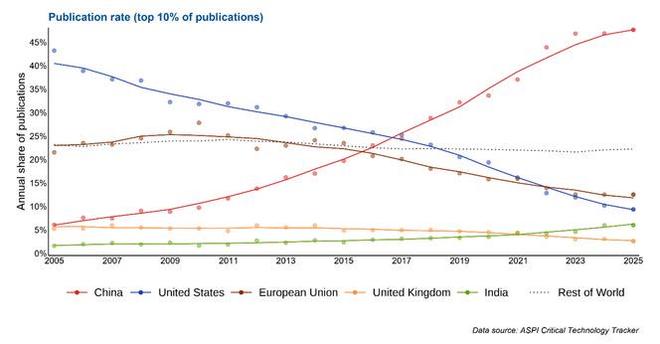
Core Viewpoint - China has achieved a dominant position in defining modern technologies, surpassing other regions in various fields such as artificial intelligence, defense, aerospace, energy, and biotechnology [1][3]. Group 1: Technological Advancements - A report by the Australian Strategic Policy Institute indicates that China leads in 66 out of 74 key technologies, while the U.S. maintains an advantage in only 8 [1]. - In the AI sector, China is ahead in 7 out of 8 technologies; in advanced materials and manufacturing, it leads in all 13 technologies; and in defense, aerospace, robotics, and transportation, it ranks first in all 7 technologies [1]. - In the energy and environment sector, China leads in 9 out of 10 technologies, and in biotechnology, genetics, and vaccines, it is ahead in 5 out of 9 technologies [1]. Group 2: Recent Technological Achievements - Recent months have seen China showcase remarkable technological feats, including a bionic robot the size of a mosquito for battlefield reconnaissance and the completion of the world's highest bridge [2]. - The DeepSeek team introduced a mathematical reasoning model, DeepSeekMath-V2, which has demonstrated significant capabilities in theorem proving, marking a milestone in AI development [2]. Group 3: Investment and Policy - China's technological achievements are closely linked to substantial investments in strategic emerging industries, amounting to 8.6 trillion yuan since the start of the 14th Five-Year Plan [6]. - Analysts highlight the difference in governance models, with China being described as an "engineering state" focused on practical solutions, while the U.S. is characterized as a "lawyerly society" that often resorts to legal measures [6][7]. Group 4: Comparative Analysis - Australia's recent AI strategy, which includes a budget of 30 million AUD (approximately 140 million yuan) for AI safety research, is seen as significantly less robust compared to China's comprehensive industrial policies [7]. - The speed of China's technological acceleration is noted as unprecedented compared to other regions, with experts suggesting that the West may struggle to catch up [8].
银河证券解读解读政治局会议:明年的结构性主线将更加清晰,重点关注“两条主线+两条辅助线”
Xin Lang Cai Jing· 2025-12-08 11:28
Core Viewpoint - The December Central Political Bureau meeting emphasizes the importance of maintaining a stable yet progressive approach to economic work in 2026, focusing on expanding domestic demand and optimizing supply to enhance resource allocation efficiency [1][6][21]. Economic Goals and Policy Framework - The meeting highlights the need to continue expanding domestic demand and optimizing supply, aiming for both qualitative and quantitative growth in the economy during the "14th Five-Year Plan" period [1][21]. - The overall policy framework for 2026 will maintain a proactive stance, with a focus on enhancing the quality and effectiveness of development, alongside a more active fiscal policy and moderately loose monetary policy [2][8][22]. Industry Policy Deployment - The meeting outlines a clear path for industry planning in 2026, prioritizing domestic demand and innovation, which will benefit sectors such as consumer goods, AI, digital economy, and new energy [3][10][24]. - Emphasis is placed on reform, opening up, and coordinated development to enhance high-quality growth, benefiting state-owned enterprises and infrastructure-related sectors [3][10][24]. Implications for A-Share Investment - The meeting provides initial guidance for economic work in 2026, focusing on domestic demand, innovation, and reform, which is expected to stabilize market expectations and boost confidence in the A-share market [4][17][26]. - Upcoming central economic work meetings are anticipated to detail specific fiscal, monetary, and industrial measures, further activating market vitality [4][17][26]. Investment Focus Areas - The current policy window indicates a clearer structural focus for 2026, with attention on new productive forces such as AI, renewable energy, and quantum technology, alongside recovery paths for manufacturing and resource sectors [12][26]. - The consumer sector is expected to see a favorable investment environment due to policies aimed at boosting domestic demand, while the trend of companies expanding overseas will enhance profit potential [12][26].
国际实业:披露向特定对象发行股票审核问询函回复
Xin Lang Cai Jing· 2025-12-08 10:42
国际实业公告称,公司于2025年11月收到深交所出具的向特定对象发行股票审核问询函。公司会同中介 机构对问题研究落实后,公开披露问询函回复,具体内容见巨潮资讯网。公司将在回复披露后报送相关 文件。本次发行尚需通过深交所审核及获中国证监会同意注册,结果及时间不确定,公司将及时披露进 展。 ...

海关总署:前11个月主要大宗商品进口价格下跌,机电产品进口值增长
Sou Hu Cai Jing· 2025-12-08 03:29
Core Viewpoint - China's import statistics for the first eleven months indicate mixed trends across various commodities, with some experiencing growth while others face declines in both volume and price [1] Group 1: Import Volumes and Changes - Iron ore imports reached 1.139 billion tons, an increase of 1.4% [1] - Crude oil imports totaled 522 million tons, up by 3.2% [1] - Coal imports decreased to 432 million tons, down by 12% [1] - Natural gas imports fell to 114 million tons, a decrease of 4.7% [1] - Soybean imports amounted to 104 million tons, increasing by 6.9% [1] - Finished oil imports dropped to 38.433 million tons, down by 14.5% [1] - Primary form plastic imports decreased to 24.281 million tons, down by 7.8% [1] - Unrefined copper and copper products imports totaled 4.883 million tons, a decrease of 4.7% [1] - Electromechanical product imports reached 6.69 trillion yuan, growing by 5.5% [1] Group 2: Price Changes - The average price of iron ore fell by 9.4% [1] - The average price of crude oil decreased by 12.1% [1] - The average price of coal dropped by 23.9% [1] - The average price of natural gas declined by 9.4% [1] - The average price of soybeans decreased by 10.7% [1] - The average price of finished oil fell by 4.9% [1] - The average price of primary form plastics decreased by 0.8% [1] - The average price of unrefined copper and copper products increased by 6.4% [1]
银河期货每日早盘观察-20251208
Yin He Qi Huo· 2025-12-08 03:14
Report Industry Investment Rating No relevant information provided. Core Viewpoints of the Report - The stock index is expected to rise steadily with a shifting center of gravity due to weekend positive news and improved market confidence [20]. - The bond market is showing a differentiated performance, with the ultra - long end facing uncertainties and the medium - short end having limited room for a "super - oversold rebound" [23]. - In the agricultural product market, most varieties are under pressure or in a volatile situation, affected by factors such as supply and demand and reports [26][27]. - The black metal market is volatile, with steel prices affected by factors like environmental protection and demand, and the prices of double - coking and iron ore showing different trends [58][62][64]. - The non - ferrous metal market is also volatile, with gold and silver prices likely to fluctuate more due to the focus on the Fed's signal, and copper prices rising due to supply concerns [68][70][78]. - The energy and chemical market is generally in a state of shock, with factors such as geopolitical disturbances, supply and demand, and cost affecting prices [112][113][117]. - The shipping market's container shipping is expected to have a short - term high - level shock, with attention paid to factors such as the increase in shipping company prices and the improvement of cargo volume [108][109]. Summary by Relevant Catalogs Financial Derivatives Stock Index Futures - Last week, the market bottomed out and rebounded, and on Friday, insurance and brokerage firms boosted the index. The stock index is expected to rise steadily with a shifting center of gravity. The trading strategies include going long with a light position, conducting IM/IC long 2512 + short ETF cash - and - carry arbitrage, and using a bullish spread option strategy [20][21]. Bond Futures - The bond market showed a further differentiated performance last week. The ultra - long end was weak, and the medium - short end was relatively stable. The trading strategy is to wait and see on the long - side and pay attention to the potential cash - and - carry arbitrage opportunities of the TF contract [23][24]. Agricultural Products Protein Meal - The CBOT soybean and soybean meal indexes declined. The USDA is expected to see a decrease in corn and wheat planting and an increase in soybean planting. The market may be under pressure from the report, and the trading strategy is to lay out a small number of short positions [26][27]. Sugar - The international sugar price is oscillating, and the domestic sugar price is weak. The Brazilian sugar production is approaching the end of the season, and the supply pressure is gradually easing. The domestic sugar production cost is high, providing some support. The trading strategy is to wait and see on the long - side and sell put options at low prices [30][31]. Oilseeds and Oils - The prices of CBOT soybean oil and BMD palm oil showed different trends. The palm oil production in Malaysia decreased in November, but the export was weak. The domestic soybean oil inventory is gradually decreasing, and the rapeseed oil is expected to continue to reduce inventory. The trading strategy is to conduct high - low - band trading on the long - side [33][34][35]. Corn/Corn Starch - The CBOT corn futures declined. Russia has reduced the export tariff on corn to zero. The domestic corn spot is strong, but the futures may have room for a decline. The trading strategy is to go long on the 03 contract on dips and short on rallies, and to narrow the spread between 01 corn and starch [36][39]. Live Pigs - The live pig price showed a rebound, but the overall supply pressure still exists. The trading strategy is to wait and see and sell wide - straddle options [40][41]. Peanuts - The peanut spot price is stable, but the futures price is oscillating downward. The trading strategy is to short the 01 contract on rallies and conduct a 15 - contract reverse arbitrage [43][44]. Eggs - The egg demand is average, and the price has declined. The short - term is expected to fluctuate in a range, and the long - side can be considered for the far - month contracts. The trading strategy is to wait and see on the long - side [46][48]. Apples - The apple cold - storage inventory is low, providing support for the price. The trading strategy is to expect high - level oscillations and wait and see [49][51][52]. Cotton - Cotton Yarn - The ICE cotton futures declined. The supply of new cotton is abundant, and the demand is in the off - season. The price is expected to be mainly oscillating. The trading strategy is to wait and see [53][55]. Black Metals Steel - The market sentiment is fluctuating, and steel prices are oscillating. Affected by environmental protection and demand, the short - term is expected to be in a weak - shock state. The trading strategy is to go short on rallies and conduct spread trading [57][58][59]. Double - Coking - The sentiment is weak, waiting for the start of winter storage. The short - term is expected to continue to be weak, but the downward space is limited. The trading strategy is to stop profiting on short positions [60][62]. Iron Ore - The price is expected to be mainly weak. The supply is relatively abundant, and the demand is weak. The trading strategy is to take a short - side view [63][64]. Ferroalloys - The price rebounds in the short - term due to cost, but the upward space is limited by demand. The trading strategy is to wait and see on the long - side and sell out - of - the - money straddle option combinations [65][66]. Non - Ferrous Metals Gold and Silver - After the release of the PCE data, the prices fluctuated. The market is focusing on the Fed's signal, and the price volatility is expected to increase. The trading strategy is to pay attention to the support level of gold and go long on silver cautiously [68][70][72]. Platinum and Palladium - Platinum is recommended to go long on dips, and palladium is expected to oscillate. The trading strategy is to go long on platinum, conduct a long - platinum - short - palladium spread, and buy out - of - the - money call options for platinum [73][74][75]. Copper - The copper price rose due to concerns about non - US long - term supply. The trading strategy is to hold long positions and pay attention to cash - and - carry arbitrage opportunities [76][78][79]. Alumina - The price is expected to be weak before the expiration of warehouse receipts. The trading strategy is to wait and see [80][83]. Electrolytic Aluminum - The price is expected to be strong, with obvious fundamental support. The trading strategy is to go long [84]. Cast Aluminum Alloy - The price follows the aluminum price. The trading strategy is to wait and see [86]. Zinc - The price is in a wide - range oscillation. The trading strategy is to wait and see on the long - side [88][91][92]. Lead - The price is in a range - bound oscillation. The trading strategy is to hold long positions and be vigilant against macro - factors [93][94]. Nickel - The oversupply is narrowing, leading to a rebound in the price. The trading strategy is to test the resistance on the long - side and sell out - of - the - money call options [95][97]. Stainless Steel - The price is in a weak - shock state, waiting for policy stimulus. The trading strategy is to wait and see on the long - side [98][99]. Industrial Silicon - Due to environmental pressure in the northwest, the price may rebound in the short - term. The trading strategy is to stop profiting on short positions [100]. Polysilicon - With the increase in delivery brands, the price is expected to be weak in the short - term. The trading strategy is to go short on the long - side and use a double - buy option strategy [102][103]. Lithium Carbonate - The supply is back in focus, and the price continues to decline. The trading strategy is to buy after a sufficient correction on the long - side and sell out - of - the - money call options [104][105]. Tin - The price lacks upward momentum, and the trading strategy is to pay attention to macro - impacts and expect high - level oscillations [106][107]. Shipping Industry Container Shipping - Shipping companies are starting to increase prices in January, and the market is expected to be in a short - term high - level shock. The trading strategy is to take partial profits on long positions and conduct a 2 - 4 positive spread arbitrage [108][109][110]. Energy and Chemical Industry Crude Oil - Geopolitical disturbances continue, and the price is oscillating. The trading strategy is to expect a wide - range oscillation and pay attention to the spread [112][113]. Asphalt - The supply and demand are weak, and the price is in a weak - shock state. The trading strategy is to expect a weak - shock and sell out - of - the - money call options [114][117]. Fuel Oil - Both high - sulfur and low - sulfur fuel oils have a weak fundamental outlook. The trading strategy is to expect a weak - shock and pay attention to the spread [118][120]. Natural Gas - LNG is weak, and US natural gas has broken through and risen. The trading strategy is to wait and see on the long - side and use option - selling strategies [121][123]. PX & PTA - PX supply is abundant, and PTA is expected to accumulate inventory. The trading strategy is to expect an oscillation and conduct a reverse spread [124][126]. BZ & EB - The cost lacks support, and inventory needs to be reduced. The trading strategy is to expect an oscillation and sell out - of - the money call options [127][130]. Ethylene Glycol - There is an expectation of inventory accumulation, and the price is falling. The trading strategy is to expect a weak - shock and sell out - of - the money call options [131][132]. Short - Fiber - The short - fiber factory has an expectation of inventory accumulation. The trading strategy is to expect an oscillation and use a double - sell option strategy [133][134]. Bottle Chips - The demand is expected to weaken in the off - season. The trading strategy is to expect an oscillation and use a double - sell option strategy [135][137]. Propylene - High inventory suppresses the price. The trading strategy is to go short on rallies and sell call options [138][140]. Plastic PP - The price is expected to be weak. The trading strategy is to wait and see on the long - side and pay attention to the support level [141][142]. Caustic Soda - The price is weak. The trading strategy is to expect a weak trend and wait and see [143][146]. PVC - The price hits a new low. The trading strategy is to expect a weak trend [147][148]. Soda Ash - The price is in an oscillating state. The trading strategy is to expect an oscillation and pay attention to the spread [150][152]. Glass - The price is weak and oscillating. The trading strategy is to expect the supply - side contraction to determine the winter - storage strength and pay attention to the spread [153][155]. Methanol - The price is in a weak - shock state. The trading strategy is to expect an oscillation [156]. Urea - The price rises and then falls. The trading strategy is to go short on the long - side and pay attention to the spread [158][161]. Pulp and Paper Industry Pulp - The spot market price has fallen from a high level. The trading strategy is to wait and see, and aggressive investors can try short positions [163][164]. Logs - The fundamental situation is weakening. The trading strategy is to wait and see, and aggressive investors can go long on a small scale [167][168]. Offset Printing Paper - The supply pressure remains high, and the market continues to decline. The trading strategy is to wait and see, and aggressive investors can go short on rallies [170][172]. Rubber Industry Natural Rubber - The warehouse receipts are accumulating, and the tire inventory remains unchanged. The trading strategy is to hold short positions on the RU01 contract and go long on the NR02 contract with a small amount [173][176]. Butadiene Rubber - The total warehouse receipts are reducing inventory, and the tire inventory remains flat. The trading strategy is to hold short positions on the BR02 contract [177][179].
“十五五”期间金融如何支持能源资源行业“双碳”战略
Jin Rong Shi Bao· 2025-12-08 02:43
Core Viewpoint - The realization of the "dual carbon" goals is crucial for global climate governance and is an inherent requirement for China's high-quality development during the 14th Five-Year Plan period. The energy resources industry, as a major contributor to carbon emissions, must undergo a green and low-carbon transformation, necessitating a collaborative effort to establish a systematic and market-oriented financial support system [1][2]. Group 1: Significance of the "Dual Carbon" Strategy for the Energy Resources Industry - Energy security is a strategic issue related to national economic and social development, and transitioning to a clean, low-carbon energy system is essential for reducing dependence on foreign energy and enhancing resilience [2]. - As the largest energy producer and consumer, China’s transition to a new energy system is a necessary choice for achieving high-quality development and ensuring national security [2]. Group 2: Opportunities and Challenges in Achieving "Dual Carbon" Goals Opportunities - The restructuring of the global energy landscape presents a strategic window for development, with historical energy transitions often coinciding with the rise of new superpowers [3]. - China's energy production structure is shifting towards cleaner energy, with the share of coal in primary energy consumption decreasing from 68.5% in 2012 to 56.8% in 2020, while non-fossil energy's share increased from 0.7% to 15.6% during the same period [3]. Challenges - The energy structure still relies heavily on fossil fuels, with coal consumption accounting for 55.3% of primary energy in 2023, despite a 12.1 percentage point decrease over the past decade [4]. - There is insufficient reserve of key low-carbon technologies, particularly in carbon capture, utilization, and storage (CCUS), necessitating increased investment and improved policies [5]. - Rising carbon costs may lead to inflation as companies pass on increased operational costs to consumers [6]. Group 3: Pathways to Achieve "Dual Carbon" Goals - Optimizing land use and resource management is essential, including promoting green mining and enhancing carbon sink functions through ecological restoration [7]. - Establishing a comprehensive marine carbon sink monitoring and evaluation system is critical for maximizing the potential of marine ecosystems in carbon storage [12][13]. - Financial institutions must provide targeted support for green projects and develop a unified natural resource asset trading platform to enhance resource allocation efficiency [14]. Group 4: Role of Financial Institutions in Supporting "Dual Carbon" Goals - Financial institutions should integrate environmental, social, and governance (ESG) principles into their core values and risk management strategies [16]. - There is a need for innovative financial products that link capital with emission reduction projects, such as carbon accounts and carbon pledges [20]. - Strengthening climate risk management capabilities is essential for banks to effectively identify and assess climate-related risks [19].
能源化工期权:能源化工期权策略早报-20251208
Wu Kuang Qi Huo· 2025-12-08 01:06
Report Summary 1. Report Investment Rating There is no information about the industry investment rating in the report. 2. Core Viewpoints - Energy - chemical options cover various categories including energy, polyolefins, polyesters, alkali chemicals, etc. [3] - The recommended strategy is to construct option combination strategies mainly as sellers, along with spot hedging or covered strategies to enhance returns. [3] 3. Summary by Relevant Catalogs 3.1 Futures Market Overview - The report provides the latest prices, price changes, trading volumes, and open interest changes of various energy - chemical futures contracts such as crude oil, LPG, methanol, etc. For example, the latest price of crude oil (SC2601) is 457 with a 4 - point increase and a 0.82% rise, and its trading volume is 6.68 million lots. [4] 3.2 Option Factors - **Volume - Position PCR**: It shows the volume and position PCR of different option varieties, which helps describe the strength of the option underlying market and the turning point of the underlying market. For instance, the volume PCR of crude oil options is 0.69 with a - 0.01 change, and the position PCR is 0.61 with no change. [5] - **Pressure and Support Levels**: From the perspective of the strike prices with the largest open interest of call and put options, the pressure and support levels of the option underlying are analyzed. For example, the pressure level of crude oil is 540 and the support level is 430. [6] - **Implied Volatility**: It includes the at - the - money implied volatility, weighted implied volatility, and its changes, as well as the historical volatility and the difference between implied and historical volatility. For example, the at - the - money implied volatility of crude oil is 25.195%, and the weighted implied volatility is 27.16% with a - 1.69% change. [7] 3.3 Strategy and Recommendations - **Energy Options (Crude Oil)**: - **Fundamentals**: US crude oil production is 13.815 million barrels per day with a 0.01% month - on - month increase, refinery throughput is 16.876 million barrels per day with a 2.63% increase, and global floating storage has risen to 108.411 million barrels with a 10.2% increase. [8] - **Market Analysis**: Crude oil showed a weak - range oscillating trend in December after a significant decline in October and a rebound in November. [8] - **Option Factor Research**: The implied volatility of crude oil options fluctuates below the average level, the position PCR is below 0.70, indicating a weak market, and the pressure and support levels are 540 and 430 respectively. [8] - **Strategies**: Construct a bearish put spread strategy, a short - biased call + put option combination strategy, and a long collar strategy for spot hedging. [8] - **Other Options (LPG, Methanol, etc.)**: Similar analysis and strategy recommendations are provided for other energy - chemical options, including fundamental analysis, market trend analysis, option factor research, and corresponding option strategies such as directional strategies, volatility strategies, and spot hedging strategies. [9][10][11]