软件

Search documents
中望软件(688083.SH)发预减,预计2025年度归母净利润1600万元至2400万元,同比下降62.48%至74.99%
智通财经网· 2026-01-30 10:23
Group 1 - The core viewpoint of the article indicates that Zhongwang Software (688083.SH) expects a significant decline in net profit for the fiscal year 2025, projecting a range of 16 million to 24 million yuan [1] - The anticipated net profit represents a decrease of 39.9643 million to 47.9643 million yuan compared to the previous year, reflecting a year-on-year decline of 62.48% to 74.99% [1]

中望软件:2025年净利同比下降62.48%~74.99%
Mei Ri Jing Ji Xin Wen· 2026-01-30 08:12
Group 1 - The company Zhongwang Software (688083) has released a performance forecast indicating an expected net profit of 16 million to 24 million yuan for the fiscal year 2025, representing a year-on-year decline of 62.48% to 74.99% [1] - The decline in profit is attributed to factors such as changes in resource allocation due to policy adjustments and low budget maintenance from clients, leading to continued pressure on the company's education business [1] - Revenue from educational clients has shown a downward trend during the reporting period [1]
中望软件(688083.SH):2025年度计提资产减值准备3635.30万元
Ge Long Hui A P P· 2026-01-30 07:57
Core Viewpoint - Zhongwang Software (688083.SH) announced a need to recognize various asset impairment provisions totaling 36.35 million yuan for the fiscal year 2025, which will impact the company's consolidated profit before tax [1] Group 1: Asset Impairment Provisions - The company will recognize asset impairment losses of 37.71 million yuan and reverse credit impairment losses of 1.36 million yuan [1] - The total impact of these provisions on the company's consolidated profit before tax is 36.35 million yuan, excluding the effects of income tax [1]
中望软件:2025年度计提资产减值准备3635.30万元
Ge Long Hui· 2026-01-30 07:52
Core Viewpoint - Zhongwang Software (688083.SH) announced a need to recognize various asset impairment provisions totaling 36.35 million yuan for the fiscal year 2025, which will impact the company's consolidated profit before tax [1] Group 1: Asset Impairment Provisions - The company will recognize an asset impairment loss of 37.71 million yuan and reverse credit impairment losses of 1.36 million yuan [1] - The total impact of these provisions on the company's consolidated profit before tax is 36.35 million yuan, excluding the effects of income tax [1]
软件板块回调,软件ETF(515230)跌超2.7%,AI应用前景受关注,资金抢筹布局,近20日净流入近30亿元
Mei Ri Jing Ji Xin Wen· 2026-01-30 06:16
Core Insights - AI technology has enabled a full-chain empowerment in animation production, transitioning the industry from "manual stacking" to "industrial generation," reducing production cycles from over 50 days to within 30 days, and lowering the cost per episode to the thousand-yuan level, demonstrating a clear logic of cost reduction and efficiency enhancement [1] Group 1 - The dynamic animation agent exhibits strong technological spillover effects, with its accumulated general assets and spatial computing algorithms being smoothly transferable to game development and architectural design, indicating potential to evolve beyond content tools into a "generative virtual world infrastructure" platform [1] - The trend of AI applications in the industry is established, with a double impact expected in 2026, making AI applications a "required course" for companies, whether from the perspective of ROI on computing power or product development by internet/software/edge companies [1] - Some companies have seen AI orders, revenue, and ARR account for 10% or more of their total revenue, indicating that the "sweet spot" has been reached [1] Group 2 - The software ETF (515230) tracks the software index (H30202), which primarily reflects the overall performance of publicly listed companies in the software industry, covering firms engaged in system software, application software development, and related services [1] - The index focuses on the information technology sector, particularly the software development and services segment, to represent the overall market value and growth potential of related enterprises [1]
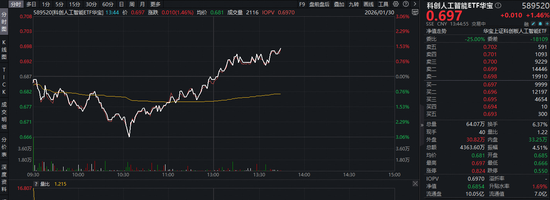
字节VS阿里,将正面对决?“春节AI竞赛”提前开幕!科创人工智能ETF逆市拉升1.4%,思看科技一字涨停
Xin Lang Cai Jing· 2026-01-30 05:54
Group 1 - The core focus is on the domestic AI industry chain, with the Science and Technology Innovation Artificial Intelligence ETF (589520) experiencing a price increase of 1.46% after two consecutive days of net capital inflow totaling 14.72 million yuan [1][8] - Major players in the AI sector, including ByteDance and Alibaba, are set to release new AI models in mid-February 2026, marking a significant competitive shift in the AI application landscape in China [3][11] - The ETF's index comprehensively covers four key segments: application software, terminal applications, terminal chips, and cloud chips, indicating a shift from reliance on foreign technology to self-sufficiency in the AI industry [3][11] Group 2 - Notable stocks within the ETF include Sikan Technology, which saw a 20% increase, and Lanke Technology, which rose over 13%, reflecting strong market performance [2][10] - The ETF's composition includes leading domestic GPU and ASIC companies, with nearly 70% of the top ten holdings and a significant focus on the semiconductor industry, indicating a robust growth potential [6][13] - The ETF serves as an efficient tool for investors looking to gain exposure to domestic computing power, being a financing and margin trading target [6][13]

昨夜,黄金、白银闪崩!史诗级暴跌,发生了什么?| 多家基金宣布:今起集体停牌
Sou Hu Cai Jing· 2026-01-30 04:19
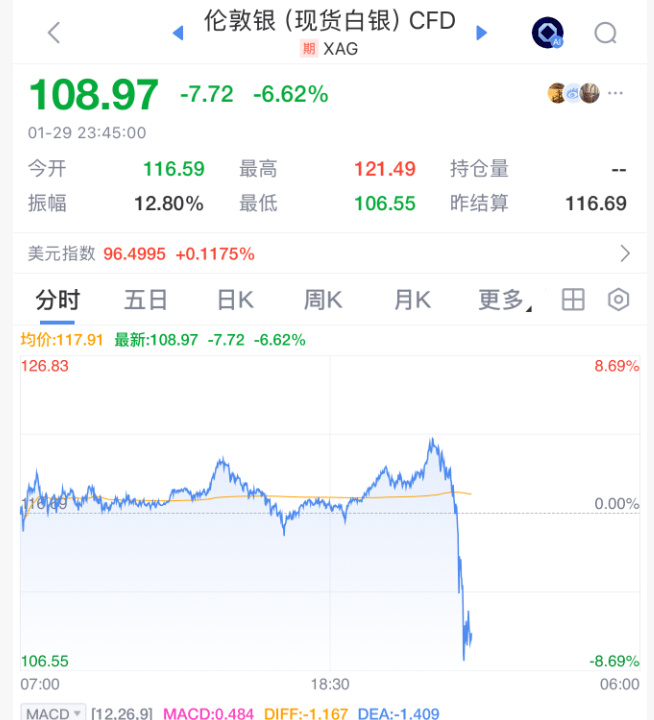
Group 1: Precious Metals Market - International precious metals futures experienced significant volatility, with gold and silver prices initially plummeting before recovering, ultimately closing with gains of over 1% for both COMEX gold and silver [1] - At one point, spot silver fell by 8%, and spot gold dropped below $5,200 per ounce [1] Group 2: Stock Market Performance - U.S. stock indices showed mixed results, with technology stocks experiencing divergent trends; Meta surged by 10%, while Microsoft fell by over 10% due to slowing cloud business growth [4][6] - Chinese online education stocks mostly rose, with TAL Education Group increasing by over 18% following better-than-expected earnings [4][8] Group 3: Fund Market Activity - Multiple funds announced a collective suspension of trading starting January 30, following a strong performance in resource-related LOFs, including oil and silver funds [9][10] - The price of WTI crude oil reached $65.002 per barrel, marking a 2.83% increase and the highest level since September 2025, driven by heightened geopolitical risks and inflation expectations [14] Group 4: Fund Subscription Limits - Starting January 30, several funds, including those managed by Huashan and GF Fund, significantly reduced their daily subscription limits to as low as 2 yuan, effectively restricting large investments [15][20] - The high premium rates in the secondary market prompted warnings from fund managers about potential risks associated with blind investments [17][18]


黄金、白银巨震
Sou Hu Cai Jing· 2026-01-30 02:15
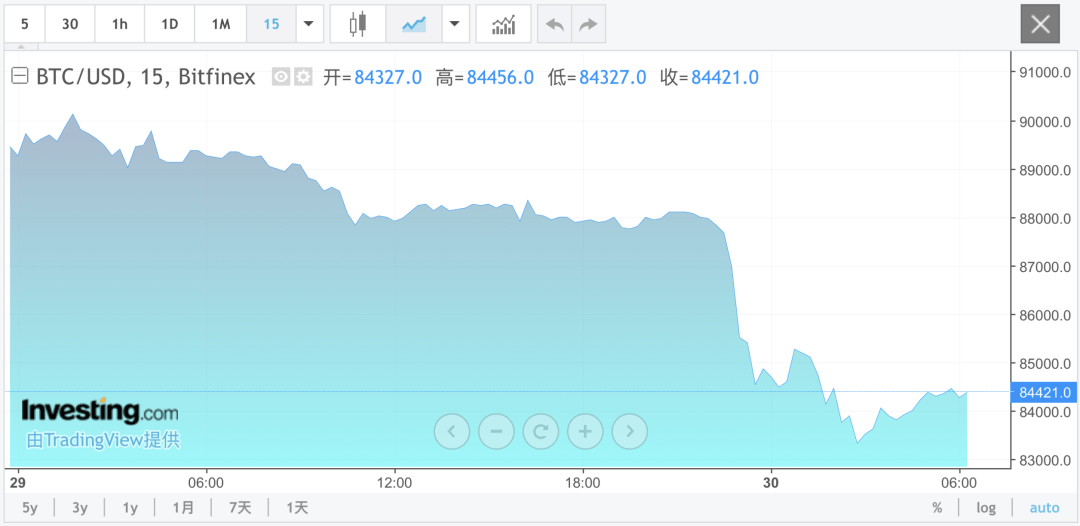
Market Overview - The global financial markets experienced significant volatility, with gold and silver prices dropping sharply after reaching historical highs, with maximum intraday declines of over 5% and 8% respectively [1][9][10] - The U.S. stock market also faced turbulence, with the Nasdaq index plunging 2.6% at one point before closing down 0.72% [2][11] Cryptocurrency Market - The cryptocurrency market saw a major sell-off, with Bitcoin dropping over 5% to below $85,000, while Ethereum and other altcoins experienced declines exceeding 6% [3][6] - Cryptocurrency-related stocks also suffered, with Strategy stock falling over 9% and Coinbase Global down more than 4% [5] Gold and Silver Market - Gold prices experienced a sharp decline, falling from a peak of $5,600 per ounce to $5,105.83, marking a maximum drop of 5.7% before rebounding [9] - Silver prices also fell from a historical high of $121.67 per ounce to $106.80, with a maximum intraday decline of 8.5% [9] Investor Sentiment - There is a growing skepticism regarding Bitcoin's status as a macro hedge, as it has underperformed compared to gold and silver despite rising geopolitical tensions [6][7] - Recent data indicates that Bitcoin holders have entered a loss realization phase for the first time in 2023, suggesting a decline in investor confidence [6] Corporate Earnings Impact - Microsoft shares plummeted nearly 12% during trading after reporting a slowdown in cloud business growth, impacting the software sector significantly [11][12] - Other tech stocks reacted variably, with Meta seeing a 10.4% increase after announcing substantial capital expenditure plans, while other companies like ServiceNow and SAP faced declines [12][13]
1.30犀牛财经早报:2026年新发基金规模突破千亿元
Xi Niu Cai Jing· 2026-01-30 02:02
Fund Market - The issuance of new funds has accelerated this year, with total scale exceeding 100 billion yuan, driven by equity and FOF products [1] - 110 new funds were established by January 29, with a total issuance scale of 110.54 billion yuan, including 85 equity funds totaling 76.81 billion yuan [1] - FOF products have also maintained high popularity, with issuance scale surpassing 80 billion yuan in 2025 [1] Technology Sector - Over 260 companies on the Sci-Tech Innovation Board have released performance forecasts for 2025, with 105 companies reporting positive growth [1] - The focus on technology growth sectors such as artificial intelligence and biomedicine is expected to attract long-term capital [1] Aerospace Industry - A series of significant announcements were made at the Commercial Aerospace Action Conference, outlining the future of China's commercial aerospace sector [2] - By 2030, low-orbit satellite constellations are expected to be established, with launch costs potentially dropping below 10,000 yuan per kilogram [2] Communication Technology - China has achieved a new milestone in ground-space laser communication, with speeds reaching 120 Gbps [2] Semiconductor Development - Research teams have made advancements in two-dimensional semiconductors, specifically in the production of molybdenum disulfide films [2] Corporate Financial Performance - Apple reported a revenue of 143.8 billion USD for the quarter ending December 27, a 16% year-on-year increase, driven by strong iPhone 17 demand and a 38% increase in sales in China [3] - Adidas preliminary data indicates a fourth-quarter revenue of 6.08 billion euros, slightly below expectations, but full-year operating profit is projected at 2.06 billion euros, above estimates [4] Market Reactions - Microsoft experienced a significant stock sell-off, with a market value decrease of 357 billion USD, the second-largest single-day drop in history, attributed to concerns over AI spending and slowing cloud business growth [5][13] - Other tech stocks, including Alphabet and Nvidia, also faced substantial market value losses [5][13]



全线暴跌!超22万人爆仓!金银、美股巨震
天天基金网· 2026-01-30 01:11
Core Viewpoint - The cryptocurrency market is experiencing significant sell-offs, with Bitcoin and other major cryptocurrencies seeing substantial declines, leading to a shift in investor sentiment towards traditional assets like gold [3][5][9]. Cryptocurrency Market - Bitcoin fell over 5%, dropping below $85,000 to $84,425, while Ethereum and Dogecoin also saw declines exceeding 6% [5]. - In the last 24 hours, over 227,939 traders were liquidated, with a total liquidation amount of $1.014 billion (approximately 70.5 billion RMB) [7]. - Tether's CEO announced plans to allocate 10% to 15% of their investment portfolio into physical gold, indicating a shift in investment strategy [7]. - Bitcoin holders have entered a loss realization phase for the first time in 2023, suggesting a decline in investor confidence [8]. Precious Metals Market - Gold and silver prices experienced extreme volatility, with gold prices dropping over $400 before recovering some losses, ultimately closing at $5,377.4 per ounce, a 0.69% decrease [12][14]. - Silver prices fell from a historical high of $121.67 per ounce to $115.87, marking a maximum drop of 8.5% [13]. - Analysts attribute the sharp decline in precious metals to profit-taking after recent price highs [14]. Stock Market - The U.S. stock market faced turbulence, with the Nasdaq Composite index dropping 2.6% at one point, ultimately closing down 0.72% [4][14]. - Microsoft shares plummeted nearly 12% during trading after reporting a slowdown in cloud business growth, impacting the software sector significantly [14]. - In contrast, Meta's shares rose 10.4% following its earnings report, which indicated a significant increase in expected capital expenditures [15]. Investor Sentiment - There is growing skepticism regarding Bitcoin's role as a macro hedge, especially as it underperforms compared to gold and silver [9][10]. - The overall market sentiment is shifting, with long-term Bitcoin believers moving towards precious metals and equities as safer investments [7][9].