
食品饮料

Search documents
“申”挖数据 | 估值水温表
申万宏源证券上海北京西路营业部· 2026-02-04 03:15
Core Viewpoint - The current Buffett Indicator for A-shares is at 91.16%, which is above the safe zone, indicating potential overvaluation in the market [5][22]. Valuation Historical Percentile Levels - The PE valuation (TTM) for major broad market indices is above the 20% percentile for the CSI 500. The PE valuations for CSI 1000, CSI 300, SSE 50, CSI 500, SZSE Component Index, STAR Market 50, CSI A100, and SSE Index are at 82.79%, 84.44%, 84.89%, 87.57%, 92.47%, 96.81%, 99.46%, and 99.67% respectively, indicating relatively high valuations and associated risks [6]. - In terms of industry, the PE valuations for the food and beverage sector and non-bank financials are below the 20% percentile of the past decade, at 7.29% and 9.02% respectively, making them areas of focus [6]. - Other industries such as steel, comprehensive, light industry manufacturing, defense, coal, oil and petrochemicals, construction materials, basic chemicals, communication, media, real estate, electronics, computers, and retail have PE valuations at historical percentiles ranging from 82.34% to 98.66%, suggesting caution in investment [6]. Market Overview - The total market capitalization of listed companies is approximately 672,864.14 billion, with a circulating market value of 632,542.89 billion and an average PE ratio of 16.9 [13][18]. - The Shenzhen market has a total market capitalization of about 462,613.69 billion with 2,886 listed companies [14]. Industry Valuation Levels - The PE valuation levels for various industries show significant variation, with agriculture at 14.95, basic chemicals at 34.21, and steel at 5.69, among others. Notably, the food and beverage sector has a PE of 16.52, while the real estate sector is at 6.8 [32]. - The PB valuation levels also vary, with agriculture at 2.02, basic chemicals at 1.41, and steel at 0.73, indicating differing levels of valuation across sectors [36]. Industry PS Valuation Levels - The PS valuation levels for industries such as agriculture at 0.82, basic chemicals at 0.55, and steel at 0.31 reflect the relative valuation metrics across sectors, with food and beverage at 3.12 and real estate at 0.37 [40].


消费旺季点燃吃喝行情!茅台股价站上1500元,食品饮料ETF华宝盘中涨超1%!
Xin Lang Ji Jin· 2026-02-04 03:09
Core Viewpoint - The food and beverage sector continues to strengthen, with the Huabao Food and Beverage ETF (515710) showing positive performance, particularly in the liquor and consumer goods segments [1][3]. Group 1: Market Performance - The Huabao Food and Beverage ETF opened with fluctuations and reached a maximum intraday increase of 1.19%, closing up by 0.68% [1]. - Key stocks in the sector, including New Dairy and Yanjing Beer, saw increases of over 3%, while Guizhou Moutai, Shanxi Fenjiu, and Luzhou Laojiao rose by more than 1% [1][3]. Group 2: Company Announcements - Guizhou Moutai announced that as of January 31, 2026, it had repurchased approximately 420,000 shares, accounting for 0.0333% of its total share capital, with a total expenditure of about 571 million yuan [1]. Group 3: Industry Outlook - According to Guosen Securities, Moutai is expected to maintain a steady price increase and improve sales during the Spring Festival, laying a foundation for annual operations [3]. - The food and beverage sector is currently at a historical low in terms of valuation, making it a favorable time for investment [3]. - The upcoming Spring Festival is anticipated to boost demand for food and beverage products, with a low performance baseline expected in Q1 2026 [6]. Group 4: Investment Opportunities - The Huabao Food and Beverage ETF tracks the CSI sub-index for the food and beverage industry, with approximately 60% of its portfolio in high-end and mid-range liquor stocks, and nearly 40% in leading stocks from beverages, dairy, and condiments [4]. - Investors can also consider the Huabao Food and Beverage ETF linked funds for exposure to core assets in the sector [4].

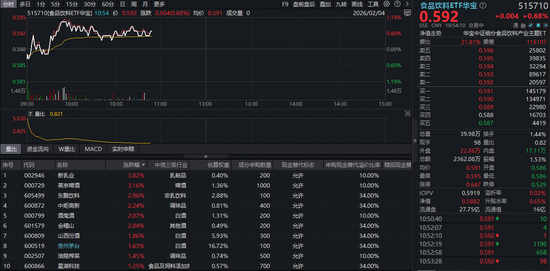
消费旺季点燃吃喝行情!茅台股价站上1500元,食品饮料ETF华宝(515710)盘中涨超1%!
Xin Lang Ji Jin· 2026-02-04 03:07
Group 1 - The food and beverage sector continues to strengthen, with the Huabao Food and Beverage ETF (515710) showing a price increase of 0.68% as of the latest report, reaching a peak intraday gain of 1.19% [1] - Key stocks in the sector, including dairy and beer companies, have performed well, with New Dairy and Yanjing Beer both rising over 3%, and other notable stocks like Guizhou Moutai and Shanxi Fenjiu increasing by more than 1% [1] - Guizhou Moutai announced a share buyback, having repurchased approximately 420,000 shares, representing 0.0333% of its total share capital, with a total expenditure of about 571 million yuan [1] Group 2 - According to Guosen Securities, Moutai is expected to maintain a steady price increase while experiencing strong sales during the Spring Festival, which will lay a foundation for the company's annual performance [3] - The food and beverage sector is currently at a historical low in terms of valuation, with the price-to-earnings ratio of the underlying index for the Huabao Food and Beverage ETF at 20.37 times, indicating a favorable long-term investment opportunity [3] - The upcoming Spring Festival is anticipated to boost demand in the food and beverage sector, as it is a peak consumption period, with expectations of strong performance in the first quarter of 2026 due to low comparative performance from the previous year [6] Group 3 - The Huabao Food and Beverage ETF (515710) tracks the CSI sub-index for the food and beverage industry, with approximately 60% of its portfolio allocated to leading high-end and mid-range liquor stocks, and nearly 40% to leading stocks in beverages, dairy, and condiments [4] - Investors can also access core assets in the food and beverage sector through the Huabao Food and Beverage ETF linked funds [4]
蜜雪冰城的雪王经济学:主题乐园或成方向丨消费参考
2 1 Shi Ji Jing Ji Bao Dao· 2026-02-04 02:56
Group 1 - The core idea of the article is that Mixue Ice City is diversifying its business model by leveraging the "Snow King" IP, which is becoming a significant asset for the company [2][4][5] - Mixue Ice City has recently posted job openings related to a "Theme Park Project," indicating its intention to create a comprehensive experience around the "Snow King" IP, including roles such as event coordination and content creation [2] - The flagship stores of Mixue Ice City, which feature limited edition drinks and "Snow King" merchandise, have shown strong customer attraction, with peak daily foot traffic reaching 46,000 and daily revenue exceeding 350,000 yuan [3] Group 2 - The "Snow King" IP has become a core competitive advantage for Mixue Ice City, significantly reducing marketing expenses, with brand promotion costs accounting for only 0.9% of revenue in the first three quarters of 2024 [4] - The company plans to allocate approximately 7% (230 million HKD) of its fundraising to further develop the "Snow King" brand and enhance consumer recognition [5] - The recruitment for the theme park project is seen as a step towards fully realizing the economic potential of the "Snow King" IP [6]
野村-必选消费:食饮出海征途:从模式探索到价值突围
野村· 2026-02-04 02:33
Investment Rating - The report rates the food and beverage industry as "essential consumption" with a stronger outlook than the market [2]. Core Insights - The Chinese food and beverage industry is transitioning from "incremental competition" to "stock competition," with overseas expansion becoming a crucial strategy for long-term survival and growth [6][12]. - The report identifies a four-stage model for overseas expansion, emphasizing the importance of supply chain specialization and ecological collaboration as the most promising path for Chinese companies [6][30]. Summary by Sections Four-Stage Overseas Expansion Model - The first stage is "Product Testing," focusing on low-cost market acceptance through exports [22]. - The second stage is "Localization," where companies establish local supply chains and operations to overcome trade barriers and enhance brand value [22]. - The third stage involves "Brand Acquisition and Integration," where companies pursue strategic acquisitions to expand their market presence [22]. - The fourth stage is "Global Value Network Construction," integrating global resources with regional agility to optimize efficiency and risk management [27]. Value Dimension Analysis - The report categorizes Chinese companies' overseas strategies into four types: efficiency advantage, product and category innovation, cultural empowerment and brand value, and supply chain ecological collaboration [30][31]. - Companies like Anqi Yeast and Xianle Health exemplify the supply chain specialization and ecological collaboration model, showcasing significant growth potential in overseas markets [30][47]. Growth Drivers and Recommended Targets - The report highlights that companies with established overseas operations and strong growth trajectories, such as Anqi Yeast and Xianle Health, are well-positioned for investment [47]. - Anqi Yeast has seen a compound annual growth rate of 20.7% in overseas revenue from 2022 to 2024, with a 37.6% share of total revenue coming from international markets [47][55]. - Xianle Health has achieved a remarkable 55.7% growth rate in overseas revenue during the same period, with 53.9% of its revenue derived from international operations [47][64].


野村东方国际 必选消费:食饮出海征途:从模式探索到价值突围
野村· 2026-02-04 02:27
Investment Rating - The report suggests a focus on companies that are transitioning from the initial product testing phase to the second phase of market penetration and localization, particularly those with strong supply chain capabilities [16][17]. Core Insights - The report identifies four stages of international expansion for Chinese companies, emphasizing the importance of product testing, localization, brand acquisition, and global value network construction [1][4]. - It highlights that the Chinese food and beverage industry has developed mature operational capabilities, making overseas expansion a natural choice [2][3]. - The report notes that while the overall overseas revenue for many Chinese companies remains low, certain segments, like health products, show higher overseas revenue ratios, indicating potential for growth [3][17]. Summary by Sections Industry Overview - The Chinese food and beverage sector is characterized by a complex domestic market, which provides a competitive advantage for companies looking to expand internationally [2][3]. - The report indicates that the overseas revenue share for food and beverage companies is significantly lower compared to other industries, suggesting room for growth [2]. Stages of International Expansion - The first stage involves product testing, where companies rely on local distributors to gauge market acceptance [6]. - The second stage focuses on market penetration and operational localization, where companies establish local supply chains and adapt products to local tastes [5][6]. - The third stage is characterized by brand acquisitions and network expansion, while the final stage involves managing a global value network [7][8]. Company Recommendations - The report recommends companies like Angel Yeast and Xinle Health, which have established strong overseas supply chains and operational entities, as key investment opportunities [18][21]. - Angel Yeast is noted for its significant overseas revenue growth, with projections indicating that overseas revenue could reach 40% by 2024 [19][20]. - Xinle Health is highlighted for its strong growth in overseas markets, particularly in regions like Europe and South America, with a focus on high-margin products [21][22].
贝因美2月3日获融资买入2100.52万元,融资余额2.73亿元
Xin Lang Cai Jing· 2026-02-04 01:31
Group 1 - The core viewpoint of the news is that Beiyinmei's stock performance and financial metrics indicate a mixed outlook, with a slight increase in stock price but a decrease in revenue year-over-year [1][2] - On February 3, Beiyinmei's stock rose by 0.66%, with a trading volume of 115 million yuan, and a net financing buy of -1.50 million yuan, indicating a low financing balance compared to historical levels [1] - As of September 30, Beiyinmei reported a revenue of 2.033 billion yuan, a year-on-year decrease of 2.59%, while the net profit attributable to shareholders increased by 48.07% to 106 million yuan [2] Group 2 - The company has a total of 147,900 shareholders as of September 30, which is an increase of 3.24% from the previous period [2] - The main business revenue composition of Beiyinmei includes 89.20% from milk powder, 4.69% from other supplements, 3.54% from rice cereal, and 1.71% from other products [1] - The company has cumulatively distributed 9.61 billion yuan in dividends since its A-share listing, but has not distributed any dividends in the last three years [2]

全力打造营商环境最佳口碑省
Liao Ning Ri Bao· 2026-02-04 01:05
Group 1: Business Environment Optimization - Liaoning's "14th Five-Year Plan" emphasizes optimizing the business environment as a crucial foundation for development, aiming for significant improvements in the short and long term [1] - Various departments are actively implementing concrete measures to enhance the business environment, including the establishment of a task list to ensure accountability and management [1][2] - The provincial government is focused on creating a favorable business environment by enhancing the efficiency of administrative services and reducing approval times for environmental projects by at least 50% [2] Group 2: Tax and Regulatory Improvements - The provincial tax authority is implementing "Twenty Hard Measures" to optimize the tax environment, ensuring compliance and enhancing service quality through proactive measures [2] - The focus is on improving tax compliance and service delivery, transitioning from passive responses to proactive and precise services [2] Group 3: Collaborative Efforts and Community Involvement - The concept of a collaborative approach to improving the business environment is emphasized, where every individual plays a role in shaping the overall perception of Liaoning [3] - The importance of integrity and positive interactions in the business community is highlighted as essential for fostering a conducive business environment [3] Group 4: International Trade and Investment - The provincial commerce department is committed to enhancing foreign trade and investment, focusing on high-quality development and ensuring foreign enterprises feel secure and supported [4] - Strategies include promoting cross-border e-commerce and integrating trade and investment efforts to attract new projects while supporting existing businesses [4] Group 5: Quality Infrastructure and Regulatory Support - The optimization of the inspection and testing industry is identified as a key technical support for improving the business environment, with a focus on enhancing data quality and industry standards [5] - The judicial department aims to reduce the regulatory burden on enterprises through flexible enforcement and streamlined inspection processes [6] Group 6: Local Government Initiatives - Local governments are implementing measures to improve policy alignment with business needs, such as simplifying approval processes and enhancing service delivery [7] - Initiatives like "one-stop" services and proactive outreach to businesses are being developed to address operational challenges faced by enterprises [7] Group 7: Customs and Trade Facilitation - Customs authorities are enhancing efficiency in inspection and clearance processes to meet the rapid demands of export and import businesses [8] - Efforts include personalized services and timely responses to businesses' inquiries regarding trade policies and regulations [8] Group 8: Project Development and Support - The successful implementation of projects, such as the environmentally friendly polymer production, showcases the effectiveness of government support in facilitating business operations [9] - The streamlined processes and supportive measures have significantly boosted investor confidence and project timelines [9]
京东:春节9天发超13亿元给一线员工;蜜雪冰城招聘多个乐园岗位;零跑董事长朱江明回应员工吐槽年会丨邦早报
Sou Hu Cai Jing· 2026-02-04 00:20
Group 1 - JD.com announced an investment of over 1.3 billion yuan during the Spring Festival to provide benefits and subsidies to frontline employees, including delivery personnel and customer service staff [1] - OpenAI is shifting its focus to prioritize the commercialization of ChatGPT, reallocating resources from long-term research, which has led to the departure of several executives [1] - Mixue Ice Cream is rumored to be building its own theme park, as indicated by multiple job postings for park-related positions with salaries ranging from 11,000 to 24,000 yuan per month [1] Group 2 - Apple is expected to use TSMC's 2nm N2 process for its M6 chip, focusing on architecture upgrades rather than adopting the N2P process [3] - XPeng Motors has merged its autonomous driving and smart cockpit centers into a new General Intelligence Center, aimed at enhancing AI capabilities across various applications [3] - A West Lake restaurant chain, Xibei, is facing allegations of breach of contract after attempting to vacate a location without proper notice [3] Group 3 - Honor's new smartphone, Power2, has been criticized for allegedly mimicking Apple's design, to which the company responded that mature designs tend to converge for functional reasons [5] - Leap Motor's chairman acknowledged shortcomings in organizational capabilities after employee complaints about a poorly organized annual meeting [7] - Zeekr has stated that premature content about its Zeekr 8X model disrupted its planned information release schedule [9] Group 4 - Porsche's CEO indicated that the company is prepared for a significant decline in sales, with a 10% drop globally and a 26% drop in China, emphasizing the importance of maintaining brand value over chasing volume [9] - PepsiCo plans to reduce prices on certain snack products by up to 15% in response to consumer complaints about high prices [9] - Douyin will discontinue its paid collection feature starting February 5, 2026, as part of a regular product iteration [9] Group 5 - Rui Meng Semiconductor has completed a new round of financing amounting to nearly 100 million yuan [11] - Beijing Human Shape Robotics Innovation Center has secured over 700 million yuan in market financing to advance its core technology platforms [11] - National Measurement Quantum Technology has announced over 100 million yuan in financing for its A++ round [11]

亿滋国际预计今年增长放缓 盘后股价下跌
Xin Lang Cai Jing· 2026-02-04 00:13
Core Viewpoint - Mondelez International forecasts a slowdown in growth this year due to fluctuating cocoa prices, which may create short-term pressures depending on competitors' responses and the stabilization of these prices [1] Group 1: Company Performance - Mondelez, owner of Oreo and Cadbury, reported a 4.8% decline in stock price during after-hours trading, dropping to $56.63 [1] - The company's stock has increased by 3.6% over the past year [1] Group 2: Market Conditions - Recent sudden drops in cocoa prices could lead to unexpected competitive reactions, prompting the company to maintain flexibility in its performance expectations [1] - CEO Dirk Van de Put expressed uncertainty about how the market will evolve in response to these price changes [1]
