
房地产

Search documents
房地产行业点评报告:上海三区启动住房以旧换新,推动新房去库存
KAIYUAN SECURITIES· 2026-02-04 08:17
Investment Rating - The industry investment rating is "Overweight" (maintained) [1] Core Insights - The report highlights the Shanghai government's initiative to purchase second-hand housing for affordable rental housing, targeting new citizens, young people, and university graduates [5] - The first batch of purchased second-hand homes will focus on properties that are well-located, have clear ownership, and are small-sized, with a strong willingness from owners to sell [6] - The report indicates a marginal recovery in Shanghai's housing market, with January 2026 seeing a year-on-year increase of 35.8% in new residential sales and 24.2% in second-hand home transactions [7] Summary by Sections Government Initiatives - Shanghai has launched a program to acquire second-hand homes for affordable rental housing, with three districts (Pudong, Jing'an, and Xuhui) as pilot areas [5] - The acquisition focuses on properties that match housing needs, are reasonably laid out, and are in well-equipped areas, ensuring affordability and sustainability [10] Market Trends - The report notes that the Shanghai housing market is showing signs of recovery, with a significant increase in both new and second-hand home sales in January 2026 [7] - The second-hand home listing index in Shanghai has decreased by 12.2% compared to early 2025, indicating a reduction in market supply [7] Investment Recommendations - The report recommends several companies that are well-positioned to benefit from the housing market recovery, including major real estate firms and property management companies that excel in service quality [8]
博时市场点评2月4日:两市涨跌不一,沪指重返4100点
Xin Lang Cai Jing· 2026-02-04 08:13
Market Overview - The Shanghai Composite Index closed at 4102.20 points, up 0.85%, while the Shenzhen Component Index rose 0.21% to 14156.27 points. The ChiNext Index fell 0.40% to 3311.51 points, and the Sci-Tech Innovation 100 Index decreased by 0.92% to 1620.23 points [4][11] - The total market turnover was 25,034.79 billion, a decrease from the previous trading day [6][12] - In the Shenwan first-level industry classification, coal, building materials, and real estate sectors led the gains, increasing by 7.58%, 3.48%, and 2.97% respectively, while media, communication, and computer sectors saw declines of 3.12%, 2.73%, and 1.70% respectively [4][11] Economic Indicators - The ISM Manufacturing Index in the U.S. unexpectedly rose from 47.9 to 52.6 in January, marking the first time in nearly a year that it entered the expansion zone, significantly exceeding market expectations [3][9] - This strong rebound may reflect a combination of inventory replenishment, demand recovery, and supply chain improvements, although its sustainability requires further data validation [3][9] Policy Developments - The Central Committee of the Communist Party of China and the State Council released the 2026 Central No. 1 Document, emphasizing the importance of food security and agricultural technology, with a target of stabilizing grain production at around 1.4 trillion jin [2][8] - The document highlights the integration of artificial intelligence with agriculture, promoting applications such as drones, IoT, and robotics, which is expected to benefit traditional agricultural sectors and open growth opportunities in agricultural technology and smart machinery [2][8] Monetary Policy - The People's Bank of China conducted a 3-month reverse repurchase operation of 800 billion, resulting in a net injection of 100 billion, marking the first increase in four months [2][9] - This action aims to maintain ample liquidity in the banking system and signals a continued supportive monetary policy stance, which may stabilize market expectations and encourage financial institutions to increase credit issuance [3][9]
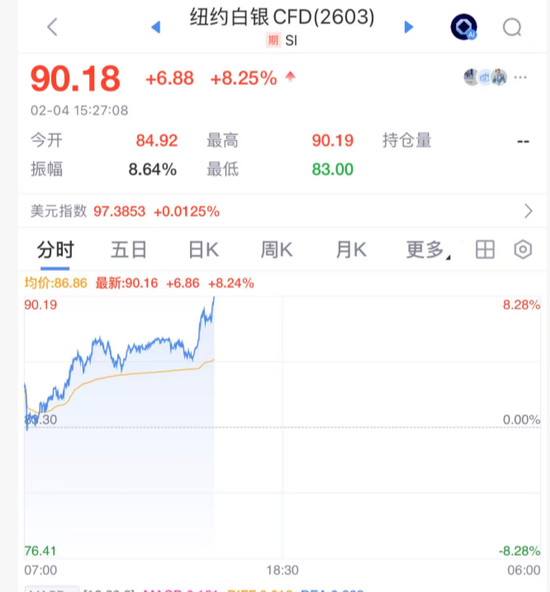
刚刚!白银,暴力拉升!
Xin Lang Cai Jing· 2026-02-04 08:13
Market Overview - The overall market performance was positive, with the three major indices rising in the afternoon, and the Shanghai Composite Index returning above 4100 points [1][4][17] - The Shanghai Composite Index closed up by 0.85%, while the Shenzhen Component Index rose by 0.21%, and the ChiNext Index fell by 0.4% [4][17] Silver Price Surge - Silver prices experienced a significant increase, with the Shanghai silver futures main contract rising over 11% and spot silver increasing by more than 6%, reaching $90 per ounce [2][14] - In New York, silver futures also rose by over 8%, with the price at $90 per ounce [2][14] Stock Performance - A total of 3254 stocks rose, with 77 stocks hitting the daily limit up, while 2130 stocks declined [5][18] - The total trading volume reached approximately 25032.63 billion, with a total of 149819.37 shares traded [19] Sector Highlights - The coal sector saw a collective surge, with multiple stocks such as China Coal Energy and Lu'an Environmental Energy hitting the daily limit up [19][20] - The space photovoltaic concept stocks continued to rise, with companies like JinkoSolar and TCL Zhonghuan also hitting the daily limit up [20][21] - The civil aviation sector experienced a significant increase, with stocks like Huaxia Airlines and China Eastern Airlines reaching the daily limit up [22][23] - Real estate stocks continued to rebound, with companies such as Jingtou Development and Rong'an Real Estate hitting the daily limit up [23] Declines in AI Sector - The AI application sector faced declines, with stocks like Yizhi Mai and Tiandi Online hitting the daily limit down [11][24] - Notable declines included a drop of 11.55% for Zhidema and a 10% drop for Tiandi Online and Yizhi Media [12][25]

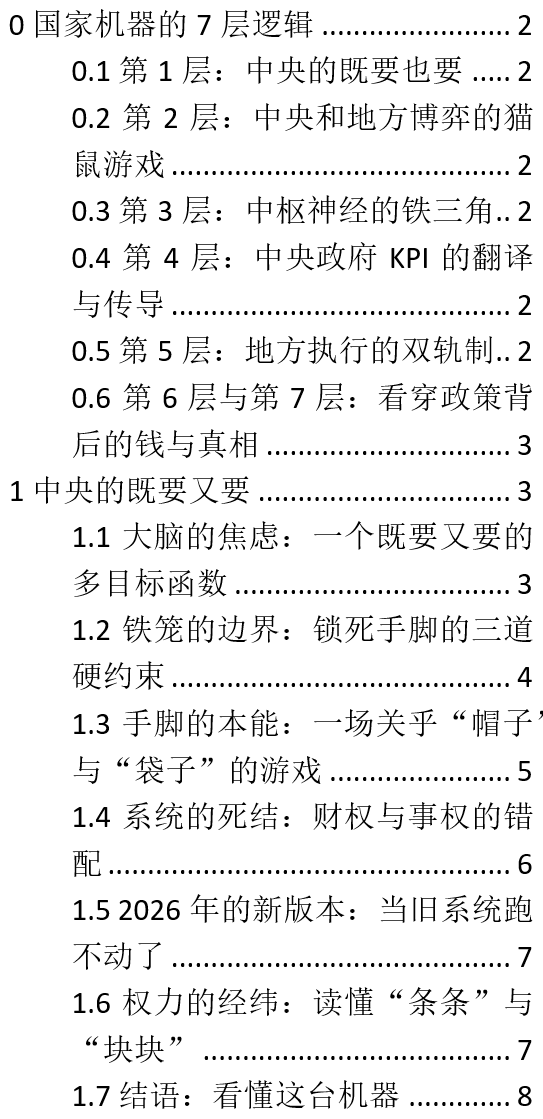
国家机器如何运转?中国政治经济底层逻辑学习笔记(中篇)
Sou Hu Cai Jing· 2026-02-04 07:47
Group 1 - The article discusses the complex dynamics of China's central government, emphasizing the interplay between various departments such as the National Development and Reform Commission (NDRC), the Ministry of Finance (MOF), and the People's Bank of China (PBOC) in macroeconomic policy-making [2][3][22] - It highlights the NDRC's dual powers of planning and approval, which are crucial for project legitimacy and funding, making it a key player in economic development [8][11][12] - The MOF's role as the budgetary authority is underscored, detailing its responsibilities in managing fiscal balance and debt issuance, which are critical during economic stimulus discussions [15][16][18] Group 2 - The article outlines the decision-making process within the central government, detailing the five critical stages from policy initiation to final approval, emphasizing the importance of inter-departmental negotiations [26][30][34] - It introduces the new mechanism of consistency evaluation for macroeconomic policies, aimed at preventing conflicting policies that could harm economic stability [40][41][70] - The central government's economic work meeting emphasizes the need for proactive fiscal and monetary policies to address current economic challenges, including maintaining a reasonable fiscal deficit and supporting domestic demand [69][90]
有人预测:今明两年,持有两套房及以上的家庭,或将面临3个问题
Sou Hu Cai Jing· 2026-02-04 07:44
Core Viewpoint - The article discusses the challenges faced by homeowners with multiple properties in China, highlighting the difficulties in selling homes, rising holding costs, and decreasing long-term demand for housing. Group 1: Selling Challenges - Selling homes has become increasingly difficult, shifting from "can sell anytime" to "may not sell at all" [9] - The inventory of unsold properties remains high, with significant increases in the number of second-hand homes listed for sale in major cities [11] - The price of second-hand homes has been declining for several months, leading to longer transaction times [13] Group 2: Rising Holding Costs - Holding costs for properties are increasing, with expenses such as mortgage payments, property fees, and maintenance becoming burdensome [20] - Rental yields are low, often not covering the costs associated with property ownership, especially for vacant homes [24] - A significant number of homes are vacant, with a vacancy rate exceeding 20%, leading to higher financial risks for homeowners [26] Group 3: Decreasing Long-term Demand - The declining birth rate and aging population are reducing the number of potential homebuyers, impacting overall housing demand [32] - Changing attitudes among young people towards homeownership, with many preferring rental options over purchasing multiple properties [34] - Government policies aimed at providing affordable housing are diverting some demand away from the market for private homes [36]

粤开市场日报-20260204
Yuekai Securities· 2026-02-04 07:32
Market Overview - The A-share market showed mixed performance today, with the Shanghai Composite Index rising by 0.85% to close at 4102.20 points, while the Shenzhen Component Index increased by 0.21% to 14156.27 points. In contrast, the Sci-Tech 50 Index fell by 1.20% to 1453.48 points, and the ChiNext Index decreased by 0.40% to 3311.51 points. Overall, 3252 stocks rose, 2126 fell, and 94 remained unchanged, with a total trading volume of 2481 billion yuan, down by 632 billion yuan from the previous trading day [1][12]. Industry Performance - Among the Shenwan first-level industries, coal, building materials, real estate, transportation, and food and beverage sectors led the gains, with increases of 7.58%, 3.48%, 2.97%, 2.82%, and 2.33% respectively. Conversely, the media, communication, computer, and electronics sectors experienced declines, with decreases of 3.12%, 2.73%, 1.70%, and 1.55% respectively [1][12]. Concept Sectors - The top-performing concept sectors today included central enterprise coal, selected coal mining, photovoltaic glass, selected air transportation, BC batteries, silicon energy, selected power equipment, photovoltaic rooftops, selected real estate, new energy, TOPcon batteries, photovoltaic, energy overseas, HJT batteries, and perovskite batteries [2][11].
海外国家房地产周期研究之英国:他山之石
Western Securities· 2026-02-04 07:30
Investment Rating - The report does not explicitly state an investment rating for the industry Core Insights - The UK real estate market has experienced significant fluctuations, with a recovery in second-hand home sales reaching 66% of pre-crisis peak levels and house prices recovering to 1.55 times the pre-crisis peak after 83 months [5][12][25] - The impact of policies such as quantitative easing (QE) and stamp duty adjustments has been significant, with the latter showing more pronounced effects on the real estate cycle [5][27] - Population dynamics, including high homeownership rates among local residents and the influx of new immigrants, have influenced housing demand, although immigration has not significantly impacted house prices [5][46][50] Summary by Sections Transaction Volume and Price Cycle Review - The UK housing market saw a decline in second-hand home sales by 64% and new home sales by 59% during the crisis period from 2007 to 2009 [12] - Currently, second-hand sales have recovered to 66% of their peak, while new home sales are at 45% of their peak [12] - House prices have increased to 1.55 times the pre-crisis peak, indicating a strong recovery [12][25] Policy Cycle Impact Review - The report highlights that the focus of policy responses during the 2007-2009 financial crisis was on stabilizing the banking system rather than directly stimulating housing transactions or prices [28] - Key measures included bank nationalization, emergency liquidity support, and the initiation of QE, which helped stabilize the housing market [28][29] Core Influencing Factors: Population Migration, Rent, and Mortgage Loans - The homeownership rate among UK-born residents is 67%, while EU-born residents have a lower homeownership rate of 35% [39][42] - New immigrants tend to rent initially, with homeownership rates increasing significantly after 20 years of residence in the UK [44] - Rental prices have shown a consistent upward trend, with recent yields recovering to 6.08% after a decline [50][62] Mortgage and Holding Costs - The average holding cost for properties is estimated to be between 1.0% and 2.5% of the property value annually [5][78] - The typical loan-to-value ratio for owner-occupied homes ranges from 75% to 90%, while investment properties usually do not exceed 75% [78] Price-to-Income Ratio and Monthly Payment Burden - The national price-to-income ratio was 4.9 in Q3 2025, with a peak of 5.8 in Q3 2022 and a low of 4.1 in Q1 2009 [73] - The monthly payment burden ratio was 33.8% in Q3 2025, with a peak of 46% in Q4 2007 and a low of 27.1% in Q3 2020 [77] Mortgage Loan Dynamics - The total amount of mortgage loans issued has seen a recovery post-crisis, with significant fluctuations in new loan commitments reflecting market sensitivity [80][83] - The pricing of mortgage loans has shifted from being risk-premium driven to being more influenced by policy interest rates [86]
收评:沪指低开高走涨0.85%重回4100点,煤炭、光伏板块集体大涨
Xin Lang Cai Jing· 2026-02-04 07:12
Market Performance - The three major A-share indices showed mixed results, with the Shanghai Composite Index rising by 0.85% and the Shenzhen Component Index increasing by 0.21%, while the ChiNext Index fell by 0.4% and the Northern Stock 50 Index decreased by 0.71% [1] - The total trading volume in the Shanghai, Shenzhen, and Beijing markets reached 25,033 billion yuan, a decrease of 624 billion yuan compared to the previous day, with over 3,200 stocks rising [1] Sector Performance - The coal mining and processing, photovoltaic equipment, airport transportation, real estate, steel, natural gas, construction materials, and retail sectors saw significant gains [1] - Conversely, sectors such as precious metals, AI applications, computing power leasing, semiconductors, gaming media, and CPO concept stocks experienced notable declines [1] Notable Events - News of Elon Musk's team visiting multiple photovoltaic companies in China boosted sentiment in the photovoltaic sector, leading to over ten stocks, including JinkoSolar and TCL Zhonghuan, hitting the daily limit [1] - Increased coal demand due to energy supply guarantees for the winter season resulted in a collective surge in the coal sector, with stocks like Yanzhou Coal and Shanxi Black Cat also hitting the daily limit [1] - The real estate chain showed active performance, with stocks such as China Merchants Shekou and Poly Development rising [1] Additional Sector Movements - The oil and gas, airport transportation, and retail sectors also experienced upward movement [1] - On the downside, some high-priced gold stocks faced corrections, with Sichuan Gold nearing a trading halt [1] - The cloud computing and computing power leasing sectors saw significant pullbacks, with stocks like Wangsu Science & Technology, Yuke Technology, and Dawei Technology leading the declines [1]
房地产行业专题:香港楼市复苏的复盘、展望与借鉴
Guoxin Securities· 2026-02-04 06:54
Investment Rating - The report maintains an "Outperform" rating for the real estate industry [5] Core Insights - The Hong Kong real estate market is experiencing a recovery, with private residential transaction volume expected to increase by 21% in 2025, marking the second-highest level since 2013. The price index has stabilized and increased by 4.8% from its lowest point, with an annual growth of 3.3% [1][14] - The recovery is characterized by a "volume precedes price" pattern, with transaction volumes at historically high levels, while prices remain approximately 25% below the peak in September 2021 [20][23] - The current recovery cycle is influenced by a combination of policy relaxation, interest rate changes, demand, and benefits from mainland China, which is expected to be less pronounced than the recovery from 2003 to 2008 [2][50] Summary by Sections 2025 Hong Kong Real Estate Overview - In 2025, Hong Kong's primary residential market is projected to see 20,540 transactions, a 21% increase year-on-year, while the secondary market is expected to have 42,292 transactions, a 17% increase, totaling over 60,000 transactions [13][14] Price and Rent Index Trends - The price index for private residential properties has rebounded by 4.8% from its lowest point, with a year-on-year increase of 3.3%. The rental index has also increased by 4.3%, surpassing the historical high reached in 2019 [14][18] Comparison of Downturn Cycles - The downturn from 2021 to 2025 is milder compared to the 1997-2003 period, with a price drop of 28% over 42 months, compared to a 66% drop over 69 months in the earlier cycle. The rental price drop was 13% over 41 months in the recent cycle, compared to 49% over 72 months previously [26][28] Factors Contributing to Recovery - Demand-side policy relaxation has been a key factor, with measures including the reduction of transaction costs and incentives for new residents. The rental yield has surpassed mortgage rates, contributing to increased transaction volumes and price stabilization [2][54] - Population inflow and rising income levels have also supported demand, with the median monthly household income in Hong Kong rising by approximately 10% since 2021-2022 [3][80] Lessons for Mainland China - The report suggests that the mainland real estate market can learn from Hong Kong's experience, particularly in terms of policy relaxation and the importance of rental yields exceeding mortgage rates. The current situation in mainland cities shows a significant gap between rental yields and mortgage rates, indicating potential for improvement [4][94]
国泰海通:汇率与运价边际回落 机械出口海外需求结构分化
智通财经网· 2026-02-04 06:40
Core Insights - The report from Guotai Junan highlights a slight depreciation of the US dollar against the Chinese yuan, with major shipping routes experiencing a year-on-year decline in freight rates. The report suggests focusing on export-oriented consumer companies that possess global manufacturing layouts, brand export capabilities, and channel integration advantages. In the context of changing external environments and policy negotiations, companies with diversified capacity, stable customer loyalty, and pricing power are expected to achieve sustained growth amid adjustments in global trade patterns [1]. Cost Tracking - The USD/CNY exchange rate showed a slight depreciation, with the spot rate at 6.95 on January 30, 2026, up 1.30% from January 23. The EUR/CNY exchange rate was 8.28, increasing by 0.97% [1]. - The China Export Container Freight Index (CCFI) for the fourth week of January 2026 reported a composite index of 1175.59, down 16.92% year-on-year and down 2.74% month-on-month. Specific routes showed the following changes: European route at 1574.69 (down 25.16% YoY, up 0.35% MoM), US East route at 975.78 (down 24.75% YoY, down 0.37% MoM), US West route at 867.79 (down 27.60% YoY, up 1.64% MoM), and Southeast Asia route at 933.11 (down 16.71% YoY, down 4.48% MoM) [1]. Industry High-Frequency Data Tracking - In the US restaurant industry, the Restaurant Performance Index (RPI) for November 2025 was reported at 99.2, a decrease of 0.4% from October's 99.6 [2]. - The US housing market index for January 2026 was 37, reflecting a month-on-month decline of 5.13% and a year-on-year decrease of 21.28%. The inventory of existing homes stood at 1.18 million units, up 3.51% YoY, while existing home sales reached 4.35 million units, up 1.40% YoY. New home sales in October were 737,000 units, up 18.68% YoY [2]. - In the golf cart industry, December 2025 saw a 1.33% month-on-month increase in export volume and a 7.66% year-on-year increase. The export value rose by 11.21% month-on-month and 8.76% year-on-year, with December exports valued at $0.43 billion and total exports for the year at $3.63 billion, down 63.74% YoY [2]. - The motorcycle industry reported a December 2025 export value decrease of 2.73% month-on-month but an increase of 15.83% year-on-year. Export volume fell by 6.79% month-on-month while increasing by 16.29% year-on-year [2].
