
非银金融

Search documents
11月信用,有点鸡肋
HUAXI Securities· 2025-11-03 15:23
Report Industry Investment Rating No relevant content provided. Core Views of the Report - In October, credit bonds outperformed interest rate bonds, with credit spreads narrowing across the board, and medium- to long-term, low-rated varieties showing significant recovery. The buying power of credit bonds increased, and the trading volume share of 1-3 year and 3-5 year bonds rose. [1][10][11] - Looking ahead to November, the central bank's bond purchases provide a strong market stability expectation, and interest rates are more likely to decline. However, the cost-effectiveness of short- to medium-term credit spreads in credit bonds is relatively low, which may limit their market performance. [2][18] - In November, credit bonds may underperform interest rate bonds. Accounts with unstable liability ends can appropriately reduce their credit bond positions and adjust to interest rate and Tier 2 capital bonds and perpetual bonds of large banks, which have good liquidity. For accounts with stable liability ends, they can prefer medium- to high-rated 3-5Y steeper entities to increase holding returns through riding the yield curve. [3][26][30] Summary by Relevant Catalogs 1. Grasp the trading opportunities of 4-5 year Tier 2 capital bonds and perpetual bonds of large banks, and prefer medium- to high-rated 3-5Y steeper entities - In October, the bond market was affected by Sino-US tariff shocks and bond market redemption fee rate regulations, with interest rate fluctuations intensifying. Credit bonds outperformed interest rate bonds, and credit spreads narrowed across the board. The buying power of credit bonds increased significantly, and the trading volume share of 1-3 year and 3-5 year bonds rose. [10][11] - Products with stable liability ends may be the important buyers of credit bond duration varieties in October. On the one hand, the opening scale of amortized cost method bond funds was relatively large in October, and some of them increased their investment in 3-5 year medium- to high-rated credit bonds. On the other hand, 3-5 year low-rated credit bonds were also bought by securities company asset management products with a 1-3 year closed period. [15] - Looking ahead to November, the central bank's bond purchases provide a strong market stability expectation, and interest rates are more likely to decline. However, the cost-effectiveness of short- to medium-term credit spreads in credit bonds is relatively low, and the potential compression space is small. [18] - In November, credit bonds may underperform interest rate bonds. Accounts with unstable liability ends can appropriately reduce their credit bond positions and adjust to interest rate and Tier 2 capital bonds and perpetual bonds of large banks, which have good liquidity. For accounts with stable liability ends, they can prefer medium- to high-rated 3-5Y steeper entities to increase holding returns through riding the yield curve. [26][30] 2. Urban investment bonds: Net financing turned positive, and medium- to long-term, low-rated bonds showed significant recovery - In October, the net financing of urban investment bonds turned positive but decreased year-on-year. The issuance sentiment was good, and the proportion of issuance multiples above 3 times increased week by week. The weighted average issuance interest rates of urban investment bonds declined across the board, with a larger decline in the medium- to long-term. [33] - The performance of net financing in each province was differentiated in October, with most provinces in a net inflow state. The yields of urban investment bonds declined across the board, and the medium- to long-term, low-rated varieties that had experienced significant adjustments earlier showed significant recovery. [35][37][40] - From the perspective of broker transactions, the buying sentiment of urban investment bonds warmed up in October. The overall TKN ratio and low valuation ratio increased month-on-month. In the last week of October, the number of transactions of medium- to long-term urban investment bonds increased significantly, and the AA(2) rating remained relatively active in transactions. [44] 3. Industrial bonds: Supply increased, and yields declined across the board - In October, the issuance and net financing scale of industrial bonds increased significantly year-on-year. The net financing scale of the comprehensive and public utilities sectors was relatively large, and the net financing of the non-bank financial sector was also above 300 million yuan. The issuance sentiment of industrial bonds improved significantly starting from the third week of October. [47] - In terms of term structure, the issuance proportion of long-term industrial bonds over 5 years increased in October, and the issuance interest rates of 1-3 year and 3-5 year bonds increased, while those of other terms declined. [48] - The yields of industrial bonds declined across the board in October, and the spreads also narrowed. The 5-year varieties performed better. The yields of public bonds in each industry declined by 3-17bp, and the medium- to long-term varieties performed better. [50][53] 4. Bank capital bonds: Net financing decreased year-on-year, and trading sentiment improved significantly No relevant content provided in the given text for this part.
开源晨会-20251103
KAIYUAN SECURITIES· 2025-11-03 14:47
Macro Economic Overview - October exports are expected to remain resilient, with port throughput increasing by 8.9% year-on-year compared to 2024, indicating a potential export growth of approximately 1.9% [7] - Industrial production remains stable, with the manufacturing PMI falling to 49.0%, indicating a contraction in manufacturing activity, while the non-manufacturing PMI slightly improved to 50.1% [21][22] - Construction activity is weak, with building starts at historically low levels, while industrial operations are relatively strong, particularly in the chemical sector [4] Industry Performance - The media, coal, oil and petrochemical, steel, and banking sectors showed the highest gains in stock performance, with media leading at 3.125% [3] - Conversely, the non-ferrous metals, home appliances, automotive, and beauty care sectors experienced declines, with non-ferrous metals down by 1.210% [3] Real Estate Sector - New housing transactions have seen a significant year-on-year decline, with major cities reporting a 34% drop compared to 2023 and 2024 [6] - The second-hand housing market remains weak, with transaction volumes in major cities still negative compared to previous years [6] Agricultural Sector - The agricultural sector reported a revenue increase of 6.44% year-on-year for the first three quarters of 2025, but Q3 profits fell by 58.8% due to declining pig prices [35] - The pig farming sector is entering a de-stocking phase, while the feed and veterinary sectors are expected to improve as pig farming volumes recover [36] REITs Market - The REITs sector outperformed both stocks and bonds in the first half of 2025, with a total return of 13.41%, driven by policy support and demand resilience [42] - The second half of 2025 has seen a decline in REITs performance, highlighting a divergence in sector performance, particularly among consumption and logistics REITs [43] Computer Industry - The computer sector has shown a 25.12% increase year-to-date, with a low fund holding ratio of 2.92%, indicating potential for growth [46][47] - Key trends include rapid advancements in AI and domestic software and hardware, with significant opportunities for investment in AI applications and domestic technology [48] Wind Power Industry - The domestic wind power sector is expected to see significant growth, with a target of 120GW of new installations during the 14th Five-Year Plan period [51] - The industry is recovering from price wars, with improved bidding practices leading to better profitability for wind turbine manufacturers [52]
非银金融行业11月3日资金流向日报
Zheng Quan Shi Bao Wang· 2025-11-03 13:17
Market Overview - The Shanghai Composite Index rose by 0.55% on November 3, with 22 industries experiencing gains, led by Media and Coal, which increased by 3.12% and 2.52% respectively. Conversely, Non-ferrous Metals and Home Appliances saw declines of 1.21% and 0.66% respectively [1] Capital Flow Analysis - The main capital outflow from the two markets totaled 23.944 billion yuan, with 9 industries seeing net inflows. The Media industry led with a net inflow of 2.031 billion yuan, followed by the Banking sector with a net inflow of 1.831 billion yuan and a daily increase of 1.33% [1] - The Non-bank Financial sector experienced a slight decline of 0.06%, with a total net outflow of 3.562 billion yuan. Out of 82 stocks in this sector, 34 rose, including one hitting the daily limit, while 44 fell [2] Non-bank Financial Sector Details - Within the Non-bank Financial sector, the top net inflow stocks included China Ping An with 104 million yuan, followed by Haide Shares and Sichuan Shuangma with inflows of 83.9628 million yuan and 37.8190 million yuan respectively [2] - The stocks with the highest net outflows included CITIC Securities, Dongfang Wealth, and Huatai Securities, with outflows of 479.562 million yuan, 370.715 million yuan, and 251.086 million yuan respectively [2][3]




1.19亿元主力资金今日撤离综合板块
Zheng Quan Shi Bao Wang· 2025-11-03 13:10
Market Performance - The Shanghai Composite Index rose by 0.55% on November 3, with 22 industries experiencing gains, led by the media and coal sectors, which increased by 3.12% and 2.52% respectively [1] - The composite industry fell by 0.39%, with a net outflow of 1.19 million in main funds [2] Fund Flow Analysis - Main funds saw a net outflow of 239.44 billion across the two markets, with the media sector receiving the highest net inflow of 20.31 billion, followed by the banking sector with an inflow of 18.31 billion [1] - In the composite industry, 12 out of 16 stocks rose, with the highest net inflow recorded for Yuegui Co., amounting to 47.45 million, followed by Sanmu Group and Yatai Group with inflows of 31.92 million and 6.88 million respectively [2] Sector Performance - The sectors with the largest net outflows included non-ferrous metals, which saw a net outflow of 70.54 billion, and the electronics sector with an outflow of 45.71 billion [1] - The composite industry's stocks with the largest net outflows included Dongyangguang, Zhangzhou Development, and Yueda Investment, with outflows of 154 million, 43.32 million, and 8.90 million respectively [2]


社保基金最新重仓股揭晓!新进比亚迪、隆基绿能、迈瑞医疗等226只个股!
私募排排网· 2025-11-03 12:00
Core Viewpoint - The social security fund's latest holdings in A-shares reveal significant investment trends, with a total market value of approximately 552.72 billion yuan, reflecting an increase of about 49.81 billion yuan from the previous quarter [2][4]. Group 1: Holdings Overview - As of the end of Q3 2025, the social security fund was a top ten shareholder in 622 A-share companies, with a total holding value of approximately 552.72 billion yuan, up from 502.91 billion yuan at the end of Q2 [2][4]. - The fund initiated positions in 226 new stocks, increased holdings in 153 stocks, and reduced holdings in 135 stocks, while maintaining positions in 108 stocks [12][4]. - The banking sector accounted for the largest portion of the fund's holdings, with a market value of 270.06 billion yuan, followed by the non-bank financial sector at approximately 63.04 billion yuan [2][4]. Group 2: Performance of Key Stocks - Among the 622 companies, 133 had a market value exceeding 500 million yuan, and 55 had a market value exceeding 1 billion yuan, collectively accounting for 76.67% of the total holdings [4]. - The top five stocks with a market value exceeding 10 billion yuan were predominantly financial stocks, including Agricultural Bank of China, Industrial and Commercial Bank of China, China Pacific Insurance, and China Communications Bank [4][5]. - Agricultural Bank of China was the largest holding, valued at 156.89 billion yuan, with a strong performance of 38.23% increase since July [4][5]. Group 3: New Energy Sector Focus - The social security fund maintained a significant focus on the new energy sector, with 20 companies in this field having a market value exceeding 300 million yuan, averaging a 45.92% increase since July [9]. - Key stocks in the new energy sector, such as Yiwei Lithium Energy and Sanyuan Electric, saw increases exceeding 80% since July [9][10]. - The fund's investments in the new energy sector reflect a strategic allocation despite the majority of holdings being in the banking and non-bank financial sectors [9][10]. Group 4: Notable Increases in Holdings - The fund significantly increased its holdings in several traditional industry stocks, with notable increases exceeding 50% in companies like Three Trees and Oriental Yuhong [17]. - The largest increase was seen in Guangxin Co., with a 277.97% increase in holdings, reflecting a strategic shift towards agricultural chemicals [16][17]. - Other companies with substantial increases included New Strong Union and Guoen Co., with increases of 251.17% and 230.28%, respectively [17][16].







A股市场2025年三季报业绩综述:全A净利边际改善,新动能延续高景气
BOHAI SECURITIES· 2025-11-03 10:46
Group 1 - The core viewpoint of the report indicates that the overall A-share market has shown improvements in both revenue and net profit for Q3 2025, driven by factors such as "anti-involution" policies and resilient exports, along with a low base effect [9][10][31] - In Q3 2025, the overall A-share revenue and net profit growth rates were 3.9% and 11.5% year-on-year, respectively, marking a recovery from Q2 2025 by 3.4 and 10.2 percentage points [9][10] - The report highlights that all sectors experienced improvements in revenue and net profit growth rates, with the ChiNext and Sci-Tech Innovation Board performing relatively better [10][12] Group 2 - The DuPont analysis shows that the return on equity (ROE) for the ChiNext was affected by seasonal factors, with Q3 2025 ROE for the main board, ChiNext, and Sci-Tech Innovation Board at 2.5%, 2.3%, and 1.0%, respectively [13][15] - The main board and ChiNext saw improvements in ROE due to increases in sales profit margins and asset turnover, while the ChiNext's decline was primarily due to seasonal sales profit margin decreases [15][14] - The report notes that mid-cap stocks, represented by the CSI 500, achieved positive revenue growth in Q3 2025, with significant improvements in net profit growth as well [22][29] Group 3 - The report indicates that the upstream resource sectors showed marginal improvements in net profit growth rates in Q3 2025, with the coal and oil & petrochemical industries experiencing reduced declines due to price recovery [31][36] - In the midstream materials sector, the steel industry saw significant improvements in net profit growth, attributed to "anti-involution" measures, while the basic chemical industry returned to positive growth [31][32] - The consumer sector remains under pressure, with optional consumption industries showing marginal improvements mainly due to low base effects, while essential consumption sectors like food and beverage faced further declines [34][31]
证券保险ETF(512070)10月“吸金”超25亿元,机构看好非银金融板块全年业绩保持高增长
Sou Hu Cai Jing· 2025-11-03 10:41
Group 1 - The financial industry showed mixed performance today, with the banking sector experiencing an upward trend while the non-bank financial sector saw wide fluctuations before a rally in the afternoon [1] - The China Securities Bank Index rose by 1.3%, while the CSI 300 Non-Bank Financial Index increased by 0.01%. In contrast, the Hong Kong Securities Index fell by 0.1%, and the CSI All Index Securities Company Index decreased by 0.2% [1] - The Securities Insurance ETF (512070) attracted over 2.5 billion yuan in October, indicating strong investor interest in related products [1] Group 2 - According to Industrial Securities, the non-bank financial sector experienced significant growth in Q3, driven mainly by investment income and new premium growth in the insurance sector. The brokerage sector also performed well due to active market trading boosting revenues [1] - The non-bank financial sector is expected to maintain strong growth throughout the year, presenting investment opportunities due to the rising sector sentiment [1]
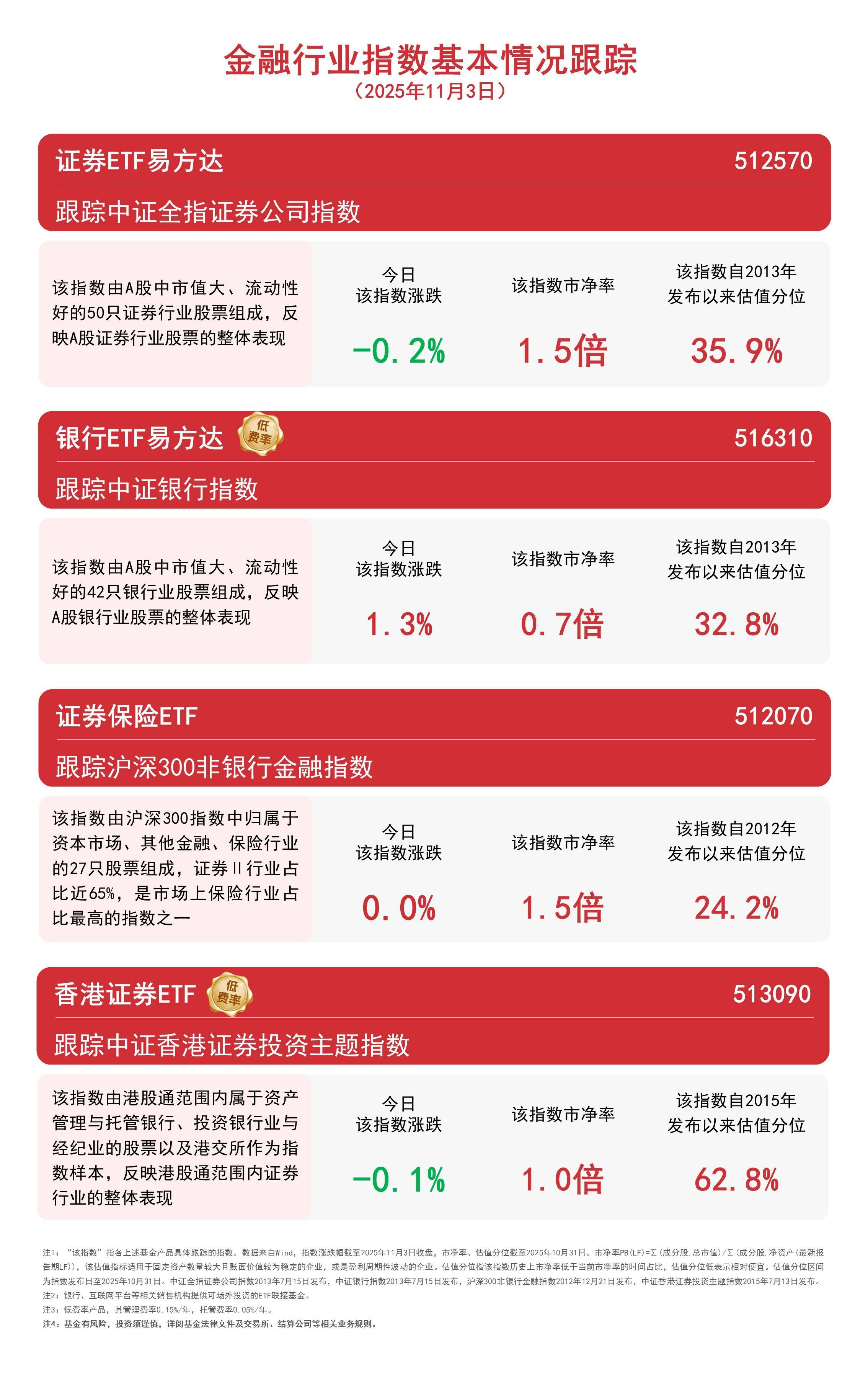
11月3日国企改革(399974)指数涨0.25%,成份股金风科技(002202)领涨
Sou Hu Cai Jing· 2025-11-03 10:23
Core Points - The State-Owned Enterprise Reform Index (399974) closed at 1902.39 points, up 0.25%, with a trading volume of 146.44 billion yuan and a turnover rate of 0.74% [1] - Among the index constituents, 56 stocks rose, with Goldwind Technology leading at a 6.94% increase, while 39 stocks fell, with China Rare Earth leading the decline at 5.24% [1] Index Constituents Summary - The top ten constituents of the State-Owned Enterprise Reform Index include: - Yingmei Ge, with a weight of 3.60%, latest price at 30.00, down 1.64%, total market value of 797.33 billion yuan [1] - Changjiang Electric Power, with a weight of 2.90%, latest price at 28.31, up 0.75%, total market value of 692.70 billion yuan [1] - CITIC Securities, with a weight of 2.90%, latest price at 29.22, down 0.54%, total market value of 433.06 billion yuan [1] - Yuanta Haitong, with a weight of 2.89%, latest price at 19.61, up 1.19%, total market value of 345.70 billion yuan [1] - China Merchants Bank, with a weight of 2.80%, latest price at 41.79, up 2.20%, total market value of 1053.94 billion yuan [1] - Industrial Bank, with a weight of 2.74%, latest price at 20.56, up 1.63%, total market value of 435.11 billion yuan [1] - North Huachuang, with a weight of 2.73%, latest price at 401.00, down 1.49%, total market value of 290.48 billion yuan [1] - Wuliangye, with a weight of 2.68%, latest price at 118.98, down 0.01%, total market value of 461.83 billion yuan [1] - China Shipbuilding, with a weight of 2.52%, latest price at 36.43, up 1.48%, total market value of 274.16 billion yuan [1] - Zhongke Shuguang, with a weight of 2.42%, latest price at 106.46, up 0.01%, total market value of 155.76 billion yuan [1] Capital Flow Summary - The net outflow of main funds from the index constituents totaled 4.443 billion yuan, while speculative funds saw a net inflow of 1.03 billion yuan, and retail investors had a net inflow of 3.413 billion yuan [3] - Notable capital flows include: - China Merchants Bank with a net inflow of 433 million yuan, accounting for 11.29% of the total [3] - Allwind Technology with a net inflow of 430 million yuan, accounting for 11.88% of the total [3] - China Petroleum with a net inflow of 326 million yuan, accounting for 14.97% of the total [3] - China Shipbuilding with a net inflow of 284 million yuan, accounting for 10.31% of the total [3]




养老金三季度持仓曝光,新进这些个股!
市值风云· 2025-11-03 10:09
Core Viewpoint - Pension funds prefer companies with stable profits and dividends, focusing on industry leaders and quality blue-chip stocks [1][4]. Group 1: Pension Fund Holdings - As of the end of Q3, pension funds entered the top ten shareholders of 176 stocks, with a total market value of 38 billion [5]. - The holdings are primarily concentrated in sectors such as machinery (24 stocks), basic chemicals (14 stocks), pharmaceuticals, and electronics [5]. - Stocks held by pension funds typically exhibit stable profitability, high technical barriers, or align with national industrial upgrade directions, reflecting a clear preference for industry leaders and quality blue-chip stocks [5][19]. Group 2: Key Stocks in Pension Fund Portfolio - The six stocks with a market value exceeding 1 billion at the end of Q3 are: Chuanfeng Power, Zhejiang Chint Electric, Transsion Holdings, GF Securities, Bluestar Technology, and Hongfa Technology [5]. - Chuanfeng Power, a leader in high-end motorcycles and ATVs, reported a net profit growth of 30.89% year-on-year for the first three quarters and has maintained a dividend payout ratio exceeding 30% for three consecutive years [7]. - GF Securities, newly added to the pension fund's portfolio, benefited from a recovering capital market, with a net profit growth of 61.6% year-on-year for the first three quarters and a stable dividend payout ratio above 30% over the past five years [10]. Group 3: Investment Trends - In Q3, pension funds actively adjusted their portfolios, increasing holdings in growth sectors, particularly machinery, automotive, electronics, and communications [14]. - Notable increases in holdings include stocks like Tiancheng Technology, Aopu Mai, and Keta Bio, with significant increases in their respective ownership percentages [15]. - The pension fund's long-term holding strategy is evident, with some stocks held for over eight consecutive quarters, including Changhai Co., Huamao Logistics, and Jiasite Technology [13]. Group 4: Performance and Growth Potential - The electronic concept stock, Ziguang Guowei, saw a significant increase in market value to nearly 900 million, driven by a recovery in the special integrated circuit market and strong growth in automotive electronics [16]. - In the automotive sector, stocks like Xinz坐标, Jingzhu Technology, and Changshu Auto Parts saw notable increases in pension fund holdings, with Jingzhu Technology focusing on key components for new energy vehicles and showing signs of improvement in performance [17].

11月信用月报:临近年末,信用债参与机会怎么看?-20251103
Western Securities· 2025-11-03 10:06
1. Report Industry Investment Rating No relevant content provided. 2. Core Viewpoints of the Report - In November, credit bonds are expected to show a volatile trend, but there are certain participation opportunities. It is recommended to seize the opportunity to buy medium - and high - grade varieties on dips. The ticket - coupon strategy is the main approach, and attention should be paid to the investment opportunities brought by the centralized position - building of amortized fixed - open bond funds [1][28]. - The supply of credit bonds in November may increase seasonally, but the incremental supply is not expected to be large. The demand side shows that bank wealth management still has increments, and the impact of the new public offering regulations on bond funds is expected to be limited [20]. 3. Summary According to Relevant Catalogs 3.1 Credit Bond Market Review and Outlook 3.1.1 October Credit Bond Market Review - In October, credit bond yields declined across the board, with the decline more than that of the same - term interest - rate bonds. Medium - and long - term bonds performed better than short - term bonds, and general credit bonds outperformed financial bonds [11]. - By week, the performance of credit bonds was affected by factors such as holiday data, tariff frictions, equity markets, risk - aversion sentiment, policy expectations, and the restart of treasury bond trading. The yields and spreads of credit bonds showed different trends in each week [10]. - As of November 2, the full - caliber wealth management scale dropped to 31.5 trillion yuan, a decrease of 6.1 billion yuan from the previous week. The net - breaking rates of all bank wealth management products and wealth management subsidiaries decreased [13]. 3.1.2 November Credit Bond Market Outlook - Supply: Seasonally, credit bond supply usually increases in November, but considering the continuous contraction of urban investment bond supply, the supply increment this year may not be large [20]. - Demand: Bank wealth management is expected to have positive growth in November, but the incremental growth may continue to narrow. If the new public offering regulations are mitigated, the impact on bond funds may be limited [20]. - Overall, credit bonds are expected to fluctuate in November. There are participation opportunities, but it is difficult to have an independent trend. It is recommended to buy medium - and high - grade varieties on dips. Pay attention to the investment opportunities brought by the centralized position - building of amortized fixed - open bond funds [28]. 3.2 Primary Market 3.2.1 Issuance Volume - In October 2025, the credit bond issuance scale was 1492.311 billion yuan, an increase of 161.8 billion yuan year - on - year and a decrease of 270.9 billion yuan month - on - month. The net financing amount was 310.974 billion yuan, a decrease of 132.1 billion yuan year - on - year and an increase of 140.4 billion yuan month - on - month [34]. - By type, the net financing amount of urban investment bonds was - 5.838 billion yuan, while that of industrial bonds and financial bonds was 300.042 billion and 16.77 billion yuan respectively [34]. 3.2.2 Issuance Cost - From October 1 to 31, the average issuance interest rate of credit bonds was 2.22%, a decrease of 8.4bp compared with September. The average issuance interest rates of industrial bonds and urban investment bonds decreased, while that of financial bonds increased [39]. 3.2.3 Issuance Term - From October 1 to 31, the average issuance term of credit bonds was 2.95 years, a decrease of 0.01 year compared with September. The average issuance terms of industrial bonds and financial bonds increased, while that of urban investment bonds decreased [48]. 3.2.4 Cancellation of Issuance - In October, 27 credit bonds were cancelled for issuance, with a cancellation scale of 10.687 billion yuan, a decrease of 26 bonds and 17.993 billion yuan respectively compared with the previous month [49]. 3.3 Secondary Market 3.3.1 Trading Volume - In October, the trading volume of all credit bond varieties except insurance sub - bonds decreased compared with the previous month. The trading volume of bank secondary capital bonds decreased the most, followed by bank perpetual bonds [54]. - By trading term, 1 - 5 - year urban investment bonds were more popular. The trading performance of industrial bonds varied by term, and the trading terms of bank perpetual bonds and some other bonds also showed different trends [54]. - By implied rating, the trading of urban investment bonds shifted from medium - rated to other ratings, while that of industrial bonds shifted to high - rated bonds [55]. 3.3.2 Trading Liquidity - In October, the turnover rates of urban investment bonds, industrial bonds, and financial bonds all decreased. By trading term, the turnover rate of 1 - 3 - year urban investment bonds decreased the most, and that of less than 1 - year industrial and financial bonds decreased the most [57]. 3.3.3 Spread Tracking - In October, the spreads of all urban investment bond varieties narrowed, with medium - and long - term spreads narrowing more significantly. The 5 - year AA - rated variety had the largest narrowing amplitude of 22bp [62]. - By region, most spreads in October narrowed, with the narrowing amplitude of each province not exceeding 5bp [66]. - In October, the spreads of AAA - rated and AA - rated industrial bonds in all industries narrowed, with the AA - rated bonds having a larger average narrowing amplitude [67]. - In October, the spreads of bank secondary and perpetual bonds narrowed, with medium - and long - term spreads narrowing more significantly [70]. - In October, most spreads of securities sub - bonds narrowed, while those of insurance sub - bonds narrowed across the board [72]. 3.4 October Hot Bonds Overview - The report selects the top 20 urban investment bonds, industrial bonds, and financial bonds in terms of liquidity scores for investors' reference [74]. 3.5 Credit Rating Adjustment Review - In October, 7 bonds had their debt ratings upgraded, and there were no downgrades [78].