证券业

Search documents
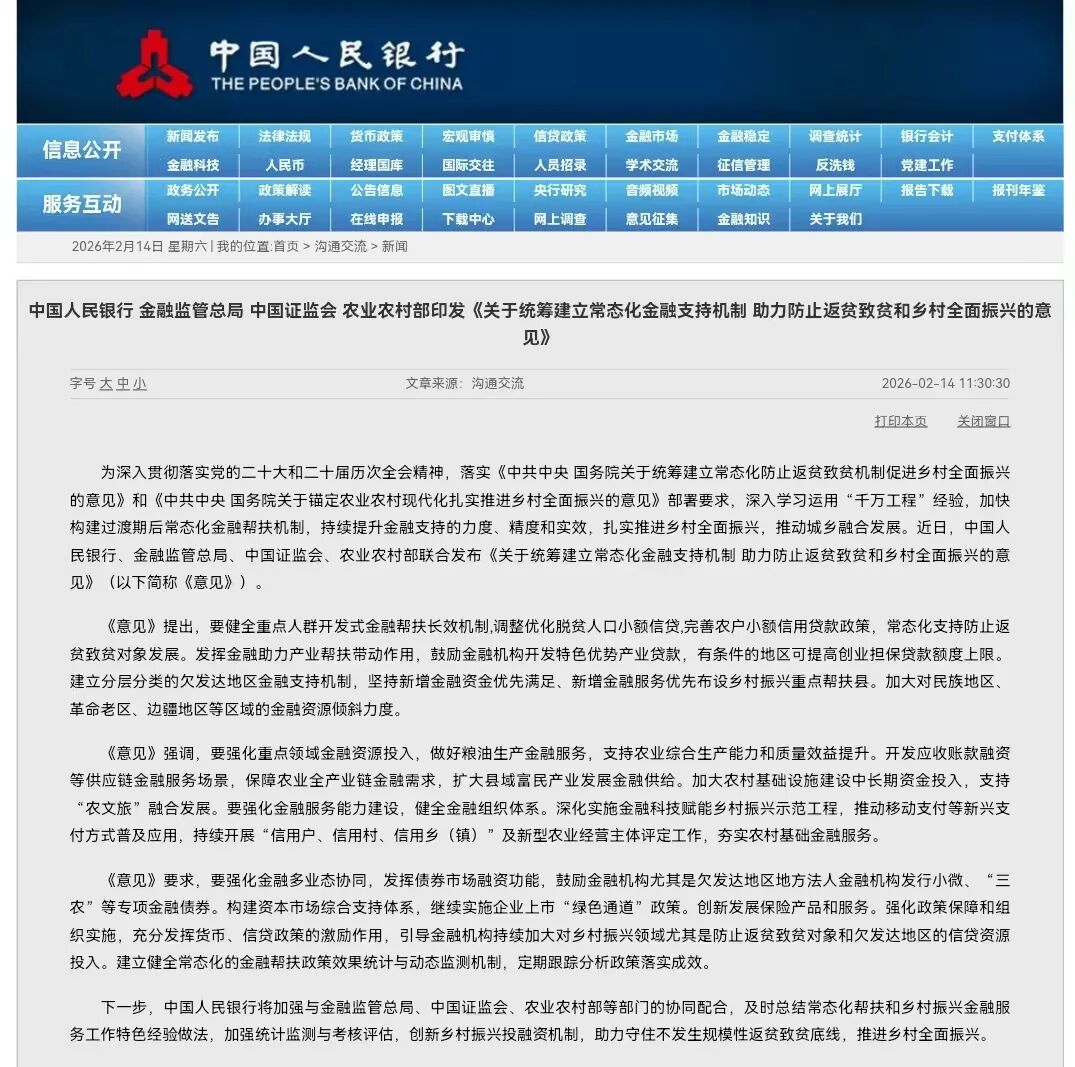
四部门发文:常态化金融支持机制助力乡村全面振兴
Xin Lang Cai Jing· 2026-02-14 21:57
Core Viewpoint - The People's Bank of China, along with financial regulatory bodies, has issued guidelines to establish a normalized financial support mechanism aimed at preventing poverty and promoting rural revitalization and urban-rural integration [1][2]. Group 1: Financial Support Mechanism - The guidelines propose a long-term financial support mechanism for key populations, optimizing microloans for impoverished individuals and enhancing credit policies for farmers [1]. - Financial institutions are encouraged to develop loans for specialized industries, with some regions allowed to increase the upper limit for entrepreneurial guarantee loans [1]. - A tiered financial support system for underdeveloped areas will be established, prioritizing new financial resources and services for key rural revitalization counties [1]. Group 2: Agricultural and Rural Development - The guidelines emphasize strengthening financial resource investment in key areas, particularly in grain and oil production, to enhance agricultural productivity and quality [2]. - Supply chain financial services, such as accounts receivable financing, will be developed to meet the financial needs of the entire agricultural industry chain [2]. - Increased long-term funding for rural infrastructure construction will support the integration of agriculture, culture, and tourism [2]. Group 3: Financial Services and Innovation - The guidelines call for enhanced financial service capabilities and the establishment of a robust financial organization system [2]. - The implementation of financial technology initiatives for rural revitalization will be deepened, promoting the adoption of mobile payment and credit evaluation systems [2]. - Financial institutions, especially local ones in underdeveloped areas, are encouraged to issue special financial bonds for small and micro enterprises and agriculture [2].
四部门重磅发文!支持特色农产品期货期权品种上市,继续稳步推进“保险+期货”
Qi Huo Ri Bao· 2026-02-14 14:23
Core Viewpoint - The People's Bank of China, along with other regulatory bodies, has issued guidelines to establish a normalized financial support mechanism aimed at preventing poverty and promoting rural revitalization, in line with the directives from the 20th National Congress of the Communist Party of China [1][4]. Group 1: Financial Support Mechanism - The guidelines emphasize the need to develop a long-term financial support mechanism for key populations, optimizing microcredit for impoverished individuals and supporting those at risk of falling back into poverty [4]. - Financial institutions are encouraged to create loans for specialized industries and increase the upper limit for entrepreneurial guarantee loans in eligible regions [4]. - A tiered financial support mechanism for underdeveloped areas will be established, prioritizing new financial resources for key rural revitalization counties [4]. Group 2: Investment in Key Areas - The guidelines stress the importance of financial resource allocation in key sectors, particularly in grain and oil production, to enhance agricultural productivity and quality [5]. - Supply chain financial services, such as accounts receivable financing, will be developed to meet the financial needs of the entire agricultural industry chain [4][5]. - There will be increased long-term funding for rural infrastructure projects and support for the integration of agriculture, culture, and tourism [4]. Group 3: Financial Innovation and Collaboration - The guidelines call for enhanced collaboration among various financial sectors, encouraging local financial institutions in underdeveloped areas to issue special bonds for small and micro enterprises and agriculture [5]. - A comprehensive capital market support system will be constructed, including the continuation of a "green channel" policy for company listings [5]. - The implementation of innovative insurance products and services will be promoted, alongside a monitoring mechanism to assess the effectiveness of financial support policies [5].


俄罗斯,降息50个基点
证券时报· 2026-02-14 07:32
Core Viewpoint - The Central Bank of Russia has lowered the benchmark interest rate from 16% to 15.5%, marking the sixth consecutive rate cut, indicating a trend towards balanced economic growth despite temporary inflation spikes [1]. Group 1: Interest Rate Changes - The Central Bank of Russia has reduced the benchmark interest rate to 15.5% from 16% [1]. - This is the sixth consecutive rate cut by the Central Bank, reflecting ongoing adjustments in monetary policy [1]. Group 2: Inflation Expectations - The Central Bank has raised its inflation forecast for 2026 to a range of 4.5% to 5.5%, while expecting inflation to approach 4% in the second half of the year [1]. - The current annual inflation rate stands at 6.3%, with expectations for it to return to target levels by 2027 [1]. Group 3: Labor Market Conditions - The labor market in Russia is showing signs of easing, with the proportion of companies facing labor shortages dropping to the lowest level since mid-2023 [1].

2026年1月金融数据点评:开年金融数据的几点信号
Hua Yuan Zheng Quan· 2026-02-14 06:56
Group 1: Report Industry Investment Rating - No information provided Group 2: Core Views of the Report - In January 2026, new loans increased significantly less year-on-year, reflecting weak credit demand. The Spring Festival in 2026 was late, and the early repayment of personal loans before the Spring Festival might affect February's personal loan data. Due to the forward - leaning credit delivery rhythm and weak credit demand, new loans in 2026 may continue to increase less year - on - year [2]. - The M1 growth rate temporarily rebounded. The new - caliber M1 growth rate at the end of January 2026 was 4.9%, up 1.1 percentage points from the end of last month, mainly due to the low year - on - year base and active stock market transactions. The M2 growth rate at the end of January was 9.0%, up 0.5 percentage points from the end of last month, mainly affected by the year - on - year base [2]. - The social financing growth rate declined month - on - month in January 2026, and it is expected to continue to decline in 2026. The social financing increment in January was 7.22 trillion yuan, a slight year - on - year increase. It is expected that new loans (in the social financing caliber) will increase slightly less year - on - year in 2026, the net financing of government bonds will expand year - on - year, the social financing increment will be similar year - on - year, and the social financing growth rate will decline slightly, reaching about 7.5% at the end of 2026 [2]. - There is further room for the long - term bond yield to decline. The long - term bond yield may decline by 5 - 10BP in the first quarter, the 10Y Treasury bond yield is expected to reach 1.75%, the 30Y Treasury bond active bond may return below 2.2%, and the 1Y large - bank inter - bank certificate of deposit rate may fall below 1.55%. It is expected that the 10Y Treasury bond yield will fluctuate in the range of 1.6% - 1.9% in 2026, and the bond market trend may be significantly stronger than the initial expectation [2]. Group 3: Summary by Related Catalogs 1. January 2026 Financial Data - New loans in January 2026 were 4.71 trillion yuan, a year - on - year decrease of 0.42 trillion yuan. Personal loans increased by 4565 billion yuan (short - term loans + 1097 billion yuan, medium - and long - term loans + 3469 billion yuan), and corporate loans increased by 4.45 trillion yuan (short - term loans + 2.05 trillion yuan, medium - and long - term loans + 3.18 trillion yuan, bill discounting - 8739 billion yuan) [2]. - At the end of January, M2 reached 347.2 trillion yuan, with a year - on - year growth rate of 9.0%; M1 had a year - on - year growth rate of 4.9%; the social financing growth rate was 8.2% [1]. - The social financing increment in January was 7.22 trillion yuan (7.05 trillion yuan in January 2025), a slight year - on - year increase. The increase mainly came from the net financing of government bonds and undiscounted bank acceptance bills. The increment of RMB loans to the real economy in January was 4.9 trillion yuan, a year - on - year decrease of 3194 billion yuan; entrusted loans were - 192 billion yuan, trust loans were - 4 billion yuan, undiscounted bank acceptance bills were + 6293 billion yuan; corporate bond net financing was 5033 billion yuan; government bond net financing was 9764 billion yuan [2]. 2. Forecast for 2026 - It is expected that new loans (in the social financing caliber) will increase slightly less year - on - year in 2026, the net financing of government bonds will expand year - on - year, the social financing increment will be similar year - on - year, and the social financing growth rate will decline slightly, reaching about 7.5% at the end of 2026 [2]. - It is expected that the 10Y Treasury bond yield will fluctuate in the range of 1.6% - 1.9% in 2026, and the bond market trend may be significantly stronger than the initial expectation [2].
央行等四部门:统筹建立常态化金融支持机制 助力防止返贫致贫和乡村全面振兴
Zheng Quan Ri Bao Wang· 2026-02-14 04:27
Core Viewpoint - The People's Bank of China, along with other regulatory bodies, has issued guidelines to establish a normalized financial support mechanism aimed at preventing poverty and promoting rural revitalization, in line with the directives from the 20th National Congress of the Communist Party of China [1][2]. Group 1: Financial Support Mechanism - The guidelines propose the establishment of a long-term financial support mechanism for key populations, optimizing microcredit for impoverished individuals and enhancing credit policies for farmers [1][2]. - Financial institutions are encouraged to develop loans for specialized industries and increase the upper limit for entrepreneurial guarantee loans in eligible regions [1][2]. - A tiered financial support mechanism for underdeveloped areas will be established, prioritizing new financial resources for key rural revitalization counties [1][2]. Group 2: Agricultural and Rural Development - The guidelines emphasize the need for financial resources to be directed towards key areas, including grain and oil production, to enhance agricultural production capacity and quality [2]. - Supply chain financial services, such as accounts receivable financing, will be developed to meet the financial needs of the entire agricultural industry chain [2]. - There will be increased investment in rural infrastructure and support for the integration of agriculture, culture, and tourism [2]. Group 3: Financial Services and Innovation - The guidelines call for strengthening the financial service capacity and improving the financial organizational system [2]. - Financial institutions, particularly local ones in underdeveloped areas, are encouraged to issue special financial bonds for small and micro enterprises and agriculture [2]. - The guidelines advocate for the innovation of insurance products and services, as well as the establishment of a monitoring mechanism for the effectiveness of financial support policies [2][3]. Group 4: Collaboration and Implementation - The People's Bank of China will enhance collaboration with regulatory bodies to summarize effective practices in financial support and rural revitalization [3]. - There will be a focus on statistical monitoring and evaluation of the financial services provided for rural revitalization [3]. - The aim is to innovate financing mechanisms to prevent large-scale poverty and promote comprehensive rural revitalization [3].
央行等4部门:加大农村地区企业上市辅导培育力度 帮助更多企业利用多层次资本市场进行融资
Xin Lang Cai Jing· 2026-02-14 04:05
Core Viewpoint - The People's Bank of China, along with financial regulatory bodies, has issued guidelines to establish a regular financial support mechanism aimed at preventing poverty and promoting rural revitalization [1] Group 1: Capital Market Support - A comprehensive support system for the capital market is proposed to enhance financing for rural enterprises [1] - Increased efforts will be made to guide and cultivate rural enterprises for listing, enabling them to utilize multi-tiered capital markets for financing [1] - The "green channel" policy for companies registered in former poverty alleviation areas will continue to be implemented for listings [1] Group 2: Financing and Investment - Support will be provided for eligible listed companies to raise development funds through methods such as additional issuance, rights issues, convertible bonds, and corporate bonds [1] - The raised funds are intended for local specialty industry development and agricultural technology innovation projects [1] Group 3: Risk Management Tools - The introduction of futures and options for specialty agricultural products will be supported to provide more risk management tools that meet rural industry development needs [1] - The "insurance + futures" model will continue to be promoted in key counties for rural revitalization to enhance project protection [1]
每日债市速递 | 中国1月信贷数据重磅出炉
Wind万得· 2026-02-13 22:56
Group 1: Monetary Policy and Market Operations - The central bank conducted a 1,450 billion yuan reverse repo operation on February 13, with a fixed interest rate of 1.40%, resulting in a net injection of 1,135 billion yuan for the day after accounting for 315 billion yuan in reverse repos maturing [3][5] - In February, the central bank has conducted a total of 18,000 billion yuan in reverse repos, with a net injection of 600 billion yuan after considering 12,000 billion yuan in maturing repos, marking an increase of 300 billion yuan compared to the previous month [3] Group 2: Market Liquidity - The interbank market is experiencing a very loose liquidity environment, with the weighted average interest rate of DR001 declining nearly 10 basis points to a low of 1.26%, and similar declines observed in DR007 and DR014 [5] - The overnight financing rate in the U.S. is reported at 3.65% [6] Group 3: Financial Instruments - The latest transaction for one-year interbank certificates of deposit is around 1.58%, showing a slight decrease from the previous day [8] - The 30-year main contract for government bonds increased by 0.04%, while the 10-year, 5-year, and 2-year contracts decreased by 0.10%, 0.09%, and 0.03% respectively [13] Group 4: Credit and Financing Data - In January, the social financing scale increased by 7.22 trillion yuan, which is 166.2 billion yuan more than the same period last year, with a total social financing scale of 449.11 trillion yuan, reflecting a year-on-year growth of 8.2% [14] - The M2 money supply grew by 9% year-on-year, while M1 and M0 increased by 4.9% and 2.7% respectively, with a net cash injection of 519.1 billion yuan in January [14] Group 5: Regulatory Developments - The State-owned Assets Supervision and Administration Commission emphasized the importance of state-owned enterprises in contributing to high-quality economic development and social responsibility [14] - Recent notices from the Shanghai and Shenzhen Stock Exchanges address inaccuracies in investor education regarding bond repurchase agreements, outlining regulatory requirements and deadlines for rectification [15]


中国接着抛美债,不再救美元,美财长喊话:中美绝对不能脱钩断链
Sou Hu Cai Jing· 2026-02-13 15:35
Core Viewpoint - The U.S. Treasury Secretary's urgent remarks about U.S.-China relations reflect concerns over China's significant reduction in U.S. Treasury holdings, which have dropped to their lowest level since 2008, while simultaneously increasing gold reserves for 15 consecutive months [1][3][9]. Group 1: U.S.-China Relations and Debt Holdings - The U.S. Treasury Secretary emphasized the importance of not decoupling from China, indicating a sense of urgency regarding China's selling of U.S. debt [3][7]. - China's U.S. Treasury holdings have decreased to $682.6 billion, a significant drop from a peak of $1.32 trillion in 2013, marking a strategic shift in asset management [5][20]. - The reduction in U.S. debt holdings has led to China losing its status as the largest foreign holder of U.S. debt, a position now held by Japan [5][7]. Group 2: U.S. Debt Crisis - The total U.S. national debt has reached $38 trillion, with interest payments projected to exceed $1.4 trillion in 2025, highlighting a growing fiscal challenge for the U.S. government [7][24]. - The U.S. government's reliance on issuing more debt to cover expenses has raised concerns about the sustainability of its fiscal policies [20][24]. Group 3: Investment Strategy Shift - China has strategically shifted from holding U.S. debt to increasing gold reserves, which now total approximately 2,308 tons, as a safer asset [11][18]. - The strategy includes lending U.S. dollars to developing countries, allowing them to repay U.S. debts while facilitating trade in local currencies, thereby reducing reliance on the dollar [13][14][28]. - This approach not only mitigates risk but also promotes the international use of the Chinese yuan, enhancing its global standing [14][28]. Group 4: Global Currency Dynamics - A broader trend is emerging where multiple countries are reducing their U.S. debt holdings, with nations like India and Saudi Arabia also selling off U.S. Treasuries [26][28]. - The global shift away from the dollar is evident, as countries seek alternative currencies and assets, such as gold and local currencies, for trade [24][28]. - The U.S. may face challenges in maintaining its dominance in global finance as countries increasingly look for alternatives to the dollar [28][29].

2026年1月金融数据解读:居民存款搬家提速
Yin He Zheng Quan· 2026-02-13 12:54
Group 1: Monetary Supply and Growth Rates - M1 growth rate increased to 4.9% in January 2026, up from 3.8% in December 2025[1] - M2 growth rate rose to 9.0% in January 2026, compared to 8.5% in December 2025[1] - New social financing (社融) reached 7.2 trillion yuan in January 2026, an increase of 165.4 billion yuan year-on-year, with a growth rate of 8.2%[1] Group 2: Household Deposits and Trends - Household deposit growth rate estimated at 7.18% in January 2026, down from 9.68% in December 2025[1] - The difference between household deposit growth and M2 growth turned negative for the first time in 7.5 years, at -1.82 percentage points[1] - Non-bank deposits showed a rapid increase in the rolling 12-month sum[1] Group 3: Loan and Credit Dynamics - New RMB loans totaled 4.71 trillion yuan in January 2026, a decrease of 420 billion yuan year-on-year, with a growth rate of 6.1%[1] - The decline in loans was primarily driven by a decrease in corporate loans, particularly in medium to long-term loans, which fell by 280 billion yuan[19] - Residential credit showed a slight increase of 128 billion yuan, with short-term loans up by 159.4 billion yuan, while medium to long-term loans decreased by 146.6 billion yuan[19] Group 4: Financing Sources and Trends - Government bond financing increased by 2.83 trillion yuan year-on-year, with a net financing of 9.76 trillion yuan in January 2026[26] - Corporate bond financing rose by 579 billion yuan, driven by technology innovation bonds, which net financed approximately 2.52 trillion yuan[25] - The effective social financing growth rate, excluding government financing, was 5.31%, down from 5.62%[5]
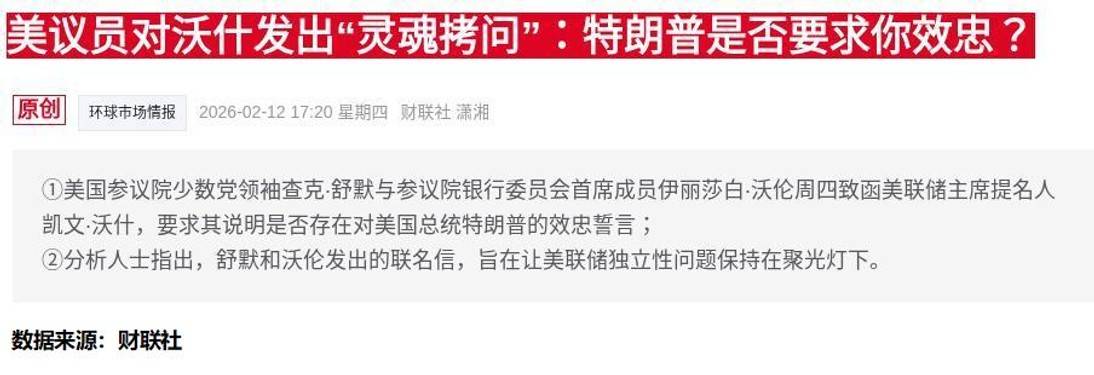
美联储迎来灵魂拷问,数据拆解涨跌逻辑
Sou Hu Cai Jing· 2026-02-13 09:05
Group 1 - The article discusses the emotional traps investors face when reacting to news, particularly regarding the Federal Reserve's nominations and the subsequent market reactions [1][3] - It highlights the tendency of investors to make impulsive decisions based on market fluctuations driven by news and emotions, often leading to buying high and selling low [1][3] - The piece emphasizes the importance of quantitative data in understanding market behavior, suggesting that it can help investors see beyond surface-level price movements to the underlying trading actions [5][9] Group 2 - Quantitative data can reveal the true nature of market movements, distinguishing between genuine market reactions and those artificially created to disrupt investor behavior [5][7] - The article illustrates how different stocks can appear to be reacting similarly to market events, but their underlying trading dynamics can be vastly different, affecting future performance [7][9] - It advocates for a shift from emotion-driven investment decisions to a data-driven approach, which can provide clearer insights into market trends and participant behaviors [11][12]