
化工

Search documents
最具爆发潜力的配置方向、行稳致远的配置策略有哪些?
Qi Huo Ri Bao· 2026-02-23 23:04
Core Viewpoint - The article discusses the investment strategies and asset allocation approaches for the year of the Horse, emphasizing the shift towards equity and physical assets in a low-interest-rate environment, while also highlighting the importance of diversification and risk management through various financial instruments [1][7]. Group 1: Macro Trends - The trend of residents moving deposits to capital markets is confirmed, with a significant increase in non-bank institution deposits expected to rise by 6.4 trillion yuan by 2025 [2]. - The scale of bank wealth management products is projected to exceed 33 trillion yuan, increasing by 3.3 trillion yuan compared to the end of 2024, with over 97% being fixed-income products [2]. Group 2: Asset Allocation Strategies - The "fixed income plus" strategy is anticipated to become mainstream, combining stable fixed-income assets with equity investments to enhance overall returns [2]. - The allocation ratio should be dynamically calibrated based on risk-return objectives, ranging from 90:10 for conservative investors to 70:30 for aggressive ones [2]. Group 3: Sector Focus - Investment focus should be on sectors such as non-ferrous metals (copper, aluminum, tin), chlor-alkali industry, and fine chemicals, as these areas are expected to benefit from sustained demand despite limited capital expenditure [3]. - The strategy of "dual expression" allows investors to manage risks within a sector while capitalizing on price movements in commodities [3]. Group 4: Risk Management and Diversification - The concept of diversification is emphasized as a "free lunch" in investing, with a focus on identifying growth opportunities and managing positions dynamically based on market conditions [4]. - Non-linear derivatives, such as deep out-of-the-money put options, are recommended for asymmetric risk protection in volatile markets [6]. Group 5: Investor Guidance - Investors are advised to define their capability circle, focusing on areas of expertise and avoiding unfamiliar investments to achieve sustainable returns [7]. - Specific risk management guidelines include limiting investment to 30% of available capital, avoiding illiquid contracts, and prioritizing strategies with limited risk and returns [7].
地缘紧张致欧洲经济复苏后劲不足
Xin Lang Cai Jing· 2026-02-23 22:48
Economic Growth and Projections - The Eurozone's GDP is projected to grow by 1.5% in 2025, while the EU's GDP is expected to grow by 1.6%, indicating a slight upward adjustment from previous market expectations [3] - Compared to other major economies like China and the US, Europe's economic recovery shows insufficient momentum [3] Trade and Investment Challenges - Trade frictions and tariff barriers are suppressing exports and investments, with the US targeting the EU in its trade policies, increasing costs for European companies exporting to the US [3] - The uncertainty in global trade policies is dampening business investment confidence, particularly affecting manufacturing sectors reliant on global supply chains [3] Energy Supply and Price Volatility - The prolonged Russia-Ukraine conflict and energy sanctions are reshaping Europe's energy landscape, with the EU planning to ban new gas contracts with Russia starting in 2026 [4] - Transitioning to liquefied natural gas from the US and Qatar faces challenges such as inadequate infrastructure and high costs, leading to potential inflation and reduced purchasing power [4] - Despite advancements in renewable energy, the slow upgrade of electrical grid infrastructure is causing inefficiencies in power distribution, leading to a mismatch in generation and transmission capabilities [4] Inflation and Monetary Policy Dilemmas - The inflation rate in Europe is expected to approach the 2% target by 2025, but supply chain disruptions from geopolitical conflicts pose upward risks to inflation [4] - The European Central Bank faces a dilemma between supporting economic growth and controlling inflation, with expectations that central banks will maintain stable interest rates throughout 2026 [4] Internal Disparities and Market Integration - Structural weaknesses in the European economy are becoming more pronounced, particularly with core economies like Germany, France, and Italy facing industrial output declines and fiscal crises [5] - Southern European countries like Spain are becoming growth leaders, but their smaller economic size cannot compensate for the weaknesses of the larger economies [6] Systemic Policy Responses - The EU is implementing a series of systemic policies to address internal and external challenges, including reforms to deepen the single market and eliminate internal barriers [7] - Initiatives include establishing a unified regulatory framework for market access, tax, and intellectual property to reduce cross-border operational costs [7] - The EU is also focusing on crisis response mechanisms to ensure market resilience against geopolitical conflicts and supply chain disruptions [7] - Significant investments are planned in strategic areas like AI, quantum computing, and clean technology to address innovation gaps and capital outflows [7] - The EU aims to accelerate green and digital transitions, with expectations for green industry investments to exceed €500 billion by 2025, representing 35% of global investments [7] - A "new independence" strategy is being promoted to reduce reliance on external powers in technology, energy, and security [7]


节后重大!900亿资金待入场,2条主线被出炉,A股上涨有戏?
Sou Hu Cai Jing· 2026-02-23 20:22
Core Insights - The market is poised for significant investment activity with over 90 billion yuan waiting to enter, driven by new ETF funds and active equity funds [1][3][4] - Two main investment themes for 2026 have been identified: technology growth, particularly in AI, and Chinese manufacturing [4][5][7] Group 1: Investment Funds - Over 90 billion yuan is ready to enter the market, primarily from newly listed stock ETFs and active equity funds that were raised before the Spring Festival [3][4] - Three new ETFs are set to launch post-holiday, expected to contribute over 1 billion yuan in direct buying power, with additional ETFs in the pipeline totaling around 3 billion yuan [3][4] - A total of 112 active equity funds are waiting to be established, collectively raising approximately 88.75 billion yuan, with 29 of these funds exceeding 1 billion yuan each [4] Group 2: Investment Themes - The first investment theme is technology growth, focusing on AI and related sectors such as robotics and smart driving, which are expected to see significant advancements [5][7] - The second theme is Chinese manufacturing, highlighting the country's strong position in sectors like new energy vehicles and electronics, which are anticipated to drive economic growth [5][7] Group 3: Market Conditions - The market has shown a relatively stable performance leading up to the Spring Festival, with the index fluctuating around 4100 points, indicating a cautious investor sentiment [8][9] - Historical data suggests a high probability of market gains in the days following the Spring Festival, with past trends showing an 70% to 80% chance of the Shanghai Composite Index rising [11] - The upcoming earnings reports from listed companies will be crucial in determining the sustainability of stock prices that have been driven up by recent fund inflows [11]

积极因素提振A股开市信心 两大主线配置价值获看好
Zhong Guo Zheng Quan Bao· 2026-02-23 20:18
Group 1 - The A-share market is expected to continue its spring rally in 2026, driven by policy guidance and industry trends, with a focus on technology and resource sectors [1][3] - The market sentiment is currently strong, with limited adjustment pressure, and the potential for a rebound in market indices post-Spring Festival [2][3] - The AI sector is highlighted as a key investment opportunity, with expectations for significant advancements and commercialization in 2026 [3][4] Group 2 - Resource sectors, including chemicals and precious metals, are gaining attention from institutions, particularly due to rising international prices for gold and oil [4][5] - The geopolitical situation may provide a short-term boost to oil prices, while precious metals are seen as a safe haven for investors [5][6] - The upcoming peak season for industrial production and construction in March and April is expected to validate price increases and influence market trends [6]
跨境和行业ETF逆势“吸金”
Shang Hai Zheng Quan Bao· 2026-02-23 18:37
Group 1 - The capital flow in the A-share market has shown a divergent trend since the beginning of 2026, with broad-based ETFs experiencing significant outflows while industry and cross-border ETFs have attracted substantial inflows [1][2] - As of February 13, 2026, the net inflow for cross-border ETFs reached 63 billion yuan, while industry ETFs such as chemical, non-ferrous metals, and satellite sectors have seen strong capital inflows [1][2] - The total net outflow from equity ETFs in the A-share market amounted to 846.46 billion yuan by February 13, 2026, with major outflows concentrated in large-scale broad-based ETFs [1][2] Group 2 - Fund managers remain optimistic about the technology sector, viewing it as a core investment theme for 2026, particularly in the context of artificial intelligence (AI) advancements [3][4] - The AI sector is perceived as a significant driver of productivity and is considered a key variable in the new industrial revolution, with expectations for continued growth and innovation in China [3][4] - Despite recent market adjustments, the long-term upward trend of the A-share market is expected to persist, with a focus on AI as a primary investment narrative [3][4]
马年A股如何开局? | 每周研选
Sou Hu Cai Jing· 2026-02-23 16:46
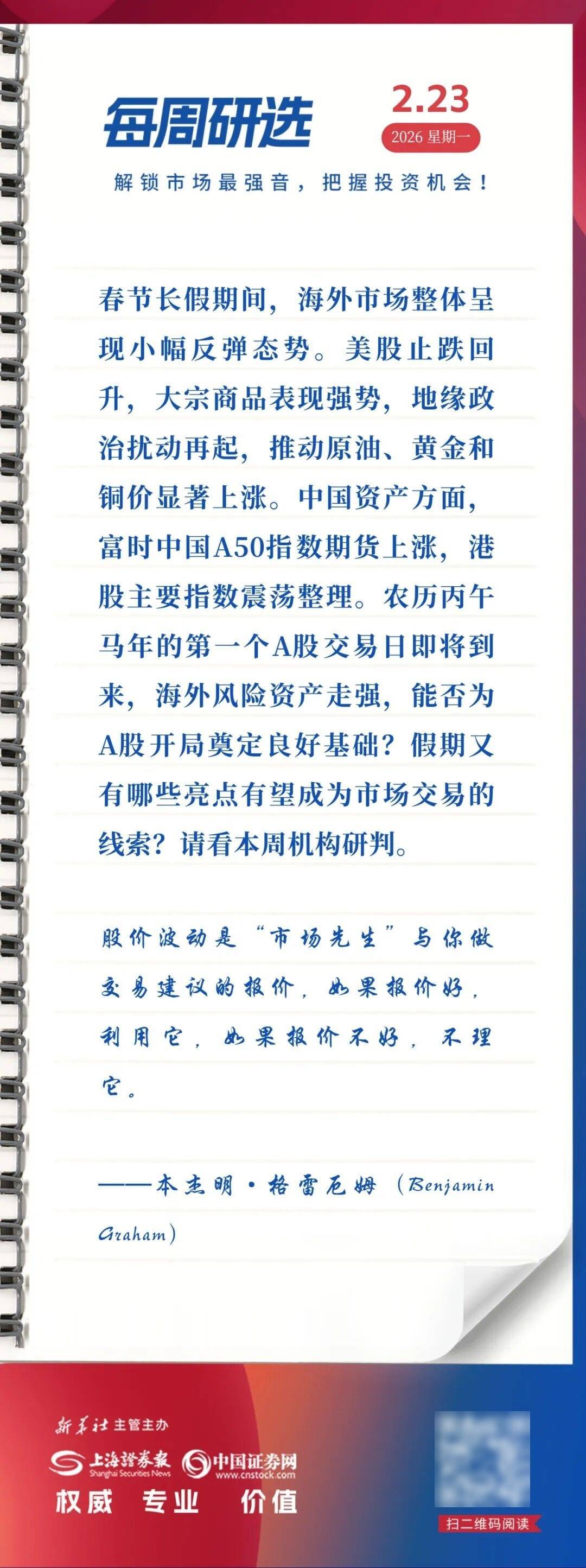
Core Viewpoint - The overseas markets showed a slight rebound during the Spring Festival holiday, with U.S. stocks recovering and commodities performing strongly, driven by geopolitical disturbances that significantly increased the prices of oil, gold, and copper. The performance of Chinese assets, particularly the FTSE China A50 index futures, also indicated a positive trend, suggesting a potentially favorable start for the A-share market in the Year of the Horse [2][4]. Group 1: Market Performance and Trends - The overseas non-U.S. assets maintained a strong performance during the holiday, indicating a high risk appetite among overseas investors, which is expected to benefit the A-share market post-holiday [5]. - The inflow of funds into the market remains unchanged, with a notable decrease in household deposits and an increase in non-bank financial institution deposits, suggesting a shift towards equity markets [6]. - Historical data shows that the A-share market typically performs well in the 20 trading days following the Spring Festival, with a 75% probability of the CSI All A Index rising during this period [9]. Group 2: Sector Focus and Investment Opportunities - The focus for investment should be on sectors benefiting from AI and resource commodities, with a particular emphasis on the robotics and AI technology applications showcased during the Spring Festival [13][14]. - The traditional sectors such as real estate and liquor are expected to see a recovery as their valuations are at historical lows, supported by improving fundamentals and policy catalysts [11]. - The "反内卷" (anti-involution) policy is anticipated to enhance the supply dynamics of resource commodities, making them attractive for investment [11]. Group 3: Strategic Recommendations - Investors are advised to focus on the technology sector, particularly in robotics and AI applications, as well as cyclical sectors like chemicals, construction materials, and machinery, which are expected to benefit from rising prices and improved demand [15]. - The market is entering a configuration phase where "technology + cyclical" remains the main theme, with technology sectors likely to respond first to market catalysts [15].
专访崔洪建:默茨访华大有深意,中德关系迎来关键“对表”时刻
2 1 Shi Ji Jing Ji Bao Dao· 2026-02-23 14:43
Group 1 - German Chancellor Merz's upcoming visit to China is seen as a crucial opportunity to recalibrate Sino-German relations amidst a complex international landscape [1][2] - The visit is expected to enhance economic cooperation, with Merz emphasizing Germany's opposition to protectionism and advocating for increased investment in China [2][3] - The large delegation accompanying Merz, consisting of over 200 members from major companies like Volkswagen, Siemens, and BASF, signals a strong commitment from the German business community to deepen economic ties with China [3][10] Group 2 - Sino-German trade relations have shown resilience, with Germany's trade with China projected to reach €253 billion in 2025, reflecting a 2.7% year-on-year increase [3][10] - Germany has maintained its position as China's largest trading partner in Europe, with bilateral trade accounting for over one-third of China's total foreign trade [3][10] - The stability of Sino-German relations is crucial not only for the two countries but also for broader Sino-European cooperation, especially as Europe faces economic transformation challenges [4][10] Group 3 - Merz's visit is positioned as a chance to foster a more pragmatic and stable relationship, potentially creating more opportunities for joint development between Chinese and German enterprises [2][11] - The visit is also seen as a response to the changing geopolitical landscape, where Europe is seeking to balance its relations with the U.S. and China [7][9] - The emphasis on economic cooperation is expected to mitigate political tensions and enhance mutual trust, allowing for a more constructive dialogue [14][15]
最具爆发潜力的配置方向、行稳致远的配置策略有哪些?|策马点金
Qi Huo Ri Bao· 2026-02-23 14:41
Group 1 - The core viewpoint of the article emphasizes the need for diversified investment strategies in the context of low interest rates and shifting capital from deposits to capital markets, suggesting that a "fixed income plus" strategy will become mainstream among investors [3][9] - The article highlights the significant increase in non-bank institution deposits, which rose by 6.4 trillion yuan in 2025, and the scale of bank wealth management products exceeding 33 trillion yuan, indicating a shift in investor preferences towards equity assets to enhance overall returns [3][4] - The article discusses the transition of China's economic engine from real estate to green industries and high-end manufacturing, which is influencing current asset allocation directions [4][9] Group 2 - Specific investment recommendations include focusing on non-ferrous metals like copper, aluminum, and tin, as well as chemical sectors such as chlor-alkali and refining, due to sustained demand from downstream industries like electric grid construction and new energy vehicles [4][5] - The article suggests a dual expression strategy where rising copper prices benefit both the profits of non-ferrous companies and direct gains from copper futures, allowing investors to manage risks effectively within a sector [4][5] - The article emphasizes the importance of diversification as a "free lunch" in investing, with strategies that include tracking product prices and profits, and being willing to rotate positions based on market conditions [6][9] Group 3 - The article outlines risk management strategies for investors in commodity futures and options markets, including limiting investment to 30% of available capital, avoiding illiquid contracts, and prioritizing low-risk, low-reward trading strategies [9][7] - It suggests that investors should actively use options and other non-linear derivatives to construct asymmetric risk protection, such as purchasing deep out-of-the-money put options to hedge against extreme tail risks [7][9] - The consensus among private equity respondents is that a multi-strategy approach combining "fixed income plus," enhanced physical assets, and derivative protection will be a rational choice for navigating market volatility [9][10]
马年收红包!关注黑马集中营!
Sou Hu Cai Jing· 2026-02-23 14:01
Group 1 - The article highlights four major signals that are expected to support the market as it opens for the Year of the Horse, including continuous policy support, strong consumer recovery, clear industry trends, and favorable external market conditions [4][6][9] - Policy measures are focused on equipment upgrades, consumer goods exchange programs, and significant support for new infrastructure, digital economy, and renewable energy sectors, which are expected to boost economic recovery [4] - Consumer spending has shown remarkable resilience, with record box office revenues during the Spring Festival, a doubling in travel bookings, and a nearly 500% increase in duty-free shopping in Hainan, alongside over 20% growth in dining and accommodation transactions [4] Group 2 - The article notes that the global market has been performing well, with significant gains in indices such as the Hang Seng Index and the Nikkei 225, which rose over 4%, creating a positive environment for the A-share market [6][7] - Commodity markets have also seen increases, with LME copper up 4%, London silver up 3%, and Brent crude oil rising 2.3%, providing support for cyclical sectors [7] Group 3 - The investment strategy for the Year of the Horse emphasizes a cautious approach, focusing on structural opportunities rather than broad market gains, with a prediction of a stable opening and active sector performance [9][10] - Four main investment themes are identified: the AI industry chain, semiconductors and advanced manufacturing, consumer recovery sectors, and cyclical resources, with AI being the strongest focus due to its recent performance [10][11][12] - The article advises against high-risk strategies, recommending a focus on core stocks within the identified themes and careful monitoring of key indicators such as trading volume and foreign capital inflows [13][14]

主动量化周报:春节特别篇:低起点,大空间,维持乐观-20260223
ZHESHANG SECURITIES· 2026-02-23 13:33
- The report does not contain specific quantitative models or factors, nor does it provide detailed construction processes, formulas, or backtesting results for any quantitative models or factors. The content primarily focuses on market analysis, investment opportunities, and thematic discussions such as AI technology and price increase logic[2][3][10][11][12][13]