
有色金属冶炼

Search documents
永安期货有色早报-20250804
Yong An Qi Huo· 2025-08-04 14:10
有色早报 研究中心有色团队 2025/08/04 铜 : 日期 沪铜现货 升贴水 废精铜 价差 上期所 库存 沪铜 仓单 现货进口 盈利 三月进口 盈利 保税库 premium 提单 premium 伦铜 C-3M LME 库存 LME 注销仓单 2025/07/28 95 435 73423 17832 -615.05 64.47 50.0 65.0 -54.34 127400 17275 2025/07/29 110 385 73423 18083 -398.80 268.30 50.0 61.0 -51.71 127625 19400 2025/07/30 170 528 73423 19973 -736.08 -40.92 49.0 60.0 -46.80 136850 19375 2025/07/31 170 176 73423 19622 -286.39 322.14 49.0 60.0 -50.76 138200 16975 2025/08/01 170 153 72543 20349 -18.16 558.11 51.0 64.0 -49.25 141750 14275 变化 0 -23 -8 ...
有色金属:海外季报:Sherritt 2025Q2 成品镍和钴权益产量分别同比增长 1%、14%至 3,431 吨和 389 吨,镍净直接现金成本同比下跌 8%至 5.27 美元/磅
HUAXI Securities· 2025-08-04 13:13
Investment Rating - The report provides a recommendation for the industry [5]. Core Insights - In Q2 2025, the production of finished nickel and cobalt by the company reached 3,431 tons and 389 tons respectively, showing a year-on-year increase of 1% and 14% [2]. - The net direct cash cost of nickel decreased by 8% year-on-year to $5.27 per pound [2]. - The Moa JV's mixed sulfide production decreased by 21% year-on-year to 3,238 tons due to planned acid plant shutdowns and challenging economic conditions in Cuba [2][3]. - The company anticipates a recovery plan to increase production in the second half of the year [2]. Production and Operational Performance - The Q2 2025 nickel production was impacted by a reduction in raw material supply, with third-party supplies unable to compensate for the loss [2]. - The company expects annual maintenance shutdowns to occur in September 2025 [2]. - Fertilizer production increased by 8% year-on-year to 65,207 tons due to improved equipment availability [3]. Financial Performance - The revenue from the metal business in Q2 2025 was CAD 124.7 million, down from CAD 150.6 million in Q2 2024 [8]. - Nickel revenue decreased to CAD 68.6 million, while cobalt revenue increased to CAD 15.2 million due to higher average realized prices [8]. - The overall company revenue for Q2 2025 was CAD 136 million, a 17% decrease year-on-year [12]. Expansion Plans and Strategic Development - The Moa joint venture expansion project is ongoing, with completion expected in mid-August 2025, aiming to enhance production capacity [13]. - The company is advancing its nickel-cobalt processing project, which has received funding support from Alberta's Emissions Reduction Alberta [14].
铜铝周报:美国新一轮关税落地,铜铝价格承压调整-20250804
Zhong Yuan Qi Huo· 2025-08-04 10:47
1. Report Industry Investment Rating No relevant content provided. 2. Core Views of the Report Copper - **Macro - aspect**: The decline of China's July manufacturing PMI and the implementation of a new round of US tariff policies have put pressure on the market [4]. - **Fundamentals**: On the supply side, the shortage of domestic spot copper and bill fluctuations limit circulation, and holders are eager to hold prices. On the demand side, copper prices are still at a high level and in the off - season, so demand is weak. - **Overall logic**: After the US tariff on copper is implemented, COMEX copper has fallen sharply. Domestic copper prices are also under short - term pressure. It is recommended to wait for the price to stabilize gradually. The upper reference pressure level for the SHFE copper 2509 contract is 80,000 yuan/ton, and the lower reference support level is 76,000 yuan/ton [4]. Electrolytic Aluminum - **Macro - aspect**: Similar to copper, the decline of China's July manufacturing PMI and the new US tariff policy have affected the market [6]. - **Fundamentals**: On the supply side, the operating capacity of domestic electrolytic aluminum is stable, the proportion of molten aluminum has decreased, the ingot casting volume has increased, and social inventories have continued to accumulate, suppressing the rise of aluminum prices. The cost is stable, but the average industry profit has narrowed by about 149 yuan/ton. On the demand side, it is still the off - season, and the demand has not improved significantly. As of August 4, domestic electrolytic aluminum social inventory was 564,000 tons, 20,000 tons more than last Thursday, and the inventory accumulation expectation is still strong. - **Overall logic**: The new US tariff policy is negative for the demand outlook of industrial metals. The decline of China's July manufacturing PMI requires attention to policy. The off - season supply - demand is under pressure, and aluminum prices may remain oscillating at a high level. The upper reference pressure level for the SHFE aluminum 2509 contract is 21,000 yuan/ton, and the lower reference support level is 20,200 yuan/ton [6]. Alumina - **Macro - aspect**: The decline of China's July manufacturing PMI and the new US tariff policy have put pressure on the market [8]. - **Fundamentals**: As of July 31, the total built - in production capacity of national metallurgical alumina was 110.32 million tons/year, and the operating total production capacity was 90.92 million tons/year. The weekly operating rate increased by 2.02 percentage points to 82.41%. The alumina market is in an oversupply pattern, and downstream aluminum plants' raw material inventories are at a high level. - **Overall logic**: Although the alumina fundamentals are in an oversupply pattern, macro - funds' sentiment and low - level warehouse receipts have a certain impact on the futures price. It should be treated with a short - term bullish mindset. The upper reference pressure level for the SHFE alumina 2509 contract is 3,600 yuan/ton, and the lower reference support level is 3,000 yuan/ton [8]. 3. Summary According to the Table of Contents 01. Market Review - **Weekly market review**: The document provides the cumulative percentage changes in the prices of various metals from July 28 to August 1, but specific data is not described in detail in the text [16]. - **Weekly news review**: - On July 30, the US announced a 50% tariff on several imported copper products starting from August 1. - On July 31, a copper mine in Chile collapsed due to an earthquake, causing casualties and suspending underground operations. - Chile's copper production in June was 424,390 tons, a 6% year - on - year decrease. - Ghana cancelled a $1.2 billion bauxite lease and sought cooperation with overseas companies. - The EU and the US will establish a metal alliance, and EU steel and aluminum producers will enjoy a quota system and low or zero - tariff treatment [17]. 02. Macro Analysis - **Domestic market**: In July, China's manufacturing PMI was 49.3%, a 0.4 - percentage - point decline from the previous month. The decline was mainly due to the traditional off - season, high - temperature, and natural disasters [19]. - **Overseas market**: - The Fed maintained the federal funds target rate range at 4.25 - 4.50% in July, but two directors voted against it, indicating differences in economic judgment and the interest - rate cut path. - In July, the number of new non - farm jobs in the US was 73,000, lower than expected, and the unemployment rate rose to 4.2%. The new non - farm job data for May and June was significantly revised downward. - On July 31, Trump signed an executive order to determine "reciprocal tariffs" ranging from 10% to 41% for multiple countries and regions [22][24][26]. 03. Copper Market Analysis - **Spot market**: The processing fee TC remains weak [30]. - **Futures market**: COMEX net long positions have declined [33]. - **Overseas market**: The US dollar index has rebounded [37]. - **Inventory**: - Exchange inventories: The document shows the inventory trends of copper in Shanghai bonded areas, SHFE, LME, and COMEX over the years [39]. - Social inventories: As of July 31, the SMM national mainstream copper inventory was 119,300 tons, a weekly increase of 5,100 tons, and 229,100 tons lower than the same period last year. The weekly operating rate of domestic major refined copper rod enterprises increased to 71.73% from July 25 to July 31, and it is expected to increase to 72.8% from August 1 to August 7 [44]. 04. Electrolytic Aluminum Market Analysis - **Domestic market**: The spot has turned to a discount [48]. - **Foreign market**: The US dollar index has weakened [50]. - **Weekly inventory**: The document shows the trends of electrolytic aluminum social inventories, aluminum rod social inventories, SHFE aluminum inventories, and LME aluminum total inventories over the years [52]. - **Downstream开工**: As of July 31, the overall operating rate of the domestic aluminum downstream processing industry decreased by 0.1 percentage point to 58.6%. It is expected to slightly decrease to 58.5% this week [54]. - **Recycled aluminum alloy**: As of July 31, the SMM ADC12 price was 20,100 yuan/ton, a decrease of 100 yuan/ton. The industry is facing raw - material shortages, profit inversions, and weak demand. The social inventory of recycled aluminum alloy ingots in domestic mainstream consumption areas has increased to 34,489 tons [59]. - **Cost - profit**: The document shows the relationship between electrolytic aluminum cost, profit, and price [64]. 05. Alumina Market Analysis - **Spot market**: The spot price has remained stable [67]. - **Futures market**: The inventory of futures is at a low level [70]. - **Supply - demand**: - Supply: The supply of alumina has increased. As of July 31, China's alumina built - in production capacity was 114.8 million tons, and the operating production capacity was 94.8 million tons. - Demand: The operating capacity of the electrolytic aluminum industry has slightly increased, leading to an increase in alumina demand [75]. - **Cost - profit**: As of July 31, the domestic alumina industry cost was 2,998.37 yuan/ton, and the average industry profit was 271.27 yuan/ton [76].
降息预期升温,支撑铜下方空间
Guan Tong Qi Huo· 2025-08-04 10:16
Report Summary 1. Report Industry Investment Rating No investment rating information is provided in the report. 2. Core View of the Report After the copper tariff is implemented, the market returns to fundamentals. The US non - farm payroll data increases the expectation of a September interest rate cut, and the weakening US dollar supports copper prices. The fundamentals remain in a loose logic, but the low domestic inventory limits the downside space, with the overall trend being weak. Attention should be paid to the support level of 78,000 yuan/ton [1]. 3. Summary by Relevant Catalogs Strategy Analysis - The US July non - farm payrolls only added 73,000, with the June data significantly revised down to 14,000. The unemployment rate rose to 4.2%. The probability of a Fed rate cut in September soared from 37.7% to 90%, strengthening the expectation of two rate cuts within the year. - In July, SMM China's electrolytic copper production increased by 39,400 tons month - on - month and 14.21% year - on - year. TC/RC fees are still negative but have stopped falling and rebounded. Three smelters have maintenance plans in the third quarter. Currently, smelters can still make up for losses with by - products such as sulfuric acid. - In the off - season, demand is weak, and market trading sentiment is tepid. The subsequent imposition of tariffs on copper semi - finished products may affect export demand. The SHFE inventory is still at a low level and has not significantly accumulated, supporting the price [1]. Futures and Spot Market Conditions - Futures: The Shanghai copper futures market opened high, then declined, and rebounded at the end of the session, closing at 78,330 yuan/ton. The long positions of the top 20 decreased by 4,500 to 106,069 lots, and the short positions decreased by 985 to 109,223 lots. - Spot: The spot premium in East China is 130 yuan/ton, and in South China it is - 55 yuan/ton. On August 1, 2025, the LME official price was 9,592 US dollars/ton, and the spot premium was - 56.5 US dollars/ton [4]. Supply Side As of August 1, the spot rough smelting fee (TC) was - 41.99 US dollars/dry ton, and the spot refining fee (RC) was - 4.19 cents/pound [6]. Fundamental Tracking - SHFE copper inventory is 0.67 million tons, a decrease of 500 tons from the previous period. As of August 1, the copper inventory in the Shanghai Free Trade Zone was 7.51 million tons, an increase of 0.35 million tons from the previous period. - LME copper inventory was 139,575 tons, a slight decrease of 2,175 tons from the previous period. COMEX copper inventory was 259,681 short tons, an increase of 1,766 short tons from the previous period [9].
沪铜日评:国内铜治炼厂8月检修产能或环减国内电解铜社会库存量环比减少-20250804
Hong Yuan Qi Huo· 2025-08-04 06:34
Report Industry Investment Rating - Not provided Core View - US employment market weakness boosts Fed's interest rate cut expectations, but the traditional domestic consumption off - season suppresses downstream demand, and the total inventory of domestic and foreign electrolytic copper fluctuates upward, suggesting that Shanghai copper prices may still have room to fall. It is recommended that investors hold their previous short positions cautiously and pay attention to support and resistance levels [2]. Summary by Related Catalogs Market Data - **Shanghai Copper Futures**: On August 1, 2025, the closing price of the active contract was 78,400 yuan, up 360 yuan from the previous day; trading volume was 80,943 lots, down 28,068 lots; open interest was 167,671 lots, down 8,522 lots; inventory was 20,349 tons, up 727 tons; the average price of SMM 1 electrolytic copper was 78,330 yuan, down 235 yuan [2]. - **Shanghai Copper Basis and Spot Premium/Discount**: The Shanghai copper basis was -70 yuan, down 595 yuan; Guangzhou electrolytic copper spot premium was -15 yuan, up 5 yuan; North China electrolytic copper spot premium was -120 yuan, down 10 yuan; East China electrolytic copper spot premium was 35 yuan, unchanged; the spread between near - month and continuous - first Shanghai copper was -10 yuan, down 70 yuan [2]. - **London Copper**: The closing price of LME 3 - month copper futures (electronic trading) was 9,633 US dollars, up 26 US dollars; the total inventory of registered and cancelled warrants was 0 tons, down 141,750 tons; the spread of LME copper futures 0 - 3 months contract was -49.25 US dollars, up 1.51 US dollars; the spread of LME copper futures 3 - 15 months contract was -142.93 US dollars, down 15.18 US dollars; the ratio of Shanghai - London copper prices was 8.1387, up 0.02 [2]. - **COMEX Copper**: The closing price of the active copper futures contract was 4.443 US dollars, down 0.19 US dollars; the total inventory was 259,681 tons, up 3,733 tons [2]. Industry News - **Policy Impact**: Due to the US government's decision on July 30, 2025, to exempt imported electrolytic copper from tariffs, the spread between COMEX copper and LME copper collapsed, leading a large amount of electrolytic copper to be transferred to the LME delivery warehouse in New Orleans [2]. - **Company Expansion**: Codelco planned to invest $5.7 billion in 2022 to expand El Teniente. As of March 31, 2025, the Andes Norte project was 73% complete, the Andesita project was 70% complete and started operation in February 2025, and the Diamante project was 43% complete. The expansion is expected to add 2 - 3 tons of copper production in 2025 and reach 15 tons after full - production, with the annual output expected to reach 50 tons after all projects are put into operation [2]. - **Accident**: A Chilean earthquake caused a casualty accident at Codelco's El Teniente copper mine, resulting in 6 deaths and halting nearby activities for investigation [2]. Investment Strategy - **Macroeconomic Situation**: The Fed kept the federal funds rate unchanged in January. Import tariffs pushed up commodity prices, causing an increase in the annual rates of US consumer - end inflation CPI and core CPI in June. Due to the possible significant downward revision or far - below - expected new non - farm payrolls in June - July, the US economy shows "stagflation" characteristics, increasing the expectation of Fed interest rate cuts in September, October, and December [2]. - **Supply and Demand**: In August, the domestic production (import) of copper concentrates increased month - on - month, the import index of Chinese copper concentrates was negative and higher than the previous week, and the port copper concentrate throughput (in - port, inventory) in the world (China) decreased (increased, decreased) compared with the previous week. The restriction on high - quality scrap steel exports in Europe and the uncertainty of Sino - US tariff negotiations affected scrap copper imports, and the import window for scrap copper was closed. Some copper smelters suspended production, and domestic smelters' rough - smelting maintenance capacity in August may decrease month - on - month, which may lead to an increase in domestic rough copper production (import) in August [2]. - **Trading Advice**: Hold previous short positions cautiously and pay attention to support and resistance levels of Shanghai copper, London copper, and COMEX copper [2]
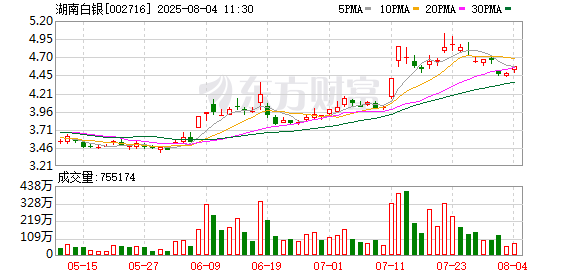
湖南白银:累计回购400万股
Mei Ri Jing Ji Xin Wen· 2025-08-04 04:32
Core Viewpoint - Hunan Silver announced a share buyback of 4 million shares, representing 0.14% of its total share capital, with a total transaction amount of approximately 18.26 million yuan [2] Group 1: Share Buyback Details - The share buyback was conducted through centralized bidding, with a maximum transaction price of 4.65 yuan per share and a minimum price of 4.47 yuan per share [2] - The total number of shares repurchased is 4 million, which is a small fraction of the company's total share capital of approximately 2.823 billion shares [2] Group 2: Revenue Composition - For the year 2024, Hunan Silver's revenue composition is entirely from non-ferrous metal smelting, accounting for 100% of the total revenue [2]


综合晨报:美国7月非农远逊预期-20250804
Dong Zheng Qi Huo· 2025-08-04 02:20
1. Report Industry Investment Ratings No information provided in the content. 2. Core Views of the Report - The US July non - farm payrolls were far below expectations, leading to a significant increase in gold prices, a weakening of the US dollar index, and concerns about the economic and demand prospects in various markets [1][14][18]. - The new issuance of treasury bonds will resume a 6% VAT levy from August 8, 2025, which may cause price differentiation between new and old bond types in the short - term and is bearish for the bond market in the long - term [25][26]. - The prices of various commodities are affected by different factors. For example, steel prices are under回调 pressure, and agricultural product prices are influenced by policies and supply - demand relationships [4][31][42]. 3. Summary by Related Catalogs 3.1 Financial News and Comments 3.1.1 Macro Strategy (Gold) - US 7 - month non - farm employment was far below expectations, with significant downward revisions in May and June. Gold prices rose about 2% on Friday. The market quickly adjusted its expectations for the Fed's rate cut in September, but gold remained in a short - term shock range. It is recommended that gold prices be in a short - term shock after pricing the positives on Friday [14]. 3.1.2 Macro Strategy (Foreign Exchange Futures (US Dollar Index)) - The resignation of the Fed governor may allow Trump to choose Powell's successor earlier. The US July non - farm data was far below expectations, and the labor market had a potential inflection point, causing the US dollar index to weaken significantly. It is recommended that the US dollar index be weak in the short - term [15][18]. 3.1.3 Macro Strategy (US Stock Index Futures) - Trump fired the Bureau of Labor Statistics director due to manipulated employment data. The July non - farm data showed a cooling employment market, and the significant downward revision of previous values increased market concerns about the real economy. It is expected that the stock index will continue to decline [21]. 3.1.4 Macro Strategy (Stock Index Futures) - Recently, many active equity funds have announced purchase restrictions. The stock market has corrected from a high level, with the Shanghai Composite Index falling below 3600 points. The 7 - month PMI was below expectations, and some micro - cap quantitative strategy funds announced purchase restrictions, indicating that the market has a preliminary perception of the high current level. It is recommended to allocate various stock indices evenly [22][24]. 3.1.5 Macro Strategy (Treasury Bond Futures) - Starting from August 8, 2025, a 6% VAT will be restored on the interest income of newly issued treasury bonds, local bonds, and financial bonds. The market is expected to rise first and then fall next week. In the short - term, it may cause price differentiation between new and old bond types, and in the long - term, it is bearish for the bond market. It is recommended that trading positions gradually withdraw from long positions [25][26][28]. 3.2 Commodity News and Comments 3.2.1 Agricultural Products (Soybean Meal) - The US June soybean crushing volume was 5.91 million short tons. The domestic soybean meal futures price was relatively strong compared to the external market. The supply - demand situation of domestic soybean meal changed little, and the inventory was expected to continue to rise. It is expected that the situation of strong domestic and weak external markets will continue, and the trading center of soybean meal will move up [31]. 3.2.2 Agricultural Products (Soybean Oil/Rapeseed Oil/Palm Oil) - Indonesia's June palm oil exports increased slightly year - on - year. Malaysia's July palm oil production increased month - on - month. There were news of domestic traders exporting soybean oil to India. It is expected that palm oil will maintain a narrow - range shock, and short - term consideration can be given to a long - soybean - oil and short - palm - oil spread [34][35]. 3.2.3 Black Metals (Coking Coal/Coke) - The coke price in the Changzhi market was running strongly. The coking coal price continued to strengthen, but the increase narrowed. The coal - coke futures market fluctuated greatly. In the short - term, it is expected to be in a shock trend, and the 09 contract will focus on the delivery situation [37][38]. 3.2.4 Agricultural Products (Cotton) - Pakistan increased the tax on imported cotton, cotton yarn, and cotton cloth by 18%. The demand for imported cotton in Vietnam decreased, and the inventory of finished products increased. The weekly export signing volume of new US cotton decreased. ICE cotton prices are expected to be in a low - level weak shock. It is expected that the decline space of Zhengzhou cotton is limited, and there may be a rebound before the large - scale listing of new cotton [42][43]. 3.2.5 Agricultural Products (Sugar) - India's 25/26 sugar production is expected to increase. StoneX lowered the global sugar supply surplus in 2025/26. Brazil's sugar production in the first half of July increased year - on - year. ICE raw sugar is expected to maintain a weak shock. Zhengzhou sugar is expected to be in a weak shock in the short - term, with the operating range between 5500/5600 - 5900 yuan/ton [44][48][49]. 3.2.6 Black Metals (Rebar/Hot - Rolled Coil) - China's heavy - truck sales increased in July. The US will impose tariffs on Brazilian semi - finished steel. Steel prices continued to be in a weak shock, with inventory accumulation and a seasonal decline in building material demand. It is expected that steel prices will still have回调 pressure in the near future [50][53][54]. 3.2.7 Black Metals (Steam Coal) - The price of steam coal in the northern port market was stable on August 1. The supply and demand of steam coal were both weakening. It is expected that the coal price will continue to be in a shock market, with limited short - term rebound height [55][56]. 3.2.8 Black Metals (Iron Ore) - The sales of new cars decreased in July. The iron ore price followed a slight correction this week, and the fundamentals were not in sharp contradiction. It is expected that the iron ore price will maintain a shock [57][58]. 3.2.9 Agricultural Products (Corn Starch) - The port inventory of cassava starch decreased slightly, and the price difference with corn starch narrowed. The开机 rate of downstream starch sugar was still weak year - on - year. It is expected that the price difference between rice and flour will remain in a low - level shock [59][60]. 3.2.10 Agricultural Products (Corn) - The average inventory of feed enterprises increased year - on - year. The North Port inventory continued to decline, and the raw material inventory of deep - processing enterprises decreased. It is expected that corn will maintain a downward shock trend in the medium - to - long - term, and it is recommended to hold short positions in new crops [61][62]. 3.2.11 Non - ferrous Metals (Nickel) - The Indonesian Nickel Mining Association called for production control and the implementation of ESG standards. The macro - environment was short - term positive, and the fundamentals of nickel showed a supply - surplus situation. It is recommended to pay attention to short - term band opportunities and medium - term short - selling opportunities [63][64][65]. 3.2.12 Non - ferrous Metals (Copper) - South Korea's copper exports to the US are expected to decline due to tariffs. Codelco cut copper mining at the El Teniente project. The overseas macro - expectations were volatile, and the global visible inventory was rising. It is recommended to take a short - term short - selling strategy and wait for medium - term long - buying opportunities [66][69][70]. 3.2.13 Non - ferrous Metals (Industrial Silicon) - The production of industrial silicon in various regions increased slightly. The inventory situation was mixed. The "anti - involution" trading of industrial silicon declined, but the fundamentals improved marginally. It is recommended that short positions consider gradually stopping losses and waiting for long - buying opportunities [71][72]. 3.2.14 Non - ferrous Metals (Polysilicon) - The Ministry of Industry and Information Technology issued an energy - saving inspection task for the polysilicon industry, and the Guangzhou Futures Exchange added designated quality inspection institutions. The spot transaction price of polysilicon increased, but the production was expected to increase in August, resulting in a surplus. It is expected that the polysilicon price will run between 45000 - 57000 yuan/ton in the short - term, and a strategy of selling out - of - the - money put options can be considered [73][75][77]. 3.2.15 Non - ferrous Metals (Lithium Carbonate) - The annual output of PLS exceeded expectations. The demand for lithium carbonate in August was positive, and the supply had uncertainties. It is recommended to consider short - term long - buying positions and stop profiting from the 9 - 11 spread [78][79]. 3.2.16 Non - ferrous Metals (Zinc) - The LME zinc cash - forward spread decreased, and the supply of zinc was expected to increase in August. The demand was weak. The zinc price may have a short - term shock, and it is recommended to wait and see in the short - term and consider a medium - term positive spread [80][81]. 3.2.17 Energy Chemicals (Carbon Emissions) - The EU carbon price was in a shock. The power industry demand was low, and the US tariff measures may affect European manufacturing. It is expected that the EU carbon price will be in a short - term shock [82][83]. 3.2.18 Energy Chemicals (Crude Oil) - The number of US oil rigs decreased. OPEC+ decided to increase production by 547,000 barrels per day in September. Oil prices fell on Friday due to concerns about demand. It is expected that oil prices will maintain a shock [85][86][87]. 3.2.19 Energy Chemicals (Caustic Soda) - The price of caustic soda in Shandong decreased. The supply increased slightly, and the demand was average. It is expected that the caustic soda market will be in a shock [87]. 3.2.20 Energy Chemicals (Pulp) - The price of some imported wood pulp varieties was stable, and some continued to decline. The pulp market was weak. It is expected that the pulp futures will follow the commodity correction [88][89]. 3.2.21 Energy Chemicals (PVC) - The price of domestic PVC powder decreased. The futures market was weak, and the demand was average. It is expected that the PVC futures will follow the commodity correction [90]. 3.2.22 Energy Chemicals (Bottle Chips) - The export price of bottle chips continued to decrease. The bottle chip factory implemented a production - cut plan. The demand was mainly for rigid needs. It is recommended to consider increasing the processing margin of bottle chips at low valuations [92][93]. 3.2.23 Energy Chemicals (Urea) - The port inventory of Chinese urea decreased. The supply pressure continued to exist, and the demand was average. The urea market was under shock pressure. It is expected to wait for new policy variables [94][95]. 3.2.24 Energy Chemicals (PTA) - The spot price of PTA decreased, and the trading atmosphere improved. The supply - demand pattern was in a tight - balance state. It is expected that PTA will follow the commodity sentiment for shock adjustment [96][98].
五矿期货文字早评-20250804
Wu Kuang Qi Huo· 2025-08-04 01:41
Report Industry Investment Ratings No relevant content provided. Core Views of the Report - The overall market is influenced by various factors such as policies, economic data, and international events. In the short - term, market sentiment may fluctuate, but in the long - run, different sectors will be affected by their own fundamentals. For instance, the capital market is supported by policies, but the real economy's recovery pace and demand are key factors affecting the prices of different commodities [3][5]. - The policy's attitude towards the capital market is positive, but the market may still face adjustments due to external factors and short - term over - valuation. For the bond market, interest rates are expected to decline in the long - term under the background of weak domestic demand and loose funds, but may be in a short - term shock pattern [3][5]. - Different commodity sectors have different supply - demand situations. Some sectors are facing supply - side challenges, while others are affected by demand - side weakness. For example, the copper and aluminum markets are affected by supply and demand, and the price trends are expected to be weak in the short - term [9][10]. Summary by Relevant Catalogs Macro - Financial Category Index Futures - **News**: The restoration of VAT on bond interest income, media comments on NVIDIA, stock market supervision, and weak US non - farm employment data [2]. - **Base Ratio**: The base ratios of IF, IC, IM, and IH contracts show different trends. The trading logic is to buy on dips based on the policy's support for the capital market [3]. Treasury Bonds - **Market**: TL, T, TF, and TS contracts showed declines on Friday. There were changes in bond tax policies, and the central bank had a large - scale net withdrawal of funds [4]. - **Strategy**: The economic data in the first half of the year was resilient, but the PMI in July was lower than expected. The interest rate is expected to decline in the long - term, and the bond market may be in a short - term shock pattern [5]. Precious Metals - **Market**: Both domestic and international gold and silver prices rose. The weak non - farm data in the US reversed the market's expectation of the US economy, increasing the expectation of the Fed's loose monetary policy [6]. - **Strategy**: It is recommended to buy on dips. The reference operating ranges for Shanghai gold and silver are provided [7]. Non - Ferrous Metals Category Copper - **Market**: The copper price oscillated weakly last week. The inventory of the three major exchanges increased, and the import of spot copper was in a loss. The price is expected to continue to oscillate weakly in the short - term [9]. Aluminum - **Market**: The aluminum price oscillated weakly. The domestic aluminum ingot inventory increased, and the downstream demand was in the off - season. The price is expected to continue to oscillate weakly in the short - term [10]. Zinc - **Market**: The zinc price declined slightly. The zinc ore inventory continued to accumulate, and the downstream consumption weakened. The risk of zinc price decline is expected to increase [11][12]. Lead - **Market**: The lead price rose slightly. The supply of lead ingots was relatively loose, and the price is expected to oscillate weakly [13]. Nickel - **Market**: The nickel price oscillated weakly. The stainless steel and nickel - iron market was in an oversupply situation, and it is recommended to sell on rallies [14]. Tin - **Market**: The tin price oscillated and declined. The supply was low, and the demand was weak. The supply is expected to increase in the fourth quarter, and the price is expected to oscillate weakly in the short - term [15]. Carbonate Lithium - **Market**: The carbonate lithium price declined. The supply reduction is expected to support the price, but the sustainability of supply reduction needs to be observed. It is recommended that speculative funds wait and see [17]. Alumina - **Market**: The alumina price declined. The supply - side contraction policy needs to be observed, and it is recommended to short on rallies [18]. Stainless Steel - **Market**: The stainless steel price oscillated. The social inventory was still at a high level, and the price is expected to maintain an oscillating pattern [19]. Cast Aluminum Alloy - **Market**: The cast aluminum alloy price oscillated and declined. The downstream was in the off - season, and the price rebound space is expected to be limited [21]. Black Building Materials Category Steel - **Market**: The prices of rebar and hot - rolled coils showed a weak oscillating trend. The export competitiveness decreased, and the inventory of rebar and hot - rolled coils was at a low level in the past five years. The price is expected to return to the real - trading logic [23]. Iron Ore - **Market**: The iron ore price rose slightly. The supply increased slightly, and the demand was supported. The price is expected to oscillate following the downstream prices [24][25]. Glass and Soda Ash - **Glass**: The glass price declined. The inventory decreased, but the downstream demand did not improve significantly. The price is expected to oscillate widely in the short - term [26]. - **Soda Ash**: The soda ash price was stable. The supply was high, and the demand was weak. The price is expected to oscillate in the short - term [27]. Manganese Silicon and Ferrosilicon - **Market**: The prices of manganese silicon and ferrosilicon showed wide - range fluctuations. It is recommended that investment positions wait and see, and hedging positions can participate opportunistically [28][29]. Industrial Silicon - **Market**: The industrial silicon price oscillated and declined. The supply was excessive, and the demand was insufficient. The price is expected to be weak in the short - term [32]. Polysilicon - **Market**: The polysilicon price showed a high - level oscillation. The price is expected to oscillate widely in the short - term, and it is recommended to participate cautiously [33][34]. Energy - Chemical Category Rubber - **Market**: NR and RU declined significantly. The tire factory's operating rate decreased, and the inventory increased. It is recommended to wait and see and conduct band - trading operations [36][37][39]. Crude Oil - **Market**: The prices of WTI, Brent, and INE crude oil futures declined. The gasoline, diesel, and fuel oil inventories decreased, while the naphtha and aviation kerosene inventories increased. It is recommended to take profits and wait and see [40]. Methanol - **Market**: The methanol price declined. The supply pressure is expected to increase, and the demand is weak. The price is under pressure [41]. Urea - **Market**: The urea price declined. The supply is expected to increase, and the demand is weak. The price decline space is limited [42]. Styrene - **Market**: The styrene spot price was stable, and the futures price declined. The BZN spread is expected to repair, and the price is expected to oscillate upward following the cost side [43]. PVC - **Market**: The PVC price declined. The supply was strong, the demand was weak, and the valuation was high. The price is expected to decline in the short - term [45]. Ethylene Glycol - **Market**: The EG price declined. The supply decreased slightly, and the demand was weak. The inventory decreased. The price is under downward pressure [46]. PTA - **Market**: The PTA price declined. The supply is expected to increase, and the demand is weak. The inventory increased. The price is expected to oscillate, and it is recommended to buy on dips following PX [47]. Paraxylene - **Market**: The PX price declined. The supply was high, and the demand was affected by PTA maintenance. The inventory decreased. The price is expected to oscillate, and it is recommended to buy on dips following crude oil [48]. Polyethylene (PE) - **Market**: The PE price declined. The cost support existed, and the demand was weak. The price is expected to be determined by the game between the cost and supply sides in the short - term [49]. Polypropylene (PP) - **Market**: The PP price declined. The supply and demand were weak, and the price is expected to oscillate strongly following crude oil [51]. Agricultural Products Category Live Pigs - **Market**: The pig price declined over the weekend. The supply was abundant, and the demand was weak. The market is paying attention to the policy's intervention in capacity reduction, and it is recommended to focus on the spread opportunities [53]. Eggs - **Market**: The egg price declined over the weekend. The supply was large, and the demand was weak. The price is expected to be stable first and then rise, and it is recommended to short on rallies in the medium - term [54]. Soybean and Rapeseed Meal - **Market**: The US soybean price oscillated weakly, and the domestic soybean meal price was supported. The supply and demand of soybean meal were in a complex situation, and it is recommended to buy on dips at low - cost intervals and expand the spread between soybean meal and rapeseed meal [55][56]. Oils and Fats - **Market**: The domestic palm oil price declined slightly. The export and production data of Southeast Asian palm oil showed different trends. The price is expected to oscillate [57][58][59]. Sugar - **Market**: The sugar price declined. The sugar production in Brazil and India increased, and the import supply increased. The price is expected to continue to decline [60][61]. Cotton - **Market**: The cotton price declined. The downstream consumption was weak, and the de - stocking speed slowed down. The price is expected to be short - term bearish [62].
国泰君安期货锡周报-20250803
Guo Tai Jun An Qi Huo· 2025-08-03 08:43
锡周报 国泰君安期货研究所 有色及贵金属 刘雨萱投资咨询从业资格号:Z0020476 日期:2025年8月3日 Guotai Junan Futures all rights reserved, please do not reprint Special report on Guotai Junan Futures 锡:再度下探支撑位 强弱分析:偏弱 价格区间:260000-265000元/吨 6月实际消费量环比下行 本周社会库存基本持平 0 5000 10000 15000 20000 25000 01-3102-2803-3104-3005-3106-3007-3108-3109-3010-3111-3012-31 吨 实际消费量 2016 2017 2018 2019 2020 2021 2022 2023 2024 2025 0 5000 10000 15000 20000 25000 01-03 01-14 01-26 02-10 02-24 03-07 03-18 03-29 04-11 04-22 05-06 05-17 05-28 06-10 06-21 07-04 07-15 07-26 0 ...
电解铝:产能受限需求存分歧,铝价承压
Sou Hu Cai Jing· 2025-08-03 07:21
本文由 AI 算法生成,仅作参考,不涉投资建议,使用风险自担 【电解铝产能受限,需求预期存分歧,铝价承压】政策预期强化,电解铝产能面临天花板。 光伏、电 网、电动车带动国内消费增长,海外需求保持稳定。 潜在供给仅1%,市场分歧集中在需求预期。 供给 变化不大,正值需求淡季,下游低价成交量有限,多以贴水成交。 国内库存持续累积,宏观氛围偏 弱,铝价因此承压。 ...