低硫燃油期货

Search documents
中国期货每日简报-20260313
Zhong Xin Qi Huo· 2026-03-13 00:29
Report Industry Investment Rating No relevant content provided. Core Viewpoints - On March 12, equity index futures dropped, and most commodities rose, with energy & chemicals leading the raise. In equity index futures, IC dropped 0.8%, and IH dropped 0.6%. In commodity futures, LSFO, Paraxylene, and Crude Oil were the top three gainers, while Apple, Silver, and Palladium were the top three decliners [10][11][12]. Summary by Directory 1. China Futures 1.1 Overview - On March 12, equity index futures dropped, and most commodities rose, with energy & chemicals leading the raise. IC dropped 0.8%, and IH dropped 0.6%. In commodity futures, the top three gainers were LSFO, Paraxylene, and Crude Oil, and the top three decliners were Apple, Silver, and Palladium [10][11][12]. 1.2 Daily Raise 1.2.1 Crude Oil - On March 12, the Crude Oil main contract rose 11.3% to 722.3 yuan/barrel (INE). Strategic petroleum reserve releases will not reverse supply tightness expectations, leaving oil prices strong. Geopolitical uncertainty and passive production cuts will keep the market volatile and biased upward [18][20][21]. 1.2.2 LSFO - On March 12, the main contract of LSFO rose 14.8% to 5653 yuan/ton (INE). LSFO is pressured by green fuel substitution and limited HSFO replacement demand, but is currently undervalued and moves with crude oil. It has strong primary product attributes, and its crack spread strengthens when crude oil prices rise. Fundamentally, it enjoys a more favorable export tax rebate rate than refined oil products [25][26][27]. 1.2.3 Paraxylene - On March 12, the main contract of Paraxylene rose 13.0% to 10218 yuan/ton (ZCE). Cost increases have evolved into actual supply shocks, with force majeure declared at multiple refineries in the Asia - Pacific. Short - term prices will stay strong, and the medium - term logic of buying on dips holds. PX 05 - 09 month spread is recommended for positive calendar spread, and PXN is expected to trade range - bound between USD 250–330/ton [32][33][34]. 2. China News 2.1 Macro News - IEA Member States Agree to Release 400 Million Barrels of Oil Reserves. The 32 member states of the International Energy Agency will release 400 million barrels of oil from their emergency reserves. - U.S. to Release 172 Million Barrels from Strategic Petroleum Reserve. The U.S. will start releasing 172 million barrels of oil from the Strategic Petroleum Reserve next week, which is expected to take about 120 days. - U.S. February CPI Rises 2.4% YoY, Core CPI Up 2.5% YoY. U.S. CPI rose 2.4% year - on - year in February, and core CPI increased 2.5% year - on - year. The market still expects the Federal Reserve to cut interest rates again as early as July. - U.S. to Launch Section 301 Investigations Against 16 Trading Partners. The U.S. will launch Section 301 investigations against 16 trading partners, including China, the European Union, Mexico, Vietnam, India, and Japan [37].
中国商品期货马年开局涨多跌少 原油涨幅居前
Zhong Guo Xin Wen Wang· 2026-02-24 14:48
Core Viewpoint - On the first trading day of the Year of the Horse, China's domestic commodity futures saw a majority of contracts closing higher, particularly in crude oil and other energy-related futures, driven by geopolitical tensions in the Middle East [1] Group 1: Market Performance - The main crude oil futures contract on the Shanghai International Energy Exchange recorded a significant increase of 6.18%, closing at 493.3 RMB per barrel [1] - Other futures such as low-sulfur fuel, platinum, and palladium also showed notable price increases [1] Group 2: Geopolitical Influences - Analysts indicate that the ongoing tensions between the U.S. and Iran are a key factor influencing oil prices, with a focus on the outcomes of U.S.-Iran negotiations and any potential military actions [1] - Recent reports suggest that the U.S. has been increasing its military presence in the Middle East, which may lead to further pressure on Iran [1] Group 3: Future Considerations - Attention is required on whether the U.S. will implement military strikes against Iran and the potential scale of such actions, as prolonged conflict could lead to a significant rise in oil prices [1]
对中东局势的担忧持续扰动油价,化?延续震荡整理
Zhong Xin Qi Huo· 2026-02-12 08:19
1. Report Industry Investment Rating No relevant content provided. 2. Core Views of the Report - Concerns about the Middle East situation continue to disrupt oil prices, and the chemical industry continues to fluctuate and consolidate. The series of events such as the US considering seizing Iranian oil tankers and the Israeli Prime Minister's visit to the US have raised market concerns about the tense geopolitical situation in the Middle East [2]. - The recent maintenance plans of polyester industry chain enterprises have strengthened the expectation of a better pattern in the polyester chain. After the Spring Festival, the polyester production starts to rise, while the raw materials are still under maintenance, and the raw material supply is reduced or remains stable while the demand side rises. The strong pattern of raw materials will continue after the festival [3]. - Coal prices are stabilizing, and crude oil and chemical prices continue to fluctuate and consolidate [4]. 3. Summary by Relevant Catalogs 3.1 Market Views 3.1.1 Crude Oil - **View**: Geopolitical premium continues to fluctuate, and the risk remains high around the holiday. The fundamentals of the current crude oil market are not optimistic, with high inventory levels of crude oil and refined oil. The weak reality and strong expectation are the main trading lines in the recent market. Geopolitical factors still support oil prices, but there is still great uncertainty in the US - Iran situation [8]. - **Outlook**: Volatility. 3.1.2 Asphalt - **View**: Asphalt futures prices fluctuate at a high level. The relaxation of US sanctions on Venezuela may lead to an abundant supply of asphalt raw materials in the long - term. The current high asphalt prices are overvalued, and the inventory accumulation pressure is still large [9]. - **Outlook**: Volatility, with the long - term valuation expected to decline. 3.1.3 High - Sulfur Fuel Oil - **View**: Fuel oil futures prices run at a high level. In the short - term, there is still geopolitical premium, but in the long - term, the increase in Venezuelan oil production and the substitution of fuel oil power generation in the Middle East will put pressure on high - sulfur fuel oil [10]. - **Outlook**: Volatility. 3.1.4 Low - Sulfur Fuel Oil - **View**: Low - sulfur fuel oil fluctuates and rises following crude oil. It is affected by natural gas price fluctuations, and although it faces some negative factors, its current valuation is low [12]. - **Outlook**: Volatility. 3.1.5 PX - **View**: There is still support at the cost end, and PTA device maintenance is implemented. Short - term PX prices will fluctuate under the guidance of sentiment [13]. - **Outlook**: Volatility. 3.1.6 PTA - **View**: PTA device maintenance eases the seasonal inventory accumulation pressure. The upstream cost provides short - term support, and the processing fee is expected to be significantly supported in the short - term [14]. - **Outlook**: Short - term volatility and consolidation. 3.1.7 Pure Benzene - **View**: The price fluctuation is mainly affected by crude oil prices and capital sentiment. In the short - term, there is an expectation of inventory accumulation, and some profit - taking may cause market fluctuations [16]. - **Outlook**: Volatility. 3.1.8 Styrene - **View**: Overseas and domestic device restarts lead to a marginal loosening of supply and demand. The upward momentum has declined, and the export - driven support has weakened [21]. - **Outlook**: Volatility. 3.1.9 Ethylene Glycol (MEG) - **View**: The import volume in the second quarter is revised downwards, and there is a weak repair expectation for supply and demand. The price has limited downside [22]. - **Outlook**: Short - term price range consolidation. 3.1.10 Short - Fiber - **View**: Both supply and demand decline, and trading is light. The price follows the upstream raw materials, and the processing fee has stronger support below [25]. - **Outlook**: Follow the upstream raw materials. 3.1.11 Polyester Bottle Chips - **View**: The volatility narrows, and the trading atmosphere declines. The price follows the cost fluctuations before the festival [27]. - **Outlook**: The absolute price follows the raw materials, and pay attention to the long PR and short TA positions. 3.1.12 Methanol - **View**: Before the festival, coastal trading is suspended, and inland inventory clearance is coming to an end. Methanol fluctuates and consolidates. The Iranian situation is still uncertain [28]. - **Outlook**: Volatility. 3.1.13 Urea - **View**: Before the festival, orders are coming to an end, and urea fluctuates and consolidates. The supply is stable, and the price is expected to remain stable until after the Spring Festival [30]. - **Outlook**: Volatility. 3.1.14 LLDPE (Plastic) - **View**: Before the long holiday, both long and short positions are cautious. After the price decline, it may fluctuate. It is affected by oil prices, market sentiment, and inventory, and there is an expectation of macro - consumption policy support [33]. - **Outlook**: Short - term volatility. 3.1.15 PP - **View**: Before the festival, both long and short positions are cautious. After the price decline, it fluctuates. It is affected by oil prices, market sentiment, and refinery profits, and there is an expectation of macro - consumption policy support [34]. - **Outlook**: Short - term volatility. 3.1.16 PL - **View**: Supported by the spot market, PL fluctuates. PDH maintenance provides some support, and the supply is under control [35]. - **Outlook**: Short - term volatility. 3.1.17 PVC - **View**: With low valuation and weak expectation, PVC fluctuates. Geopolitical factors affect the market sentiment, and the "export rush" support may weaken [37]. - **Outlook**: Volatility. 3.1.18 Caustic Soda - **View**: The comprehensive profit is poor, and caustic soda weakly stabilizes. The chlorine - alkali profit is weak, and there is a risk of production reduction after the festival [38]. - **Outlook**: Volatility. 3.2 Variety Data Monitoring 3.2.1 Energy Chemical Daily Index Monitoring - **Inter - period Spreads**: Data on the inter - period spreads of various varieties such as Brent, Dubai, PX, PTA, etc. are provided, including the latest values and changes [40]. - **Basis and Warehouse Receipts**: Data on the basis and warehouse receipts of various varieties such as asphalt, high - sulfur fuel oil, low - sulfur fuel oil, etc. are provided, including the latest values and changes [41]. - **Inter - Variety Spreads**: Data on the inter - variety spreads of various varieties such as PP - 3MA, TA - EG, etc. are provided, including the latest values and changes [42]. 3.2.2 Chemical Basis and Spread Monitoring No specific summary content is provided in the given text for each variety under this section. 3.3 Commodity Index - **Comprehensive Index**: The comprehensive index, special index, and sector index are provided. The comprehensive index shows an upward trend, and the energy index has positive daily, 5 - day, 1 - month, and year - to - date returns [283][285].
收评|内盘期货多数收涨 沪银收涨逾8%
Xin Lang Cai Jing· 2026-01-29 07:05
Core Viewpoint - The domestic futures market experienced a majority increase on January 29, 2026, with significant gains in precious metals and energy commodities, while some materials like polysilicon and lithium carbonate saw declines [3][7]. Group 1: Price Movements - Silver futures (沪银) rose over 8% [3][7]. - Gold futures (沪金) increased nearly 8% [3][7]. - International copper (国际铜) saw a rise of 7% [3][7]. - Domestic copper (沪铜) gained over 6% [3][7]. - Fuel oil (燃油) increased by 4% [3][7]. - Coking coal (焦煤), crude oil (原油), asphalt (沥青), coking coal (焦炭), and low-sulfur fuel oil (低硫燃油) all rose over 3% [3][7]. Group 2: Declines in Specific Commodities - Polysilicon (多晶硅) fell over 4% [3][7]. - Lithium carbonate (碳酸锂) dropped over 3% [3][7].


国内期货主力合约多数收涨 集运欧线涨近9%
Zheng Quan Shi Bao Wang· 2025-12-22 07:22
Group 1 - The majority of domestic futures main contracts experienced an increase, with the shipping European line rising nearly 9% [1] - Palladium and platinum saw a rise of 7%, while silver in Shanghai increased by 6% [1] - Nickel in Shanghai rose over 4%, and lithium carbonate also increased by 4% [1] Group 2 - Other commodities such as rebar, asphalt, low-sulfur fuel oil, crude oil, pulp, and gold in Shanghai rose by over 2% [1] - Conversely, plastics and polysilicon fell by over 2%, while glass and alumina dropped by over 1% [1]
收评|国内期货主力合约涨跌互现 钯期货涨超4%
Xin Lang Cai Jing· 2025-12-16 07:07
Group 1 - The core viewpoint of the article highlights the mixed performance of domestic futures contracts, with palladium futures rising over 4% and rebar increasing over 3%, while other commodities like tin and asphalt saw declines of over 2% [2][6]. Group 2 - Analysts from Huatai Futures attribute the rise in platinum and palladium prices to a "spillover effect" from funds, driven by macroeconomic factors such as the Federal Reserve's recent interest rate cut and ongoing liquidity measures [4][8]. - The Federal Reserve's FOMC meeting on December 11 resulted in a 25 basis point rate cut to a range of 3.5-3.75%, with a commitment to purchase $40 billion in short-term government bonds monthly to maintain liquidity, which has led to expectations of a weaker dollar and supported the overall rise in precious metal prices [4][8]. - Supply disruptions in platinum and palladium are exacerbated by ongoing power crises in South Africa, maintenance of aging mines, and geopolitical issues affecting Russian supply, while demand from traditional automotive sectors remains weak [4][8].
对俄罗斯供应担忧重燃,能化延续震荡整理
Zhong Xin Qi Huo· 2025-12-04 00:53
1. Report Industry Investment Rating The report does not explicitly mention the industry investment rating. 2. Core Viewpoints of the Report - The energy and chemical sector continues to experience weak and volatile trends, with olefins showing weakness and aromatics having a slightly stronger pattern [4]. - In December, the fundamentals of the energy and chemical market are expected to be weak, and the rebound space is limited. Attention should be focused on geopolitical disturbances [8]. 3. Summary by Related Catalogs 3.1 Market Outlook - **Crude Oil**: Geopolitical premiums fluctuate, and supply pressure persists. The progress of the Russia - Ukraine peace terms is still uncertain, and the situation in the Caribbean region is also highly unpredictable. EIA data shows that the US commercial crude oil inventory increased slightly in the week of November 28, and the refinery operating rate continued to rise [8]. - **Asphalt**: After the asphalt futures price fell below the normal range, it is expected to recover towards the spot price. The supply - demand situation is weak, and there is still significant pressure on inventory accumulation [10]. - **High - Sulfur Fuel Oil**: The futures price of high - sulfur fuel oil is in a weak and volatile state. The three major drivers supporting high - sulfur fuel oil are currently weak, and the demand is still relatively low [10]. - **Low - Sulfur Fuel Oil**: The low - sulfur fuel oil futures price is also in a weak and volatile state. It is affected by factors such as the decline in shipping demand, green energy substitution, and high - sulfur substitution. However, the current valuation is relatively low and it follows the movement of crude oil [11]. - **PX**: In the short term, the cost guidance is limited, and the profit is strong under the independent logic of PX. The supply and demand are both strong, and the price is relatively resistant to decline [12]. - **PTA**: The market lacks new driving forces and follows the cost fluctuations. The supply - demand balance sheet is expected to show inventory reduction, and the price is expected to follow the upstream PX to fluctuate slightly upward [12]. - **Pure Benzene**: The price fluctuates mainly, with improved expectations but still under pressure in reality. The inventory in East China ports continues to accumulate significantly, and there is still pressure on inventory accumulation in December [14]. - **Styrene**: The liquidity is slightly tight, and the price fluctuates slightly upward. The port inventory decreased in November, and the actual available inventory is lower than the total inventory. The cost support from pure benzene is weak, but the market has already priced in the inventory accumulation pressure [15]. - **Ethylene Glycol (MEG)**: The domestic supply - demand pattern has not significantly weakened, but the expectations suppress the market sentiment. The price is expected to remain in a low - level volatile range [16]. - **Short - Fiber**: The upstream cost provides support, but the demand is in the off - season, and the price fluctuates slightly upward. The terminal demand is difficult to improve substantially in the short term [19]. - **Polyester Bottle Chip**: The price volatility narrows, and the trading atmosphere declines slightly. The price follows the raw materials, and the processing fee has certain support [20]. - **Methanol**: The expected unloading volume in coastal areas is high, and the supply - demand in inland areas provides phased support. The price fluctuates and consolidates [22]. - **Urea**: The off - season storage is progressing steadily, and the futures price fluctuates and consolidates. The supply remains at a high level, and the demand from compound fertilizer enterprises is limited [23]. - **LLDPE (Plastic)**: The supply - demand pattern does not show a significant weakening, but expectations suppress sentiment. The price is expected to remain in a low - level volatile range [24]. - **PP**: The oil price rebounds slightly, and the price fluctuates. The focus is on the changes in maintenance and the supply - demand situation [25]. - **PL**: The spot price is relatively strong, and the price fluctuates. The supply device has a restart expectation, and the buying is mainly for rigid demand [26]. - **PVC**: The valuation is low, and the expectations are weak. The price is cautiously bearish. The high inventory is difficult to reduce smoothly, and attention should be paid to whether low profits can lead to enterprise production cuts [28]. - **Caustic Soda**: The inventory continues to accumulate, and the price fluctuates weakly. The supply - demand situation is pessimistic, and attention should be paid to whether low profits can drive upstream production cuts [29]. 3.2 Variety Data Monitoring 3.2.1 Energy and Chemical Daily Indicator Monitoring - **Inter - Period Spread**: The inter - period spreads of various energy and chemical varieties show different trends, such as Brent's M1 - M2 spread is 0.42 (+0.02), and PX's 1 - 5 month spread is - 36 (-6) [31]. - **Basis and Warehouse Receipts**: Different varieties have different basis and warehouse receipt situations, for example, the basis of asphalt is - 2 (-46), and the warehouse receipt is 6060 [33]. - **Inter - Variety Spread**: The inter - variety spreads also vary, like the 1 - month PP - 3MA spread is - 2 (-16), and the 1 - month TA - EG spread is 908 (+33) [35]. 3.2.2 Chemical Basis and Spread Monitoring - This part mainly monitors the basis and spreads of specific chemical varieties such as methanol, urea, styrene, etc., but the specific data and analysis are not fully presented in the given text [36][48][60]. 3.3 Commodity Index - **Comprehensive Index**: The commodity index is 2270.14 (-0.22%), the commodity 20 index is 2587.91 (-0.13%), and the industrial product index is 2219.45 (-0.41%) [277]. - **Energy Index**: On December 3, 2025, the energy index is 1117.42, with a daily decline of 1.10%, a 5 - day increase of 0.19%, a 1 - month decline of 4.17%, and a year - to - date decline of 9.00% [279].
俄乌和谈进展主导油价,聚烯烃期价创近年新低
Zhong Xin Qi Huo· 2025-11-26 02:41
1. Report Industry Investment Rating No information provided in the report. 2. Core Views of the Report - The progress of the Russia-Ukraine peace talks dominates oil prices, and the prices of polyolefin futures have reached new lows in recent years. The situation of strong current and weak expectations in the crude oil market continues, and the key variable lies in the progress of the Russia-Ukraine peace talks. Investors should temporarily adopt a volatile mindset [2]. - The weakening of crude oil leads to a decline in the cost of oil-based chemicals. The production capacity growth rates of PP and PE in 2025 both exceed 10%, and the maintenance efforts are insufficient. The production of polyolefins has been at the highest level in the same period in the past five years, and the monthly production of both varieties in October reached a record high [3]. - The energy and chemical industry will continue its weak and volatile trend, with olefins being weak and the aromatics pattern being slightly stronger [4]. 3. Summary by Relevant Catalogs 3.1 Market Views 3.1.1 Crude Oil - **View**: Geopolitical premium fluctuates, and supply pressure persists. If geopolitical support gradually weakens, it is expected to be volatile and weak [8]. - **Main Logic**: The progress of the Russia-Ukraine peace plan is becoming more optimistic, but uncertainties remain high. API data shows that the US crude oil inventory decreased last week while gasoline and diesel inventories increased. The pressure of inventory accumulation due to oversupply still exists, and there is a lack of marginal positive factors after the reduction of Russian oil production. Macro and geopolitical factors have had an increasing impact on oil prices recently [8]. 3.1.2 Asphalt - **View**: Due to raw material supply disruptions and optimistic sentiment, the asphalt futures price rebounded. The absolute price of asphalt is overestimated, and the monthly spread of asphalt is expected to decline as warehouse receipts increase [9]. - **Main Logic**: OPEC+ will continue to increase production in December, and White House officials expect Russia and Ukraine to reach a framework agreement by the end of November. The increase in crude oil and rebar prices driven by optimistic expectations has boosted the asphalt futures price. Reuters reported that Venezuela is seeking key raw material supplies from Chevron, and the shortage of Venezuelan diluted naphtha supply may lead to a decline in its crude oil exports. After the futures pricing returned to the Shandong spot price, the recent stability of the Shandong spot price has strengthened the support for the futures price [9]. 3.1.3 High-Sulfur Fuel Oil - **View**: The fuel oil futures price is in a weak and volatile state. Geopolitical escalation will only cause short-term price disturbances, and attention should be paid to changes in the Russia-Ukraine situation [9]. - **Main Logic**: OPEC+ will continue to increase production in December, and White House officials expect Russia and Ukraine to reach a framework agreement by the end of November. The three major drivers supporting high-sulfur fuel oil, namely the Russia-Ukraine conflict, refinery purchases, and the Palestine-Israel conflict, are currently weak. The refinery operating rate has dropped significantly in the off-season, and the refinery processing demand is weak. The United States is currently using gas oil as a substitute for residue oil, and the fuel oil demand in the Middle East is still weak during the off-season [9]. 3.1.4 Low-Sulfur Fuel Oil - **View**: The low-sulfur fuel oil futures price is in a weak and volatile state. It is affected by the substitution of green fuels and high-sulfur fuels, and the demand space is limited. However, the current valuation is low, and it will fluctuate with crude oil [10][11]. - **Main Logic**: Low-sulfur fuel oil follows the decline of refined oil products, and the pressure level of 3500 is temporarily effective. Recently, the decline in Russian refined oil exports has driven the rebound of gasoline and diesel cracking spreads, which has supported low-sulfur fuel oil. However, White House officials expect Russia and Ukraine to reach a framework agreement by the end of November, and diesel prices have dropped significantly, causing low-sulfur fuel oil to follow the decline. Low-sulfur fuel oil faces negative factors such as a decline in shipping demand, the substitution of green energy, and the substitution of high-sulfur fuels. Its valuation is low and is expected to fluctuate with crude oil [11]. 3.1.5 Methanol - **View**: The rebound has reflected the confirmed expectations, and high inventories will suppress the upward space of the futures price. It is expected to be in a short-term volatile consolidation state, and there may be a possibility of repeated bottoming in the long term [30][31]. - **Main Logic**: On November 25, methanol continued to rise but showed signs of weakness. The trading atmosphere in the inland market was active, and the demand for long-term contracts and replenishment by traders was obvious. Olefin enterprises purchased in normal quantities, smoothly digesting the enterprise inventories. After the confirmation of the shutdown information of Iranian methanol plants, the expectations have been basically reflected in the futures price through the reduction of short positions on the 24th. However, considering the high expected import volume, the high coastal inventories are expected to remain at a historical high level, continuing to suppress the upward space of the futures price after the rebound [30]. 3.1.6 Urea - **View**: Downstream demand is weak, and the futures price has declined slightly. The fundamental pattern of strong supply and weak demand remains unchanged, with high inventories suppressing prices and spot prices providing support. The market is expected to be in a narrow and volatile consolidation state, and attention should be paid to the impact of environmental protection restrictions on the operation of downstream compound fertilizers [31]. - **Main Logic**: On November 25, the daily production on the supply side remained at a high level. Some devices are expected to resume operation soon, while others have started maintenance. The demand side lacks sustainability, and the market lacks continuous upward momentum. Some regional prices have loosened, and the futures price has declined slightly following the spot price [31]. 3.1.7 Ethylene Glycol - **View**: Without further positive support, the price has entered an adjustment range. The long-term inventory accumulation pressure is large, the rebound height is limited, and the price will maintain a wide and volatile range at a low level [21][22]. - **Main Logic**: The ethylene glycol price rose and then fell during the day. After the short-term sentiment was further released, there was no other obvious positive support. The early implementation of the maintenance plan at Sinochem Quanzhou has relieved the supply-side pressure to some extent, and the price has experienced an emotional recovery. However, there is still an expectation of the return of coal-based devices, and the expectation of inventory accumulation from November to December has not been reversed. With the expectation of future production capacity expansion, the price increase is under pressure [21]. 3.1.8 PX - **View**: The cost-side support is slightly insufficient, but the demand-side support maintains the profitability. In the short term, it is expected to shift from the previous strength to an adjustment phase, and the price will fluctuate with the cost, waiting for the fermentation of sentiment and further feedback from downstream industries [13]. - **Main Logic**: International oil prices are volatile and weak, and the cost-side support for PX is slightly insufficient. After the price increase, PX has entered a correction phase. The market news is relatively calm, and there have been no significant changes in PX devices. The sentiment for blending into gasoline has cooled down slightly, but PX supply still remains at a high level. The demand side still provides some support for PX prices, which will fluctuate within a certain range under the influence of cost and sentiment [13]. 3.1.9 PTA - **View**: The spot basis is strong, and the processing fee has been slightly repaired. The price will fluctuate with the cost, and the support for the processing fee has increased. The basis has emerged from a weak state. There may be an opportunity for a positive spread arbitrage in TA01 - 05 when it is below -50 [14][15]. - **Main Logic**: The cost-side support from upstream is average, and the market sentiment has cooled down, resulting in average negotiations. However, the PTA supply-demand pattern has improved compared to the previous period, leading to a stronger basis. There is a possibility of inventory reduction from November to December. Attention should be paid to the export performance after the cancellation of BIS [15]. 3.1.10 Short Fiber - **View**: Downstream demand is temporarily maintained, and it will passively follow the upstream. The short fiber price will fluctuate with the upstream, and the processing fee is expected to be compressed. A light long position in TA and short position in PF can be considered [24][25]. - **Main Logic**: The cost-side support is limited, and the price increase is modest even with the rebound of ethylene glycol. The current supply-demand pattern of polyester staple fiber is in a weakening cycle, and demand only meets the basic needs. Polyester staple fiber factories are mainly focused on sales [25]. 3.1.11 Bottle Chip - **View**: The price fluctuation is limited, and the profit is stagnant. The absolute price will fluctuate with the raw materials, and the overall support for the processing fee has increased [26]. - **Main Logic**: The upstream raw material futures prices rose and then fell. Polyester bottle chip factories slightly increased their prices in some areas. The trading atmosphere in the polyester bottle chip market was average, and there was a large price difference among different brands. The short-term upstream cost is expected to fluctuate within a certain range, providing no clear directional guidance, and the profit of polyester bottle chips will have limited fluctuations [26]. 3.1.12 Propylene - **View**: The spot is strong, and PL is volatile. PL is expected to be volatile in the short term [35]. - **Main Logic**: The restart of supply has been delayed, and the overall supply remains tight. Propylene enterprises have controllable inventories, and some offer prices have increased slightly. Downstream demand has been positive, with an increase in the premium for actual orders, and the trading center has shifted upwards significantly. The PP - PL spread has narrowed in the short term, and the operating rate of downstream powder plants has declined [35]. 3.1.13 PP - **View**: Oil prices are weakening, and there are still fundamental pressures. Attention should be paid to changes in maintenance. It is expected to be volatile and weak in the short term [34][35]. - **Main Logic**: Oil prices are volatile and declining. The progress of the Russia-Ukraine negotiations has led to a lack of marginal positive factors after the reduction of Russian oil production. The macro and geopolitical factors point to a pessimistic outlook for oil prices. The fundamental support for PP itself is still limited. Although maintenance has increased slightly, the high growth of production capacity still exerts pressure on output. The midstream inventory is at the highest level in the same period in the past five years, and weak demand will continue to suppress the price [35]. 3.1.14 Plastic - **View**: Oil prices are falling, and the downstream is entering the off-season. Maintenance provides limited support, and it is expected to be volatile and weak. It is expected to be volatile and weak in the short term [33][34]. - **Main Logic**: Oil prices are volatile and declining. The progress of the Russia-Ukraine negotiations has led to a lack of marginal positive factors after the reduction of Russian oil production. The macro and geopolitical factors point to a pessimistic outlook for oil prices. The fundamental support for plastics itself is still limited. The upstream and midstream still have the intention to reduce inventories at high prices, which will suppress the upward space of prices. Short-term maintenance provides limited support, and the increase in production capacity still exerts pressure on output. The profit support is limited, and the downstream demand is gradually entering the off-season, with a cautious purchasing attitude [34]. 3.1.15 Styrene - **View**: The narrative of blending into gasoline has faded, and styrene has returned to a volatile state. It is expected to be volatile for the time being. Attention should be paid to the expected difference between the de - stocking of styrene ports and the inventory accumulation of pure benzene ports [19]. - **Main Logic**: The gasoline crack spread and the Asia - US aromatic hydrocarbon spread indicate that the driving force of blending into gasoline is questionable. After the speculative premium is squeezed out, the downward space for styrene is limited. There are some positive factors such as exports and the reduction of Korean aromatic hydrocarbon production. The supply - demand balance between pure benzene and styrene from December to January is not a major issue, with only minor de - stocking and inventory accumulation, so it will be mainly volatile for the time being [19]. 3.1.16 PVC - **View**: High inventories suppress prices, and PVC may be anchored to production cuts. If low profits lead to upstream production cuts or export volume exceeds expectations, the downward pressure on the futures price will be relieved [37]. - **Main Logic**: At the macro level, attention should be paid to the Politburo meeting in December and the Fed's interest rate decision to guide market expectations. At the micro level, the de - stocking of high PVC inventories is slow, and attention should be paid to whether low profits can lead to enterprise production cuts. Specifically, PVC production is at a high level, the profits of marginal enterprises are poor but there are no clear production cut plans; downstream operating rates are seasonally weak, and only low - price purchases increase; the anti - dumping measures in India have been cancelled, and with the new low in Chinese PVC prices, last week's PVC export orders were booming; the supply and demand of calcium carbide have both increased, and the price is weakly stable; the supply - demand expectation of caustic soda is different, and the downward space of the price may be restricted by liquid chlorine [37]. 3.1.17 Caustic Soda - **View**: With low valuation and weak supply - demand, caustic soda is in a volatile state. If low profits lead to upstream production cuts or the logic of warehouse receipts in December takes effect, the futures price may stabilize [37]. - **Main Logic**: At the macro level, attention should be paid to the Politburo meeting in December and the Fed's interest rate decision to guide market expectations. At the micro level, the supply - demand expectation of caustic soda is poor, and attention should be paid to whether low profits can lead to upstream production cuts. Specifically, the marginal profit of alumina plants is poor, and the operating capacity may decline; Weiqiao's caustic soda inventory is high, and the purchase volume is still large; the commissioning of a 4.8 million - ton alumina plant in Guangxi in Q1 2026 will boost the demand for caustic soda, and the purchase of caustic soda is in progress, but the delivery time has been postponed; the non - aluminum operating rate has slightly weakened, and the willingness to replenish inventory is not high; the maintenance in November will end one after another, and the production of caustic soda will increase month - on - month; the price of liquid chlorine is 50 yuan/ton and may decline in the future, and the cost of caustic soda (2250 yuan/ton) may increase [37]. 3.2 Variety Data Monitoring 3.2.1 Energy and Chemical Daily Indicator Monitoring - **Cross - Period Spread**: The report provides the cross - period spreads and their changes for various varieties such as Brent, Dubai, PX, PTA, MEG, etc. [40]. - **Basis and Warehouse Receipts**: It shows the basis, its changes, and the number of warehouse receipts for varieties like asphalt, high - sulfur fuel oil, low - sulfur fuel oil, etc. [41]. - **Cross - Variety Spread**: The cross - variety spreads and their changes are presented, including 1 - month PP - 3MA, 5 - month TA - EG, etc. [42]. 3.2.2 Chemical Basis and Spread Monitoring - Although specific data and analysis for each variety (methanol, urea, styrene, etc.) are mentioned, no detailed content is provided in the given text, so a summary cannot be made. 3.3 Commodity Index - **Comprehensive Index**: The comprehensive index, special index, and plate index of the commodity are provided. The comprehensive index shows an increase, and the energy index has declined in the short term [284][285].
能源化策略日报:原油价差继续?弱,能化延续偏弱态势-20251016
Zhong Xin Qi Huo· 2025-10-16 03:38
1. Report Industry Investment Rating - Most of the energy and chemical products are rated as "oscillating weakly", including crude oil, asphalt, high - sulfur fuel oil, low - sulfur fuel oil, PX, PTA, etc. Some are rated as "oscillating", such as urea, PVC, and caustic soda [4][7][9] 2. Core Viewpoints - The overall energy and chemical sector continues to be in a weak pattern. The crude oil market is under pressure from fundamentals and macro - disturbances, and its price direction is downward, although the rhythm is affected by various factors. The bottom of the petrochemical industry is determined by crude oil, and due to factors such as over - supply and some varieties' capacity expansion, the chemical industry will maintain a weak trend [2][3] 3. Summary by Related Catalogs 3.1 Market Overview - The Fed's hint of a possible October rate cut and the market's expectation of improved Sino - US relations led to a rebound in the US stock market and a significant rise in the Chinese A - share market on Wednesday. This slightly boosted the crude oil price, which had fallen to a five - month low. The reports from three major energy agencies show that the expected growth in global crude oil demand in 2025 is 700,000 barrels per day, which contradicts the large - scale production increases of OPEC + and some countries [2] 3.2 Sector Logic - Chemical products continue to be in a weak pattern. The measure of imposing port fees on each other's ships by China and the US has little impact on the supply - demand of varieties, only causing some disturbances in the trading process. The bottom of the petrochemical industry is determined by crude oil, and due to factors such as some varieties' good benefits and capacity expansion, the chemical industry will maintain a weak trend [3] 3.3 Variety Analysis - **Crude Oil**: Macro factors affect the rhythm, and the fundamentals are under continuous pressure. The API data shows a significant accumulation of US crude oil inventories last week, and the global supply is in a production - increasing period dominated by the high - growth rate of OPEC + production. The oil price is expected to continue to be weakly oscillating [7] - **Asphalt**: The decline has slowed down, and the asphalt futures price is expected to oscillate. The geopolitical premium has declined, the supply tension has been significantly alleviated, and the over - valuation premium is starting to fall [9] - **High - Sulfur Fuel Oil**: The fuel oil futures price has entered an oscillating mode. The end of the Palestine - Israel conflict is negative for high - sulfur fuel oil, and the demand is still weak [9] - **Low - Sulfur Fuel Oil**: It follows the crude oil to oscillate. It is facing negative factors such as a decline in shipping demand, green energy substitution, and high - sulfur substitution, and is expected to maintain a low - valuation operation [10] - **PX**: The international oil price is in a stalemate, and PX has limited variables and follows the market to consolidate. The supply and demand are both strong, and the processing fee support is enhanced [12] - **PTA**: The polyester profit has expanded passively, and the sales volume has increased. However, the PTA processing fee is still under pressure. The supply is increasing, and the demand is stable, and the spot benefit is still under pressure [12] - **Short - Fiber**: The processing fee support is good, and the factory's willingness to sell goods has increased. The overall supply - demand pattern has certain support in the short term [18] - **Bottle Chip**: The short - term processing fee of bottle chips has improved. The upstream polyester raw materials are weakly sorted, and attention should be paid to whether polyester factories increase production due to profit repair [19] - **Methanol**: The port inventory has slightly decreased, and methanol is expected to oscillate widely. The port inventory is still at a relatively high level, but considering the possible disturbances in Iran in winter, methanol still has low - buying value [23] - **Urea**: The spot price is firm, but the futures price is under pressure. The supply - demand pattern of "strong supply and weak demand" remains unchanged, and the enterprise inventory continues to accumulate [24] - **Ethylene Glycol (MEG)**: There are no obvious positive factors, and the supply - demand is relatively under pressure. The futures price is seeking support. There is an expectation of continuous inventory accumulation in the far - month, and the price is expected to be weakly sorted [16] - **PP**: The oil price is weakly operating, and PP continues to decline. The supply - demand fundamentals support is limited, and the high inventory will suppress the price [29] - **Plastic**: The oil price has fallen, and combined with macro - disturbances, plastic oscillates weakly. The self - fundamental support is limited, and the upper - middle reaches have the intention to reduce inventory [28] - **Styrene**: The price has broken through the previous low and rebounded slightly after the decline. The high port inventory is the main pressure, and the price is expected to have limited rebound [15] - **PVC**: It has low valuation and weak expectations and oscillates. The macro - level Sino - US tariff disturbance has reappeared, and the micro - level fundamentals are under pressure, with the cost moving down [33] - **Caustic Soda**: The spot price has stabilized, and the short - position on the futures market should stop profit when the price is low. The short - term spot supply - demand has improved, and future inventory replenishment needs to be concerned [34] 3.4 Variety Data Monitoring - **Inter - period Spread**: Different varieties have different inter - period spread values and changes, which can reflect the market's expectations for the future price trends of various varieties [35] - **Basis and Warehouse Receipts**: The basis and warehouse receipt data of each variety are provided, which can help analyze the relationship between the spot and futures prices and the market's delivery situation [36] - **Inter - variety Spread**: The inter - variety spread data shows the price differences between different varieties, which is helpful for cross - variety arbitrage analysis [38] 3.5 Commodity Index - On October 15, 2025, the comprehensive index of CITIC Futures commodities was 2232.58, up 0.41%; the commodity 20 index was 2533.12, up 0.57%; the industrial products index was 2189.17, down 0.09%; the PPI commodity index was 1321.22, up 0.27%. The energy index was 1122.04, with a daily decline of 0.82%, a 5 - day decline of 4.56%, a 1 - month decline of 6.33%, and a year - to - date decline of 8.62% [280][281]
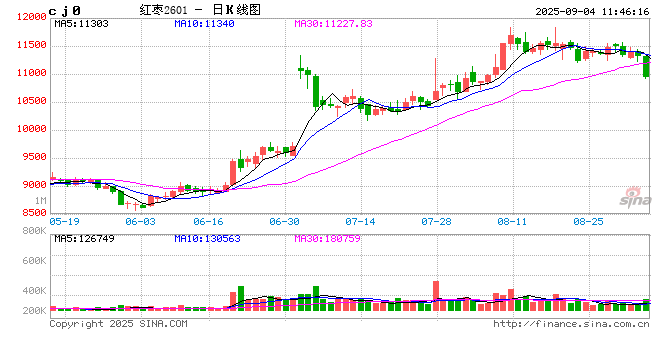
期货收评:国内期货主力合约跌多涨少,红枣跌3%,低硫燃油、上证50跌2%;碳酸锂、菜籽、铁矿石、工业硅涨1%
Sou Hu Cai Jing· 2025-09-04 03:56
Group 1 - The domestic futures market saw a majority of contracts decline, with red dates dropping over 3% and low-sulfur fuel and the Shanghai Stock Exchange 50 index falling over 2% [2] - On the upside, lithium carbonate, rapeseed, iron ore, and industrial silicon all increased by more than 1% [2]