
社融

Search documents
新增人民币贷款、社融环比或多增
Xin Lang Cai Jing· 2026-02-09 23:18
Core Viewpoint - The financial data for January is expected to show a significant increase in new RMB loans and social financing compared to the previous month, with experts predicting a stable outlook for credit and social financing growth in the near term [1][3]. Group 1: Predictions for January Financial Data - Experts anticipate that new RMB loans in January could reach approximately 5 trillion yuan, representing a month-on-month increase of about 4 trillion yuan, although this would be a decrease of around 1 billion yuan compared to the same month last year [1][3]. - The new social financing is projected to be around 7 trillion yuan, with some analysts estimating it could be as high as 7.5 trillion yuan, indicating a year-on-year increase [2][4]. - The bond financing is expected to play a significant role in supporting the new social financing figures, with a notable year-on-year increase anticipated [2][4]. Group 2: Trends in Monetary Policy - The growth rates for various loans, social financing, and M2 (broad money) are expected to slightly decline but will remain significantly above the nominal GDP growth rate, reflecting a continued supportive stance in monetary policy [2][4]. - Future monetary policy adjustments may include a reduction in reserve requirements by 25 to 50 basis points and a potential interest rate cut of 10 basis points, with a focus on structural monetary policy tools to support sectors like technology innovation and small to medium enterprises [2][4].
1月份金融数据前瞻:新增人民币贷款、社融环比或多增
Zheng Quan Ri Bao· 2026-02-09 16:06
Group 1 - The financial data for January is expected to show a significant increase in new RMB loans and social financing compared to December, with estimates suggesting new loans could reach 5 trillion yuan, an increase of approximately 4 trillion yuan month-on-month, but a decrease of about 100 billion yuan year-on-year [1] - Analysts predict that the new social financing in January will be around 7 trillion yuan, with bond financing expected to be a major support factor, indicating a stable overall performance in credit and social financing [2] - The growth rates of various loan balances, social financing, and M2 (broad money) are anticipated to slightly decline, yet remain significantly above the nominal GDP growth rate, reflecting a continued supportive monetary policy stance [2] Group 2 - The chief economist at Zheshang Securities forecasts a potential reduction in reserve requirement ratios by 25 to 50 basis points and a 10 basis point interest rate cut in 2026, alongside ongoing structural monetary policy tools aimed at supporting sectors like technology innovation and small to medium enterprises [2]

财联社C50风向指数调查:2025年12月社融增速或继续回落,M2与M1剪刀差走扩
Sou Hu Cai Jing· 2026-01-09 03:41
Group 1: Loan and Social Financing Trends - The median forecast for new RMB loans in December 2025 is 0.77 trillion yuan, representing a year-on-year decrease of 0.22 trillion yuan compared to 0.99 trillion yuan in December 2024 [2] - The median forecast for new social financing in December 2025 is 1.74 trillion yuan, down 1.12 trillion yuan from 2.86 trillion yuan in December 2024 [6][9] - High-frequency data indicates that the manufacturing and construction PMIs in December are above the threshold, recorded at 50.1% and 52.8% respectively, suggesting potential support for corporate loans [4] Group 2: Consumer Price Index (CPI) and Producer Price Index (PPI) - The CPI for December 2025 increased by 0.8% year-on-year, aligning with market expectations, while the PPI decreased by 1.9%, showing a smaller decline than anticipated [12][16] - Food prices rose by 1.1%, while non-food prices increased by 0.8%, contributing to the overall CPI increase [15] - The PPI decline was less severe than in previous months, indicating a potential stabilization in industrial prices [16][17] Group 3: Economic and Financial Conditions - The M1 growth rate is expected to continue its downward trend, while M2 growth is projected to slightly decline, leading to an expansion of the M2-M1 gap [10][11] - The pressure on local finances due to hidden debt becoming visible is expected to persist, affecting credit availability [5] - The overall economic environment remains cautious, with businesses likely to prioritize efficiency in capital usage amid uneven recovery in profits and cash flows [10]

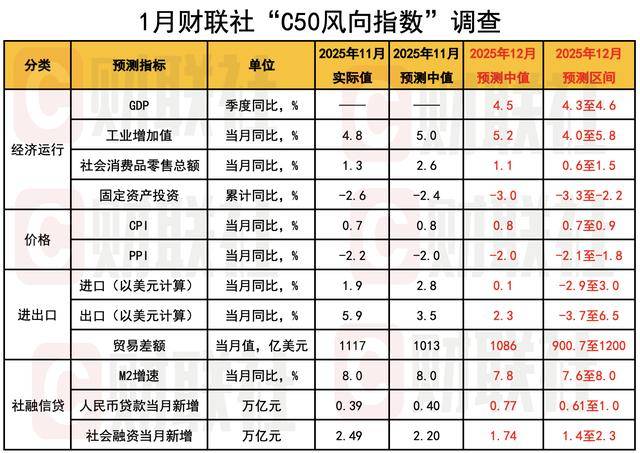
——12月经济数据预测:平稳收官,价格修复或加快
Huachuang Securities· 2026-01-07 10:46
1. Report Industry Investment Rating No information about the industry investment rating is provided in the report. 2. Core Viewpoints of the Report - In December, the economic operation was in the traditional off - season, but factors such as the late Spring Festival and the extended stocking cycle might boost industrial production. The export growth rate might decline slightly but still be better than that in October. The GDP growth rate in the fourth quarter was expected to reach around 4.5%, and the whole - year GDP was likely to achieve 5% and end smoothly [3][6]. - For the bond market, there was little suspense about the economic data in December. The market mainly focused on the verification of the "good start" of the economy at the beginning of the year. With the concentrated implementation of macro - policies to stabilize growth at the end of the year, the "two new" policies were issued one week earlier than in 2025, and the support amount for the early - batch "two important" and central budget - investment plan projects also increased compared with the previous year. January 2026 was expected to be the window for the concentrated effect of the "good start" policies, and high - frequency verification during the data "vacuum period" should be concerned [3]. 3. Summary According to the Directory 3.1 Inflation - CPI: It was expected that the CPI in December would rise to around 0.9% year - on - year. Fruit and vegetable prices supported the food price to rise above the seasonal level, and the non - food item was in line with the seasonality. The CPI was expected to increase by about 0.2% month - on - month [3][6][8]. - PPI: It was predicted that the PPI in December would rise to around - 1.9% year - on - year. The non - ferrous industry faced imported inflation pressure, and the prices of domestic bulk commodities such as steel and PTA improved. The PPI was expected to increase by about 0.2% month - on - month [3][6][14]. 3.2 Export - The export growth rate was expected to be around 5.0% in December. The export momentum in December was not weak, although the year - on - year growth rate of container throughput at ports was lower than that in November but better than that in October. The import was expected to increase by around 1.5% year - on - year, with the price support continuing to expand [3][21]. 3.3 Industrial The industrial growth rate in December was expected to be around 5.1%. The PMI in December returned above the boom - bust line, and the production sub - item further expanded. The late Spring Festival in 2026 extended the stocking cycle, which had a certain driving effect on production [3][6][24]. 3.4 Investment - The cumulative growth rate of fixed - asset investment from January to December was expected to be around - 3.0%. The cumulative year - on - year growth rate of infrastructure investment (excluding electricity) was about - 1.5%, the cumulative year - on - year growth rate of real estate investment was about - 16.7%, and the cumulative year - on - year growth rate of manufacturing investment was about + 1.2% [3][6][33]. 3.5 Social Retail The year - on - year growth rate of social retail in December was expected to be around 1.0%. As the national subsidy funds were approaching the end, the marginal boost to automobile consumption from the subsidy decline weakened. The year - on - year decline in gasoline prices widened, and the drag on social retail from petroleum product consumption continued to increase [3][6][36]. 3.6 Financial Data - In December, the bill interest rate declined against the trend, reflecting the weak credit impulse at the end of the year. The new credit in December was expected to be about 80 billion yuan, slightly lower than the level of 99 billion yuan in the same period of the previous year. The new social financing was about 1.7 trillion yuan, a year - on - year decrease of 58.85 billion yuan [3][6][45]. - The M2 growth rate was expected to remain around 8.0%. The new deposits were close to the seasonal level. From the asset side, the year - on - year growth rate of the credit balance might slightly decline to 6.3%, and the social financing growth rate might decline to around 8.4% affected by the high base of government bonds. From the liability side, the M2 in December might increase by 1.5 trillion yuan [3][48].
2026年社融与M2能否利好债市?
CAITONG SECURITIES· 2025-12-26 07:02
1. Report Industry Investment Rating No relevant content provided. 2. Core Views of the Report - Although the central bank is gradually downplaying quantitative targets and transitioning towards price - based tools, social financing and M2 are not decoupled from the bond market. The transformation takes time, and the central bank does not completely abandon quantitative targets. A decline in social financing is inherently favorable for the bond market. In 2026, the growth rate of social financing is expected to decline in a volatile manner, with the first and fourth quarters being relatively stable and the second and third quarters facing greater downward pressure. In particular, the disturbance of social financing to the bond market will significantly bottom out in the first quarter, so the bond market can be somewhat optimistic [2]. - The predicted growth rate of social financing in 2026 is 7.6%, corresponding to a new social financing of around 33.5 trillion yuan. The growth rate of M2 is expected to be around 7.1% [3]. 3. Summary According to Relevant Catalogs 3.1 Total Perspective on Social Financing and M2 in 2026 3.1.1 How to View the Growth Rates of Social Financing and M2 with the Downplaying of Quantity and Optimization of Intermediate Variables? - In November 2025, the central bank proposed to optimize intermediate variables of monetary policy and gradually downplay the focus on quantitative targets. This sets the tone for the adjustment of the intermediate target of monetary policy in 2026. The growth rate of financial aggregates will decline naturally due to the large base and the shift from high - speed to high - quality economic growth [10][13]. - Downplaying quantitative targets does not mean having no requirements for social financing and M2. The transformation of the intermediate target of monetary policy takes time, and in the short term, the central bank still adheres to the "basic matching" principle [15]. 3.1.2 What Changes are There in the "Basic Matching" Principle? - Reasons for setting the "basic matching" principle: It is conducive to cross - cycle policy design, stabilizing the monetary aggregate in the long term, providing a scientific "anchor" for macro - policies, guiding market expectations, and stabilizing the macro - leverage ratio [15]. - Understanding of "basic matching": It does not mean "exactly equal"; it requires comprehensive consideration of nominal economic growth, potential output, and economic growth targets; and it is a medium - to - long - term concept, not a short - term one [19]. - By taking annual data as an example, the years when the growth rates of social financing and M2 were mentioned as "basically matching" with the nominal GDP growth rate are 2018, 2019, and 2021. The annual intervals for the "basic matching" of the growth rate differences between social financing and nominal GDP and between M2 and nominal GDP are [- 0.2%, 3.2%] and [- 2.4%, 1.2%] respectively. When refined to quarters, the time periods when the central bank quantitatively mentioned "basic matching" cover the third quarter of 2018 to early 2020, 2021 - 2023 (related to the economic cycle), and 2024 (switched to "economic expected targets") [20][22][23]. 3.2 Forecast of Social Financing and M2 in 2026 3.2.1 Total Forecast - Based on the predicted nominal GDP growth rate of about 4.5% in 2026, referring to the "basic matching" principle, the predicted growth rate of social financing is around 7.6%, corresponding to a new social financing of around 33.5 trillion yuan. Considering the strong base effect of M2 in 2026, the growth rate of M2 is expected to be around 7.1% [26][27]. 3.2.2 Sub - item Analysis of Social Financing in 2026 - **Credit**: The new credit in 2026 is expected to be around 15.2 trillion yuan, with a growth rate of around 5.6%. The rhythm is expected to be high in the front and low in the back, and the structure will continue to focus on the "Five Major Articles" [30][31]. - **Government Bonds**: The net financing of government bonds in 2026 is expected to be around 15.5 trillion yuan. The issuance rhythm is expected to be balanced and front - loaded, with the possibility of an increase in the fourth quarter [34][35]. - **Corporate Bonds**: The net financing of corporate bonds in 2026 is expected to be around 1.7 trillion yuan, with a rhythm of low in the front and high in the back [40]. - **Other Items**: The net financing of off - balance - sheet items is expected to be around 0 trillion yuan, and the total of stock financing, credit write - offs, ABS, and foreign currency loans is expected to be around 1.1 trillion yuan, with a rhythm of low in the front and high in the back [41]. 3.2.3 Forecast of the Rhythm within the Year - The overall new social financing is 33.5 trillion yuan, corresponding to a stock growth rate of 7.6%. The rhythm of social financing and M2 is expected to be high in the front, low in the middle, and stable in the back. The predicted credit growth rates/ social financing growth rates/M2 growth rates for Q1/Q2/Q3/Q4 are (6.3%/5.7%/5.8%/5.6%)/(8.1%/7.8%/7.6%/7.6%)/(7.6%/7.2%/6.8%/7.1%) [4][5]. 3.3 How to View Interest Rates When Social Financing is at a Low Level and Credit is Declining? - Currently, policies are downplaying the focus on financial aggregates, and the intermediate variables of monetary policy are shifting from quantitative to price - based tools [45]. - However, the relationship between social financing, M2, and interest rates does not change with monetary policy. A downward trend in social financing growth allows for moderate optimism in the bond market. The bond market is under less pressure in the first quarter [46].
“稳中求进”基调不变 重点转向激发内需与修复工业品价格
Jing Ji Guan Cha Wang· 2025-11-21 14:27
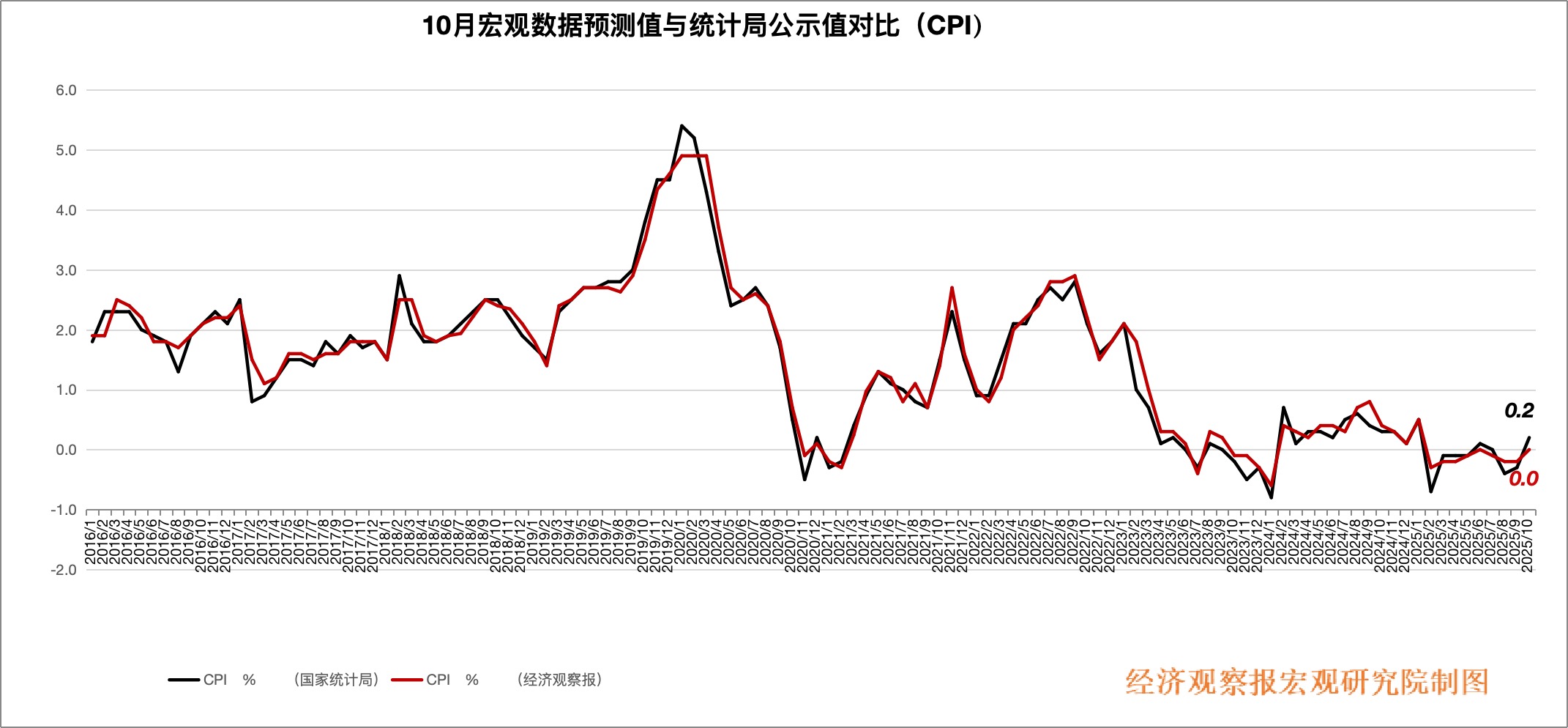
Core Insights - The macroeconomic data for October indicates a short-term increase in economic downward pressure, with adjustments in policies focusing on stimulating domestic demand and repairing industrial product prices [1] CPI - The Consumer Price Index (CPI) rose from -0.3% to 0.2% year-on-year, marking a 0.5 percentage point increase from the previous month [4] - The month-on-month CPI increased by 0.2%, influenced by rising prices of fruits and vegetables, with food prices showing a higher growth rate compared to historical values [4] PPI - The Producer Price Index (PPI) decreased by 2.1% year-on-year, but saw a month-on-month increase for the first time this year, supported mainly by the mining industry [7] - Prices for production materials rose by 0.1%, with mining prices increasing by 1% [7] PMI - The Manufacturing Purchasing Managers' Index (PMI) fell to 49% from 49.8%, indicating a contraction in manufacturing activity [10] - The decline in PMI is attributed to high inventory levels, a significant drop in new export orders, and weakened investment demand due to debt repayment acceleration [10] Fixed Asset Investment - Fixed asset investment (FAI) decreased by 1.7% year-on-year, with construction and real estate investments showing significant declines [14] - Factors contributing to the low performance in infrastructure include accelerated debt repayment, insufficient project reserves, and seasonal construction slowdowns [14] Credit - New credit issuance in October was 220 billion yuan, a decrease of 280 billion yuan compared to the previous year [17] - The total social financing (TSF) increased by 815 billion yuan, but the growth rate has slowed down [17] M2 - The M2 money supply grew by 8.2% year-on-year, a slight decrease from the previous month's growth rate of 8.4% [21] - The decline in M2 growth is influenced by a slowdown in social financing and an increase in fiscal deposits [21]
6月金融数据点评:边际转暖的融资,平稳宽松的资金
Shenwan Hongyuan Securities· 2025-07-15 02:44
Group 1 - The report highlights a marginal improvement in financing conditions and a stable, accommodative monetary environment as of June 2025 [2][3] - In June 2025, new RMB loans amounted to 2.24 trillion yuan, significantly higher than May's 0.62 trillion yuan, while new social financing reached 4.20 trillion yuan compared to 2.29 trillion yuan in May [3] - The year-on-year growth rate of social financing was 8.9% in June, slightly up from 8.7% in May, and M2 growth was 8.3%, up from 7.9% in the previous month [3] Group 2 - Government bonds continued to support the growth rate of social financing in June, with net financing of government bonds reaching 1.41 trillion yuan, although slightly down from 1.49 trillion yuan in May [3][5] - The demand for credit from the real economy remains weak, indicating that the effects of a loose monetary policy may take time to materialize [3] - The report notes that while corporate short-term loans showed seasonal improvement, medium to long-term loans remained low, suggesting weak investment intentions among enterprises [3] Group 3 - The report indicates that the growth rates of M1 and M2 have both increased, with the M1-M2 spread narrowing, which may reflect a marginal improvement in economic activity [3][34] - The adjustment in the bond market is primarily driven by risk appetite and asset pricing effects, with expectations that the adjustment period will be limited in time and space [3] - The report anticipates that the probability of continued tight funding conditions in July is low, supported by the central bank's clear stance on maintaining a moderately accommodative monetary policy [3]
6月份新增人民币贷款、社融或环比大增
Zheng Quan Ri Bao· 2025-07-06 16:15
Group 1 - The financial data for June is expected to show positive changes due to the implementation of financial support measures in May, with an anticipated increase in new RMB loans and social financing compared to previous months [1][2] - In May, new RMB loans amounted to 0.62 trillion yuan, while new social financing reached 2.29 trillion yuan [1] - Analysts predict that new RMB loans in June will be around 2.1 trillion yuan, showing a significant seasonal increase compared to May, while year-on-year figures are expected to remain stable [1][2] Group 2 - The expectation for June's new social financing is approximately 4 trillion yuan, which will also reflect a seasonal increase and a year-on-year rise [2][3] - Government bond financing is expected to be a major contributor to the increase in new social financing, with net financing expected to rise by about 700 billion yuan compared to the same period last year [2] - The People's Bank of China is anticipated to implement further monetary easing measures, including potential interest rate cuts, to support economic growth and stabilize prices [3]