
纽元

Search documents
利率风向突变?外汇交易员开始押注:新鹰派时代将至!
Jin Shi Shu Ju· 2026-02-25 07:21
Core Viewpoint - The foreign exchange market is experiencing a significant shift as traders bet on a transition from declining global interest rates to rising rates, with the Australian dollar, Norwegian krone, and New Zealand dollar outperforming other major currencies this year [2][3]. Group 1: Currency Performance - The Australian dollar has risen nearly 6% against the US dollar this year, reaching a three-year high, driven by the Reserve Bank of Australia's anticipated new rate hike cycle to combat inflation [2][3]. - The New Zealand dollar has increased by nearly 4%, with traders expecting the country to initiate its first rate hike in the coming months [2]. - The Norwegian krone has appreciated over 5%, spurred by unexpected inflation increases that have led traders to price in potential rate hikes in the first half of the year [2][3]. Group 2: Economic Context - Analysts suggest that these currencies are indicative of a broader hawkish shift among major economies, moving away from years of rate cuts to focus on controlling inflation [3]. - The Australian economy is at the forefront of this rate hike wave, with the trimmed mean inflation rate reported at 3.4%, exceeding analysts' expectations and increasing the likelihood of further rate hikes [3][4]. - The performance of these currencies is also supported by rising prices of commodities such as oil and copper, which are significant for their economies [3]. Group 3: Investor Sentiment - Investors are diversifying away from US dollar assets due to concerns over the unpredictable policies of the Trump administration and rising government debt [4]. - The expectation of rate hikes in other regions has contributed to the weakening of the US dollar, as higher rates elsewhere erode the support for the dollar [4]. - Despite pressure from President Trump for lower borrowing costs, most traders believe the Fed's rate cut cycle is not yet over, with expectations of two to three 25 basis point cuts this year [4]. Group 4: Fiscal Health - The Australian dollar, Norwegian krone, and New Zealand dollar are favored by investors due to the relative fiscal health of their countries, contrasting with concerns over large government deficits and rising debt in currencies like the yen, dollar, and pound [4][5]. - The top-performing G10 currencies are characterized as fiscally sound and commodity-exposed, making them attractive destinations for capital as it rotates out of the US [5][6].
摩根大通警告:外资将加码对冲,美元下行压力再升级
Jin Shi Shu Ju· 2026-02-19 04:08
Group 1 - Foreign investors are likely to increase their hedging operations against currency risks associated with dollar-denominated assets, which will exacerbate downward pressure on the dollar [1] - Investors holding significant amounts of U.S. stocks are trading currencies that have reached new highs against the dollar, prompting further hedging against dollar weakness [1] - The potential resumption of foreign exchange hedging flows is one reason for maintaining a bearish outlook on the dollar [1] Group 2 - Other reasons for a bearish outlook on the dollar include the Federal Reserve's current inability to raise interest rates and ongoing capital outflows from U.S. stocks [4] - The dollar's downward trend has accelerated over the past month, reaching some key targets earlier than expected [4] - Currencies expected to appreciate against the dollar include the Australian dollar and New Zealand dollar, with target prices adjusted upward due to anticipated interest rate hikes [4] Group 3 - The Australian dollar's target price against the dollar has been raised from 0.68 to 0.73, supported by the Reserve Bank of Australia's rate hike [4] - The New Zealand dollar's target price against the dollar has been increased from 0.59 to 0.63, while the euro's target price remains at 1.20 but with upward risks [4] - The dollar has depreciated by 1% against the yen, trading at 154.87, following speculation about potential currency intervention by Japanese authorities [5]


瑞郎本周涨约1.1%,瑞典克朗涨1.3%,挪威克朗涨约2%
Jin Rong Jie· 2026-02-13 21:35
Core Viewpoint - The article discusses the fluctuations in various currency pairs, highlighting the performance of the Euro, British Pound, and commodity currencies against the US Dollar during the week. Group 1: Currency Performance - The Euro appreciated by 0.04% against the US Dollar, closing at 1.1875, with a weekly gain of 0.51% [1] - The British Pound increased by 0.33% against the US Dollar over the week [1] - The US Dollar depreciated by 1.07% against the Swiss Franc [1] Group 2: Commodity Currencies - The Australian Dollar rose by 0.89% against the US Dollar [1] - The New Zealand Dollar increased by 0.44% against the US Dollar [1] - The US Dollar fell by 0.41% against the Canadian Dollar [1] Group 3: Scandinavian and Eastern European Currencies - The Swedish Krona appreciated by 1.31% against the US Dollar [1] - The Norwegian Krone increased by 1.98% against the US Dollar [1] - The Danish Krone rose by 0.50% against the US Dollar [1] - The Polish Zloty gained 0.73% against the US Dollar [1] - The Hungarian Forint increased by 0.14% against the US Dollar [1]
2026年:去美元化趋势推动黄金成为市场新焦点
Sou Hu Cai Jing· 2026-01-26 09:48
Group 1 - The global financial market is undergoing a significant paradigm shift, moving from a dollar liquidity-dominated environment to a multi-faceted, real asset-driven era due to increasing geopolitical uncertainties and the physical transformation of the AI industry [1][3]. - The trend of de-dollarization is gaining momentum, with a shift in capital flows from U.S. tech stocks to Asian manufacturing and commodities, reflecting a market preference for companies capable of monetizing AI technology in practical applications [3][4]. - The demand for physical assets, particularly in hardware, energy, and raw materials, is rising as investors pivot from U.S. software companies to emerging market tech firms and resource suppliers [3][4]. Group 2 - Gold and silver markets are experiencing strong upward trends, with gold prices surpassing $4,800 and silver prices exceeding $90 per ounce, driven by central bank balance sheet restructuring and a long-term shift in global economic dynamics [4][6]. - The gold-silver ratio has significantly narrowed to 51.3, indicating a historical correction where silver is outperforming gold, reflecting a shift in market risk appetite towards higher beta assets [6]. - Industrial demand for silver is projected to exceed 65%, driven by AI and green energy needs, further supporting silver's price increase [6]. Group 3 - Copper prices have surpassed $6 per pound, with expectations of reaching $7 per pound due to strong demand from AI data centers and limited supply chain flexibility in copper mining [7]. - The Asian stock markets are benefiting from capital flows as investors seek lower valuations compared to U.S. tech stocks, with A-shares and H-shares presenting attractive opportunities [8]. - The offshore RMB is expected to appreciate by 3%-4% against the dollar in 2026, supported by increased international trade using RMB and a favorable economic structure [9][10]. Group 4 - The Australian and New Zealand dollars are positioned to benefit from strong commodity prices and hawkish central bank policies, contrasting with the U.S. Federal Reserve's potential dovish stance [9][10].

非美货币普遍上涨,欧元涨超0.5%,瑞郎涨超0.7%,澳元、纽元涨约1.1%
Jin Rong Jie· 2026-01-22 21:14
Group 1 - The Euro against the US Dollar increased by 0.54%, reaching 1.1748, and later peaked at 1.1751 [1] - The British Pound against the US Dollar rose by 0.51%, reported at 1.3498 [1] - The US Dollar depreciated against the Swiss Franc by 0.75%, with a rate of 0.7897 [1] Group 2 - Commodity currencies saw significant gains, with the Australian Dollar increasing by 1.19% and the New Zealand Dollar by 1.09% against the US Dollar [1] - The Swedish Krona appreciated by 1.12%, the Norwegian Krona by 1.08%, and the Danish Krona by 0.55% against the US Dollar [1] - The Polish Zloty rose by 0.93%, and the Hungarian Forint increased by 1.19% against the US Dollar [1]
欧元、丹麦克朗跌超0.3%,瑞郎跌约0.8%
Jin Rong Jie· 2026-01-21 20:37
Core Viewpoint - The article discusses the fluctuations in various currency pairs, highlighting the performance of the Euro, British Pound, and commodity currencies against the US Dollar during the trading session on Wednesday in New York. Currency Performance - The Euro declined by 0.32% against the US Dollar, trading at 1.1687, and continued to decrease since 22:00 Beijing time [1] - The British Pound fell by 0.17% against the US Dollar [1] - The US Dollar appreciated by 0.78% against the Swiss Franc [1] Commodity Currencies - The Australian Dollar increased by 0.37% against the US Dollar [1] - The New Zealand Dollar rose by 0.21% against the US Dollar [1] - The US Dollar remained stable against the Canadian Dollar, showing a V-shaped trend since 19:00 [1] Other Currencies - The Swedish Krona appreciated by 0.23% against the US Dollar [1] - The Norwegian Krona increased by 0.28% against the US Dollar [1] - The Danish Krona decreased by 0.33% against the US Dollar [1] - The Polish Zloty fell by 0.12% against the US Dollar [1] - The Hungarian Forint declined by 0.08% against the US Dollar [1]
非美货币普遍走高,欧元涨约0.4%,纽元涨超0.7%
Sou Hu Cai Jing· 2026-01-19 22:26
Core Viewpoint - The article highlights significant movements in currency exchange rates, particularly the strengthening of the Euro and British Pound against the US Dollar, indicating a shift in market sentiment and potential investment opportunities in foreign currencies [1]. Currency Movements - The Euro increased by 0.38% against the US Dollar, reaching a rate of 1.1643, with notable gains observed after 07:00 Beijing time [1]. - The British Pound rose by 0.36% against the US Dollar, trading at 1.3427, showing a strong rebound during the Asia-Pacific trading session [1]. - The Swiss Franc depreciated by 0.56% against the US Dollar, with a trading rate of 0.7975, indicating a downward trend throughout the day [1]. Commodity Currencies - The Australian Dollar appreciated by 0.45% against the US Dollar, while the New Zealand Dollar saw a more significant increase of 0.72% [1]. - The Canadian Dollar weakened by 0.34% against the US Dollar, reflecting a mixed performance among commodity currencies [1]. Scandinavian and Eastern European Currencies - The Swedish Krona strengthened by 0.17% against the US Dollar, while the Norwegian Krona and Danish Krona increased by 0.32% and 0.40%, respectively [1]. - The Polish Zloty and Hungarian Forint both appreciated by 0.28% and 0.34% against the US Dollar, indicating positive movements in Eastern European currencies [1].
大跌近10%!美元恐创2003年以来“最惨一年”,全球央行政策分化成崩盘推手
Hua Er Jie Jian Wen· 2025-12-24 12:26
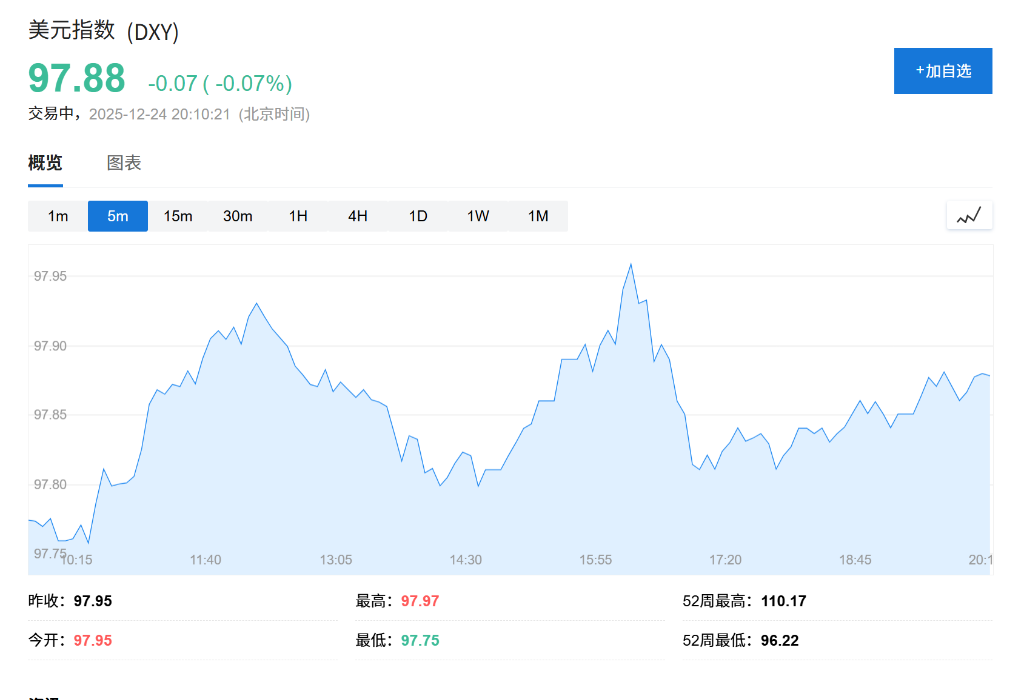
Core Viewpoint - The US dollar is experiencing a historic sell-off due to rising expectations of interest rate cuts by the Federal Reserve and hawkish stances from major global central banks, with the dollar index hitting a two-and-a-half-month low and a year-to-date decline of nearly 10% [1][4]. Group 1: US Dollar Performance - The dollar index fell to 97.767, marking a potential record annual decline since 2003, and the worst performance since 2017 [1]. - The euro has risen over 14% against the dollar this year, potentially achieving its best annual performance since 2003 [1]. Group 2: Interest Rate Expectations - Despite solid US GDP data, market expectations for interest rate cuts by the Federal Reserve remain strong, with predictions of two more 25 basis point cuts by 2026 [4][5]. - In contrast, central banks in the Eurozone, Australia, and New Zealand are signaling tightening policies, with some markets anticipating rate hikes instead of cuts [4][6]. Group 3: Currency Movements - The weakness of the dollar has led to a rise in non-US currencies, with the British pound and Australian dollar reaching multi-month highs [4]. - The Australian dollar has appreciated by 8.4% against the US dollar this year, while the New Zealand dollar has also reached a two-and-a-half-month high [6]. Group 4: Gold and Safe-Haven Assets - The depreciation of fiat currencies has driven spot gold prices to a historical high, reflecting a trend of capital flowing into safe-haven assets amid global policy uncertainty [4][9]. Group 5: Japanese Yen Intervention Risks - The Japanese yen has weakened despite a recent interest rate hike by the Bank of Japan, raising concerns about potential market intervention by Japanese authorities [10]. - The Japanese Finance Minister has indicated that the government has "free hand" in managing excessive volatility in the yen, which has temporarily halted its decline [10].
澳纽元续涨 澳洲联储鹰派纪要强化支撑
Jin Tou Wang· 2025-12-23 13:48
Group 1 - The Australian and New Zealand dollars continue to rise, supported by a recovery in global stock markets and increasing commodity prices [1] - The Australian dollar against the US dollar showed a daily increase of approximately 0.14%, trading around 0.6665 USD, following a significant rise of 0.7% in the previous trading day [1] - The New Zealand dollar against the US dollar also strengthened, with a daily increase of 0.33%, reported at 0.5811 USD, after a 0.66% rise the day before [1] Group 2 - The Reserve Bank of Australia's December policy meeting minutes highlighted discussions on the necessity and feasibility of future interest rate hikes, particularly in light of unexpected inflation data [2] - The market currently anticipates a low probability of an interest rate hike in February, as the sustainability of recent inflation data remains to be verified [2] - Analysts suggest that the RBA is likely to make a key policy decision regarding interest rates in the first half of next year, based on further economic data [2] Group 3 - In the cross-currency market, the Australian and New Zealand dollars against the Japanese yen experienced slight pullbacks due to profit-taking, yet maintained a strong position near multi-year highs [3] - The divergence in monetary policy between the RBA and the Bank of Japan, with the former maintaining a vigilant stance on inflation and the latter keeping negative interest rates, has created a favorable interest rate differential [3] - Future movements of the Australian and New Zealand dollars will be influenced by global risk sentiment, commodity price fluctuations, and changes in monetary policy expectations from major central banks [3]
【UNforex财经事件】美联储政策与通胀预期牵动黄金 短线承压
Sou Hu Cai Jing· 2025-12-18 09:27
Core Viewpoint - The international gold market is experiencing cautious fluctuations as investors take profits ahead of key data releases, with geopolitical tensions and central bank policies influencing market volatility [1][2]. Group 1: Gold Market Dynamics - Gold prices are under pressure due to profit-taking after a period of gains, with the market adopting a cautious stance ahead of the November CPI release [1]. - Geopolitical events, such as Venezuela's naval escort of oil tankers in response to U.S. blockades, are attracting safe-haven investments, providing some support for gold prices [1]. - The expectation of low interest rates continues to be a significant factor supporting gold's mid-term structure, as lower rates reduce the opportunity cost of holding non-yielding assets like gold [1]. Group 2: Currency and Economic Indicators - The U.S. dollar index saw a slight rebound, impacting gold's upward momentum, while the market is closely watching the upcoming U.S. CPI data, which is expected to show a year-on-year increase of 3.1% for overall CPI and 3.0% for core CPI [2]. - The European Central Bank has maintained its policy stance, while the Bank of England is anticipated to cut rates by 25 basis points, and the Bank of Japan's rate decision is expected soon [2]. - Market sentiment is heavily reliant on the CPI data, with expectations that it could influence the Federal Reserve's policy decisions in January, particularly regarding the likelihood of rate cuts [2]. Group 3: Trading Strategies and Market Sentiment - The trading logic for gold is shifting from trend-driven to event-driven, with short-term volatility reflecting position adjustments and expectation corrections rather than a change in trend [3]. - If the CPI data meets expectations, gold may continue to experience high-level fluctuations, supported by resilient rate expectations; however, stronger inflation could lead to a stronger dollar and increased gold price retraction [3]. - The gold market is currently in a phase of uncertainty, with price movements primarily reflecting macroeconomic expectations rather than a clear directional trend [3].