预调酒

Search documents
2026酒饮即时零售趋势报告
中国酒业协会x酒业家x美团闪购· 2026-03-30 06:45
Investment Rating - The report does not explicitly state an investment rating for the industry Core Insights - Instant consumption has become a new growth engine for the beverage industry as traditional planned consumption models reach their peak [12] - Brand competition has shifted from broad layouts to precise and rapid responses, making responsiveness a key factor [13] - Data has emerged as a new production resource, with real-time consumption data from instant retail platforms being more valuable than personal experience, driving data-driven decision-making [14] - The instant retail market is accelerating its penetration across the country, with significant growth in lower-tier cities [15] - Beverage consumption scenarios are diversifying, entering an "around-the-clock response era" [16] - Generation Z is becoming the core growth force, leading the generational shift in beverage consumption through instant retail [17] - The next generation of beverage products needs to embody diversification, lightweight, and socialization [18] - Omnichannel growth has become a consensus, with leading beverage companies collectively embracing instant retail [19] - Distributors are transforming their roles from "distribution" to "user management," enhancing data operations and online marketing capabilities [20] Key Data Highlights - Nearly half of the respondents believe that the penetration rate of instant beverage retail is expected to exceed 10% [22] - In 2025, the consumption growth rate of beverages through Meituan Flash Purchase in B-level and below cities is expected to reach around 70% [22] - In 2025, 73% of orders for beverages through Meituan Flash Purchase will be delivered to residential communities, a year-on-year increase of 25.8% [22] - The frequency of consumption among users aged 40 and above who purchase beverages through instant retail increased from 4.1 to 4.5, with the user base growing by 46.9% year-on-year [22] - By 2025, the share of low-alcohol beverages (below 45 degrees) in total beverage sales on the Meituan Flash Purchase platform will rise to 13.8% [22] - The number of beverage flash warehouses cooperating with Meituan Flash Purchase will increase by 130% year-on-year in 2025 [22]
食品饮料行业周报暨春季策略会反馈:首推餐饮链改善,白酒重回底部买点-20260309
CMS· 2026-03-09 03:13
Group 1: Core Insights - The report emphasizes the improvement of the cyclical restaurant chain, particularly in condiments and beer, as a key investment opportunity in the consumer sector due to government policies aimed at boosting consumption [2][16][19] - The liquor sector is highlighted as having reached a bottom buying point, with the price of Feitian Moutai temporarily dropping below 1600 yuan, but actual dealer inventories are low, indicating potential price stabilization around this level [2][18] Group 2: Company Tracking - Shede Liquor has shown strong sales performance during the spring season, with a positive revenue growth target for 2026, despite some pressure in the 1000 yuan price range [3][11] - Yili Group is expected to stabilize and achieve positive growth in liquid milk sales, benefiting from rising milk prices and improved market conditions [3][11] - Bairun Group's terminal sales have outperformed reported growth, with a positive outlook for 2026 driven by double-digit growth in pre-mixed liquor and a target of 300-500 million yuan for its whiskey business [4][12] - Shouxian Valley is focusing on online channels to boost revenue and profit, with a goal of achieving a 50% online sales ratio [4][12] - Minsheng Health's new product, Vaniklan, has exceeded internal expectations in online sales, with plans to expand into offline channels [5][13] Group 3: Investment Recommendations - The report recommends focusing on cyclical restaurant chain improvements, particularly in condiments and beer, as well as the recovery of the liquor sector, with specific companies like Haidilao and Qingdao Beer highlighted for their growth potential [16][19] - The report suggests that the liquor sector, particularly Moutai, remains a strong investment due to its market position and expected price stabilization [18][19] Group 4: Industry Valuation - The report includes a valuation table for key companies in the food and beverage sector, indicating market capitalization and projected earnings for 2025-2027, with notable companies like Kweichow Moutai and Wuliangye highlighted for their strong market positions [20]






未知机构:百润股份股东大会要点260303春节动销情况整体反馈结果不-20260304
未知机构· 2026-03-04 02:35
Summary of Key Points from the Conference Call Company Overview - The conference call pertains to 百润股份 (Bairun Co., Ltd.), focusing on its business outlook and performance metrics for 2026. Industry Insights - The overall sentiment for the industry is optimistic, with a positive trend expected in the beverage sector, particularly in flavored spirits and pre-mixed drinks. Core Business Segments 1. **Flavor and Fragrance**: Expected to maintain stable growth [1] 2. **Pre-mixed Drinks**: Identified as a key growth area with a target of double-digit growth [2] 3. **Spirits**: Aiming for revenue between 300 million to 500 million, with favorable industry trends [2] Channel Strategy 1. **Pre-mixed Drinks**: - Strengthening existing advantageous channels - Expanding into snack retail channels, which are experiencing rapid growth - Advancing digital integrated channel management [2] 2. **Spirits**: - Introducing products that align with pre-mixed drink terminals - Considering the 125ml small bottle of 崃州22 as a core flagship product [2] Financial Metrics - Advertising expense ratio for pre-mixed drinks is projected at 12-13% - Spirits advertising expense ratio is expected to exceed 20%, with significant initial investment during the incubation period, anticipated to decrease in the long term [2] Market Penetration - Currently, the company has direct control over more than 400,000 terminals and reaches over 200,000 terminals through distributors [2] Digital Transformation - Digital initiatives were piloted in Guangdong in 2025, with plans for large-scale rollout in the current year [2]
春节食品动销表现几何-后市如何看
2026-02-24 14:16
Summary of Conference Call Records Industry Overview - The conference call discusses the performance of the food and beverage industry during the 2026 Spring Festival, highlighting a strong recovery in social consumption with average daily sales for retail and catering enterprises increasing by 8.6% year-on-year, marking a high growth level among major holidays since 2024 [1][2] Key Points by Sector General Food Consumption - The overall performance of mass food consumption during the Spring Festival was strong, driven by increased consumer activity in lower-tier cities and favorable weather conditions [2] - The average number of travel days per person reached 5.9 days, an increase of 1.1 days compared to the previous year [3] - Inventory levels were well-managed, with high freshness in channels and sufficient stock, leading to restored confidence among distributors [4] Dairy Industry - The dairy sector showed varied performance across regions, with significant growth in East and Central China. For instance, ambient liquid milk grew by approximately 7%, with Yili and Mengniu reporting growth rates of 8-9% and 5-6% respectively [5] - Ambient yogurt ended its three-year decline, achieving a positive growth of 3-4% [5] - The South China region showed weaker performance, but high-end products maintained growth, with Junlebao's low-temperature products growing by about 20% [5] Ready-to-Drink Tea Industry - The ready-to-drink tea sector benefited from warm winter weather and increased travel, with same-store GMV showing good performance, with brands like Mixue and Luckin Coffee achieving over 10% growth [6] - The focus on dine-in consumption led to higher profits for franchisees, with limited pressure from delivery subsidies [6] Snack and Frozen Food Sectors - The snack sector performed strongly, particularly in county-level stores benefiting from returning travelers, with same-store sales growth of 15-20% [7] - Brands like Wei Long and Salted Fish achieved growth rates of 7-8% and nearly 20% respectively, indicating a robust fundamental performance in the snack sector [7][8] - The frozen food sector showed significant improvement, with companies like Anjuke reporting growth in the range of 20-25% [9] Condiment Industry - The condiment sector is closely tied to the recovery of the catering industry, with major retail and catering enterprises reporting a daily sales increase of 8.6% [10] - Companies like Haitian and Qianhe are actively expanding new channels, with Haitian reporting nearly 10% growth in shipments [11] Beverage and Beer Sectors - The beverage sector, particularly Nongfu Spring and Dongpeng Beverage, is expected to see double-digit growth, with Nongfu Spring's overall growth in January-February reaching double digits [13] - The beer industry is focusing on profit growth exceeding revenue growth, with recommendations for companies like China Resources Beer and Yanjing Beer [14] Additional Insights - The overall market sentiment is positive, with expectations for continued growth across various sectors, driven by improved consumer confidence and strategic inventory management [4][5][6][9][10][11][13]
从“历史经典产业”到“传统优势民生产业”,新五年酿酒产业提质发展
Soochow Securities· 2026-02-24 00:45
Investment Rating - The report maintains an "Accumulate" rating for the beverage industry, indicating a positive outlook for investment in this sector [1]. Core Insights - The report emphasizes the transition of the brewing industry from a "historical classic industry" to a "traditional advantageous livelihood industry," highlighting its importance in cultural heritage and economic development [4][9]. - The "14th Five-Year Plan" outlines specific goals for the brewing industry, including the establishment of over three trillion-level traditional advantageous wine production areas and more than ten hundred-billion-level specialty brewing industrial parks by 2028 [10][12]. - The report identifies a shift in the industry towards digitalization, green practices, and internationalization, with leading companies actively pursuing these transformations [18][20]. Summary by Sections 1. Development of the Brewing Industry - The brewing industry is recognized as a traditional advantageous industry, playing a crucial role in cultural transmission and regional economic development [9]. - The "Guidance on Quality Improvement and Upgrading of the Brewing Industry (2026-2030)" outlines a clear path for high-quality development, focusing on adapting to market changes [9][10]. - The report details a comprehensive plan with 21 key tasks across seven dimensions, including enhancing raw material supply, promoting technological innovation, and transforming business models [17][18]. 2. Investment Recommendations - The report suggests that while traditional beverages like baijiu, beer, and yellow wine are well-established, emerging categories such as fruit wines and craft beers present new opportunities [21]. - It recommends focusing on companies like Kweichow Moutai, which is expected to stabilize and recover in valuation, along with other notable brands such as Gujing Gongjiu and Luzhou Laojiao [22].


食品饮料行业跟踪周报从“历史经典产业”到“传统优势民生产业”新五年酿酒产业提质发展
Soochow Securities· 2026-02-23 00:30
Investment Rating - The report maintains an "Add" rating for the food and beverage industry, indicating a positive outlook for the sector [1]. Core Insights - The report emphasizes the transition of the brewing industry from a "historical classic industry" to a "traditional advantageous livelihood industry," highlighting its importance in cultural heritage and economic development [4][9]. - The "14th Five-Year Plan" outlines clear goals for the brewing industry, aiming for high-quality development and the establishment of over three trillion-level traditional advantageous wine-producing areas and more than ten hundred-billion-level specialty brewing industrial parks by 2028 [10][12]. - The report identifies a shift in the industry towards digitalization, green practices, and internationalization, with leading companies actively pursuing transformation strategies [18][20]. Summary by Sections 1. Development of the Brewing Industry - The brewing industry is recognized as a traditional advantageous industry, playing a crucial role in cultural transmission and regional economic development [9]. - The "Guidance on Quality Improvement and Upgrading of the Brewing Industry (2026-2030)" sets a roadmap for adapting to market changes and achieving high-quality growth [9][10]. - The report outlines a two-phase goal structure for the industry, focusing on enhancing raw material supply, technological innovation, and brand empowerment [12][17]. 2. Investment Recommendations - The report suggests that while traditional sectors like white wine, beer, and yellow wine are mature, emerging segments such as fruit wine and craft beer present new opportunities [21]. - It recommends focusing on companies like Guizhou Moutai, which is expected to stabilize and recover in valuation, along with other notable brands [22].
白酒稳基盘、低度酒寻增量:中国酒类市场的结构分化与投资机会
QYResearch· 2026-02-14 00:48
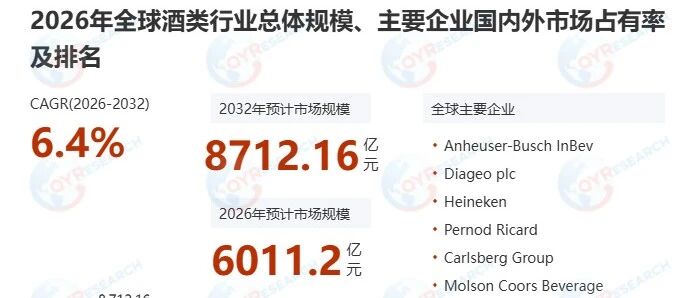
Core Insights - The Chinese alcoholic beverage market is projected to reach USD 254.1 billion by 2032, with a CAGR of 6.63% during the forecast period [2] - The market is highly concentrated, with baijiu (Chinese liquor) expected to account for 78.57% of revenue by 2025, significantly higher than beer (11.22%) and other categories [2] Market Structure - Baijiu dominates the market, while beer is experiencing a shift towards premiumization and craft options, and low-alcohol/no-alcohol products are gaining traction among new consumer demographics [2] - The structure indicates that the base of the market is determined by baijiu, but growth and structural changes are driven by the premiumization of beer and the penetration of low-alcohol products [2] Technical Features and Product Classification - The alcoholic beverage industry is characterized by a combination of raw material systems, fermentation/distillation processes, aging systems, blending capabilities, and packaging/channel adaptation, which ultimately contribute to brand premium and price segmentation [5] - Baijiu is defined by solid-state fermentation and aging techniques, leading to high margins and strong brand characteristics, but also slower capacity ramp-up and sensitivity to inventory and pricing [5] - Beer is the most industrialized, focusing on scale and channel efficiency, with recent competition shifting towards high-end and craft products [5] Competitive Landscape - The Chinese market shows a concentration in baijiu, with leading companies like Kweichow Moutai and Wuliangye dominating the high-end segment, while regional players seek growth through local market penetration [7] - The beer market is characterized by competition among major players like Tsingtao Brewery and China Resources Snow Breweries, focusing on product upgrades and channel penetration [8] - The wine and yellow wine markets are smaller, where brand and channel efficiency are more critical than scale [9] Future Trends and Challenges - Over the next 3-5 years, the market is expected to stabilize with baijiu, while beer will focus on premiumization and low-alcohol/no-alcohol products will drive growth [17] - Challenges include consumer segmentation, price pressure, raw material cost fluctuations, and stricter regulatory requirements [20]

福建“尾牙”市场调查:数量缩减、规格降低,有宴会低度酒唱主角
Sou Hu Cai Jing· 2026-01-28 10:51
Group 1 - The number of year-end banquets (尾牙宴) in Fujian is significantly decreasing, with many hotels reporting no bookings at all [2][5] - The scale and standards of these banquets are shrinking, with many companies opting not to hold them or reducing their scale and specifications [4][5] - The impact of the "limit on alcohol" policy has exacerbated the situation, leading to a reported 50% reduction in corporate year-end events [2][5] Group 2 - There is a notable shift in the types of alcoholic beverages being purchased for these events, with a preference for lower-cost options and an increase in the popularity of craft beers and low-alcohol beverages [6][8] - Companies are increasingly focusing on cost-effectiveness, with many opting for cheaper wines and spirits, and a significant drop in the procurement of mid to high-end products [6][9] - The changing preferences reflect a broader trend where companies prioritize practicality over extravagance, favoring a more relaxed dining experience [9]

开源证券晨会纪要-20260118
KAIYUAN SECURITIES· 2026-01-18 14:44
Macro Economic Insights - The government is intensifying efforts to clear overdue corporate payments and wages, focusing on key regions and implementing special bonds to support this initiative [6][7] - The central bank has introduced a series of monetary policies, including a 0.25 percentage point reduction in relending and rediscount rates, and plans to maintain a loose monetary stance throughout 2026 [7][17] - The real estate policy includes extending tax incentives for residential property transactions and lowering the minimum down payment for commercial property loans to 30% [7] Industry Insights Computer Industry - Alibaba is fully integrating its Qianwen App into its ecosystem, enhancing its capabilities as an AI shopping assistant and potentially becoming a major entry point for AI services [50] - The launch of "Ant Health Assistant" and "Lingguang," a multimodal AI assistant, indicates Alibaba's strong positioning in the AI sector, with significant user engagement [51][52] - Investment opportunities in AI applications are highlighted, with recommendations for companies benefiting from this trend [53] Machinery Industry - The use of polyurethane TPU materials in humanoid robots is emphasized, showcasing their advantages in safety and shock absorption, which are critical for the mass production of robots [55][56] - The TPU market is expected to grow significantly due to its application in humanoid robots, with a projected market space exceeding 3 billion yuan as production scales up [58] Non-Banking Financial Sector - The regulatory environment for derivatives is becoming more transparent, which may benefit leading brokerage firms as restrictions on scale are expected to ease [6] - The financial sector is experiencing a "slow bull" phase, with positive performance in brokerage and insurance businesses [6] Chemical Industry - The polyester filament industry is entering a new round of production cuts, while the supply-demand dynamics for glyphosate are improving, leading to price increases [6] Automotive Industry - China's heavy truck sales are projected to reach 1.145 million units by 2025, indicating a robust market outlook [6] Food and Beverage Industry - Moutai is deepening market reforms, and the value of Bai Run shares is becoming more apparent, suggesting potential investment opportunities [6] Pharmaceutical Industry - The focus remains on innovative drug sectors, with continued recommendations for investment in this area [6] Trade and Export - China's exports have shown unexpected growth, with a year-on-year increase of 6.6% in December, driven by high-tech products and diversified markets [41][42][45]
凉了?当年疯抢波尔多酒庄的中国富豪,如今120万起拍都没人要
Sou Hu Cai Jing· 2025-12-04 11:13
Core Viewpoint - The article discusses the dramatic shift in Chinese consumers' attitudes towards red wine over the past decade, highlighting a decline in its social status and desirability, leading to a significant drop in sales and interest in wine estates previously sought after by wealthy buyers [1][4][21]. Group 1: Historical Context - Ten years ago, Bordeaux vineyards were highly sought after by Chinese buyers, with some transactions reaching nearly 1 billion RMB for multiple estates in a single day [1]. - At that time, red wine was perceived as a symbol of wealth, status, and cultural sophistication, often used as a social tool in various gatherings [4][9]. Group 2: Changing Consumer Preferences - Post-2020, a new generation of consumers emerged, prioritizing authenticity and emotional satisfaction over the complex rituals associated with red wine consumption [13][15]. - The younger demographic prefers easy-to-consume beverages like fruit-flavored sparkling wines and ready-to-drink cocktails, which align better with their lifestyle and consumption habits [17]. Group 3: Market Dynamics - The market for red wine in China is experiencing a decline, with sales continuing to drop as consumers shift towards more accessible and less ritualistic alcoholic beverages [17][25]. - Many previously acquired wine estates are now being sold at prices lower than their purchase value, indicating a significant loss of interest and value in the red wine market [19][21]. Group 4: Cultural Shift - The decline of red wine's social value in China reflects a broader cultural shift away from status-driven consumption towards a focus on personal enjoyment and authenticity [21][23]. - This transformation suggests that consumers are moving away from using products like red wine to signify social status, instead opting for experiences and products that provide genuine happiness [27].