
Zhong Guo Qi Che Bao Wang

Search documents
第二十届中国经济论坛平行论坛汽车大咖金句集锦
Zhong Guo Qi Che Bao Wang· 2025-11-19 06:03
Core Viewpoint - The forum emphasized the importance of the automotive industry as a pillar of macroeconomic development and discussed strategies for the "14th Five-Year Plan" to enhance China's automotive advantages [1][3]. Group 1: Industry Development - The automotive industry in China has transitioned from "catching up" to "running alongside" global competitors during the "14th Five-Year Plan," particularly in electrification and intelligent networking [9]. - The "15th Five-Year Plan" will focus on broader innovation, including advancements in materials, basic technologies, and smart chassis applications [10]. - The competitive landscape will shift from single product competition to ecosystem competition, necessitating localized and cross-sector collaboration for survival [13]. Group 2: Regional Opportunities - Nansha District is positioned as a hub for advanced manufacturing, particularly in smart connected and new energy vehicles, benefiting from national strategic missions and policy support [16]. - Nansha is recognized as the first area in Guangzhou to pilot intelligent connected vehicle mixed traffic, highlighting its role as a gateway for open cooperation and development [16]. Group 3: Globalization and Cooperation - The international cooperation trend in the automotive industry will become more pronounced during the "15th Five-Year Plan," with a focus on electric vehicle platforms and technology sharing [19]. - The global penetration rate of new energy vehicles still has room for growth, presenting investment opportunities for the Chinese automotive supply chain [19]. - Insurance can enhance the high-quality development of new energy vehicles, optimizing the automotive industry chain and supporting China's global advantage in this sector [24]. Group 4: Future Outlook - By 2025, significant technological advancements and product launches are anticipated, with companies like NIO aiming to play a key role in leading the industry [28].


“十五五”,中国汽车迎核心窗口期!——记第二十届中国经济论坛平行论坛
Zhong Guo Qi Che Bao Wang· 2025-11-19 06:03
Core Insights - The "15th Five-Year Plan" for China's automotive industry aims to consolidate and enhance the country's automotive advantages, contributing to high-quality development and modernization efforts [2][3][5]. Group 1: Development Goals and Strategies - The "15th Five-Year Plan" emphasizes significant achievements in high-quality development, technological self-reliance, and the balance between development and safety [3][5]. - The automotive industry is transitioning from a "follower" to a "runner" phase, particularly in electrification and intelligent networking, positioning itself among global leaders [7][20]. - The upcoming period is seen as a critical window for China to establish a dominant position in the global automotive industry, with a shift from product competition to ecosystem competition [9][20]. Group 2: Innovation and Safety - Safety is highlighted as a fundamental requirement for the healthy and high-quality development of the automotive industry, with ongoing regulatory innovations to address emerging challenges [11]. - The automotive supply chain is expected to undergo significant innovation, moving from imitation to independent innovation and resource integration [22][23]. Group 3: Globalization and Market Opportunities - The automotive industry is poised to deepen its global cooperation, particularly in the electric vehicle sector, as domestic demand matures and international markets present growth opportunities [16][18]. - The industry is encouraged to adopt a long-term perspective, focusing on quality and brand value while pursuing international expansion and collaboration [23][24].

跨国车企中国“调兵遣将”背后
Zhong Guo Qi Che Bao Wang· 2025-11-19 01:49
Core Viewpoint - The recent wave of executive changes among multinational automotive companies in China reflects a broader transformation in the industry, driven by the urgency to improve performance, strategic shifts, and the need for deeper localization in response to evolving market dynamics [3][7][11]. Group 1: Executive Changes - A significant number of multinational automotive companies, including General Motors, Hyundai, and Volkswagen, have recently announced high-level executive changes in China, indicating a widespread trend across the industry [3][4][5]. - General Motors appointed John Roth as the new head of its China operations, succeeding Steve Hill, who will take on a global role [4][10]. - Ferrari and Volkswagen also made notable leadership changes, with Ferrari appointing Jan Hendrik Voss as the new president for Greater China [4][5]. Group 2: Market Dynamics - The Chinese automotive market has shifted from a phase of rapid growth to intense competition, with domestic brands like BYD and NIO gaining significant market share, leading to pressure on multinational companies [7][8]. - In 2024, sales of Chinese brand passenger vehicles reached 17.97 million, a 23.1% increase year-on-year, while joint venture brands saw their sales drop below 10 million for the first time [7][8]. Group 3: Strategic Shifts - The ongoing executive changes are a response to the need for strategic adjustments in the face of declining sales and increased competition from local brands [7][11]. - Multinational companies are focusing on electric vehicle (EV) transitions, with Volkswagen increasing its investment in local EV production and development to enhance competitiveness in the Chinese market [12][13]. - The trend of appointing local talent to leadership positions is becoming more pronounced, as companies recognize the importance of understanding local consumer preferences and market conditions [14][15]. Group 4: Performance Challenges - General Motors' retail sales in China fell to 1.8 million in 2024, less than half of its peak in 2017, highlighting the challenges faced by multinational companies in maintaining market share [10]. - Nissan's sales in China have also declined significantly, with 2024 figures dropping to 696,600 units from a peak of 1.564 million in 2018 [9][13]. - Ferrari's sales in China have seen a continuous decline, with a 22% drop in 2024, marking it as the worst-performing region globally for the brand [9][10]. Group 5: Localization Efforts - The push for localization is evident as companies like Toyota and Hyundai are transferring more decision-making power to local teams, aiming to better align with the unique characteristics of the Chinese market [15][17]. - The establishment of local engineering teams and the introduction of the "China Chief Engineer" system by Toyota are steps towards enhancing local product development capabilities [15][16]. - The trend of appointing executives with extensive experience in the Chinese market is expected to facilitate better integration of global strategies with local needs [16][17].

V2G为啥跑不通
Zhong Guo Qi Che Bao Wang· 2025-11-19 01:45
随着充换电需求的不断提升,电网难堪重负问题凸显,V2G(反向充电)有望成为确保充换电需 求、电网安全运转的必要保障。但事实上,我国的V2G却一直未能实现商业化运营,究其原因,关键在 于缺乏适配的市场机制。 收益低是最大拦路虎 这样的收益水平,于车主而言,很难抵消电池衰减带来的损失。即使蔚来提供了电池衰减补偿,但车主 参与意愿仍不高。这充分说明收益较低的情况下,V2G很难大规模推广。 不仅车主收益有限,电网(车企)等试点推动者更是无"利"可图。绿能慧充数字技术有限公司产品总监 王昊表示,当前V2G规模化发展的核心矛盾在于商业模式不成熟,其背后是众多环节尚未打通,导致一 个理论上完美的闭环在实践中难以形成。尽管存在峰谷电价套利和虚拟电厂等潜在收益模式,但其中牵 扯的电网、运营商、车主三方利益分配机制尚未理顺,这是当前商业模式无法走通的根本原因之一。 从现阶段看,V2G于试点推行主体而言,只是起到了电网削峰填谷的作用,运营方还未能从中得到实实 在在的经济利益。"现在试点都是赔钱赚吆喝,真要大规模推广,必须解决'谁埋单'的问题。"在电网内 部,对V2G的商业化运营也未能找到有效的商业途径。按照目前的试点,包括电网和运 ...

观车 · 论势 || 小鹏“自证”背后:车企竞争已驶入多维新赛道
Zhong Guo Qi Che Bao Wang· 2025-11-19 01:45
Core Insights - The event surrounding the unveiling of the IRON humanoid robot by XPeng Motors has transcended technical debates, evolving into a broader discussion about trust, technology, and the future of the automotive industry [1][5] - XPeng's efforts to validate the IRON robot reflect a significant shift in the automotive sector, moving from traditional competition focused on hardware to a comprehensive transformation towards building future transportation ecosystems [1][4] Industry Transformation - The automotive market has shifted from hardware-centric competition, exemplified by brands like Volkswagen and Toyota, to a landscape where electric and intelligent vehicles dominate, allowing new entrants to redefine competition [2][3] - XPeng's product matrix, including the X9 range-extended vehicle and the IRON robot, showcases a cross-disciplinary approach that integrates AI and sensor technologies, indicating a move towards a holistic mobility service provider model [2][3] Technological Integration - The underlying logic of automotive companies venturing into robotics is based on decades of technological accumulation in areas such as intelligent control and multi-sensor integration, which align with the core needs of humanoid robots [3] - XPeng's commitment to full-stack self-research, from AI chip design to material development for the IRON robot, exemplifies a high level of control and innovation, enabling precise coordination of the robot's movements [3] Competitive Landscape - The trend of multi-dimensional strategies in the automotive industry is not unique to XPeng; other companies like Hyundai and Chery are also integrating robotics into their operations, indicating a collective industry shift [4] - The future competitiveness of automotive companies will hinge on their ability to create a complete ecosystem that combines hardware, software, and service scenarios, moving beyond mere vehicle sales [4][5] Conclusion - The process of validating the IRON robot serves as a metaphor for the automotive industry's broader transformation, emphasizing the need for innovation and adaptability in the face of skepticism [5]

岚图泰山37.99万元起售!岚图以三旗舰矩阵夯实高端化路径
Zhong Guo Qi Che Bao Wang· 2025-11-19 01:16
Core Insights - The launch of the Lantu Taishan marks a significant entry into the luxury SUV market, with a price range of 379,900 to 509,900 yuan, positioning it as a competitor in the 500,000 yuan luxury SUV segment [2] Product Features - The Lantu Taishan is the first Chinese SUV equipped with the 800V Lanhai Intelligent Super Hybrid System, featuring a standard 65kWh lithium battery, 350 km pure electric range, and over 1400 km comprehensive range [4] - It introduces a three-chamber air suspension system and a rear-wheel steering parking system, enhancing maneuverability with a turning radius of just 5.4 meters despite its length exceeding 5.2 meters [6] - The vehicle is equipped with Huawei's latest ADS 4.0 with four laser radar systems, enabling advanced intelligent driving capabilities that surpass human driving [8] Interior and Comfort - The interior features high-end amenities comparable to luxury vehicles, including a dual-door intelligent climate control box, 32-speaker sound system, and a 21.4-inch 3K ceiling screen [10] - AI cloud comfort seats with 66 high-precision sensors provide 26-point massage functionality, enhancing passenger comfort [10] Safety Features - The Lantu Taishan includes a comprehensive collision avoidance system (CAS 4.0) and advanced passive safety features, such as a high-strength door ring and multiple airbags, aimed at minimizing injury risks [12] Market Position and Performance - The Lantu Taishan redefines the value benchmark for flagship large six-seat SUVs and signifies Lantu's complete product lineup from sedans to SUVs, showcasing its competitive stance against international luxury brands [13] - From January to October, Lantu's cumulative delivery volume increased by 82%, with a gross margin rising from 8.3% in 2022 to 21.0% in 2024, making it the second highest in the EV industry [15] - Lantu achieved a milestone with the rollout of its 300,000th vehicle, becoming the first high-end new energy brand from a central state-owned enterprise to reach this scale, further enhancing its market competitiveness [15]

万众一心,再启新篇!BJ40增程元境智行携手北京北汽男篮启幕新赛季
Zhong Guo Qi Che Bao Wang· 2025-11-19 00:59
Core Viewpoint - The Beijing Shougang Basketball Club, in partnership with BAIC Group, is gearing up for the 2025-2026 season, emphasizing a strong collaboration that merges the automotive and sports industries, showcasing the BJ40 range as a symbol of this partnership [1][3][14]. Group 1: Partnership and Collaboration - BAIC Group has been the title sponsor of the Beijing Shougang Basketball Club for three consecutive years, contributing to the development of Beijing's sports industry [1][3]. - The partnership is characterized by a shared spirit and commitment to excellence, with BAIC Group pledging to support the basketball team with quality products and services [3][14]. Group 2: Product Launch and Features - The BJ40 Extended Range Intelligent Driving SUV was highlighted at the event, featuring advanced capabilities such as the unique high-speed NOA function for automated parking and memory parking [5][7]. - The BJ40 Extended Range model boasts a low fuel consumption of 1.33L/100km, enhancing its appeal for urban commuting while maintaining off-road capabilities [7]. Group 3: Sales Performance and Market Impact - Since its launch, the BJ40 Extended Range has achieved over 30,000 units delivered, establishing itself as a leader in the hard-core extended range SUV segment in China [12]. - The BJ40 Extended Range Intelligent Driving model received 5,217 orders within 24 hours of its launch, indicating strong market demand and interest [12]. Group 4: Promotional Activities - BAIC Group announced various promotional activities for the new season, including cash bonuses and exclusive gifts for customers purchasing BJ40 models [8]. - The promotional campaign aims to enhance customer engagement and drive sales, aligning with the basketball team's spirit of perseverance and excellence [8][14].


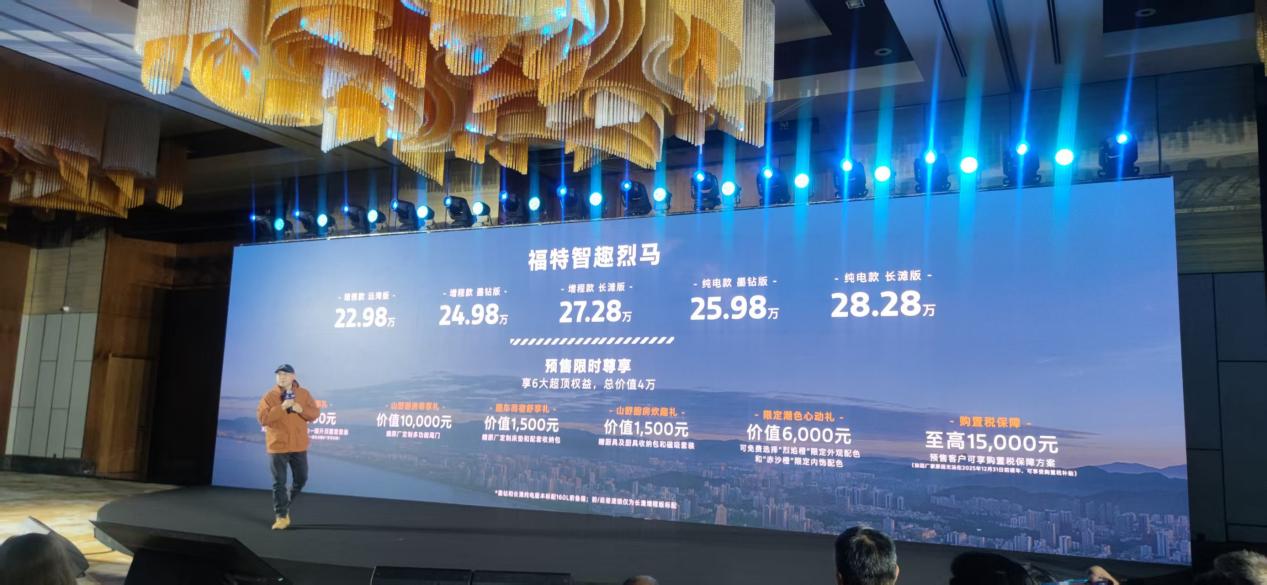
全系四驱,“可城、可玩、可野”,福特智趣烈马正式开启预售,22.98万元起
Zhong Guo Qi Che Bao Wang· 2025-11-18 13:58
Core Viewpoint - Ford's new electric vehicle, the Ford Mustang Mach-E, has officially started pre-sales, offering both extended-range and pure electric versions with attractive pricing and extensive features [1][18]. Group 1: Vehicle Specifications - The Ford Mustang Mach-E features a length of 5025mm and a wheelbase of 2950mm, providing spacious interior comfort [5]. - The vehicle offers the largest trunk space in its class at 497L, along with a unique 160L front trunk in the pure electric version [5]. - The pure electric version is equipped with a 105.4kWh battery, achieving a CLTC range of 650km, while the extended-range version has a 43.7kWh battery with a total range of 1220km when fully fueled and charged [7]. Group 2: Intelligent Features - The vehicle's smart cockpit is built with top-tier hardware, including a 70-inch AR-HUD and a 15.6-inch Mini-LED central control screen, providing an immersive user experience [8]. - It features a dual AI voice system supported by a Qualcomm 8255 chip, enabling natural conversation interactions [8]. - The vehicle includes a "Travel Log" function that recommends routes and provides real-time navigation, enhancing the outdoor experience [11]. Group 3: Off-Road Capabilities - The Ford Mustang Mach-E boasts impressive off-road capabilities with a 30° approach angle, 32° departure angle, and a minimum ground clearance of 220mm [14]. - It is equipped with an intelligent four-wheel-drive system and offers eight driving modes tailored for various terrains [16]. - The vehicle's chassis is designed for durability and handling, featuring a robust aluminum double-wishbone front suspension [16]. Group 4: Safety Features - The vehicle incorporates advanced safety measures, including a high-strength body structure with a steel content of 25% and ten airbags for comprehensive passive safety [16]. - The battery pack is designed with multiple layers of physical protection and has passed rigorous safety tests, ensuring reliability under extreme conditions [17]. Group 5: Market Positioning - The Ford Mustang Mach-E is positioned as a versatile vehicle catering to urban commuting, weekend getaways, and long-distance exploration, aligning with modern consumer needs [18]. - The pre-sale event commenced on November 18, allowing users to reserve the vehicle through the "Ford Beyond" app [1][18].

70.8%对3.2%!合资品牌被甩出赛道?
Zhong Guo Qi Che Bao Wang· 2025-11-18 10:52
Core Insights - The Chinese electric vehicle (EV) market is experiencing a stark contrast between domestic brands and joint venture brands, with domestic brands achieving a penetration rate of 77.9% in October, while joint venture brands only reached 7% [2][3] - The market share for domestic brands stands at 70.8%, while joint venture brands hold a mere 3.2%, indicating a significant gap in the transition to electric vehicles [3] Group 1: Market Performance - In October, the total retail sales of passenger vehicles in China reached 2.242 million units, with domestic brands selling approximately 1.55 million units, of which 77.9% were EVs [2] - Joint venture brands sold around 510,000 units, with only 7% being electric vehicles, highlighting their continued reliance on traditional fuel vehicles [2] - The luxury vehicle segment also shows a shift, with 22.2% of luxury car sales being electric, indicating a growing acceptance of EVs among higher-end consumers [2] Group 2: Challenges for Joint Venture Brands - Joint venture brands face challenges due to a disconnect between product positioning, technological advancements, and the rapidly changing demands of the Chinese market [5] - Many joint venture brands are still relying on "oil-to-electric" conversion strategies, with limited dedicated electric vehicle platforms, which hampers their competitiveness [5] - The technological gap is evident, as domestic brands have made significant advancements in battery systems and smart features, while joint venture brands often depend on technology from their headquarters [5] Group 3: Strategic Shifts in Joint Venture Brands - In response to the challenges, joint venture brands are restructuring their management and product strategies to enhance their market responsiveness [7][8] - Notable changes include the appointment of local leaders in key positions, such as the first non-Japanese general manager for Toyota China, aimed at improving local decision-making [7] - Companies like Beijing Hyundai are also focusing on launching new products, with plans to introduce 20 new models by 2030, including 13 electric vehicles [8] Group 4: Future Outlook - Major automakers like General Motors, Volkswagen, and BMW are accelerating the launch of new electric models through dedicated platforms and partnerships with local companies [9] - While joint venture brands currently face slow product iterations and high costs, there is potential for improvement as local management teams become more effective and new products are introduced [9]
站稳3000万辆、增长超过20%,“十四五”中国汽车硕果盈枝
Zhong Guo Qi Che Bao Wang· 2025-11-18 09:50
Core Insights - The article highlights the significant growth and transformation of China's automotive industry during the "14th Five-Year Plan" period, showcasing advancements in production, sales, and technology [2][10]. Production and Sales Growth - China's automotive production and sales increased by over 5 million units during the "14th Five-Year Plan," with a market size growth of 20% [2]. - In 2021, automotive production and sales reached 26.08 million and 26.27 million units, respectively, marking a year-on-year increase of 3.4% and 3.8% [3]. - By 2023, production and sales surpassed 30 million units for the first time, reaching 30.16 million and 30.09 million units, with year-on-year growth of 11.6% and 12% [3]. - In 2024, production and sales are projected to reach 31.28 million and 31.44 million units, reflecting year-on-year growth of 3.7% and 4.5% [3]. Market Dynamics - The market for Chinese brands has significantly expanded, with market share for domestic passenger cars rising from 44.4% in 2021 to 65.2% in 2024 [4]. - In the first ten months of 2023, sales of Chinese brand passenger cars reached 16.8 million units, a year-on-year increase of 21.3% [4]. Export Milestones - China's automotive exports reached a historic milestone, with exports surpassing 2 million units for the first time in 2021, and reaching 4.91 million units in 2023, a year-on-year increase of 57.9% [4]. - By 2024, exports are expected to exceed 6 million units, solidifying China's position as the world's largest automotive exporter [4]. New Energy Vehicles (NEVs) - NEV sales in China experienced over 4-fold growth during the "14th Five-Year Plan," leading the global market [5]. - In 2021, NEV production and sales reached 3.55 million and 3.52 million units, respectively, with a market share of 13.4% [6]. - By 2024, NEV production and sales are projected to exceed 12 million units, with a market share of 40.9% [6]. Infrastructure Development - The charging infrastructure for electric vehicles has expanded significantly, with over 18 million charging points established by September 2025, reflecting a year-on-year growth of 54.5% [7]. - The improvement in charging facilities has enhanced the convenience and efficiency of energy replenishment for NEV owners [7]. Technological Advancements - The automotive industry has made substantial technological breakthroughs, particularly in battery technology, with a 30% reduction in battery costs and a 40% increase in battery lifespan [9]. - The penetration rate of vehicles with L2-level driving assistance features reached 62% in the first half of 2023, indicating a strong push towards intelligent vehicle technology [9]. Conclusion - The "14th Five-Year Plan" period has marked a transformative era for China's automotive industry, characterized by significant growth in production, sales, and technological innovation, positioning the country as a leader in the global automotive market [10].
