
3 6 Ke

Search documents
国资入主、控股权更迭,赛力斯计划剥离蓝电汽车,野心不止于问界
3 6 Ke· 2026-02-09 11:23
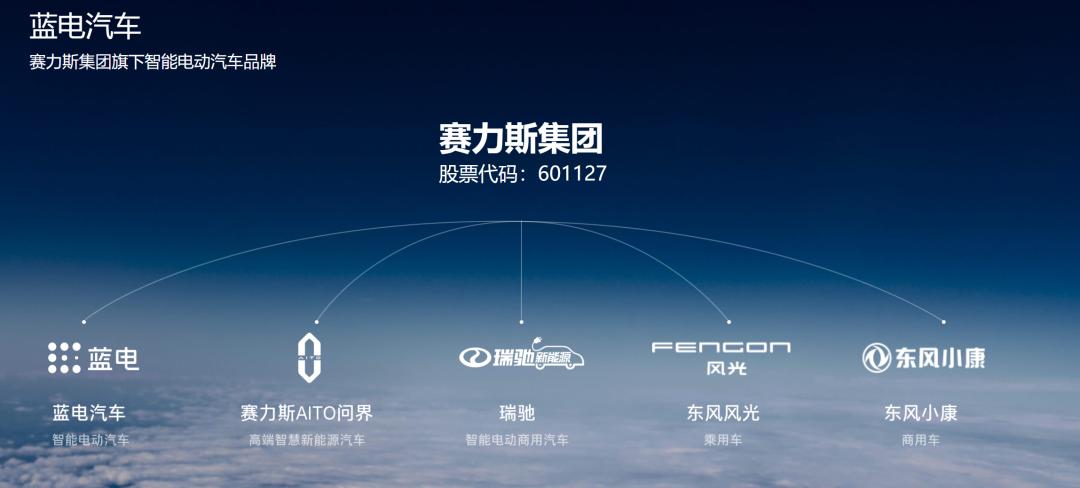
Core Viewpoint - The announcement by Seres (601127.SH) regarding the signing of a cooperation agreement with the Shapingba District Government aims to optimize the company's asset structure and focus on the development of its premium brand, AITO Wenjie [1][3]. Group 1: Cooperation Agreement Details - On February 8, 2026, Seres signed a cooperation agreement with the Shapingba District Government, where Seres will contribute its existing assets related to Blue Electric vehicles to establish a new company [1]. - The Shapingba District Government will form or introduce a limited partnership or fund to invest cash into the new company, resulting in a shareholding structure where the government holds approximately 33.5%, other investors hold about 18.5%, and Seres and designated entities hold around 32% [2][3]. Group 2: Strategic Implications - The asset divestiture is seen as a strategic move to reduce burdens and restructure resources, allowing Seres to focus on its core high-end business and explore future business opportunities [1][3]. - Analysts suggest that this move is not merely a sale of assets but a strategic partnership that leverages local government capital and support, potentially providing Blue Electric with new opportunities for independent development [3][6]. Group 3: Market Context and Performance - As of February 9, 2023, Seres' stock price was 110.98 CNY per share, reflecting a 2.43% increase, with a market capitalization of 193.34 billion CNY [1]. - In January 2026, Seres Group's total sales of new energy vehicles reached 43,034 units, with a significant year-on-year increase of 143.5% for Seres vehicles [5]. - The Blue Electric brand, launched in March 2023, is positioned in the mid-to-low-end market, facing challenges due to intense competition and lack of first-mover advantage [5][6]. Group 4: Future Directions - The divestiture allows Seres to concentrate resources on the AITO Wenjie brand, which has established a competitive edge in the high-end market, while also addressing the increasing competition from both external and internal sources [10]. - The collaboration with local government and other investors is expected to enhance Blue Electric's capabilities in artificial intelligence and smart vehicle technology, aligning with industry trends towards "automobile + AI" [6][10].


氪星晚报|全球最大石油贸易商维多集团推迟全球石油需求达峰预期;亚马逊与意法半导体就数据中心建设达成合作
3 6 Ke· 2026-02-09 11:23
大公司: 浙江极氪智能科技有限公司召回部分极氪001WE版汽车 36氪获悉,日前,浙江极氪智能科技有限公司根据《缺陷汽车产品召回管理条例》和《缺陷汽车产品召 回管理条例实施办法》的要求,受浙江吉利汽车有限公司委托向国家市场监督管理总局备案了召回计 划。召回编号S2026M0023V:自2026年3月6日起,召回生产日期从2021年7月8日至2024年3月18日期间 生产的部分极氪001WE版汽车,共计38277辆。本次召回范围内的部分车辆,由于高压动力电池的部件 制造一致性原因,长期使用动力电池内阻会异常升高,可能导致部分动力电池性能下降,极端情况下可 能导致动力电池热失控,存在安全隐患。 Meta遭欧盟警告:须向竞争对手AI聊天机器人开放WhatsApp 欧盟委员会2月9日公告称,已向Meta发出异议声明,初步认定Meta通过阻止第三方人工智能助手访问 和交互WhatsApp用户,违反了欧盟反垄断法规,Meta的行为可能阻碍竞争对手进入或拓展快速增长的 人工智能助手市场。欧盟委员会拟采取临时措施,在Meta作出答复并行使辩护权的前提下,防止该政 策变更对市场造成严重且不可逆的损害。2025年10月15日,M ...
前 Codex 大神倒戈实锤,吹爆 Claude Code:编程提速 5 倍,点破 OpenAl 死穴在上下文
3 6 Ke· 2026-02-09 11:17
Calvin French-Owen 是 Segment 联合创始人、前 OpenAI 工程师、Codex 项目的早期研发者。他最近在一档播客中,对当前最火的代码智能体 Codex、 Claude Code 和 Cursor 进行了锐评。 结论出人意料,他最常用、也最偏爱的,是 Claude Code,他表示搭配 Opus 模型更"香"。 Calvin 用了一个极具画面感的比喻,来形容用 Claude Code 的体验: 就像残疾人换上了一副仿生膝盖,写代码的速度直接提升了 5 倍。 在他看来,Claude Code 真正的杀手锏,是极其有效的 上下文拆分能力。 面对复杂任务,Claude Code 会自动生成多个 探索型子智能体,独立扫描代码仓库、检索上下文,再将关键信息汇总反馈。这种设计,显著降低了上下文 噪音,也解释了它为何能稳定输出高质量结果。 不过,他也肯定了自家产品,认为 Codex 很有"个性",像 AlphaGo。在调试复杂问题时的表现上,Codex 堪称超人类,很多 Opus 模型解决不了的问题, Codex 都能搞定。 "上下文管理",是 Calvin French-Owen 在整期播客中 ...

给特斯拉松绑,向中国下战书:解读2026美国新法
3 6 Ke· 2026-02-09 11:14
2026年伊始,自动驾驶产业发展的冲锋号,从大洋彼岸吹过来。 在审议《2026年自动驾驶汽车法案》草案的听证会上,美国自动驾驶政策风向发生180 度大转弯。 委员会主席Bilirakis高喊,立法核心动力是"战胜中国"(This legislation is also necessary to successfully compete against communist China)。会议推出了精准解决商业化三大"拦路虎"的方案: 一是产能的解放。 针对无方向盘车辆,此前每家车企每年仅有2500辆的豁免额度,这仅够维持小规模测试。新规将其大幅 提升至90000辆,跨过了量产化的红线,被视为专门为特斯拉Cybercab和Waymo的大规模量产开绿灯。 二是权力的回收。 此前加州等地法规严苛,车企面临法规割裂的困局。新规提出的"联邦优先权(Preemption)",拟禁止 各州自行制定自动驾驶性能标准,确立了联邦法律的至高地位,以防止类似加州对Robotaxi实施的严苛 限制再次出现。 三是监管逻辑的进化。 企业不再需要向政府提交极其详尽的原始代码,这既涉及核心商业机密,又超出了政府的审计能力。而 是改为提交"安 ...

2026年人工智能+的共识与分歧
3 6 Ke· 2026-02-09 11:14
Core Insights - Generative AI is transitioning from "technically feasible" to "value feasible," entering a critical validation period for its practical application [1] Group 1: Consensus on AI Implementation - The bottleneck for AI deployment has shifted from the supply side to the demand side, with 88% of surveyed medium to large enterprises using AI in at least one business function, but only one-third achieving large-scale deployment [2] - The high customization requirement for AI solutions poses challenges, with about 70% needing customization and only 30% being standardizable, leading to difficulties in monetization and product capability accumulation [3] - The commercial model for AI applications remains unproven, with significant price competition pressures, particularly in the B2B sector, where API prices have dropped by 95%-99% since 2024 [4][5] Group 2: Divergences in AI Development - The extent to which intelligent agents can evolve by 2026 is uncertain, with significant advancements in task completion capabilities but still facing challenges in high-risk scenarios like finance and healthcare [6] - The competition for computing power is shifting from training to inference, with a focus on optimizing inference efficiency and cost, which will redefine market dynamics for chip manufacturers and cloud service providers [7][8] - The evolution of the AI ecosystem is complex, with debates on data flow rules and privacy concerns, indicating a need for a new regulatory framework to address these challenges [9][10] Group 3: Recommendations for Future Actions - Companies should prioritize application scenarios that demonstrate real value, focusing on areas with good data foundations and manageable risks [11] - Standardization efforts are needed to reduce customization costs and foster replicable product capabilities, particularly in key industries [12] - High-risk AI applications require robust quality supervision and safety audits to mitigate systemic uncertainties [13] - Encouraging diverse commercial models is essential to avoid detrimental price competition and foster long-term industry health [14]
2026,新茶饮加盟还能干吗?
3 6 Ke· 2026-02-09 11:11
时代踩下油门和刹车,远比想象中来得更快。 2019年,阿浪在湖北省一个县级市加盟了第一家蜜雪冰城,全年营业额干到150多万,"抛去成本也有的 赚"。彼时,新茶饮市场正以每年超30%的增速狂飙,蜜雪冰城的门店刚突破7000家,尚处于拓荒年 代。特别是在下沉市场,仍有大片空白。 2020年,武汉疫情解封,阿浪看准空置门店和低租金的窗口期,逆势连开几家蜜雪冰城,完成原始积 累。他前后加盟20多家茶饮门店,成了茶饮"圈地运动"的受益者。 2024年初,他又陆续加盟了茶百道、古茗和塔斯汀等,但发现游戏规则已变。此时,全国茶饮门店突破 50万家,市场从"增量竞争"彻底转为"存量厮杀";蜜雪冰城门店数已达3.3万家,古茗突破9000家,茶 百道也冲刺到近8000家。 "2025年下半年,依然没有一家回本,开始亏钱。"阿浪告诉亿邦动力,"古茗投了60万,好的时候月净 利润4万多。但是受季节影响大,冬天基本不赚钱。熬不住,回本周期太长,最后30多万兑出去了。" "投资回报比不值得,不想干了。"2026年,他倾向于把店面全部兑出去。硬币的另一面,现在仍有许多 人排队加盟蜜雪冰城,或者在找店。但在阿浪眼里,那已是别人想象中的红利。 ...

让人上瘾的「高铁零食刺客」,抱不上春运的大腿
3 6 Ke· 2026-02-09 11:00
Core Viewpoint - The spring transportation season has seen a decline in the popularity of "marinated snacks," particularly the three major duck brands, which are facing performance downturns and store closures due to market saturation and changing consumer preferences [2][3][8]. Group 1: Company Performance - The three major duck brands, Zhou Hei Ya, Jue Wei, and Huang Shang Huang, have experienced significant declines in performance, with Jue Wei projected to lose between 160 million to 220 million yuan in 2025, marking its first annual loss [6][19]. - The market capitalization of these brands, once in the hundreds of billions, has now dwindled to tens of billions, and over 5,300 stores were closed in the first half of 2025 alone [6][19]. - Zhou Hei Ya, despite its high-end positioning, saw its net profit drop by over 94% in 2022, while Huang Shang Huang's store count fell below 2,898 by mid-2025, lower than in 2019 [19][21]. Group 2: Market Dynamics - The marinated snack market is experiencing a slowdown, with the market size expected to reach 157.3 billion yuan in 2024, reflecting a drastic decline in growth rate to 3.7% compared to over 15% in previous years [21][23]. - Consumer behavior has shifted, with a preference for lower-priced options; the most common spending range for marinated snacks is 20-30 yuan, while the major brands often exceed this price point [23][25]. - The competitive landscape has evolved, with local brands and snack giants entering the marinated snack market, offering similar or better value propositions, thus diluting the unique selling points of the major brands [25][27]. Group 3: Strategic Changes - To regain market share, the major brands are attempting various marketing strategies, including collaborations with popular culture and introducing new product lines [30][32]. - There is a push towards redefining their product offerings, with Zhou Hei Ya and Jue Wei introducing lower-priced items and expanding into hot marinated dishes to attract younger consumers [34][36]. - Operational efficiency is becoming crucial, with brands needing to close underperforming stores and focus resources on profitable locations to improve overall performance [38][41].


境内严禁,境外严管,设备数据可能正在"踩线"?42号文给AIoT企业3个合规警示
3 6 Ke· 2026-02-09 10:42
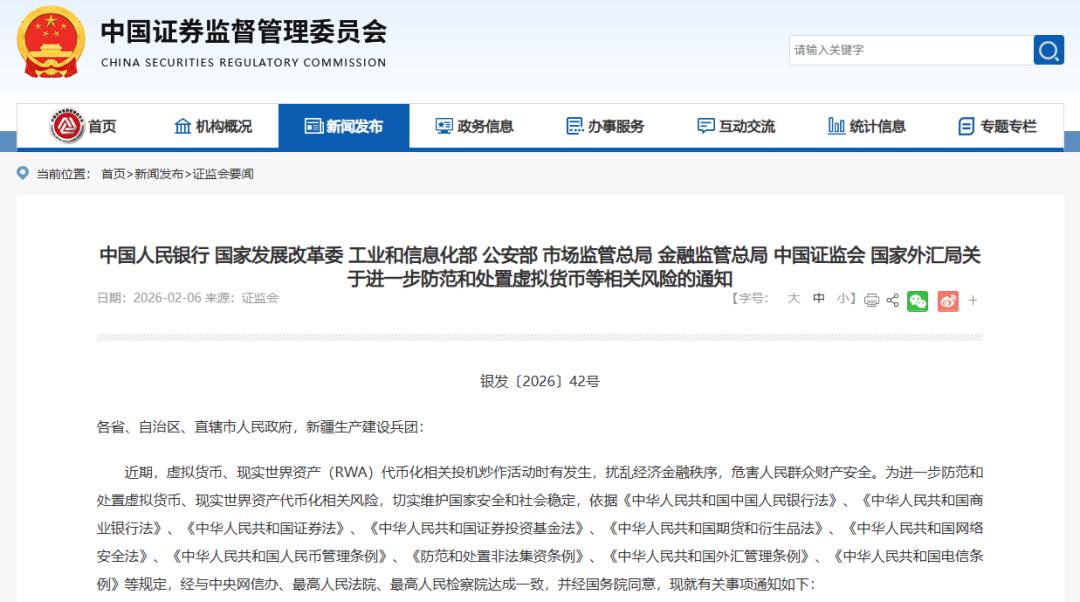
Core Viewpoint - The recent regulatory documents from Chinese authorities signify a shift in the approach to digital asset regulation, moving from strict prohibition to a framework that allows for compliance and controlled utilization of tokenization of real-world assets (RWA) [1][15]. Regulatory Framework - The primary focus of the regulatory documents is on virtual currencies and RWA activities, explicitly prohibiting the tokenization of real-world assets within China and related services, which are deemed illegal financial activities [2][7]. - The documents establish a differentiated regulatory approach, allowing RWA activities under specific conditions while maintaining strict prohibitions on virtual currency operations [3][10]. Definition and Scope - RWA tokenization is defined as the use of cryptographic technology and distributed ledger to convert ownership and rights into tokens for issuance and trading [5]. - The distinction between asset digitization and tokenization is crucial, as the former does not fall under the regulatory scope, while the latter does [4][5]. Compliance Obligations - The regulations impose specific compliance obligations on various market participants, including financial institutions and technology service providers, to ensure that they do not engage in unauthorized RWA activities [9][11]. - For compliant cross-border RWA activities, technology service providers must adhere to legal frameworks, enhance risk management, and report their activities to relevant authorities [11]. Data Security and Cross-Border Concerns - The documents emphasize the importance of data security and the risks associated with cross-border data flows, particularly when domestic asset data is used in foreign financial contexts [12][13]. - Companies must ensure the legality of data transfers and classify data appropriately, especially when it pertains to sensitive information related to asset tokenization [13][14]. Implications for AIoT Companies - AIoT companies must recognize the potential implications of their data usage, especially if their outputs are utilized in RWA activities, as this could subject them to regulatory scrutiny [6][14]. - The regulatory framework necessitates that AIoT firms proactively clarify their data usage and ensure compliance with the new obligations set forth in the regulatory documents [15].
训练加速1.8倍,推理开销降78%,精准筛选题目高效加速RL训练
3 6 Ke· 2026-02-09 10:39
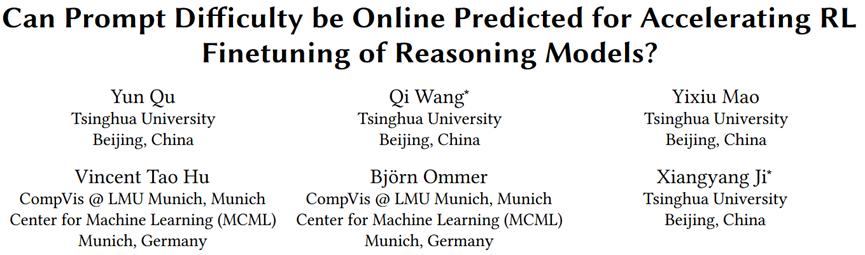
Core Insights - The article discusses the introduction of MoPPS, a new framework for model predictive prompt selection that aims to enhance the efficiency of reinforcement learning fine-tuning for large language models by accurately predicting question difficulty without the need for expensive evaluations from large models [5][26]. Group 1: Training Efficiency - MoPPS significantly reduces computational costs associated with training by minimizing the reliance on large model self-evaluations, achieving up to 78.46% reduction in rollouts compared to traditional methods [15][18]. - The framework accelerates training efficiency by 1.6x to 1.8x compared to conventional uniform sampling methods, ensuring that the most critical questions are selected for training [16][26]. Group 2: Methodology - MoPPS employs a lightweight Bayesian model to predict question difficulty, using a Beta distribution to estimate success rates for each question, which allows for efficient updates based on training feedback [8][9]. - The framework utilizes Thompson Sampling for active question selection, balancing exploration and exploitation to identify questions that are optimally challenging for the model [10][12]. Group 3: Performance Metrics - Experimental results indicate that MoPPS maintains a high correlation between predicted and actual question difficulty, demonstrating its reliability and effectiveness in training scenarios [19][22]. - The framework is compatible with various reinforcement learning algorithms and can adapt to different sampling strategies, enhancing its applicability across different training contexts [20][24]. Group 4: Industry Impact - The research has garnered attention from major industry players such as Alibaba, Tencent, and Ant Group, indicating its potential impact on the field of AI and machine learning [4]. - The MoPPS framework represents a significant advancement in the cost-effective fine-tuning of large models, potentially influencing future developments in reinforcement learning applications [26].
机构今日买入巨力索具等17股,卖出通源石油1.68亿元


3 6 Ke· 2026-02-09 10:27
Summary of Key Points Core Viewpoint - On February 9, a total of 35 stocks were involved in institutional trading, with 17 stocks showing net buying and 18 stocks showing net selling by institutions [1] Institutional Net Buying - The top three stocks with the highest net buying by institutions were: - JuLi Rigging: Net buying amount of 154 million [1] - Hunan Silver: Net buying amount of 118 million [1] - FeiWo Technology: Net buying amount of 71.62 million [1] Institutional Net Selling - The top three stocks with the highest net selling by institutions were: - Tongyuan Petroleum: Net outflow amount of 168 million [1] - TuoRi New Energy: Net outflow amount of 155 million [1] - Zhongwen Online: Net outflow amount of 95.74 million [1]