申万宏源证券上海北京西路营业部

Search documents
快讯 | 申万宏源助力创石钼业在新三板挂牌
申万宏源证券上海北京西路营业部· 2025-12-04 02:11
Core Viewpoint - Liaoning Chuangshi Molybdenum Industry (Group) Co., Ltd. has successfully listed on the National Equities Exchange and Quotations (NEEQ), with Shenwan Hongyuan as the lead underwriter, indicating a significant milestone for the company and its growth strategy [1]. Company Overview - Established in 2006, Chuangshi Molybdenum specializes in the research, production, processing, and sales of molybdenum series products, including molybdenum iron alloy, molybdenum oxide, ammonium molybdate, high-purity molybdenum trioxide, molybdenum powder, and molybdenum metal [1]. - The company has developed into a large enterprise engaged in the entire line of research, production, and sales of molybdenum products, from rough processing to deep processing, after over a decade of technological accumulation [1]. Market Position - Chuangshi Molybdenum is positioned as a leading enterprise in the domestic molybdenum iron alloy industry, with its main product, molybdenum iron alloy, ranking among the top in domestic sales market share in 2024 [1]. Future Strategy - The company plans to extend its industrial chain by engaging in mineral mining through its subsidiary, Mongolian Molybdenum Metal Company, to ensure stable raw material supply, reduce procurement costs, enhance overall operational efficiency, and improve risk resistance [1]. - Shenwan Hongyuan's support aligns with the national innovation-driven development strategy, providing a solid foundation for Chuangshi Molybdenum's future industrial chain upgrades and the layout of rhenium series products [1].


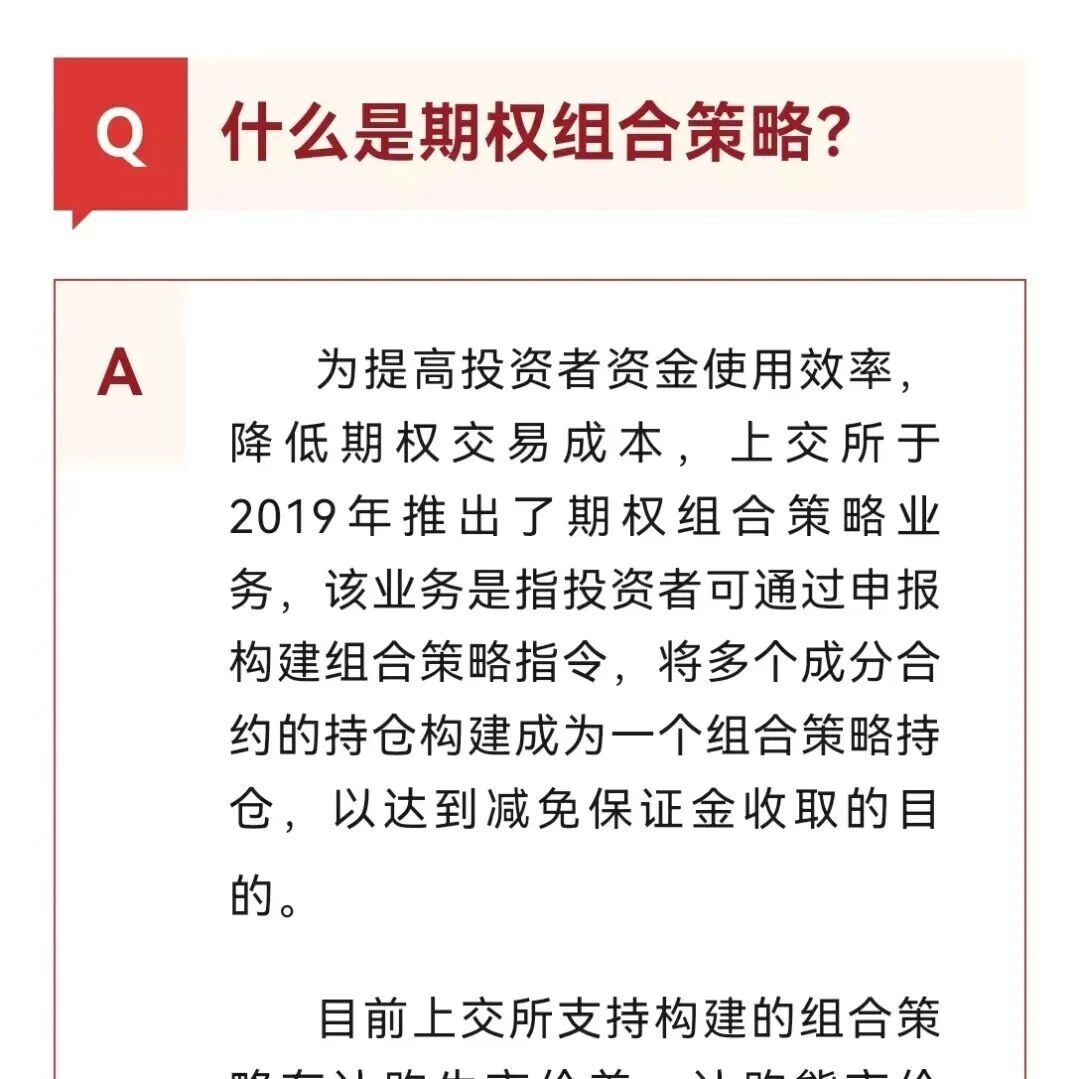
什么是期权组合策略
申万宏源证券上海北京西路营业部· 2025-12-04 02:11
Group 1 - The core idea of the article is to explain the option combination strategy introduced by the Shanghai Stock Exchange in 2019, aimed at improving capital efficiency for investors and reducing trading costs [1] - The article outlines six types of combination strategies supported by the exchange: call bull spread, call bear spread, put bull spread, put bear spread, straddle short, and wide strangle short [1] - Investors can convert ordinary positions into covered positions if they hold sufficient underlying securities, allowing for margin release [1] Group 2 - The article specifies that investors can construct combination strategies during trading hours from 9:30 to 11:30 and 13:00 to 15:15 within the same derivative account [1] - It provides a table for margin calculation based on different strategies, indicating that the margin for a call bull spread is calculated as the difference in strike prices multiplied by the contract unit [3] - The margin for a straddle short is determined by the maximum of the call option opening margin and the put option opening margin, plus the margin for the lower-priced contract [3]
“申”挖数据 | 估值水温表
申万宏源证券上海北京西路营业部· 2025-12-04 02:11
Core Viewpoint - The article highlights the current high valuation levels across various industries and indices in the A-share market, indicating potential investment risks due to elevated PE ratios and the Buffett indicator being above the safe zone [1][6][7]. Valuation Levels - The PE valuation (TTM) for steel, coal, electronics, retail, computing, and real estate industries are at historical percentiles of 80.08%, 81.60%, 86.36%, 94.77%, 95.27%, and 97.74% respectively, suggesting caution for investors [8]. - The Buffett indicator for the A-share market stands at 87.95%, which is considered relatively high and above the safe zone [6][22]. - Major broad market indices such as the North Securities 50, Shanghai 50, Shanghai Index, Sci-Tech 50, and China A100 have PE valuations (TTM) at percentiles of 82.85%, 88.31%, 91.89%, 95.53%, and 98.68% respectively, indicating high valuation levels [7]. Industry-Specific Insights - Non-bank financials and food & beverage sectors have PE valuations (TTM) below the 20th percentile of the past decade, at 3.02% and 13.25% respectively, making them areas of potential interest [8]. - The overall market PE valuation averages around 15.95 times, with the Shanghai market showing a total market capitalization of approximately 628.83 billion [18][25]. Index Valuation Performance - The current PE valuation levels for various indices indicate that most are above 20%, with significant declines noted in some indices such as the ChiNext Index and the Shanghai Composite Index [26][27]. - The PB valuation levels for major indices also reflect a similar trend, with the Shanghai Index at 1.12 and the Shenzhen Component Index at 1.75, both showing a decrease [28][30]. Industry Valuation Levels - The PE valuation levels across various industries show significant variation, with sectors like agriculture, steel, and electronics having valuations of 14.95, 5.69, and 79.76 respectively, indicating differing levels of market confidence [32]. - The PB valuation levels for industries such as steel and electronics are at 0.73 and 1.92 respectively, suggesting a mixed outlook across sectors [36].

快讯 | 申万宏源香港保荐全国排名第一的机器按摩服务提供商乐摩科技成功登陆港交所
申万宏源证券上海北京西路营业部· 2025-12-04 02:11
Group 1 - LeMo Technology successfully listed on the Hong Kong Stock Exchange on December 3, 2025, with a share price of HKD 40.00, raising a total of HKD 222 million [2] - The company launched the "LeMo Bar" brand in 2016, providing machine massage services in commercial complexes, cinemas, and transportation hubs, establishing over 48,000 service points and deploying more than 533,000 massage machines across 31 provinces and 337 cities in China [4] - According to Frost & Sullivan, LeMo Technology ranked first among all machine massage service providers in China by transaction value from 2022 to 2024 [4] Group 2 - The public offering for LeMo Technology was highly successful, with a subscription rate of 7,324.29 times, leading to a high-end pricing within the price range [4] - Shenwan Hongyuan Hong Kong played a crucial role in the listing process, leveraging domestic and international resources to support the company's successful IPO [4] - The company aims to continue enhancing its internationalization and integration strategies, taking advantage of opportunities from domestic and international market connectivity to build a "dual circulation" ecosystem in investment banking [4]

早盘直击|今日行情关注
申万宏源证券上海北京西路营业部· 2025-12-04 02:11
首先,目前时点进入12月份,临近年底,年末因素如机构年终结账等开始影响市场。 同时,短线市场缺乏新的热点,在半导体芯片、人工智能等科 技股进入调整后,市场缺乏稳定而持续的新热点,导致场内资金被动观望,成交量持续萎缩,目前维持在1.6~1.8万亿元的日成交量较8月底3.1万亿元的最 大量相比,萎缩超过40%。而没有强而有力的领涨板块,大盘就难以持续放量,进而也较难推动大盘放量上涨。从目前看,12 月份以震荡整理,过渡性 行情为大概率事件,波动空间有限。 从热点看, 热点轮动,交通运输、有色金属等周期性行业震荡走强,而前期涨幅较大的如传媒、计算机等板块冲高回落,市场风格由激进转向防 御。另外,前期炒名字的热潮有所降温,部分代表性个股周三出现跌停,盲目追涨风险凸显。 展望后市: 大盘继续震荡整理,以稳为主。从技术面看,成交量萎缩,观望气氛有所增强。关注陆续公布的11月份宏观经济数据以及盘中热点和量 能的匹配情况。 风险提示: 消息面或海外市场表现超预期,流动性的不确定性。 ...

【申万固收|利率】生产强于需求,债市空间仍窄——11月中采PMI点评
申万宏源证券上海北京西路营业部· 2025-12-04 02:11
申万宏源固收研究 【申万固收|利率】生产强于需求,债市空间仍窄——11月中采PMI点评 原创 阅读全文 ...

新股日历|今日新股/新债提示
申万宏源证券上海北京西路营业部· 2025-12-04 02:11
申万宏源证券 星期四 12月 E SAH首 Textal Ball Di 今日申 ... 令日下…。 今日中签缴... 0 今日无新股新债 免责声明 投资有风险,入市需谨慎。本内容不构成任何投资建议。投 资者不应以该等信息取代其独立判断或仅根据该等信息做出 决策。申万宏源对这些信息的准确性或完整性不作保证,亦 不对因使用该等信息而引发或可能引游艇操练预报给圆感 ...

【申万固收|地方债周报】发行提速但下周再降速,5000亿结存限额发行或已过半——地方债周度跟踪20251128
申万宏源证券上海北京西路营业部· 2025-12-04 02:11
Core Viewpoint - The article discusses the acceleration in local government bond issuance, indicating that the issuance limit of 500 billion may have already been exceeded halfway through the period [2] Group 1: Issuance Trends - Local government bond issuance has accelerated, with a notable increase in the volume compared to previous weeks [2] - The article suggests that the issuance pace may slow down in the upcoming week, indicating a potential shift in market dynamics [2] Group 2: Financial Implications - The current issuance limit of 500 billion is highlighted, with the implication that the remaining capacity may be limited as more bonds are issued [2] - The article emphasizes the importance of monitoring the issuance trends closely, as they can impact liquidity and investment opportunities in the market [2]

申万宏源助力浦发银行200亿元二级资本债成功发行
申万宏源证券上海北京西路营业部· 2025-12-03 02:26
此次两品种债券的成功发行,是浦发银行主动进行资本管理的体现。双品种设计与投资者的需求相适配,投资者广泛认购,市场信心彰 显,同时也展现出浦发银行对市场需求的深刻理解和精准把握。本次大规模资本的顺利补充,将进一步夯实浦发银行的总资本实力,为其 在复杂经济形势下继续保持业务稳健增长、持续服务国家重大战略和实体经济筑牢安全垫。 深化合作共筑新篇 申万宏源证券作为本期债券联席主承销商,在本期债券的发行过程中为浦发银行提供了专业的承销支持。通过协助浦发银行顺利完成此次 发行,进一步巩固了在大型股份制商业银行复杂资本工具发行领域的优势地位以及面对多样化市场环境与发行需求时的专业响应能力。本 项目的成功发行,强化了申万宏源证券与浦发银行的良好合作关系,为未来申万宏源在股份制商业银行资本工具创新领域的持续开拓积累 了宝贵经验。 免责 声 明 浦发银行二级资本债成功发行 NEWS 2025 年 11 月 17 日,上海浦东发展银行股份有限公司 2025 年第一期二级资本债 券成功发行。本期债券创新采用双品种发行机制,其中品种一发行规模 165 亿元,期 限 5+5 年,票面利率 2.17% ;品种二发行规模 35 亿元,期限 ...


早盘直击|今日行情关注
申万宏源证券上海北京西路营业部· 2025-12-03 02:26
Market Overview - The A-share market struggled to maintain the 3900-point level, experiencing weak fluctuations and a decline in trading volume to approximately 1.6 trillion yuan, indicating low market sentiment [1] - As the year-end approaches, investor participation has decreased, leading to a shrinking trading volume and a cautious market atmosphere [1] - The market is expected to remain in a consolidation phase for the next few weeks, with potential upward movement as conditions improve [1] Future Outlook - The market is anticipated to experience fluctuations around the 4000-point level, which may prepare for a new upward phase [1] - Key focus areas for November include the impact of the 14th Five-Year Plan on industries, event-driven dynamics in the technology sector, and price recovery driven by anti-involution trends [1] Sector Highlights - In December, sectors benefiting from dividends and price increases are expected to outperform, with short-term attention on banking, public utilities, coal, and non-ferrous metals [2] - Technology remains a primary focus for 2026, with particular attention on AI, lithium batteries, military industry, and robotics [2] - The trend of AI hardware is solidifying, with increasing token usage in major AI models, indicating a peak in AI applications by 2026 [2] - The domestic production of robots is expected to expand, with opportunities arising in sensors, controllers, and dexterous hands as the market evolves [2] - The semiconductor industry is moving towards domestic production, with a focus on semiconductor equipment, wafer manufacturing, materials, and IC design [2] - The military sector is expected to see a recovery in orders, with signs of bottoming out in the performance of various military sub-sectors [2] - The innovative drug sector is entering a recovery phase after nearly four years of adjustment, with positive net profit growth expected to continue into 2026 [2]