华尔街见闻

Search documents
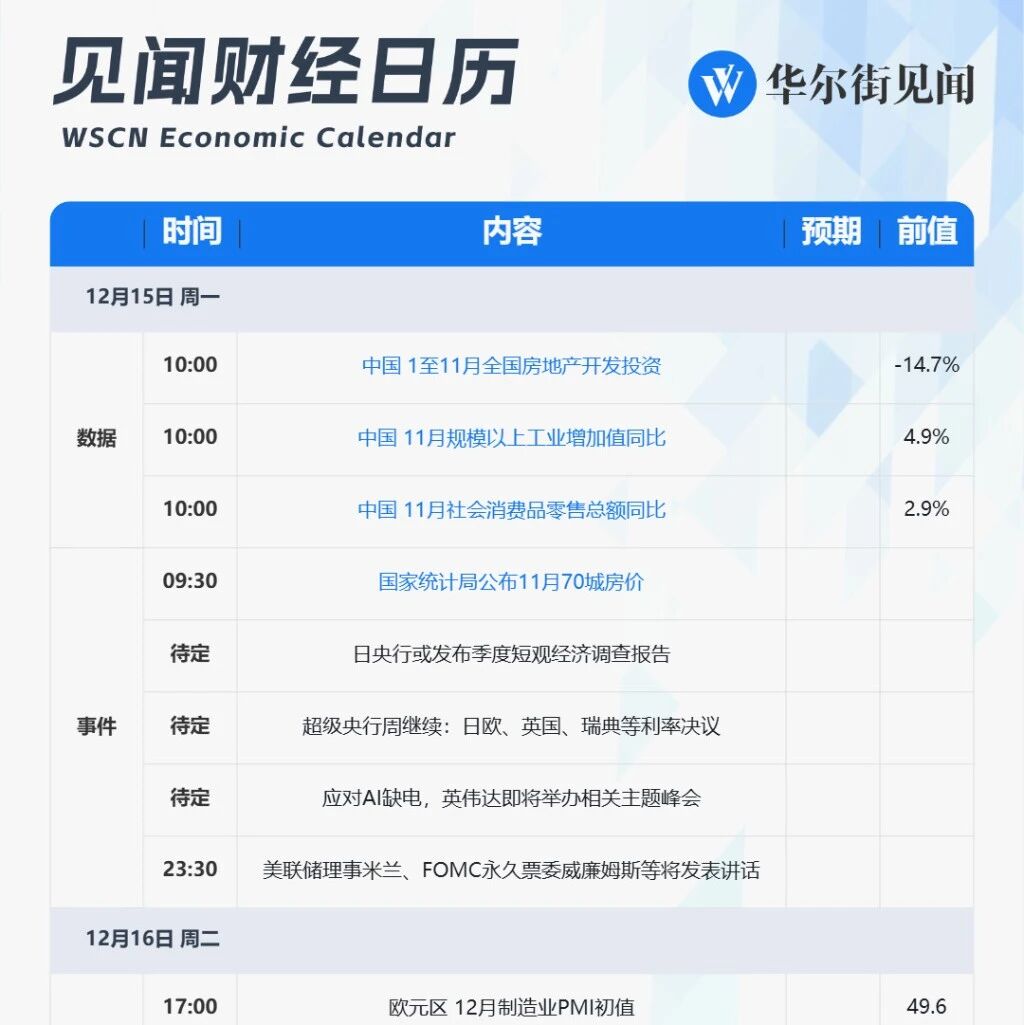
一周重磅日程:超级央行周,中美关键数据,字节火山引擎和摩尔线程大会备受关注
华尔街见闻· 2025-12-14 10:31
Economic Data and Events - China's real estate development investment from January to November is expected to decline by 14.7% [3] - China's industrial added value for November is projected to grow by 4.9% year-on-year [3] - China's retail sales of consumer goods for November are anticipated to increase by 2.9% year-on-year [3] - Japan's November CPI is expected to be 2.9% year-on-year, with a core CPI forecasted to remain at 3.0% [7][10] - The U.S. non-farm payroll report for November is expected to show an increase of 130,000 jobs, following a decrease of 10,000 jobs in October [8][10] Central Bank Decisions - The Bank of Japan is expected to raise interest rates by 25 basis points to 0.75% during its meeting on December 19 [7] - The European Central Bank is anticipated to maintain its interest rates, with no rate cuts expected until 2026 [11] - The Bank of England is likely to lower its interest rate by 25 basis points to 3.75%, potentially marking the end of the rate-cutting cycle [12] Corporate Events and Financial Reports - Micron Technology and Nike are set to release their financial reports, with expectations of revenue growth and positive earnings per share [35] - The first MUSA Developer Conference by Moore Threads will unveil a new generation of GPU architecture [16] - ByteDance's Volcano Engine is expected to announce significant upgrades or new products at the FORCE conference [17] Market Impact and Trends - The Federal Reserve's Reserve Management Plan (RMP) involves purchasing $40 billion in short-term government bonds monthly, indicating a strong commitment to market support [20] - The launch of the Hainan Free Trade Port is expected to impact sectors such as duty-free retail and modern logistics [19] - The upcoming Alpha Summit aims to explore macroeconomic and financial market trends, providing insights into investment opportunities for 2026 [34]

华尔街投行:明年更大的风险不是“美国衰退导致市场崩盘”,而是“市场崩盘导致美国衰退”
华尔街见闻· 2025-12-14 10:31
Core Viewpoint - A recent report from BCA Research indicates that the biggest threat to the U.S. economy in 2026 may stem from the financial markets themselves, rather than an economic recession dragging down the stock market. The report suggests that a potential stock market crash could directly push the U.S. economy into recession, challenging conventional market views [1][2]. Economic Structure and Risks - The report highlights a significant structural change in the U.S. labor market, with approximately 2.5 million "excess retirees" whose consumption is closely tied to stock market performance. This group has retired early due to the pandemic and the subsequent stock market boom, creating a demand side that is sensitive to stock market fluctuations [1][3][5]. - The consumption of these retirees injects strong demand into the U.S. economy, but their retirement means they do not contribute to labor supply, leading to a constrained labor market. This situation creates a delicate balance where strong demand exists alongside limited supply, preventing a recession driven by weak demand [5][7]. Federal Reserve's Dilemma - BCA Research outlines a dilemma for the Federal Reserve: maintaining a 2% inflation target while avoiding a recession. The report predicts that the Fed will prioritize preventing a market crash over its inflation target, potentially allowing inflation to rise above 2% and adopting aggressive rate cuts in response to any signs of economic or market weakness [2][8]. Market Concentration and Challenges - The report notes that the current market rally is historically concentrated, with about two-thirds of global stock market value concentrated in U.S. stocks, and 40% of that in just ten stocks. This concentration poses risks, as the fortunes of these stocks are heavily tied to the success of the generative AI narrative [9][11]. - However, there are signs of divergence among leading tech stocks, indicating that the market is not treating all tech stocks as a single entity. This divergence suggests that value investors are still assessing individual company valuations [11][12]. Investment Opportunities - BCA Research suggests that as the era of U.S. tech stocks outperforming the market may be coming to an end, funds could rotate into undervalued sectors and regions, such as healthcare and European markets. Unlike the U.S., Europe does not face inflationary pressures caused by labor market distortions, creating a favorable environment for the bond market [12].

巨变酝酿中?美国财政部将“合并”美联储,贝森特才是真正的“影子联储主席”
华尔街见闻· 2025-12-14 10:31
Core Insights - The article discusses a significant shift in the relationship between the U.S. Treasury and the Federal Reserve, suggesting a de facto "merger" of their balance sheets, with Treasury Secretary Yellen playing a pivotal role as an "shadow Fed Chair" [1][4] - The Federal Reserve plans to restart asset purchases, beginning with $40 billion in Treasury bills in January, which is seen as a commitment to finance Treasury expenditures and stabilize market interest rates [1][3] - This new framework indicates that the market's ability to signal government spending limits through interest rates will be diminished, leading to a tighter coordination of policies between the Treasury and the Fed [4][5] Treasury and Federal Reserve Merger - The Federal Reserve's decision to resume bond purchases fundamentally alters traditional market dynamics, as it aims to set money market rates rather than manage them through open market operations [3] - The Fed's actions are intended to ensure that Treasury spending can be financed without causing interest rate "blockages," effectively merging the operational roles of the two institutions [4] New Power Structure - Should Kevin Hassett be confirmed as a potential Fed official, Secretary Yellen will effectively become his "boss," establishing a "single presidential authority" for daily communication and coordination [5] - The goal is to achieve low financing costs by injecting liquidity into the short end of the market, which is expected to contribute to rising inflation expectations by 2026 [5] Economic Outlook - The article highlights a concerning economic outlook, with recent labor data revisions indicating a downward trend in employment, suggesting a potential for further Fed rate cuts [7][8] - While short-term monetary easing is anticipated, long-term inflation risks remain, with fiscal policy expected to support economic activity and inflation potentially resurfacing in late 2026 or 2027 [8]

潮汕老板卖0.1克黄金,今年已进账62亿
华尔街见闻· 2025-12-14 10:31
Core Viewpoint - The article discusses how the jewelry brand潮宏基 is successfully appealing to the Z generation by offering lightweight gold products combined with popular IP collaborations, thus transforming the perception of gold from a mere investment to an emotional and wearable value [3][12][52]. Group 1: Market Trends and Consumer Behavior - The trend of "lightweight gold" is gaining traction among the Z generation, who prefer affordable and shareable gold items over traditional heavy gold jewelry [4][15]. -潮宏基's strategy of selling gold in small weights (0.1 grams to 0.96 grams) at prices ranging from 200 to 1000 yuan has sparked enthusiasm among young consumers for "low-cost gold" [12][14]. - The emotional value associated with these products, rather than just their investment potential, is a key driver of consumer interest [15][18]. Group 2:潮宏基's Business Model and Financial Performance -潮宏基's revenue surged nearly 30% in the first three quarters of 2025, exceeding 6.2 billion yuan, but the company faces a profit dilemma with "increasing revenue but not increasing profit" [8][38]. - The company's gross margin has declined from nearly 36% in 2020 to about 24% in 2024, marking a ten-year low, primarily due to the lower margins from franchise operations [39][42]. -潮宏基's aggressive expansion strategy, including a franchise model, has led to a significant drop in overall profit levels, raising concerns about sustainability [41][43]. Group 3: Product Innovation and IP Collaborations -潮宏基 has positioned itself as the "Bubble Mart of the jewelry industry" by leveraging IP collaborations with popular characters, enhancing its appeal to younger consumers [5][22]. - The brand's innovative approach includes using hollow and hollowed-out designs, along with fashionable elements, to create visually appealing lightweight gold products [19][21]. -潮宏基's marketing strategies, such as limited edition blind boxes and exclusive gift sets, have effectively engaged the young consumer base [24][25]. Group 4: Challenges and Future Outlook - Despite its growth,潮宏基 faces challenges such as declining product quality and increasing consumer complaints, which could undermine brand trust [47][50]. - The company is also dealing with intellectual property disputes, which may affect its expansion into overseas markets [50][52]. - As潮宏基 prepares for its IPO on the Hong Kong Stock Exchange, concerns about its profit quality and sustainability of its growth strategy are paramount [52][56].

宇树首发人形机器人App Store
华尔街见闻· 2025-12-13 11:54
Core Viewpoint - The article discusses the launch of a humanoid robot application store by Yushu Technology, aiming to modularize and standardize robot functionalities, thereby reducing the complexity of robot programming and enhancing user accessibility [3][5]. Group 1: Application Store Features - Yushu's application store integrates four core modules: "User Square," "Action Library," "Data Set," and "Developer Center," allowing users to deploy complex motion control algorithms easily via a mobile app [5][9]. - Users can connect their robots to the app over Wi-Fi and install skills from the "Action Library," enabling real-time control of the robot's movements [7][9]. Group 2: Developer Ecosystem - The platform aims to build a developer ecosystem by allowing global developers to upload their motion sequences or datasets for algorithm training and optimization [9][11]. - This "global functionality sharing center" model is expected to accelerate the iteration of humanoid robot capabilities through crowdsourcing, shifting industry competition towards software ecosystems and content services [11].

谁做下一任美联储主席,摩根大通CEO戴蒙押注沃什,而非哈赛特
华尔街见闻· 2025-12-13 11:54
Core Viewpoint - Jamie Dimon, CEO of JPMorgan Chase, supports Kevin Warsh for the Federal Reserve chairmanship, believing he would be a "great chairman" and warning against Kevin Hassett's potential influence from the White House, which could undermine the Fed's independence [1][2]. Group 1: Dimon's Analysis - Dimon warns that if Hassett is appointed, he may quickly lower short-term interest rates to align with Trump's economic demands, but the Fed can only control short-term rates while long-term rates are determined by the market [2]. - Concerns arise that aggressive rate cuts under Hassett could ignite inflation expectations, leading to a rise in long-term rates, such as the 10-year Treasury yield, due to investor sell-offs [2][3]. Group 2: Market Reactions - Since reports of Hassett's candidacy emerged, the 10-year U.S. Treasury yield has increased from 4.0% to 4.2%, indicating market pricing for the associated risks [3]. - There is growing anxiety among bond market traders regarding inflation, as the 5-year forward inflation swap rate has recently risen by 0.06 percentage points, reaching a one-month high [3]. Group 3: Investor Concerns - Senior investors managing a $30 trillion U.S. Treasury market have expressed concerns to Treasury officials about Hassett's political ties to Trump, questioning the potential impact on the credibility of monetary policy [5]. Group 4: Selection Process - Trump has expressed dissatisfaction with current Fed Chair Jay Powell's policies and has indicated that loyalty and willingness to cut rates are key criteria for his selection of a new chair [7]. - The selection process, led by incoming Treasury Secretary Scott Bansen, continues, with Trump expected to interview more candidates soon [9].


史上最大IPO!SpaceX内部定价曝光:每股421美元,估值8000亿美元
华尔街见闻· 2025-12-13 11:54
Core Insights - SpaceX's internal stock price has reached $421 per share, leading to a valuation of $800 billion, potentially setting a record for the largest IPO in history [1] - The valuation has doubled in less than six months, from $400 billion in July to $800 billion now, reclaiming the title of the world's "unicorn" king from OpenAI [2][3] - SpaceX is preparing for a potential IPO in 2026, aiming to raise over $30 billion [4] - Elon Musk aims for a total company valuation of $1.5 trillion, which would bring SpaceX close to the record market value achieved by Saudi Aramco during its IPO in 2019 [5] Funding Allocation - The upcoming financing will focus on three core areas: 1. Supporting the "crazy launch frequency" of the Starship rocket 2. Establishing advanced "space AI data centers" 3. Building a lunar base [6] Market Practices - SpaceX conducts two tender offers annually, allowing employees and shareholders to cash out or increase their holdings, with the current pricing being part of this mechanism [7] - Despite high market expectations, the CFO has emphasized that the timing and valuation of the IPO remain uncertain, and the company may decide not to proceed based on market conditions [7]

AI惊魂一日:甲骨文、博通大跌,Fermi差点“一日腰斩”
华尔街见闻· 2025-12-13 11:54
Core Viewpoint - The article highlights a significant downturn in the stock prices of major tech companies, particularly Oracle and Broadcom, amidst growing concerns about the sustainability of AI infrastructure spending and potential valuation bubbles in the market [1][6][9]. Group 1: Market Reactions - Oracle and Broadcom experienced substantial stock declines, with Oracle's stock dropping over 14.8% in two days following disappointing earnings and news of project delays [1][8]. - The Philadelphia Semiconductor Index fell over 5%, marking its largest drop in nearly two months, reflecting widespread panic among investors [3][6]. - Fermi, an AI infrastructure company, saw its stock plummet by 46% during trading, primarily due to a major client withdrawing a $150 million investment commitment [14][16]. Group 2: Company-Specific Developments - Oracle's delay in completing data centers for OpenAI, pushed from 2027 to 2028, raised concerns about labor and material shortages, contributing to its stock decline [6][7]. - Despite strong earnings, Broadcom's stock fell nearly 12% after investors expressed disappointment over the lack of comprehensive revenue guidance for AI products [10][11]. - Oracle's capital expenditures surged to $12 billion, significantly exceeding expectations, leading to a negative free cash flow of $10 billion and a total debt of $106 billion [8][9]. Group 3: Industry Concerns - The article discusses a potential bubble in AI infrastructure spending, with Texas facing a projected power demand of over 220 GW by 2030, primarily driven by data centers [1][6]. - Analysts are questioning whether the massive investments in AI infrastructure can continue at the current pace, especially given the recent financial performance of key players [6][9]. - The overall sentiment in the market has shifted from optimism about AI growth to concerns about high investments, increasing debt, and slow returns [9].



不要错过养老列车的“车票”
华尔街见闻· 2025-12-12 09:42
Core Viewpoint - The article emphasizes the importance of seizing investment opportunities in the context of the emerging trend of pension investment, particularly through tax-advantaged channels in the A-share market, as a response to strong policy encouragement and public demand [2][3]. Group 1: Current Trends and Historical Context - The article draws parallels between historical investment trends in the U.S. and the current situation in China, suggesting that significant investment opportunities arise when policies align with market demands [1]. - The introduction of the personal pension system in China, which was officially launched on December 15, 2024, is highlighted as a pivotal moment for investors to utilize tax benefits for pension investments [6][7]. - The performance of public pension funds has shown promising results, with a reported 99.6% of Y-share pension products achieving profitability in 2025, indicating a successful initial phase of the pension investment strategy [8][9]. Group 2: Investment Performance and Future Outlook - Historical data from the U.S. indicates that the implementation of tax-advantaged pension policies can lead to substantial long-term gains in stock markets, as evidenced by the S&P 500's significant growth since the introduction of the 401(k) plan in 1981 [10][12]. - The article notes that since the announcement of the personal pension policy in China, major stock indices have risen over 17.6% within 11 months, suggesting a positive correlation between pension policy and market performance [14]. - The necessity for individuals to engage in pension investments is underscored, as reliance solely on social pension systems may not provide adequate financial security in the future due to demographic changes and economic factors [15][18]. Group 3: Investment Strategies and Tools - Index funds are presented as a favorable investment tool for pension investments due to their transparency, lower management costs, and historical performance, with top-performing Y-share products being predominantly index funds [21][22][23]. - The article advises on selecting index funds based on three key criteria: the underlying index, fund fees, and the management team's experience, emphasizing the importance of these factors in achieving long-term investment success [27][30]. - The potential for significant returns from investing in well-established indices, such as the CSI 300 and industry-specific indices, is highlighted, with examples of funds achieving double-digit returns [29].

央视解读:2026年房地产政策有四个“新变化”
华尔街见闻· 2025-12-12 09:42
Core Viewpoint - The recent Central Economic Work Conference has outlined specific requirements for the real estate sector in the upcoming year, emphasizing the need for stability in the market and introducing new policy goals, directions, and tools [1][2]. Policy Changes Change 1: Policy Goals - The policy goal has shifted from "continuously promoting the stabilization of the real estate market" to "focusing on stabilizing the real estate market," indicating a stronger commitment to maintaining stability. This change reflects the current market conditions, where the housing market has entered a phase dominated by existing inventory, with second-hand housing transactions accounting for 45% of total transactions, and a narrowing decline in housing prices [3][4]. Change 2: Policy Direction - The focus has transitioned from "reasonably controlling new land supply" and "promoting the disposal of existing properties" to a new emphasis on "controlling increments, reducing inventory, and optimizing supply." The introduction of "optimizing supply" as a new term suggests a coordinated approach to policy implementation, where local governments must consider inventory levels while ensuring that supply meets public needs [5]. Change 3: Policy Tools - New policy tools have been introduced, including reforms to the housing provident fund and the promotion of "good housing" construction. The expansion of coverage for flexible employment individuals to access housing provident funds, even for rental purposes, and increased loan limits for home purchases aim to alleviate financial pressure on first-time buyers and those seeking improved housing [6][7]. Change 4: Emphasis on Urban Renewal - The term "urban renewal" has been prioritized in the policy framework, moving from a secondary position to a key focus area within the broader strategy to stimulate domestic demand. This shift highlights the importance of urban renewal initiatives in the upcoming economic agenda [8].