国泰海通证券研究

Search documents
国泰海通|电子:世界机器人大会即将开幕,精细操作或为未来看点
国泰海通证券研究· 2025-08-05 13:56
Core Viewpoint - The 2025 World Robot Conference will be held in Beijing from August 8 to 12, focusing on humanoid robots' capabilities in general scenarios, which are expected to be a key area for future development [1][2]. Summary by Sections Event Overview - The 2025 World Robot Conference will feature over 1,500 exhibits from more than 200 domestic and international robot companies, including over 100 new product launches [2]. - A record number of 50 humanoid robot manufacturers will present their latest products and industry solutions at the conference [2]. Technological Advancements - Significant breakthroughs in mobility and dexterity have been achieved in humanoid robots, which are expected to play crucial roles in domestic services, manufacturing, and logistics [3]. - The introduction of high-performance embodied intelligent models is anticipated to accelerate the iteration of humanoid robots' fine operation capabilities [4]. Market Potential - The fine operation capability in general scenarios is identified as the core advantage of humanoid robots compared to industrial and collaborative robots, and is expected to be a focal point for commercialization [2][3]. - The 2024 patent application volume for robots in China accounted for two-thirds of the global total, indicating a strong innovation landscape [3].


国泰海通|海外科技:多家巨头Capex超预期,AI产业趋势加速
国泰海通证券研究· 2025-08-04 14:50
报告导读: Meta 收入利润显著超预期,净利率维持高位, FY2025E 并提升资本开支下 限。多家科技巨头累计资本开支超预期。 投资建议: 维持行业增持评级,推荐 AI 算力方向、云厂商方向、 AI 应用方向、 AI 社交方向以及 AI 注入周期下的中概巨头。 Meta 发布 FY25Q2 财报,收入利润显著超预期,净利率维持高位,并提升资本开支下限。 Meta 25Q2 实现收入 475.16 亿美元,同比 +21.6% ;营业利 润率 43.0% ,同比 +5.0pct ;净利润 183.37 亿美元,同比 +36.2% ;净利率 38.6% ,同比 +4.1pct 。 Meta 指引 25Q3 收入 475-505 亿美元,同 比 +17.0%-24.4% 。 25 全年总费用指引收窄至 1140-1180 亿美元,同比 +20-24% 。预计 26 年费用同比增速将高于 25 年,主要由于基础设施规模 扩张与优先领域的技术人才引进。通过算力基建 + 人才储备构建超级智能。 25Q2 资本支出为 170.12 亿美元,同比 +100.8% 。 25 年资本支出指引小幅 上调至 660-720 亿美元 ...


国泰海通 · 晨报0805|固收、医药、通信
国泰海通证券研究· 2025-08-04 14:50
Group 1: Government Bond Tax Policy Impact - The Ministry of Finance and the State Taxation Administration announced that from August 8, 2025, interest income from newly issued government bonds, local government bonds, and financial bonds will be subject to value-added tax, reversing the previous tax exemption [2][3] - The market is particularly concerned about whether this change will lead to cross-period arbitrage opportunities or short squeeze phenomena in government bond futures, which hinges on whether there will be a switch in the cheapest-to-deliver (CTD) bonds [2][4] Group 2: CTD Bond Switching Dynamics - Generally, new bonds find it difficult to replace old bonds as CTD bonds unless they offer a yield premium of over 15 basis points, which is challenging to achieve in practice [3] - However, exceptions exist for T contracts and TS contracts, where new bonds can more easily become CTD bonds due to their shorter duration and lower required discount [3][4] Group 3: Cross-Period Arbitrage Opportunities - The potential for cross-period arbitrage in government bond futures depends on whether the CTD bonds for near and far month contracts switch, which could lead to price discrepancies [4] - The upcoming issuance of new 2-year and 7-year bonds on September 12 may trigger CTD bond switches, creating arbitrage opportunities between TS2512-TS2603 and T2512-T2603 [4] Group 4: Short Squeeze Potential - There is a possibility of a short squeeze in government bond futures if new bonds become CTD bonds, especially given the limited supply of new bonds initially [5] - The market's lack of experience with new bonds as CTD bonds could exacerbate the short squeeze pressure, particularly for contracts like T and TS2603, which are associated with new 7-year and 2-year bonds [5] Group 5: Domestic Weight Loss Drug Innovations - Domestic pharmaceutical companies are making significant progress in the development of innovative weight loss drugs, with several companies completing key clinical trials and receiving regulatory approvals [9][10] - The year 2025 is anticipated to be a pivotal year for the commercialization of competitive domestic weight loss drugs, with notable advancements in clinical data and market readiness [10][11] Group 6: Fund Holdings in Communication Sector - The fund holdings in the communication sector have shown a positive trend, with a 1.31 percentage point increase in the market value share, indicating a recovery in investor confidence [15] - The AI computing power supply chain remains a focal point for investment, with significant capital expenditures expected from major domestic internet companies [14][15]

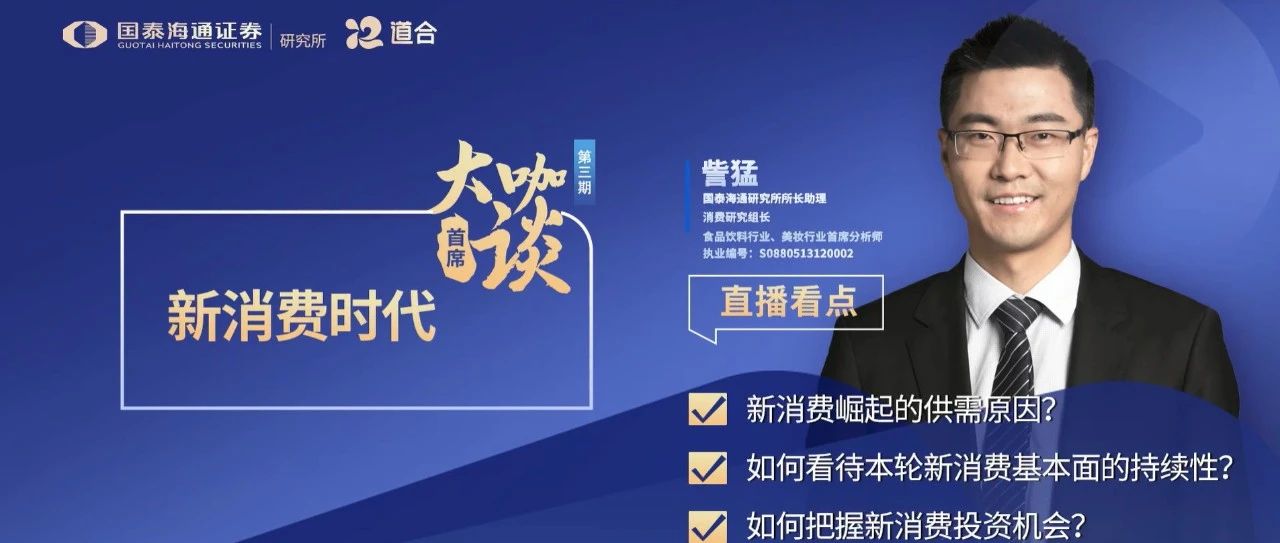
国泰海通 · 首席大咖谈|精彩回放:食饮/化妆品訾猛谈新消费
国泰海通证券研究· 2025-08-04 14:50
查看完整回放 ▼ 更多国泰海通研究和服务 亦可联系对口销售获取 本订阅号所载内容仅面向国泰海通证券研究服务签约客户。因本资料暂时无法设置访问限制,根据《证 券期货投资者适当性管理办法》的要求,若您并非国泰海通证券研究服务签约客户,为保证服务质量、 控制投资风险,还请取消关注,请勿订阅、接收或使用本订阅号中的任何信息。我们对由此给您造成的 不便表示诚挚歉意,非常感谢您的理解与配合!如有任何疑问,敬请按照文末联系方式与我们联系。 法律声明 重要提醒 本公众订阅号(微信号: GTHT RESEARCH )为国泰海通证券股份有限公司(以下简称"国泰海通证券") 研 ...

国泰海通|家电:割草机器人赛道迎来“奇点”时刻——割草机器人行业
国泰海通证券研究· 2025-08-04 14:50
报告导读: 割草机器人赛道迎来"奇点"时刻,具备技术领先优势和出海经验的企业有望胜 出。 目前,无边界智能割草机器人掀起了割草机全行业科技创 新的浪潮。 相较依赖于密集的人力劳作和燃油动力的传统割草机,智能割草机器人年平均成本仅为 183 美元左右,凭借着节省人力成本、方便户主操作、能源损耗低且环境友好、功能多元、割草效率高等优势,受到广大消费者青睐。同时,无边界智能割 草机器人仍处于发展初期,众企业采取了各具优势的技术路径,其中 RTK+ 视觉融合是较为主流的技术路线,兼备高精度定位功能和强大的视觉系统的感知 能力,且可以快速适应复杂地形和多变天气,并保证信号的稳定性,还可以根据草坪大小、边界和障碍物分布智能规划割草路线,避免重复和遗漏,显著提升 割草效率。 割草机市场庞大成熟,智能割草机器人潜在市场空间高达 300 万台。 欧美国家近 2 亿私家花园催生了对草坪维护的刚性需求,加之园艺文化、消费者教 育、法律规定的共同作用,塑造了年销额高达 82.92 亿美元的割草机市场。然而,割草机器人全球渗透率仍处于较低水平,欧洲地区相对高,美国则不足 5% ,主要是草坪规格、政策、渠道等层面上的差异所导致的。总体来 ...

国泰海通|策略:稳固优化:中国权益仍具备上行动能
国泰海通证券研究· 2025-08-04 14:50
Group 1 - The article highlights concerns about the resilience of the US economy due to significant downward revisions in employment data, which may impact market perceptions and bond yield configurations [1] - The outlook for A-shares remains highly optimistic due to continuous upgrades in economic sentiment, strong government support for capital markets, stable market liquidity, improving risk appetite, and optimized micro trading structures [1] - The article suggests that multiple factors are likely to support the performance of Chinese assets, maintaining a tactical overweight view on A-shares [1] Group 2 - The article maintains a tactical overweight view on US equities, despite short-term doubts about economic resilience stemming from employment data revisions [2] - It notes that global geopolitical conditions have eased, leading to reduced concerns over oil supply, while global oil demand remains weak, resulting in a tactical underweight view on oil [2] - The article emphasizes that the strong risk appetite is beneficial for supporting the stability of the RMB exchange rate, maintaining a tactical benchmark view on the currency [2]

国泰海通|计算机:数智转型AI渗透,券商金融科技竞赛进行中
国泰海通证券研究· 2025-08-04 14:50
Core Insights - The report highlights the increasing investment in information technology by leading domestic securities firms, with the top ten firms investing over 1.5579 billion yuan in 2024, reflecting a slight increase of 1.4% compared to 2023 [1][2] - The report emphasizes the importance of technology investment in enhancing customer experience, driving business growth, improving operational efficiency, and reducing risk costs, particularly in light of the ongoing AI revolution in the financial sector [3] Group 1: Investment Trends - In 2024, the top ten securities firms for information technology investment are all major players, with Huatai Securities and Guotai Junan exceeding 2 billion yuan in spending [1] - Among the top ten firms, seven reported an increase in their technology investment, while three experienced a decline [1] - The firms with the highest growth rates in technology investment include First Capital Securities, Caida Securities, and Everbright Securities, all exceeding 20% growth [1] Group 2: Profitability and Revenue Ratios - The top ten securities firms' technology investment amounts account for over 10% of their net profits, with the highest ratios seen in Guotou Securities, CICC, and Huatai Securities [2] - Most firms in the top ten have technology investment ratios exceeding 7% of their operating revenue, with only Galaxy Securities and Shenwan Hongyuan falling below this threshold [2] Group 3: Workforce and Technology Personnel - The report notes that seven of the top ten firms disclosed their number of technology personnel, with four firms having technology staff constituting over 7% of their total workforce [3] - The firms with the highest proportions of technology personnel include China Merchants Securities (16.3%), Shenwan Hongyuan (8.6%), CICC (7.4%), and GF Securities (7.1%) [3]

国泰海通|金工:综合量化模型和日历效应,8月大概率小市值风格占优、价值风格占优
国泰海通证券研究· 2025-08-04 14:50
Group 1: Market Strategy Insights - The report indicates that small-cap stocks are likely to outperform in August, supported by a quantitative model signal of 0.5, suggesting an overweight position in small-cap stocks [1] - Year-to-date, the small-cap strategy has yielded a return of 15.74%, outperforming the equal-weight benchmark return of 11.79% by 3.95% [1] - The value-growth rotation strategy shows a quantitative model signal of -0.33, indicating a shift towards value stocks, with a year-to-date return of 11.11% and an excess return of 7.63% [2] Group 2: Factor Performance Tracking - Among eight major factors, volatility and value factors have shown positive returns this month, while liquidity and momentum factors have shown negative returns [2] - Year-to-date, volatility and quality factors have performed well, whereas liquidity and large-cap factors have underperformed [2] - The report highlights that the beta, investment quality, and momentum factors have positive returns this month, while residual volatility, mid-cap, and long-term reversal factors have negative returns [2] Group 3: Covariance Matrix Update - The report updates the factor covariance matrix as of July 31, 2025, which is crucial for predicting stock portfolio risks [3] - The covariance matrix is constructed using a multi-factor model that combines factor covariance and stock-specific risk matrices for accurate estimation [3]

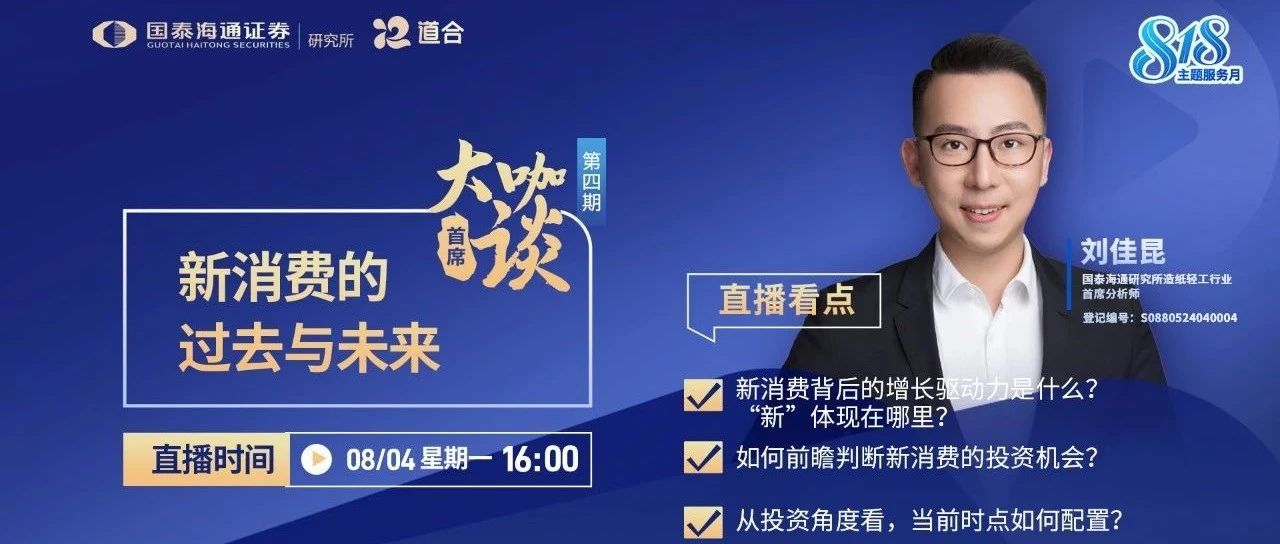
国泰海通 · 首席大咖谈|轻工刘佳昆:新消费的过去与未来
国泰海通证券研究· 2025-08-04 06:16
Group 1 - The core viewpoint of the article discusses the growth drivers behind new consumption and how to identify investment opportunities in this sector [2][4]. - The article emphasizes the characteristics of "new" consumption, highlighting the shifts in consumer behavior and preferences that define this trend [4]. - It provides insights on how to forecast and assess potential investment opportunities within the new consumption landscape [4].
国泰海通|“新宏观30讲”宏观框架报告系列电话会
国泰海通证券研究· 2025-08-03 13:50
Core Viewpoint - The article discusses the transformation of macroeconomic analysis frameworks, highlighting the revaluation of global assets, the migration of wealth allocation, and the rebalancing of great power competition in the current economic landscape [5]. Group 1: New Macro Analysis Framework - The article introduces a "New Macro" framework that signifies a significant change in the analysis of macroeconomic conditions [5]. - It emphasizes the importance of understanding the new clues related to global asset revaluation [5]. Group 2: Wealth Allocation Migration - The article outlines a "New Era" characterized by a major shift in wealth allocation strategies [5]. - It discusses how low interest rates influence asset allocation decisions among residents and financial institutions [5]. Group 3: Rebalancing of Great Power Competition - The article presents a "New Stage" focusing on the rebalancing of great power competition, particularly in the context of U.S.-China relations [5]. - It highlights the implications of U.S. fiscal policies, such as tax cuts and tariffs, on global economic dynamics [5].