TENCENT(00700)

Search documents
“薅羊毛”激战正酣基金销售逐步进入“精耕细作”阶段
Zhong Guo Zheng Quan Bao· 2026-01-18 20:45
Core Viewpoint - The competition among leading internet fund sales platforms to attract high-net-worth clients has intensified in 2026, with platforms offering various incentives and promoting "transfer custody" services to facilitate fund movement [1][4]. Group 1: Competition for High-Net-Worth Clients - Major platforms like Ant Wealth, Tencent Finance, and JD Finance are actively competing for high-net-worth clients by introducing various membership tiers and benefits [2][3]. - Ant Wealth has launched higher-tier cards targeting ultra-high-net-worth clients, while other platforms have quickly followed suit with their own offerings [2][3]. - Social media discussions have surged around the comparison of benefits and incentives offered by different platforms, highlighting the competitive landscape [3][4]. Group 2: Transfer Custody Services - Several platforms have developed detailed "transfer custody" guides to assist investors in moving their funds from one platform to another, indicating a direct effort to capture high-net-worth clients [4][5]. - The popularity of these guides reflects the growing demand from investors for easier fund management and better service experiences [6][7]. Group 3: Shift in Industry Focus - The new regulations effective from January 1, 2026, require fund sales institutions to prioritize investor interests and long-term returns, shifting the focus from merely selling products to retaining clients and ensuring profitability [5][6]. - The industry is transitioning from a rapid growth model based on traffic and scale to a more refined approach that emphasizes customer value and service quality [5][6]. Group 4: Enhanced Wealth Management Services - Platforms are increasingly offering comprehensive wealth management services, moving beyond basic transaction functionalities to meet the evolving needs of high-net-worth clients [7][8]. - Services such as wealth analysis reports, exclusive financial advisors, and personalized investment tools are being introduced to enhance user experience and build trust [8][9]. Group 5: Building Trust and Long-Term Relationships - The competition is not solely based on incentives; platforms are focusing on establishing trust and long-term relationships with clients through improved service offerings and transparency [9][10]. - The transition from "traffic operation" to "trust management" is seen as essential for sustainable growth in a low-fee environment [9][10].


中国式科技推动智慧场景升级 小程序跨境交易金额增超七成
Nan Fang Du Shi Bao· 2026-01-18 16:16
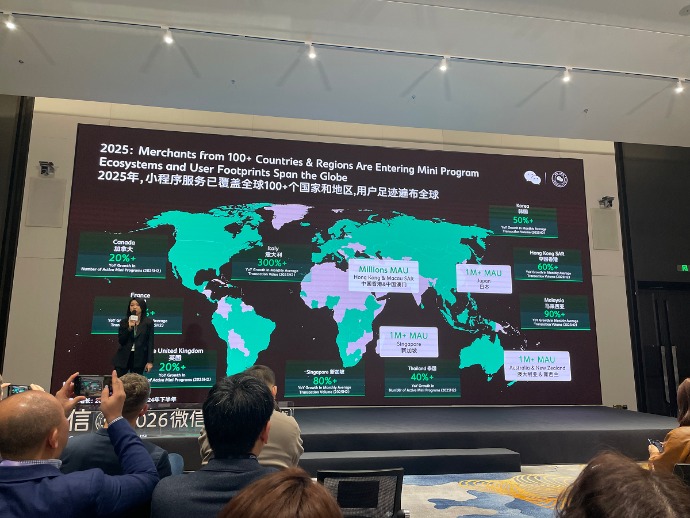
Core Insights - WeChat's cross-border ecosystem data reveals significant growth in cross-border transactions and user engagement in 2025, particularly in countries like Malaysia, New Zealand, and the UK [1][3]. Group 1: Cross-Border Payment Growth - In 2025, WeChat's cross-border payment services expanded to 78 countries and regions, supporting 36 currencies [3]. - The fastest-growing countries for transaction volume include Malaysia, New Zealand, the UK, Australia, and South Korea [3]. - The number of active overseas merchants using mini-programs increased by over 30% year-on-year [3]. Group 2: User Transaction Growth - In the second half of 2025, transaction amounts for three user categories saw significant growth: outbound Chinese users increased by over 60%, local overseas users by over 70%, and inbound users by over 50% [3]. - Monthly transaction volume in the transportation sector via mini-programs grew by over 140%, while the restaurant service sector saw a 50% increase [3]. Group 3: Regional Performance - Notable regional performance includes Malaysia with a monthly transaction volume surge of over 90%, Singapore with an 80% increase, and Italy achieving a remarkable 300% growth in monthly transaction amounts [3]. Group 4: International User Engagement - Foreign visitors to China using WeChat to bind overseas bank cards saw transaction volume more than double, with duty-free shop spending increasing sixfold [4]. - WeChat Pay's "outbound use" has expanded to support 29 overseas wallets, covering users in over 12 countries and regions [4].

未来的机会在这里!任泽平带你看前沿科技
泽平宏观· 2026-01-18 16:05
Core Insights - The article emphasizes the importance of practical learning experiences in the field of investment and technology, highlighting the value of direct engagement with leading companies and experts in various industries [2][7][19]. Schedule Overview - The schedule for 2026 includes visits to major tech companies and universities, such as NVIDIA, Tesla, and Stanford University, focusing on cutting-edge technologies and innovations [3][4][5]. - Specific events include closed-door research meetings on AI and technology trends, as well as visits to companies like Huawei, BYD, and others in the robotics and AI sectors [18][19][57]. Company Engagement - The program aims to connect entrepreneurs with top executives and scientists to gain insights into strategic decisions and technological advancements [7][19]. - Participants will explore various sectors, including AI, robotics, and new energy, through hands-on experiences and discussions with industry leaders [19][57]. Learning Philosophy - The initiative promotes a philosophy of "reading extensively and traveling widely," encouraging participants to learn from real-world applications and innovations in technology [2][38]. - The focus is on fostering a mindset of long-term thinking and ethical business practices among entrepreneurs [2][40].





恒生科技指数暴涨3%,腾讯控股市值重返港股前三
Sou Hu Cai Jing· 2026-01-18 15:11
Group 1: Core Drivers - Policy incentives are accelerating, with the central economic work conference emphasizing "technological innovation" and the Ministry of Industry and Information Technology promoting domestic AI chip procurement, establishing a 100 billion yuan industry fund, and aiming for a 70% localization rate of key equipment by 2025 [1] - Global liquidity is improving, as the central bank's 0.5% reserve requirement ratio cut releases 1.2 trillion yuan in liquidity, alongside a reduction in long-term holding risk factors for insurance companies, releasing approximately 20 billion yuan in capital [1] - The Hang Seng Tech Index constituents are showing strong performance, with companies like SMIC reporting a nearly 130% quarter-on-quarter net profit increase, and Li Auto's retail penetration rate for new energy vehicles exceeding 50% for the first time [1] Group 2: Tencent's Financial and Strategic Dynamics - Tencent's revenue for 2024 is projected at 660.3 billion yuan, an 8% year-on-year increase, with net profit expected to reach 194.07 billion yuan, reflecting a 68% growth [4] - The AI strategy is being upgraded with the MoE architecture for the Mix Yuan model, applied in over 700 scenarios, and a partnership with DeepSeek has driven the DAU of the Yuanbao App to 3.6 million [4] - Tencent's capital expenditure on AI is projected to be 76.7 billion yuan in 2024, a 221% increase, but efficiency improvements in GPU and cloud business returns are expected to cover costs, keeping profit margin pressures manageable [4] Group 3: Market Impact and Future Outlook - Structural opportunities are emerging in sectors like technology, consumption, and pharmaceuticals, driven by policy and demand, particularly in the AI industry chain, new energy vehicles, and biomedicine [6] - The Hang Seng Tech Index's price-to-earnings ratio is approximately 23 times, significantly lower than that of the Nasdaq and ChiNext, indicating strong value [7] - Institutional earnings forecasts for the Hang Seng Tech Index are optimistic, with a projected 42.6% earnings growth rate by 2026, and Tencent's gaming business expected to grow by 10% in 2025 [7]
中国所有互联网公司市值加起来,竟然不如一个 Google?劝劝巨头们 别再卷了 通过免费打压行业对手追求垄断
Xin Lang Cai Jing· 2026-01-18 13:23
Core Viewpoint - The market capitalization of Google (Alphabet) is approximately $4 trillion, while the combined market capitalization of China's top internet companies is only about $1.8 trillion, indicating a significant disparity in valuation and market perception [25][28][30]. Market Capitalization Comparison - As of the end of 2025 or early 2026, the estimated market capitalizations of major companies are as follows: - Google (Alphabet): ~$40,000 million - Tencent: ~$5,917 million - Alibaba: ~$3,333 million - Xiaomi: ~$1,987 million - Pinduoduo: ~$1,486 million - Meituan: ~$975 million - NetEase: ~$852 million - JD: ~$471 million - Trip.com: ~$383 million - Kuaishou: ~$345 million - Tencent Music: ~$302 million - The total market capitalization of the top 10 Chinese internet companies is estimated to be around $17,000–20,000 million, which is more than 2.2 times less than that of Google [28][3][25]. Competitive Landscape - The primary issue in the Chinese internet sector is not a lack of effort but rather a misdirection in competitive strategies, focusing excessively on user acquisition, subsidies, and speed, leading to a dangerous cycle of competition [30][5]. - This competitive model, which relies on free services to gain scale and eliminate competitors, is damaging long-term sustainability in the industry [31][32]. Impact on Entrepreneurship - The current environment is systematically clearing out entrepreneurs, reducing their roles to mere tools for larger platforms, and stifling genuine innovation [34][37]. - The lack of reasonable pricing, stable profits, and long-term investment in research and development is leading to fewer companies being profitable and surviving [35][36]. Employment Challenges - The concentration of the industry into a few dominant platforms is contributing to job losses, with monopolistic structures eliminating positions rather than technological advancements like AI [39][10]. - As industry profits shrink, salaries are also compressed, leading to fewer job opportunities for young people [11][39]. Comparison with Google - Google’s strength lies not in the number of applications but in its focus on foundational capabilities, allowing ecosystem partners to thrive and generating productivity-based revenue rather than merely capturing attention [40][41]. - The competitive landscape in China, characterized by internal strife, hinders the emergence of globally competitive companies [41][42]. Future Outlook - If the current competitive practices continue, the industry may end up with a few platforms and many dependent entities, leading to a degraded ecosystem rather than a mature industry [42][45]. - A healthy internet ecosystem should support entrepreneurship and job creation, rather than relying solely on free services as a competitive tool [44][51].



网络骂战二十年,从没好好说过理
凤凰网财经· 2026-01-18 13:15
Core Viewpoint - The article discusses the evolution of online disputes in China, highlighting how they have escalated from anonymous forum arguments to public confrontations and legal battles, reflecting the growing intensity and complexity of internet culture and conflicts in the digital age [1][2][3][4][5]. Group 1: Historical Context of Online Disputes - The evolution of internet argumentation has progressed from early anonymous exchanges to real-name confrontations and live debates, indicating a shift in how disputes are handled online [3][4]. - Legal frameworks are increasingly relied upon to resolve disputes when consensus cannot be reached, marking a transition from informal to formal resolution mechanisms [5]. Group 2: Notable Disputes - The "Fang-Han War" in 2012, sparked by a blog post questioning the authenticity of writer Han Han, became a significant cultural event, showcasing the power of social media in shaping public opinion [6][7][8]. - The conflict escalated with Han Han offering a reward for evidence of ghostwriting, leading to a split in public opinion and further involvement from prominent figures like Fang Zhouzi, who intensified the scrutiny on Han Han's works [10][16][20]. - The "3Q War" between Tencent and Qihoo 360 highlighted the commercial aspects of online disputes, with both companies engaging in public and legal battles over user privacy and market dominance [21][22][31][32]. Group 3: Personal Confrontations in the Tech Industry - The 2014 live debate between Wang Ziru and Luo Yonghao over the evaluation of the Smartisan phone exemplified how personal and professional conflicts can draw massive public attention, with 2.5 million viewers tuning in [40][47]. - The debate showcased contrasting styles, with Luo presenting a prepared defense while Wang focused on clarifying his evaluation, leading to a heated public discourse [51][52][54]. Group 4: Escalation to Physical Confrontations - The incident between Wu Faitian and journalist Zhou Yan illustrates how online disputes can spill over into physical confrontations, culminating in a chaotic public altercation involving eggs and accusations of organized violence [56][68][75]. - This event reflects a concerning trend where online disagreements transition into real-world conflicts, raising questions about the societal implications of such behavior [78][81]. Group 5: Future of Online Disputes - As the internet matures, there is a movement towards more regulated and structured forms of discourse, with calls for disputes to be handled through media channels rather than public confrontations [81]. - The evolution of online conflict resolution indicates a shift towards a healthier internet ecosystem, where emotional outbursts are replaced by institutional frameworks for discussion and debate [81].



千问App全面接入阿里生态,ChatGPT新增广告功能
GF SECURITIES· 2026-01-18 12:06
Core Insights - The report maintains a bullish outlook on the internet sector, particularly e-commerce, social entertainment media, internet healthcare, short videos, and IP-related markets, driven by advancements in AI applications and product innovations [3][17][22]. E-commerce - The report continues to recommend Alibaba in the e-commerce sector, highlighting the recent AI application developments that are expected to catalyze growth. The MAU of the Qianwen app has surpassed 100 million, indicating strong user engagement [3][17]. - JD.com is projected to experience marginal improvements after a weak growth quarter in Q4 2025, maintaining a buy rating [3][17]. Social Entertainment Media - Bilibili and Tencent are noted for their strong advertising momentum, with Tencent's gaming fundamentals improving. The report anticipates the release of new games from both companies, enhancing their product offerings [3][17][22]. - Tencent's game "Delta Action" is expected to become a significant title alongside "Honor of Kings" and "Peacekeeper Elite" [3][17]. Internet Healthcare - JD Health and Alibaba Health are leveraging their leading platform advantages to deepen collaborations with upstream pharmaceutical manufacturers, resulting in strong revenue and profit growth [3][17]. Short Videos - Kuaishou is recognized for its stable core business and technological leadership in AI, with ongoing efforts to optimize user engagement and monetization through advanced recommendation systems [3][17][22]. IP and Trendy Toys - Pop Mart is expanding its overseas supply chain, with recent shipments from partners in Indonesia, Cambodia, and Mexico, indicating a robust international strategy [3][17]. Long Videos - The report notes a recovery in the number of TV series registrations, with multiple platforms releasing high-quality content, suggesting investment opportunities in companies like iQIYI and Mango TV [3][17]. Music Streaming - Tencent Music and NetEase Cloud Music have shown stable performance, although concerns about competition have led to a valuation adjustment. The report emphasizes the importance of quality content in driving subscription growth [3][17][22]. Gaming Sector - The gaming industry is expected to maintain its growth trajectory into 2026, with a focus on leading companies like Tencent and NetEase, as well as emerging players with strong product pipelines [3][22]. Advertising - The report indicates stable advertising spending from Q1 flash purchase advertisers, with AI applications like Canva and Afu being utilized in advertising strategies, suggesting continued growth in the advertising sector [3][22]. AI Developments - The report highlights the current phase of intensive AI development in China, recommending attention to companies involved in AI model iterations and applications across various sectors [3][22].

被员工怒怼“磕了”,追觅CEO:我有肚量;AI恋人陪聊涉黄被判刑,2.4万人付费;马斯克、奥特曼又开撕|AI周报
AI前线· 2026-01-18 05:32
Group 1: AI-related Legal Issues - The first criminal case involving AI-related obscenity in China was brought to trial, with the accused facing charges for providing chat services through the AlienChat software, which had 116,000 users, including 24,000 paying members, generating over 3 million yuan in revenue [3][4]. - The court found that out of 12,495 chat segments sampled from paying users, 3,618 segments were deemed obscene, leading to convictions for the founders [4]. Group 2: Corporate Developments in Technology - Pursuing a goal to create the world's first trillion-dollar company, the CEO of Chasing Technology, Yu Hao, stated that achieving this target is not expected within a year, despite facing internal criticism from employees regarding ambitious strategic goals [5][6][7]. - Ctrip is under investigation for alleged monopolistic practices, with the company confirming it will cooperate with regulatory authorities [10][11]. - The "Dead or Not" app, previously renamed "Demumu," is seeking a new brand name after feedback indicated the original name was considered inauspicious [12]. Group 3: Semiconductor and Tariff Changes - The U.S. government announced a 25% tariff on certain imported semiconductors and related products, effective January 15, 2026, as part of ongoing trade policy adjustments [14][15]. Group 4: Talent Movements in AI - Chen Lijie, a notable figure from Tsinghua University's Yao Class, has joined OpenAI to focus on mathematical reasoning, alongside the return of former OpenAI executives [16][18]. Group 5: Legal Actions and Financial Claims - Elon Musk is suing OpenAI and Microsoft for up to $134 billion, claiming that OpenAI has deviated from its non-profit mission and misled him regarding its financial dealings [19][20]. - OpenAI has characterized Musk's lawsuit as part of a pattern of harassment rather than a legitimate economic claim [20]. Group 6: AI Infrastructure and Innovations - Elon Musk announced the operational status of the "Colossus 2" supercomputer, which is designed to support the Grok AI chatbot, with plans for further upgrades [24][25]. - Meta is launching a new infrastructure initiative called "Meta Compute" to enhance its AI capabilities, while also planning to cut about 10% of jobs in its Reality Labs division [26][27]. Group 7: New AI Models and Technologies - Baichuan Intelligence released a new medical AI model, Baichuan-M3, which outperformed GPT-5.2 in various assessments, showcasing advanced diagnostic capabilities [39]. - Tencent's WeDLM model aims to improve inference efficiency in AI applications, addressing traditional limitations in model performance [35].





数码家电行业周度市场观察-20260118
Ai Rui Zi Xun· 2026-01-18 05:08
Investment Rating - The report does not explicitly provide an investment rating for the digital home appliance industry Core Insights - The digital home appliance industry is undergoing a transformation driven by data quality and AI integration, with a focus on high-end market growth and consumer emotional value [2][5] - The report highlights significant trends in various sectors, including the rise of AI in logistics, healthcare, and retail, emphasizing the importance of data-driven decision-making and technological innovation [5][8] Industry Environment - Data quality is more critical than algorithms in determining the effectiveness of AI, with successful companies maintaining clean and unified data [2] - The 2025 report on China's high-end home appliance market indicates a 10.2% year-on-year growth in retail sales, driven by consumer demand for emotional value and quality [2] - The healthcare AI market is projected to reach 16.4 billion yuan in 2024, with significant advancements in efficiency and precision in medical applications [5] - The logistics sector is expected to grow to 965.5 billion yuan by 2025, transitioning from scale competition to value-driven strategies [5] - The smartphone market is experiencing a shift towards AI integration, with AI smartphones expected to account for 15% of global shipments by 2024 [5] - The retail industry is facing challenges in data integration and supply chain efficiency, with AI technologies being pivotal for transformation [5] Top Brand News - Honor aims to regain market share through AI smartphones and overseas expansion, facing competition from established players [19] - Ant Group is enhancing its C-end applications with AI health solutions, targeting the underserved market [20] - Xiaomi's flagship model features advanced AI capabilities, aiming to strengthen its hardware ecosystem [21] - DingTalk is expanding into AI hardware, marking a strategic shift in its offerings [21] - ByteDance is significantly increasing salaries to attract AI talent, reflecting the competitive landscape in the AI sector [23]
【数智周报】 谷歌DeepMind CEO:中国的AI模型仅落后美国几个月;DeepSeek开源相关记忆模块Engram;微软在人工智能上的支出将达到5...
Tai Mei Ti A P P· 2026-01-18 02:38
Group 1 - Keda Xunfei's Chairman Liu Qingfeng stated that the domestic AI infrastructure has taken initial shape, with domestic large models matching international standards despite having half the parameters [2] - Michael Burry warned that the era of tech giants earning huge profits with minimal investment is ending, primarily due to AI, and investors should focus on Return on Invested Capital (ROIC) rather than revenue growth [3] - A BlackRock survey revealed that while investors are optimistic about AI, they are shifting their investment focus towards energy and infrastructure suppliers, with only one-fifth considering large US tech companies as attractive investment opportunities [4] Group 2 - Demis Hassabis, CEO of Google DeepMind, indicated that Chinese AI models are only a few months behind those in the US and Western countries, with significant advancements made by Chinese developers [5] - DeepSeek released a new paper on conditional memory, significantly improving model performance in various tasks, and has open-sourced a related memory module [6] - Wang Xiaochuan, CEO of Baichuan Intelligent, mentioned that the company has 3 billion yuan on hand and may initiate an IPO plan in 2027 [7] Group 3 - Zhiyu and Huawei launched the first domestically trained multimodal SOTA model on local chips, achieving a full training process on the Ascend Atlas 800T A2 device [8] - Kuaishou announced that Keling AI's revenue exceeded $20 million in December 2025, with an annual recurring revenue (ARR) of $240 million [9] - Yongyou Network projected a net loss of 1.3 to 1.39 billion yuan for 2025, although it expects to reduce losses compared to the previous year [10] Group 4 - JD.com and Lenovo deepened their "hybrid AI" cooperation, launching new products at CES 2026, with a focus on strategic collaboration around smart devices and services [11] - Alibaba's Qianwen app integrated with various services, allowing users to order food and book flights through AI, marking a significant upgrade in functionality [12] - Alipay and partners released China's first AI commercial agreement, aimed at creating a universal language for AI tasks across platforms [13] Group 5 - Yunhai Medical launched the "YunJian AI Spirit," a product that reduces long-term costs for users by offering unlimited access to traditional Chinese medicine infrared algorithms [14] - Zhiyuan purchased thousands of hours of robot training data for various tasks [15] - Meituan released the open-source "ReThink" model, achieving state-of-the-art performance in several benchmarks [16] Group 6 - Teslian introduced the upgraded T-Cluster 512 super node architecture, designed for high-performance AI model training, with a total computing power exceeding 500 PFlops [17] - Keda Xunfei launched a marketing AI platform based on the "SuperAgent" framework, enhancing efficiency in marketing strategies [18] - The first domestically trained text-to-image model was released by Zhiyu and Huawei, completing the entire training process on local chips [19] Group 7 - Tencent Cloud ADP launched the first "AI-native Widget," enhancing task delivery experiences through natural language interaction [20] - Anthropic implemented stricter measures to prevent third-party tools from bypassing rate limits, affecting several developer projects [21] - Google announced a partnership with Walmart to expand AI model shopping capabilities, allowing direct transactions through its AI application [22] Group 8 - Mark Zuckerberg initiated the "Meta Compute" project, aiming to build substantial AI infrastructure by 2030, with a focus on collaboration with governments [23] - Meta plans to lay off hundreds of employees in its Reality Labs department, shifting focus from the metaverse to AI [24] - Alphabet's market value surpassed $4 trillion for the first time, joining a select group of companies [24] Group 9 - Nvidia and Eli Lilly will jointly invest $1 billion to establish an AI drug laboratory over the next five years [26] - The US relaxed export controls on Nvidia's H200 chips to China, potentially impacting the AI hardware market [27] - Microsoft announced a plan to limit the impact of data center energy costs and water usage on local communities [29] Group 10 - OpenAI is reportedly seeking US hardware suppliers for its planned consumer devices and cloud data center expansion [32] - Elon Musk's lawsuit against OpenAI is set to go to trial in late April [33] - OpenAI and Cerebras announced a partnership worth over $10 billion to deploy a large-scale AI inference platform [34] Group 11 - Zivariable Robotics completed a 1 billion yuan A++ round of financing, backed by major investors including ByteDance and Meituan [35] - Qiangnao Technology submitted a confidential IPO application in Hong Kong [36] - OpenAI agreed to acquire the AI health application Torch for approximately $100 million [37] Group 12 - K2 Lab, founded by a former DingTalk executive, secured tens of millions in seed funding to develop an AI-driven content e-commerce agent [38] - Alibaba Cloud completed a strategic investment in ZStack, achieving a controlling stake [39] - Skild AI raised nearly $1.4 billion in funding, reaching a valuation of over $14 billion [40] Group 13 - WeLab completed a $220 million D-round strategic financing, the largest single round since its inception [41] - Merge Labs, a brain-machine interface startup, raised $252 million in seed funding, with OpenAI as a major investor [42] Group 14 - A report indicated that by 2026, the Chinese tech giants index is expected to surpass the US tech giants in profitability growth for the first time since 2022 [43] - China is accelerating the establishment of a data property registration system to enhance data circulation and value [44] - Storage prices are expected to surge by 40%-50% in Q4 2025 and again in Q1 2026 due to increased demand from AI and server capacity [45] Group 15 - A new AI model developed by US researchers can predict the risk of approximately 130 diseases based on sleep data [46] - Foreign investment firms are increasingly incorporating AI into their research processes in the Chinese market [47] - UBS believes the probability of an AI bubble in China is low, with monetization relying on cloud services and advertising [48] Group 16 - The number of AI companies in China has exceeded 6,200, with applications expanding across various industries [49]