TENCENT(00700)

Search documents
陆家嘴财经早餐2026年2月14日星期六
Sou Hu Cai Jing· 2026-02-14 01:14
Financial Data - In January, China's social financing increased by 7.22 trillion yuan, up by 166.2 billion yuan year-on-year, while RMB loans rose by 4.71 trillion yuan, with a total balance of 276.62 trillion yuan, reflecting a year-on-year growth of 6.1% [1] - The weighted average interest rate for new corporate loans in January was approximately 3.2%, down by about 20 basis points year-on-year, while the rate for personal housing loans remained stable at 3.1% [3] - The M2 money supply grew by 9% year-on-year, and M1 increased by 4.9% [1] Real Estate Market - Data from the National Bureau of Statistics indicated that the month-on-month decline in second-hand housing prices in 70 cities narrowed, with first, second, and third-tier cities seeing reductions of 0.4, 0.2, and 0.1 percentage points respectively [1] - Year-on-year, new and second-hand housing prices in 70 major cities continued to decline, with the rate of decrease further widening [1] Stock Market Performance - The A-share market showed a positive trend in the post-Spring Festival period, with the Shanghai Composite Index rising by 4.85% in the first five trading days of 2024, marking the highest increase in nearly a decade [2] - The Shanghai Composite Index closed down by 1.26% at 4082.07 points on the last trading day before the Spring Festival, with a total market turnover of 2 trillion yuan [4] Regulatory Developments - The China Securities Regulatory Commission (CSRC) imposed strict penalties on Tianfeng Securities for illegal financing and information disclosure violations, with fines totaling 25 million yuan [4] - The State Administration for Market Regulation and the Ministry of Commerce announced enhanced supervision of cross-border e-commerce retail imports, focusing on recall regulations [3] Corporate News - Meituan projected a loss of over 23 billion yuan for the previous year, with continued losses expected in the first quarter of this year, primarily due to a significant decline in operating profit in its core local business segment [6] - The Hong Kong Stock Exchange is considering expanding the scope of confidentiality applications beyond technology and biotech sectors to include traditional industries [5]





交通运输部:全国已有396家平台公司取得网约车平台经营许可
Sou Hu Cai Jing· 2026-02-13 22:32
Summary of Key Points Core Viewpoint - As of January 31, 2026, a total of 396 ride-hailing platform companies have obtained operating licenses in China, with a slight increase of one company from the previous month. The regulatory information exchange system received 974 million orders in January 2023 [1]. Group 1: Order Compliance Rates - The top 10 platforms by order compliance rate (the percentage of orders where both drivers and vehicles are licensed) are ranked as follows: Fengyun Travel, Ruqi Travel, Jishi Ride, Xixing Ride, T3 Travel, Xiangdao Travel, Sunshine Travel, Caocao Travel, Didi Travel, and Huaxiaozhu Travel [1]. - The platforms with the highest growth in order compliance rates are Caocao Travel, Xixing Ride, and Xiangdao Travel, while the platforms with the lowest growth are Jishi Ride (-0.6%), Didi Travel (-0.7%), and Huaxiaozhu Travel (-3.0%) [1]. Group 2: Aggregator Platforms and Major Cities - Aggregator platforms, which provide services in conjunction with ride-hailing companies, completed 302 million orders, reflecting a month-on-month growth of 3.4%. The order compliance rates for these platforms are ranked as follows: Huaxiaozhu Travel, Didi Travel, Gaode Dache, Baidu Dache, Tencent Travel, Ctrip Travel, and Meituan Dache [3]. - Among major cities, the top ten by order compliance rate are Xiamen, Chengdu, Shenzhen, Hangzhou, Guangzhou, Nanjing, Jinan, Chongqing, Ningbo, and Qingdao, with all 26 cities reporting compliance rates above 80% [3].




北水成交净买入202.19亿 北水抢筹港股ETF及科技股 全天加仓盈富基金超36亿港元
Zhi Tong Cai Jing· 2026-02-13 21:54
Group 1 - The Hong Kong stock market saw a net inflow of 202.19 billion HKD from northbound trading, with 114.77 billion HKD from the Shanghai Stock Connect and 87.43 billion HKD from the Shenzhen Stock Connect [2] - The most net bought stocks included the Tracker Fund of Hong Kong (02800), Alibaba-W (09988), and Tencent (00700), while the most net sold stocks were Longi Green Energy (601869) and CNOOC (00883) [2][8] - Northbound trading showed significant interest in semiconductor stocks, with Huahong Semiconductor (01347) and SMIC (00981) receiving net purchases of 8.46 billion HKD and 5.73 billion HKD respectively [6] Group 2 - Tencent Holdings (00700) had a net inflow of 22.00 billion HKD, with total trading volume reaching 35.63 billion HKD [3] - Alibaba-W (09988) received a net inflow of 20.13 billion HKD, with a total trading volume of 28.70 billion HKD [3] - Meituan-W (03690) saw a net inflow of 10.35 billion HKD, with a total trading volume of 14.60 billion HKD [3] Group 3 - Huahong Semiconductor reported a fourth-quarter revenue of 659.9 million USD, a significant quarter-on-quarter increase of 22.4%, with a gross margin of 13.0% and a net profit of 34.1 million USD, reversing a previous loss [6] - SMIC also reported strong performance, contributing to the positive sentiment in the semiconductor sector [6] - CNOOC (00883) faced a net outflow of 1.43 billion HKD amid geopolitical tensions and market shifts towards supply-demand dynamics [7]




谁用腾讯会议谈恋爱啊
Sou Hu Cai Jing· 2026-02-13 16:52
Core Viewpoint - Tencent Meeting is positioned as a vital tool for maintaining relationships in long-distance romances, emphasizing its role in fostering trust and connection through formal and dedicated interactions [3][4][27]. Group 1: Emotional Value - The emotional value of Tencent Meeting surpasses other apps, as it transforms the experience of physical separation into a more connected and intimate interaction [5]. - The platform allows couples to share experiences, such as watching shows or studying together, which diminishes the feeling of distance [9][10]. Group 2: Communication Quality - Tencent Meeting facilitates deep conversations that are often lost in fragmented communication through other platforms like WeChat, allowing for uninterrupted and focused discussions [21][22][24]. - The formal nature of the meetings signals commitment and seriousness in the relationship, which helps to build trust [41][42]. Group 3: Trust and Frequency of Interaction - Trust issues in long-distance relationships often stem from a lack of frequent interactions; Tencent Meeting serves as a substitute for high-frequency reunions [30][35][37]. - The act of scheduling a meeting itself becomes a significant gesture, reinforcing the importance of the relationship [38][40]. Group 4: Record Keeping and Understanding - Tencent Meeting's features, such as real-time transcription and meeting minutes, enhance communication by providing a record of discussions, which can help couples navigate misunderstandings [57][60]. - The platform's ability to capture emotional nuances and context in conversations aids in understanding each other's feelings better [63]. Group 5: Coping with External Pressures - During challenging times, such as family gatherings, Tencent Meeting can help maintain connection and provide a space for couples to support each other amidst external pressures [66][78]. - The platform's features allow couples to share their experiences in real-time, fostering empathy and understanding [80][92].

南向资金持续“扫货”港股 房地产、金融等板块受青睐
Zheng Quan Ri Bao· 2026-02-13 15:42
Group 1 - Southbound funds have been actively purchasing stocks since the beginning of 2026, significantly supporting the Hong Kong stock market [1] - The Hang Seng Technology Index's price-to-earnings ratio is lower than that of most major global market indices, indicating strong investment value [1] - As of February 13, 2026, southbound funds have accumulated a net purchase amount of 152.84 billion yuan year-to-date, with 83.869 billion yuan in February alone [1] Group 2 - The top three industries for net purchases by southbound funds in the past month are real estate, finance, and consumer discretionary, followed by the information technology sector [1] - Insurance funds represent the highest proportion of southbound investments, accounting for approximately 25% of the total market value of Hong Kong stocks as of Q3 2025 [1] - The current shift of stable bond positions towards stock allocations is becoming a key source of incremental funds for dividend stocks [1] Group 3 - Leading companies and growth stocks, such as Tencent, Alibaba, and Meituan, are favored due to their stable cash flows [2] - The technology sector in the Hong Kong stock market is significantly undervalued, with a historical high valuation discount compared to A-shares, suggesting potential for a rebound [2] - International investors are increasing their holdings in insurance, internet, renewable energy, and industrial sectors [2] Group 4 - The Hong Kong stock market exhibits a clear liquidity stratification, with trading concentrated in a few large-cap core assets [2] - Newly listed companies tend to be small-cap stocks, which do not significantly impact the liquidity of core assets [2]
联邦式管理,还适配腾讯的 AI 野心吗?
Sou Hu Cai Jing· 2026-02-13 14:16
Core Viewpoint - The article discusses the organizational management challenges faced by Tencent in the context of AI transformation, highlighting a shift from a "federal" management model to a more centralized "Qin system" approach as companies navigate the AI competition [4][10]. Group 1: Tencent's Current Management and AI Strategy - Tencent's capital expenditure growth has slowed compared to expectations, particularly after 2025, despite initial increases [7]. - The company's current management model is lagging behind its business needs, necessitating a new round of organizational adjustments [4][11]. - Tencent's "federal" model, which allows for independent operations among its business units, may hinder overall efficiency and resource allocation, leading to potential conflicts in AI strategy implementation [5][9]. Group 2: Industry Trends and Comparisons - Other tech companies, such as Google and Alibaba, are adopting centralized management structures to enhance efficiency and resource allocation in their AI initiatives [4][5]. - The global trend is moving towards a "Qin system" where companies consolidate power to better manage resources and drive AI advancements [10]. - The need for companies to balance short-term profitability with long-term AI investments is becoming increasingly critical, as seen in the adjustments made by Alibaba and others [5][10]. Group 3: Future Outlook - There is uncertainty regarding whether Tencent can effectively adjust its organizational structure in the near future to better align with its AI ambitions [12]. - The management's ability to adapt and reorganize could determine Tencent's success in the competitive AI landscape [11].

支付行业信息保护树立标杆? 财付通个人信息保护获认证
Sou Hu Cai Jing· 2026-02-13 13:52
Core Viewpoint - The issuance of the "Personal Information Protection Certification" to Tenpay by the National Cybersecurity Review Certification and Market Regulation Big Data Center signifies a significant step in enhancing financial data security governance in the digital economy era [1][2]. Group 1: Certification Details - The certification process adhered to the GB/T 35273-2020 standard, involving a comprehensive audit of Tenpay's personal information handling practices, including collection, storage, usage, transmission, and deletion [1]. - The certification confirms that Tenpay has established a robust data security risk prevention system, ensuring compliance, appropriateness, and operational effectiveness of its protection mechanisms [1][2]. Group 2: Company Overview - Tenpay, as a core third-party payment platform under Tencent, supports WeChat Pay and QQ Wallet, serving over 1 billion online payment users and covering various payment scenarios [2]. - The company has prioritized user information protection as a strategic focus, implementing a dual security system combining technical defenses and human oversight [2]. Group 3: Industry Implications - The certification enhances Tenpay's user trust framework and serves as a model for compliance in the payment industry, demonstrating the practical value of personal information protection certification as a third-party evaluation system [2][3]. - The personal information protection certification system is evolving into a refined development stage, becoming a crucial support for the security of the digital economy, particularly in sensitive areas like payment [3]. - The National Cybersecurity Review Certification Center plans to expand the coverage of personal information protection certification, promoting compliance construction among leading industry institutions [3].

微信电脑版,有新功能!
Zhong Guo Jing Ji Wang· 2026-02-13 13:30
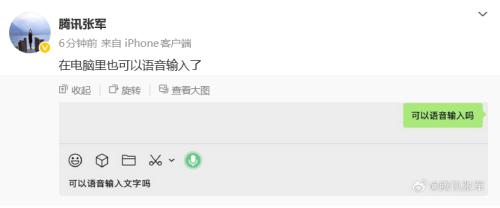
Group 1 - The core point of the article is that Tencent has introduced a voice input feature for its WeChat desktop application, allowing users to input text via voice without needing to hold down the voice button continuously [1][3]. - The announcement was made by Zhang Jun, Tencent's public relations director, highlighting the new functionality available in the WeChat desktop interface [1]. - Users have expressed excitement and anticipation for this feature, indicating a positive reception from the community [4].
大厂AI竞速,争抢超级入口|TMT年度盘点
Jing Ji Guan Cha Wang· 2026-02-13 13:17
Core Insights - In 2025, the technology and internet sectors are experiencing rapid changes, with major companies competing fiercely in computing power and large model applications, while also navigating regulatory challenges in e-commerce [2] - The era of easy financing through simple presentations is over, and companies must focus on technology, commercialization, and ecosystem advantages to survive [2] Group 1: Major Companies and Their Strategies - Tencent, Alibaba, and ByteDance are re-engaging in a traffic war, utilizing cash incentives to integrate AI into their platforms, with Tencent distributing 10 billion cash red envelopes and Alibaba offering 30 billion in incentives [2] - Alibaba plans to invest 380 billion yuan over the next three years, exceeding its total investment in the past decade, while ByteDance's capital expenditure is projected to reach 150 billion yuan in 2025 [4] - Tencent is heavily investing in NVIDIA and domestic GPUs, establishing AI research centers, and has ambitions to explore super entry points despite facing challenges with its red envelope strategy [4] Group 2: Technological Developments and Market Trends - The competition in AI is shifting from a focus on computing power to a more nuanced understanding of AI application value, with companies like Huawei proposing a critical point for AI application value to exceed energy costs [5] - Open-source models are becoming standard in 2025, with Alibaba's Qwen3 generating over 170,000 application scenarios globally, indicating a shift towards ecosystem vitality over mere user metrics [5] - The year 2026 is anticipated to be a turning point, with a few multi-modal foundational models likely to dominate the market, leading to the emergence of an intelligent agent internet [6]

打败你(恒生科技)的不是天真,是字节
Xin Lang Cai Jing· 2026-02-13 13:02
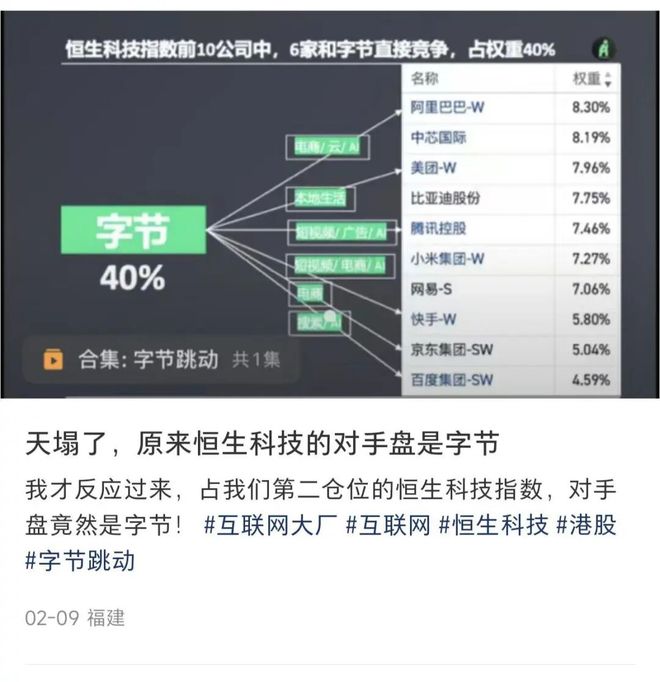
Core Viewpoint - The article discusses the dominance of ByteDance in the tech industry, particularly in the context of the Hang Seng Tech Index, highlighting how its aggressive strategies and innovative approaches have outpaced traditional competitors like Tencent and Alibaba [1][19][22]. Group 1: Competitive Landscape - ByteDance is described as a formidable competitor that has effectively created a "red ocean" in various sectors, challenging established players without being a publicly listed company [1][19]. - Among the top 10 companies in the Hang Seng Tech Index, 6 are in direct competition with ByteDance, collectively holding a 40% weight in the index [2]. - The article emphasizes that ByteDance's approach to competition is not merely about financial strength but about its relentless drive and adaptability in the market [1][19]. Group 2: Market Disruption - ByteDance's entry into e-commerce through Douyin (TikTok) has significantly impacted Alibaba, with Douyin's GMV projected to approach 4 trillion yuan by 2025, capturing a substantial market share [6][9]. - The article argues that ByteDance's innovative model of combining content with e-commerce is more effective than Alibaba's traditional search-based approach, leading to a shift in consumer behavior [6][9]. - The dominance of ByteDance in various sectors, including short videos, news, and AI, is highlighted, indicating its broad market influence [7][9]. Group 3: Management and Leadership - The core competitive advantage of ByteDance is attributed to its founder, Zhang Yiming, whose unique management style and continuous learning mindset set the company apart from its competitors [11][12]. - Zhang's approach to management emphasizes equality, flexibility, and a focus on talent density, allowing for a more dynamic and innovative corporate culture [12][13]. - The article suggests that ByteDance's ability to maintain efficiency and cross multiple sectors is a testament to its superior management capabilities compared to other tech giants [13][19]. Group 4: Industry Implications - The article posits that the ongoing competition in the tech industry is not just between companies but also a challenge for companies to adapt and innovate continuously [22][23]. - It warns that companies in the Hang Seng Tech Index must either learn from ByteDance's strategies or risk being outpaced and potentially eliminated from the market [22][23]. - The narrative concludes that the future of the tech industry will be shaped by companies that embrace change and innovation, with ByteDance leading the charge [22][23].