
CHINA TAIPING(00966)

Search documents
险企今年以来发债超700亿元 永续债成资本补充主力
Zhong Guo Zheng Quan Bao· 2025-11-20 20:09
Core Viewpoint - Insurance companies are accelerating capital replenishment as the transition period for the second phase of the solvency regulation approaches its end, with 19 companies issuing capital supplementary bonds or perpetual bonds totaling over 70 billion yuan this year, with nearly 70% being perpetual bonds [1][2] Group 1: Capital Supplementation Trends - As of November 20, 2023, 19 insurance companies have issued capital supplementary bonds or perpetual bonds, with a total issuance scale of 741.7 billion yuan, slightly down from the previous year but still at a high level [1][2] - Half of the issuing companies opted for perpetual bonds, with a total issuance close to 500 billion yuan, representing nearly 70% of the total [2] - Major issuers of perpetual bonds include Ping An Life (13 billion yuan), Taiping Life (9 billion yuan), ICBC-AXA Life (7 billion yuan), Taikang Life (6 billion yuan), and Sunshine Life (5 billion yuan) [2] Group 2: Cost of Issuance and Debt Management - The average coupon rate for the bonds issued this year is below 3%, with the highest at 2.8% and the lowest at 2.15% [2][3] - Some insurance companies are redeeming old bonds while issuing new ones to lower financing costs, as seen with China Merchants Jinhe Life redeeming an 8 billion yuan bond with a higher interest rate [3] Group 3: Regulatory Context and Future Outlook - The issuance of bonds is primarily driven by the need to enhance solvency and meet stricter regulatory requirements under the second phase of solvency regulations, which has seen a decline in solvency ratios [3] - The transition period for these regulations has been extended to the end of 2025, prompting insurance companies to expedite capital replenishment efforts [3] - Industry experts suggest that insurance companies should diversify their capital replenishment channels and improve their profitability and capital management efficiency for sustainable development [3]

月内超150亿元!险企发债“补血”迎小高潮
Guo Ji Jin Rong Bao· 2025-11-20 15:48
Core Viewpoint - Insurance companies are increasingly issuing perpetual bonds and capital supplementary bonds to enhance their capital and solvency, with a total issuance exceeding 15 billion yuan since November [1][2]. Group 1: Bond Issuance Trends - The total bond issuance by insurance companies has decreased compared to last year but remains at a high level, with a notable preference for perpetual bonds [1][2]. - In November, several insurance companies accelerated their bond issuance, including Zhongyou Life (1.27 billion yuan), Yingda Taihe Life (2.5 billion yuan), Zhongzheng Property Insurance (4 billion yuan), Ping An Property Insurance (6 billion yuan), and others [2]. - The primary purpose of these bond issuances is to supplement capital and enhance the companies' solvency to support sustainable business development [2]. Group 2: Factors Influencing Bond Issuance - The surge in bond issuance is attributed to multiple factors, including a favorable regulatory approval timeline and the need to address the impact of new accounting standards on solvency ratios [3]. - The relatively low financing costs have also encouraged insurance companies to issue bonds, with coupon rates ranging from 2.15% to 2.40%, significantly lower than the previous years' rates around 3.5% [3][4]. Group 3: Perpetual Bonds as a Financing Tool - Perpetual bonds have emerged as a new tool for capital supplementation, allowing insurance companies to meet regulatory capital requirements without a fixed maturity [5]. - The issuance of perpetual bonds has gained momentum since the regulatory framework was established in 2022, with major companies like Taikang Life leading the way [5][6]. - The total issuance of perpetual bonds in 2023 reached 35.77 billion yuan, with projections for 2024 indicating further growth [6]. Group 4: Long-term Capital Strategies - While bond issuance provides short-term capital relief, the long-term solution lies in enhancing the insurance companies' internal capital generation capabilities [7]. - Companies are encouraged to focus on high-quality development, optimize business structures, and improve operational efficiency to reduce reliance on external capital [7]. - Strengthening asset-liability management and leveraging technology for operational efficiency are essential for sustainable growth in the insurance sector [7].



港股收评:三大指数再跌,恒科指跌1.93%!黄金股大跌
Ge Long Hui· 2025-11-18 08:39
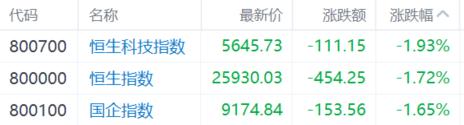
Market Overview - On November 18, global financial markets experienced a collective decline due to multiple factors affecting market risk sentiment, with Hong Kong's three major indices showing weakness throughout the day. The Hang Seng Index fell by 1.72%, closing below the 26,000-point mark, while the Hang Seng China Enterprises Index and the Hang Seng Tech Index dropped by 1.65% and 1.93%, respectively [1][2]. Sector Performance - Concerns over overvaluation in artificial intelligence have led to a continued decline in technology stocks. The spot gold price briefly fell below $4,000, causing significant drops in gold and non-ferrous metal stocks, with Lingbao Gold experiencing a nearly 9% decline. The steel sector also faced notable declines due to significant price drops throughout the year [2][5]. - The steel sector led the declines, with China Hanking down over 9%, Maanshan Iron & Steel down over 7%, and several other steel companies experiencing declines of over 5%. A report from CITIC Construction indicated that the steel price is expected to decline significantly by 2025 due to supply-demand mismatches and weakened cost support [5][6]. - The gold sector saw substantial losses, with Lingbao Gold down nearly 9% and other gold mining companies also experiencing declines of over 5% [6][8]. - The lithium battery sector continued to decline, with major companies like Cai Ke New Energy and Zhong Chuang Innovation falling over 10% and 8%, respectively [10]. - The automotive sector faced a downturn, with sales data indicating a 0.8% year-on-year decline in retail sales for October, and a significant drop in November sales figures [11][12]. Investment Trends - Southbound funds recorded a net inflow of HKD 7.466 billion, with the Shanghai-Hong Kong Stock Connect and Shenzhen-Hong Kong Stock Connect seeing net purchases of HKD 2.745 billion and HKD 4.721 billion, respectively [15]. - Looking ahead, Guosen Securities noted that the upcoming Central Economic Work Conference in December will set the tone for macro policies and key tasks for the following year, influencing investment strategies and stock valuations [17].





2026年保险行业策略报告:高弹性标签助力板块破圈,看好资负两端改善趋势-20251118
Shenwan Hongyuan Securities· 2025-11-18 06:53
Core Insights - The insurance sector is characterized by a "high elasticity" label, with a significant profit increase driven by investment performance, as evidenced by a 68% year-on-year profit growth in Q3 2025, with investment performance contributing 79% of the pre-tax profit increment for the first three quarters [3][11][12] - The "14th Five-Year Plan" emphasizes strong rule of law, strict regulation, risk mitigation, and development promotion, indicating a strategic focus on enhancing the legal framework and regulatory environment for the insurance industry [3][27][28] - The ongoing "anti-involution" policy is expected to boost dividend insurance, while property insurance is undergoing comprehensive governance to improve high-risk insurance types [3][19][27] - The strategic positioning of insurance assets is evolving, with a notable increase in stock and fund investments by listed insurance companies, projected to reach an additional 875.2 to 943.4 billion yuan in A-shares from 2025 to 2027 [3][11][19] - The insurance sector's valuation recovery is anticipated to continue, with recommendations to focus on undervalued, high-elasticity stocks such as China Life, Ping An, and others [3][19][21] Review of Performance - The insurance sector index has risen by 13.5% since the beginning of the year, underperforming the CSI 300 index by 4.1 percentage points [6][10] - In Q3 2025, the total net profit of listed insurance companies reached 426 billion yuan, a year-on-year increase of 33.5%, with significant contributions from investment performance [11][12][19] Policy Outlook - The "15th Five-Year Plan" outlines key directions for the insurance industry, focusing on high-quality development, technological independence, and comprehensive reform [24][28] - The regulatory environment is expected to remain stringent, with a focus on risk mitigation and the promotion of sustainable growth in the insurance sector [27][31] Liability and Asset Management - The "anti-involution" policy is driving a shift towards dividend insurance, while property insurance is seeing a rationalization of competition [3][19][27] - The strategic focus on asset allocation is expected to enhance the investment capabilities of insurance funds, with a projected increase in equity market allocations [3][11][19] Investment Recommendations - The report suggests maintaining a focus on undervalued, high-elasticity stocks within the insurance sector, highlighting companies such as China Life and Ping An as key investment opportunities [3][19][21]


中国太平20251113
2025-11-14 03:48
Summary of China Taiping's Conference Call Company Overview - **Company**: China Taiping - **Industry**: Insurance Key Financial Performance - In the first half of 2025, China Taiping's net profit growth exceeded 60%, and net assets increased by 31% compared to the beginning of the year [2][3] - In Q3 2025, Taiping Life, a major subsidiary, reported a net profit increase of 370% for the quarter, with a year-to-date net profit growth also exceeding 60% [3] Strategic Focus and Transformation - The company successfully transitioned to a dividend insurance model, achieving a target where at least 50% of new single premiums come from this product by 2025 [2][7] - The focus for 2025 is on transformation rather than rapid growth, laying the groundwork for a strong start in 2026 [2][5] - The company is shifting towards a diversified product strategy, emphasizing traditional insurance 2.0 in the latter half of 2025 [2][5] Investment Strategy - In Q3 2025, China Taiping adjusted its investment strategy, increasing its allocation to A-shares, with 30% of new premium funds invested in this market [4][9] - The investment yield for the first half of 2025 was influenced by a conservative approach, but the company is now focusing on growth stocks in the A-share market [9][10] Tax and Regulatory Environment - The high effective tax rate in 2024 was due to losses under old accounting standards, leading to significant deferred tax assets [8] - The company expects a more accurate and lower effective tax rate after transitioning to new accounting standards in 2026 [8] Pension Ecosystem Development - China Taiping has made significant progress in building a pension ecosystem, with high occupancy rates in projects like Shanghai Wutong and Chengdu Furong [8] - The company has completed 5 to 6 major asset projects and is expanding through a light asset model to over seventy institutions [8] Competitive Positioning - The management team is highly market-oriented and committed to maintaining competitiveness through strategic execution and product diversification [6][7] - The company aims to balance between traditional and dividend insurance products while maintaining a competitive edge in the market [7] Future Outlook - China Taiping anticipates continued growth in net profit, value, and net assets, focusing on a stable investment strategy amid market uncertainties [10][11] - The company is optimistic about its stock price performance, believing it is undervalued compared to peers [17] Miscellaneous - The comprehensive cost ratio for Taiping Property & Casualty Insurance was 96.9% in the first half of 2025, marking a historical high [14] - The company is actively exploring new market opportunities while consolidating its existing positions in both domestic and international markets [14] This summary encapsulates the key points from the conference call, highlighting China Taiping's financial performance, strategic initiatives, investment strategies, and future outlook.
贯通金融动脉 互联互通赋能大湾区建设丨魅力湾区·相约南沙
Guo Ji Jin Rong Bao· 2025-11-13 06:10
Group 1: Financial Market Connectivity - The financial market connectivity in the Guangdong-Hong Kong-Macao Greater Bay Area is deepening, driven by reforms and opening up, with a cumulative transaction amount of 125 trillion yuan for the "Shenzhen-Hong Kong Stock Connect" by September 2025 [1] - The "Cross-Border Wealth Management Connect" has expanded, with a scale exceeding 120 billion yuan, indicating a growing cross-border financial service market [1] Group 2: International Competitiveness - Three financial center cities in the Greater Bay Area have entered the top ten in the Global Financial Centers Index (GFCI 38), reflecting an increase in international competitiveness [1] - The Greater Bay Area's financial industry is recognized for its large scale, comprehensive elements, and high degree of internationalization, positioning it among the global leaders [1] Group 3: Cross-Border Banking Initiatives - The establishment of WeBank's technology company in Hong Kong marks a significant step for domestic banks in international markets, with over 20 partnerships and intentions exceeding hundreds of millions of dollars [2] - Local banks are actively expanding their international presence, with Dongguan Bank's subsidiary opening in Hong Kong and other global financial institutions increasing their footprint in the Greater Bay Area [3] Group 4: Cross-Border Wealth Management - The "Cross-Border Wealth Management Connect" 2.0 has seen a 120% increase in participating individual investors compared to its previous version, indicating strong market response [4] - Securities firms are optimistic about the upcoming "Cross-Border Wealth Management Connect" 3.0, which is expected to expand beyond the Greater Bay Area to major cities like Beijing and Shanghai [5] Group 5: Cross-Border Insurance Services - The cross-border insurance services are improving, with over 90,000 vehicles insured under the "equivalent recognition" policy and health insurance serving over 150,000 individuals [7] - The insurance sector is actively developing cross-border products, with significant growth in new policies from mainland visitors to Hong Kong, reflecting a robust demand for cross-border insurance solutions [8] Group 6: Investment and Growth in the Greater Bay Area - China Taiping reported an investment scale of 120.3 billion HKD in the Greater Bay Area, highlighting the financial commitment to regional development [9] - The upcoming "2025 Greater Bay Area Technology and Financial Innovation Development Conference" aims to foster collaboration between technology and finance sectors, promoting sustainable growth in the region [13]




人工智能如何重塑再保险行业? 访太平再保险(中国)有限公司党委书记、总经理李立松
Jin Rong Shi Bao· 2025-11-12 13:17
Core Viewpoint - The introduction of the AI agent "Rui Shu" by Taiping Reinsurance (China) is a strategic move to enhance the competitiveness of the reinsurance industry and better serve the real economy, aligning with national policies on AI application in finance [1][2]. Group 1: AI Integration in Reinsurance - The development of "Rui Shu" aims to address industry challenges by integrating AI models with professional expertise, achieving over 90% accuracy in generating high-quality reinsurance contracts exceeding 100,000 tokens [2]. - AI is seen as a strategic necessity for the company, enhancing both internal efficiency and external service innovation, which are core competitive advantages in financial services [2][3]. - The reinsurance sector's unique characteristics, such as high professional barriers and compliance requirements, make traditional automation difficult, highlighting the need for AI to overcome efficiency bottlenecks [1][3]. Group 2: Challenges and Solutions - The reinsurance industry faces common challenges in AI integration, including the complexity of professional knowledge, compliance and risk management, talent development, and organizational restructuring [5][6]. - AI's application in reinsurance requires a careful balance between innovation and risk assessment, particularly in understanding which business areas are suitable for AI deployment [5]. - The company emphasizes the importance of building an open, collaborative, and healthy AI ecosystem within the industry, focusing on the systematic collection and definition of professional knowledge [6][7]. Group 3: Future Directions - The company plans to deepen its "AI+" strategy, aiming to enhance service levels, operational efficiency, innovation capabilities, and risk management through intelligent transformation [4]. - The introduction of AI functionalities into traditional tools, such as the global natural disaster risk analysis platform, demonstrates the commitment to integrating AI into existing processes for improved performance [4]. - The company recognizes the need for ongoing collaboration with industry peers and regulatory bodies to foster a robust AI ecosystem that supports sustainable growth and innovation [7].
中国太平(00966.HK)深度研究报告:兼具弹性 转型头雁估值修复可期
Ge Long Hui· 2025-11-11 12:47
Core Viewpoint - China Taiping is transforming into a dividend insurance leader, focusing on high-quality development and leveraging its strong capital structure to enhance profitability and growth potential [1][3]. Group 1: Life Insurance - The company is leading the transformation towards dividend insurance, with a continuous release of CSM (Contractual Service Margin) profits [1]. - In 2023, new business value (NBV) is recovering, although growth rates are fluctuating due to policy impacts; the new business value rate is second only to Ping An in the industry [1]. - The distribution channel is primarily agent-based, with ongoing reforms leading to improved performance; the bancassurance channel is optimizing both volume and price, driven by network expansion and enhanced policy quality [1]. - The premium structure remains dominated by traditional insurance, but dividend insurance accounts for 87.1% of first-year premiums, significantly higher than peers, indicating a positive shift in cost structure [1]. Group 2: Property Insurance - The property insurance business is mainly concentrated domestically, accounting for 86% of total operations, with steady growth driven by auto and non-water insurance [2]. - Domestic combined operating ratio (COR) is improving, gradually narrowing the gap with the top three players in the property insurance sector [2]. - Internationally, the property insurance segment, primarily in Hong Kong and Macau, is experiencing slower growth, with noticeable COR fluctuations [2]. - Reinsurance business has seen a reduction in scale this year, but the central COR has improved significantly [2]. Group 3: Asset Management - The asset management segment is experiencing steady growth, primarily driven by insurance premium inflows, with total managed assets exceeding HKD 2.65 trillion by mid-2025 [2]. - Net investment returns are declining due to interest rate impacts, with total investment returns showing significant volatility [2]. - The allocation structure is increasingly favoring bonds, maintaining a leading position compared to listed peers; equity allocation is also rising, placing the company at the median level within the industry [2]. Group 4: Investment Recommendations - The company's push for dividend insurance transformation is expected to reduce rigid costs from existing policies, alleviating pressure from declining interest rate spreads [3]. - The capital market's improved activity since last year presents opportunities for the company to capitalize on equity asset allocations, potentially leading to excess returns [3]. - The company is primarily focused on life insurance, with a projected PEV (Price-Embedded Value) valuation method indicating an expected target price of HKD 22.6, with a recommendation rating of "Buy" [3].
中金:25Q3险企NBV延续高增速 向后看负债端对股价影响或增强
Zhi Tong Cai Jing· 2025-11-11 07:50
Group 1 - The core viewpoint is that the new business value (NBV) of Chinese life insurance companies continues to show high growth, with optimistic outlooks for the liability side [2][1] - In 9M25, the NBV growth rates for major life insurance companies are as follows: China Life +76.6%, Ping An +46.2%, China Life +41.8%, and Taiping +31.2% [2][1] - The first-year premium value rates for Ping An and Taiping increased by 7.6 percentage points and 1.7 percentage points to 25.2% and 18.0%, respectively [2][1] Group 2 - The comprehensive cost ratio (CoR) for property insurance companies is improving, with the following year-on-year changes: China Property -2.1 percentage points to 96.1%, Ping An Property -0.8 percentage points to 97.0%, and Taiping Property -1.1 percentage points to 97.6% [3][1] - Regulatory measures have led to improvements in the quality and efficiency of auto insurance, and the current focus on non-auto insurance governance is expected to enhance profitability for leading property insurance companies [3][1] Group 3 - Net profits are experiencing significant growth, driven by strong stock market performance, with annualized total investment returns for China Life and Xinhua increasing by 1.0 and 1.8 percentage points to 6.4% and 8.6%, respectively [4][1] - Taiping and China Property's non-annualized total investment returns increased by 0.5 and 0.8 percentage points to 5.2% and 5.4%, while Ping An's non-annualized comprehensive investment return rose by 1.0 percentage point to 5.4% [4][1] Group 4 - The impact of the liability side on stock prices may increase, as the high investment return-driven market may be nearing its end, leading to a higher probability of weakened asset-side elasticity [5][1] - The focus should be on optimizing liability product structures, reducing costs, and highlighting growth trends in quality life insurance [5][1] - The industry ranking remains as follows: Ping An (601318.SH), China Taiping (00966), China Taiping (601601.SH), China Life (02628), and China Property (601319) [5][1]
中国太平(00966):深度研究报告:兼具弹性,转型头雁估值修复可期
Huachuang Securities· 2025-11-10 08:40
Investment Rating - The report assigns a "Buy" rating for China Taiping (00966.HK) with a target price of HKD 22.6 [1][6][9] Core Views - China Taiping is positioned as a leader in the transformation towards participating insurance, with a strong potential for valuation recovery. The company is actively pushing for this transformation, which is expected to reduce rigid costs from new policies and alleviate the pressure from declining interest rates [8][9][10] Financial Performance - The projected insurance service revenue for 2024 is HKD 22,024 million, with a year-on-year growth of 18.8%. The net profit attributable to shareholders is expected to reach HKD 8,432 million, reflecting a significant year-on-year increase of 36.2% [2][3] - The earnings per share (EPS) for 2024 is forecasted at HKD 2.35, with a price-to-earnings (P/E) ratio of 7.8 [2][3] Business Segments Life Insurance - China Taiping's life insurance segment is a key driver, contributing approximately 80% of the net profit. The new business value (NBV) has started to recover in 2023, with a year-on-year increase of 23% to HKD 6.8 billion in 2025H1 [6][32] - The company has a robust channel structure, primarily through individual agents, with a significant shift towards participating insurance, which accounted for 29% of the new business in 2025H1 [32][52] Property and Casualty Insurance - The domestic property and casualty insurance business is gradually improving, with a combined ratio (COR) of 95.5% in 2025H1, indicating a year-on-year improvement [59][60] - The overseas property and casualty insurance segment, primarily in Hong Kong and Macau, has shown slower growth, contributing 14% to the overall property and casualty business [67] Asset Management - The asset management segment has seen steady growth, with total managed assets exceeding HKD 2.65 trillion as of 2025H1. The investment performance has been influenced by interest rates, with a focus on equity allocations expected to yield strong beta opportunities [6][9][10] Valuation and Estimates - The report utilizes the Present Value of Embedded Value (PEV) method for valuation, predicting an embedded value per share (EVPS) of HKD 56, 64.6, and 74.1 for 2025, 2026, and 2027 respectively. The current dynamic PEV is estimated at 0.33x for 2025 and 0.28x for 2026, with a target PEV of 0.35x for 2026 [9][10]