
KUAISHOU(01024)

Search documents
快手捐赠500万港元支援香港火灾救援及灾后恢复
Xin Lang Cai Jing· 2025-11-27 15:01
Core Viewpoint - Kuaishou announced a donation of 5 million HKD through the Beijing Kuaishou Public Welfare Foundation to support emergency rescue and post-disaster recovery efforts following a fire in Tai Po, Hong Kong [1] Group 1 - The company expressed deep condolences to the victims of the incident and high respect for the firefighters, medical personnel, and all those involved in the rescue efforts [1] - Kuaishou will continue to monitor the situation and collaborate with relevant organizations to support ongoing rescue and recovery work [1] - The company wishes for the affected residents to overcome difficulties and return to normal life as soon as possible [1]
古韵新声,快手达人高鹏用唢呐吹响黄土地上百态人生
Yang Guang Wang· 2025-11-27 10:25
在陕北,唢呐的曲子是这方水土中不可或缺的一种关乎生命的韵律。代代相传的子洲唢呐在时光中走过,以陕北群山为坐标的音乐标记,同信天游、秧 歌、剪纸、民俗等具有陕北文化内涵的所有事物交织于一体,成为整个陕北民间文化最嘹亮、高亢的文化符号。高鹏的唢呐启蒙,正是扎根于这样深厚的文 化土壤中。 回忆起学艺时光,高鹏说:"最基础的就是拔长音,每天早上起来,一个音一个音地练。"辛苦吗?他笑了笑:"那时候就像玩一样,挺好玩的。"十六七 岁时,他在一场农村婚礼上完成了首次登台。"紧张是肯定的,"他坦言,"但舞台多了就习惯了。"这把唢呐,从父亲手中传到他手里,传递的不仅是技艺, 更是一份责任。 陕北的传统里,唢呐有着严格的规矩。"红事要选喜庆的曲子,白事吹哀怨的曲牌,连曲名都很讲究。"高鹏细数着这些祖辈传下的规矩。然而,时代在 变,唢呐也需要新的声音。 《黄土谣》和《沸腾的大理河》的出现带来了转机。这两首由作曲家张伦创作,高鹏父亲首吹的新式唢呐曲,打破了传统曲牌的固定模式。这两首曲子 在保留陕北唢呐传统框架的基础上,借鉴现代协奏曲和交响乐的创作手法,改变了陕北传统唢呐全程粗犷豪放的风格,运用细腻多变的气息指法,使旋律在 强弱对比中 ...


港股科技ETF(159751)涨近1%,多重利好催化港股科技
Sou Hu Cai Jing· 2025-11-27 02:38
Core Viewpoint - The Hong Kong technology sector is experiencing a strong rally, driven by multiple favorable factors including increased expectations for Federal Reserve interest rate cuts and improved market liquidity, alongside significant revenue growth in Alibaba's cloud business and a resurgence in AI focus [1]. Group 1: Market Performance - As of November 27, 2025, the CSI Hong Kong Stock Connect Technology Index (931573) has seen a strong increase, with notable gains in constituent stocks such as Huahong Semiconductor (up 5.36%), Kangfang Biotech (up 4.89%), and Li Auto (up 3.87%) [1]. - The Hong Kong Technology ETF (159751) has risen by 0.73%, marking its fourth consecutive increase, with the latest price reported at 1.1 HKD [1]. Group 2: Influencing Factors - The recent rally in the Hong Kong technology sector is attributed to the anticipated easing of monetary policy by the Federal Reserve, which is expected to enhance liquidity in the market [1]. - The combination of the Federal Reserve's halt on balance sheet reduction and the relaxation of SLR regulations is expected to limit liquidity pressure in the medium term [1]. Group 3: Index Composition - The CSI Hong Kong Stock Connect Technology Index comprises 50 large-cap technology companies with high R&D investment and revenue growth, reflecting the overall performance of leading technology stocks within the Hong Kong Stock Connect [1]. - As of October 31, 2025, the top ten weighted stocks in the index include Alibaba-W, Tencent Holdings, and SMIC, collectively accounting for 66.81% of the index [2].


智通港股沽空统计|11月27日
智通财经网· 2025-11-27 00:25
Short Selling Ratios - Geely Automobile-R (80175), Kuaishou-WR (81024), and JD Health-R (86618) have the highest short selling ratios at 100.00% each [1][2] - China Ping An-R (82318) has a short selling ratio of 89.61%, while SenseTime-WR (80020) and China Resources Beer-R (80291) follow with 89.27% and 75.13% respectively [2] Short Selling Amounts - Alibaba-SW (09988) leads in short selling amount with 3.768 billion, followed by Meituan-W (03690) at 2.272 billion and Xiaomi Group-W (01810) at 1.584 billion [3] - Tencent Holdings (00700) and AIA Group (01299) also feature in the top five with short selling amounts of 1.242 billion and 0.582 billion respectively [3] Short Selling Deviation Values - China Ping An-R (82318) has the highest deviation value at 64.42%, indicating significant divergence from its historical short selling average [4] - Geely Automobile-R (80175) and Kuaishou-WR (81024) follow with deviation values of 56.33% and 40.21% respectively [4] - Baidu Group-SWR (89888) also shows a notable deviation value of 36.29% [4]


智通港股通资金流向统计(T+2)|11月27日




智通财经网· 2025-11-26 23:36
Key Points - On November 24, Alibaba-W (09988), Tencent Holdings (00700), and Kuaishou-W (01024) ranked the top three in net inflow of southbound funds, with net inflows of 4.06 billion, 1.168 billion, and 817 million respectively [1] - In terms of net outflow, SMIC (00981), CNOOC (00883), and Hua Hong Semiconductor (01347) led the market with net outflows of -1.033 billion, -380 million, and -336 million respectively [1] - In terms of net inflow ratio, Tuhu-W (09690), Yuexiu Transport Infrastructure (01052), and China Resources Beverage (02460) topped the market with ratios of 65.44%, 57.38%, and 53.66% respectively [1] - Conversely, China International Marine Containers (02039), Zhongzhou Securities (01375), and Zoomlion Heavy Industry (01157) had the highest net outflow ratios at -58.23%, -44.11%, and -43.10% respectively [1] Top 10 Net Inflow Stocks - Alibaba-W (09988) had a net inflow of 4.06 billion, representing a 13.22% increase, closing at 154.500 (+4.67%) [2] - Tencent Holdings (00700) saw a net inflow of 1.168 billion, with an 8.38% increase, closing at 624.500 (+2.38%) [2] - Kuaishou-W (01024) recorded a net inflow of 817 million, with a 17.96% increase, closing at 68.550 (+7.11%) [2] - Other notable stocks include Southern Hang Seng Technology (03033) with a net inflow of 634 million and a 6.56% increase, and Xiaomi Group-W (01810) with a net inflow of 484 million and a 5.33% increase [2] Top 10 Net Outflow Stocks - SMIC (00981) experienced the largest net outflow of -1.033 billion, with a -10.62% decrease, closing at 68.050 (-1.09%) [2] - CNOOC (00883) had a net outflow of -380 million, representing a -16.00% decrease, closing at 21.220 (-1.49%) [2] - Hua Hong Semiconductor (01347) saw a net outflow of -336 million, with a -6.02% decrease, closing at 69.650 (-4.91%) [2] - Other significant outflows included Innovent Biologics (01801) with -303 million and a -19.38% decrease, and Zijin Mining (02899) with -215 million and a -9.18% decrease [2] Top 10 Net Inflow Ratios - Tuhu-W (09690) led with a net inflow ratio of 65.44%, with a net inflow of 13.1377 million, closing at 17.130 (+1.90%) [3] - Yuexiu Transport Infrastructure (01052) followed with a net inflow ratio of 57.38%, with a net inflow of 2.1533 million, closing at 4.420 (+1.84%) [3] - China Resources Beverage (02460) had a net inflow ratio of 53.66%, with a net inflow of 1.74498 million, closing at 10.370 (-0.29%) [3]
智通ADR统计 | 11月27日
智通财经网· 2025-11-26 22:25
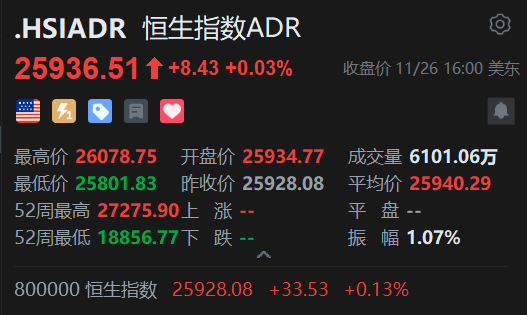
Market Overview - The Hang Seng Index (HSI) closed at 25,936.51, up by 8.43 points or 0.03% on November 26 [1] - The index reached a high of 26,078.75 and a low of 25,801.83 during the trading session, with a trading volume of 61.01 million shares [1] Stock Performance - Major blue-chip stocks showed mixed performance, with HSBC Holdings closing at HKD 109.799, up by 2.04% compared to the Hong Kong close [2] - Tencent Holdings closed at HKD 614.101, down by 0.87% compared to the Hong Kong close [2] Individual Stock Movements - Tencent Holdings (00700) reported a price of HKD 619.500, down by HKD 5.500 or 0.88%, with an ADR price of USD 614.101, reflecting a decrease of 0.87% [3] - Alibaba Group (09988) saw a decline of HKD 3.000 or 1.90%, with a latest price of HKD 154.800 and an ADR price of USD 153.233, down by 1.01% [3] - HSBC Holdings (00005) increased by HKD 0.800 or 0.75%, with a latest price of HKD 107.600 and an ADR price of USD 109.799, up by 2.04% [3] - AIA Group (01299) rose by HKD 1.450 or 1.83%, with a latest price of HKD 80.700 and an ADR price of USD 81.128, up by 0.53% [3] - Meituan (03690) increased significantly by HKD 5.550 or 5.65%, while other stocks like Baidu (09888) and Kuaishou (01024) experienced declines of 2.05% and 2.83% respectively [3]



快手-W(01024.HK)11月26日回购40.00万股,耗资2748.89万港元
Zheng Quan Shi Bao Wang· 2025-11-26 15:16
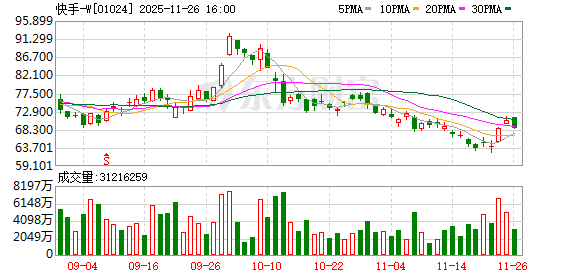
Core Points - Kuaishou-W announced a share buyback on November 26, purchasing 400,000 shares at a price range of HKD 68.650 to HKD 68.800, totaling HKD 27.49 million [2] - The stock closed at HKD 68.650 on the same day, reflecting a decline of 2.83%, with a total trading volume of HKD 2.16 billion [2] - Year-to-date, Kuaishou-W has conducted 29 buybacks, acquiring a total of 4.43 million shares for a cumulative amount of HKD 2.31 billion [2] Buyback Details - The latest buyback on November 26 involved 400,000 shares at a maximum price of HKD 68.800 and a minimum price of HKD 68.650, with a total expenditure of HKD 27.49 million [2] - Previous buybacks include: - November 21: 750,000 shares at a maximum price of HKD 64.250, totaling HKD 47.77 million [2] - November 20: 900,000 shares at a maximum price of HKD 64.950, totaling HKD 58.21 million [2] - October 14: 1.31 million shares at a maximum price of HKD 75.100, totaling HKD 98.41 million [2] - September 22: 1 million shares at a maximum price of HKD 74.300, totaling HKD 73.80 million [2]
港股通净卖出39.52亿港元


Zheng Quan Shi Bao Wang· 2025-11-26 15:15
Core Points - The Hang Seng Index rose by 0.13% to close at 25,928.08 points on November 26, with a net southbound capital outflow of HKD 39.52 billion through the Stock Connect [1][3] - The total trading volume for the Stock Connect on November 26 was HKD 917.88 billion, with a net outflow of HKD 39.52 billion [1][3] Trading Activity Summary - In the Shanghai Stock Connect, the trading volume was HKD 548.48 billion, with a net outflow of HKD 14.33 billion [1] - In the Shenzhen Stock Connect, the trading volume was HKD 369.40 billion, with a net outflow of HKD 25.18 billion [1] Active Stocks - Alibaba-W was the most actively traded stock in the Shanghai Stock Connect, with a trading volume of HKD 81.62 billion and a net inflow of HKD 7.51 billion, despite a closing price drop of 1.90% [1][2] - In the Shenzhen Stock Connect, Alibaba-W also led with a trading volume of HKD 51.54 billion and a net inflow of HKD 7.77 billion, with the same closing price drop of 1.90% [2] - Tencent Holdings had the highest net outflow in the Shenzhen Stock Connect, amounting to HKD 11.65 billion, with a closing price decrease of 0.88% [2] - Meituan-W and Xiaomi Group-W also featured prominently in trading, with respective trading volumes of HKD 36.34 billion and HKD 22.55 billion in the Shanghai Stock Connect [1][2]
恒生科技涨幅居前,医疗、互联网、大消费等紧随其后,银行相对弱势
Ge Long Hui· 2025-11-26 12:40
Group 1 - The Hang Seng Index has risen by 1.15%, with the Hang Seng Tech sector leading the gains, followed by healthcare, internet, and consumer sectors, while banks are relatively weak [1] - The consumer sector opened high and has maintained a strong position, currently up by 1.88%. Notable stocks include Xiaomi Group up by 5.33%, Baidu Group up by 3.94%, and Kuaishou up by 3.5%, with several others like Alibaba, SMIC, and BYD also showing gains around 2% [3] - The healthcare sector has also seen significant gains, currently up by 1.95%. Key performers include Kangfang Biotech up by 4.98%, CSPC Pharmaceutical up by 4.37%, and China Biologic Products up by 3.79% [3] Group 2 - The banking sector experienced a sharp decline at the open but has since rebounded slightly, currently up by 0.42%. Notable increases include Citic Bank up by 2.34%, with nearly ten other banks like Qingdao Bank and Agricultural Bank also rising over 1% [3] - Some banks, such as Zhengzhou Bank and Everbright Bank, are experiencing slight declines despite the overall sector rebound [3]


快手-W11月26日斥资2748.89万港元回购40万股
Zhi Tong Cai Jing· 2025-11-26 11:19
Core Viewpoint - Kuaishou-W (01024) announced a share buyback plan, indicating confidence in its stock value and future prospects [1] Group 1: Share Buyback Details - The company plans to repurchase 400,000 shares at a total cost of HKD 27.4889 million [1] - The buyback price per share ranges from HKD 68.65 to HKD 68.80 [1]