
KUAISHOU(01024)

Search documents
快手AI化提速:用户生态+广告变现双提升,可灵增长潜力巨大
Hua Er Jie Jian Wen· 2025-11-29 10:56
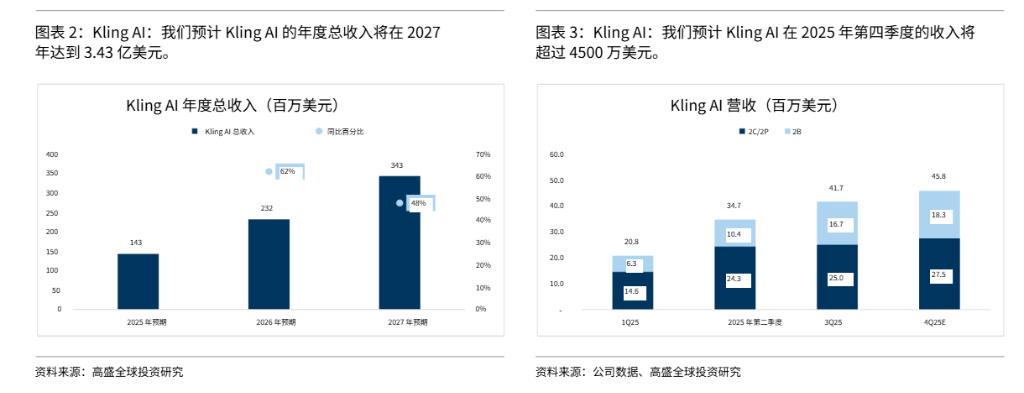
Core Insights - Kuaishou Technology is transforming AI from a cost center into a profit center, demonstrating how AI can drive efficiency in traffic, advertising, and e-commerce operations [1][6] - The company’s AI tool, Keling AI, is transitioning from a user acquisition phase to a monetization phase, with projected quarterly revenue exceeding $45 million by Q4 2025 and annual revenue reaching $343 million by 2027 [1][4] Keling AI Development - Keling AI is positioned as a "professional content creation tool," with a significant shift in user demographics from 70% consumer to 60% business users, indicating a move towards B2B applications [4] - The tool has onboarded approximately 10,000 B2B clients, including platforms like Freepik and various advertising agencies, which are expected to provide higher retention and payment capabilities compared to C-end users [4] Cost Efficiency and Model Performance - The latest Keling 2.5 Turbo model has significantly reduced video generation costs while maintaining high performance, with costs per video dropping to as low as $0.201 [5] - AI algorithms have contributed to a 4-5% growth in Kuaishou's core advertising business, showcasing the effectiveness of AI in enhancing revenue streams [6] User Engagement and Revenue Metrics - Despite recent price reductions aimed at expanding the user base, increased user engagement has mitigated the impact on revenue, with average revenue per user (ARPU) stabilizing between $20 and $30 per month [7] - The global market for professional video creators is vast, with a low penetration rate indicating significant growth potential for Keling AI [7] AI's Impact on Core Business - AI-driven systems like OneRec are applied to 25%-30% of traffic distribution, resulting in at least a 1% increase in video views and user engagement, translating to substantial commercial value [8] - The application of AI in advertising has led to a 4-5% incremental growth in ad revenue for Q3 2025, highlighting the technology's effectiveness in improving return on investment (ROI) [8] Traditional Metrics and Growth Opportunities - Kuaishou's current ad load rate is approximately 9%, significantly lower than competitors like Douyin, which stands at 14%-15%, indicating room for improvement [9] - The company aims to increase its shelf-based e-commerce GMV from 30% to over 40% by enhancing product offerings and integrating more live-streaming links [9]

快手X新周刊X捷达开启“小店中国”探访之旅,真实烟火气赋能品牌营销
Sou Hu Wang· 2025-11-29 02:36
Core Insights - The article emphasizes the shift in consumer behavior towards a more rational approach, focusing on genuine quality of life, which necessitates brands to engage in meaningful marketing that resonates with everyday life [1][12] - The collaboration between Jetta, Kuaishou, and New Weekly to create the "Little Shop China" IP effectively connects brand values with real-life scenarios, enhancing user emotional engagement and driving sales conversion [1][9] Group 1: Brand Marketing Strategy - Jetta's marketing strategy centers around "content creativity + product performance + emotional resonance," utilizing the "Little Shop China" IP to create relatable narratives that foster emotional connections with users [1][5] - The documentary-style short films highlight the daily lives of small shop owners, showcasing the Jetta VS8's product features while amplifying emotional resonance through storytelling [3][5] - The campaign transforms Jetta's brand perception from merely a transportation tool to a reliable companion in users' lives, establishing a new marketing path based on shared values [1][8] Group 2: Content Creation and User Engagement - Kuaishou's approach involves immersive short films that evoke emotional responses, effectively embedding the Jetta VS8 into the daily routines of small shop owners, thus enhancing brand penetration [5][6] - The campaign leverages real-life scenarios to naturally present the VS8's selling points, reinforcing user recognition of product functionality while aligning with positive life philosophies [8][10] - Kuaishou's integration of high-traffic IPs and warm content facilitates deep engagement with potential consumers, driving brand awareness and emotional connection [9][14] Group 3: Targeted Marketing for VS5 - For the Jetta VS5, Kuaishou employs seasonal themes and collaborates with rural influencers to create relatable content that highlights the vehicle's strengths in everyday rural scenarios [12] - The campaign avoids overt technical specifications, instead showcasing the VS5's advantages through authentic, relatable moments in rural life, enhancing its market positioning [12][14] - Kuaishou's strategic use of various advertising resources ensures broad exposure for the brand, maintaining discussion momentum around the vehicles [14]

快手-W注销165万股已回购股份
Zhi Tong Cai Jing· 2025-11-28 11:39
Core Viewpoint - Kuaishou-W (01024) announced the cancellation of 1.65 million repurchased shares on November 28, 2025 [1] Group 1 - The company issued 20,300 shares as a result of exercising options under the employee shareholding plan adopted on February 6, 2018 [1] - The conversion of 6.2731 million Class A ordinary shares to Class B ordinary shares occurred on the same day [1]
快手-W(01024)注销165万股已回购股份
智通财经网· 2025-11-28 11:34
Group 1 - Kuaishou-W (01024) announced the cancellation of 1.65 million repurchased shares on November 28, 2025 [1] - On the same day, the company issued 20,300 shares through the employee stock ownership plan adopted on February 6, 2018 [1] - The conversion of 6.2731 million Class A ordinary shares to Class B ordinary shares also took place [1]
快手(01024) - 翌日披露报表
2025-11-28 11:08
翌日披露報表 (股份發行人 ── 已發行股份或庫存股份變動、股份購回及/或在場内出售庫存股份) 表格類別: 股票 狀態: 新提交 FF305 公司名稱: 快手科技(於開曼群島註冊成立以不同投票權控制的有限公司) 呈交日期: 2025年11月28日 如上市發行人的已發行股份或庫存股份出現變動而須根據《香港聯合交易所有限公司(「香港聯交所」)證券上市規則》(「《主板上市規則》」)第13.25A條 / 《香港聯合交易所有限公司GEM證券 上市規則》(「《GEM上市規則》」)第17.27A條作出披露,必須填妥第一章節 。 | 第一章節 | | | | | | | | | | --- | --- | --- | --- | --- | --- | --- | --- | --- | | 1. 股份分類 | 不同投票權架構公司普通股 | 股份類別 | B | | 於香港聯交所上市 | 是 | | | | 證券代號 (如上市) | 01024 | 說明 | | | | | | | | 多櫃檯證券代號 | 81024 | RMB 說明 | | | | | | | | A. 已發行股份或庫存股份變動 | | | | | | | ...
抛弃“级联”架构!快手OneRec用大模型重构推荐系统,服务成本降至1/10
AI前线· 2025-11-28 02:54
传统推荐架构正成为技术与业务演进的瓶颈。从最早的规则引擎到线性模型,再到深度学习进入推荐、行为序列建模,每一次技术跃迁都伴随着可 用算力的数量级提升。以 FM 到基于行为序列的精排模型为例,单个推荐 item 的计算量大约提升了 5 个数量级,同时带来显著效果增益。然而, 近两年 LLM 突飞猛进,推荐领域却更多停留在精排等局部环节的微调上,整体创新进入瓶颈。如果我们仍将迭代重心局限于排序模块、围绕单点 模型做细节优化,要获得数量级的提升将愈发困难。 能否直接借用 LLM 的技术栈与算力方案,重构一套端到端的推荐系统? 直接采用 LLM 架构来做推荐的想法,看似美好,但深入思考并不简单,根本原因在于 LLM 与推荐的在线服务场景差异巨大。推荐是典型的低延 迟、高并发服务,需要实时响应海量请求;而在 Chatbot 等场景中,用户可以接受更长的等待时间,请求量也与推荐系统不在同一量级。 因此,当被询问"能不能用 LLM 来做推荐"时,团队往往会给出"想法很好但不现实"的反馈,常见理由有三点:其一,推荐模型本身已经很大。若将 用于表示物料 ID 的稀疏 Embedding 计算在内,推荐模型规模已达 T 级(万亿 ...

多家企业驰援香港大埔火灾救援,捐款捐物总额超6亿港元
Xin Lang Cai Jing· 2025-11-28 02:02
Group 1: Incident Overview - A major fire occurred in Hong Kong's Tai Po district, resulting in 94 fatalities, including one firefighter, and 76 injuries, with 11 being firefighters [1] - The Hong Kong government established a relief fund with an initial allocation of 300 million HKD to assist affected residents [1] Group 2: Corporate Donations - Alibaba Group announced a donation of 20 million HKD for immediate relief efforts and additional support for affected families [2] - Tencent Charity Foundation pledged a total of 30 million HKD, including an initial 10 million HKD and an additional 20 million HKD to the relief fund [2] - ByteDance (Hong Kong) and Baidu each committed 10 million HKD for emergency relief and community recovery efforts [2] Group 3: Additional Corporate Contributions - Various companies, including NetEase, Xiaomi, and Kuaishou, each donated 10 million HKD to support emergency relief and community recovery [3] - Anta Group and Bosideng Group each contributed 30 million HKD, while Li Ning Group and Xtep Group donated 20 million HKD each for disaster relief [4][5][6] - Other companies like 361°, Chow Tai Fook, and Nongfu Spring also made significant contributions, totaling millions in cash and supplies [7][8] Group 4: Broader Industry Response - Multiple sectors, including automotive, real estate, and finance, participated in the relief efforts, with companies like Chery Automobile and BYD each donating 10 million HKD [9][10] - Financial institutions and logistics companies, such as Didi and SF Express, also pledged substantial amounts for emergency aid and recovery efforts [15]




快手科技:调研要点 -AI 赋能用户生态与广告变现;Kling 业务增长潜力可期
2025-12-01 00:49
Kuaishou Technology (1024.HK) Conference Call Summary Company Overview - **Company**: Kuaishou Technology - **Ticker**: 1024.HK - **Market Cap**: HK$292.7 billion / $37.6 billion - **Current Price**: HK$68.65 - **12-Month Target Price**: HK$83.00, indicating an upside of 20.9% [2][22] Key Industry Insights - **AI Integration**: Kuaishou is leveraging AI to enhance user experience and advertising monetization, with a focus on the Kling AI platform [1][5] - **User Ecosystem**: The user base is divided into professional (P-end) and business (B-end) users, with a notable shift in user mix from 70:30 to 60:40 in favor of B-end users [7][8] Core Business Highlights - **User Growth**: - Approximately 200 million professional users globally, with a low single-digit percentage of paying users out of 20-30 million monthly active users (MAU) [7] - Average Revenue Per User (ARPU) is currently between $20-$30 per month, with expectations for stability in the short term [7] - **Advertising and E-commerce**: - Advertising revenue growth of 4-5% in Q3 2025 attributed to AI technology [12] - E-commerce now accounts for approximately 30% of total Gross Merchandise Value (GMV), with a target to increase this to over 40% [11] - The aggregate take rate is around 4%, with 1% from e-commerce commissions and 3% from e-commerce ads [11] Financial Projections - **Kling AI Revenue**: Expected to reach $343 million by 2027, with a forecast of $45 million+ in Q4 2025 [14][16] - **Revenue Growth**: - Revenue projections for Kuaishou are as follows: - 2025E: RMB 142.0 billion - 2026E: RMB 157.0 billion - 2027E: RMB 172.4 billion [19][22] Risks and Challenges - **Key Risks**: - Slower-than-expected recovery in advertising budgets - Weaker monetization of the Kling platform - Slower growth in user engagement metrics - Lower-than-expected profitability and AI progress [20] Additional Insights - **User Engagement**: Kuaishou is focusing on attracting younger users through diverse content categories to drive daily active users (DAU) and traffic [12] - **Advertising Strategy**: The current ad load is approximately 9%, with plans to increase this to over 9% through improved native advertising and algorithm enhancements [12] - **Financial Health**: The company is maintaining a strong gross margin, projected to reach 57.3% by 2027 [19] This summary encapsulates the key points from the conference call, highlighting Kuaishou's strategic focus on AI, user growth, and financial projections while also addressing potential risks that could impact its performance.

智通港股通资金流向统计(T+2)|11月28日
智通财经网· 2025-11-27 23:34
Key Points - On November 25, Alibaba-W (09988), Kuaishou-W (01024), and Pop Mart (09992) ranked the top three in net inflow of southbound funds, with net inflows of 5.587 billion, 567 million, and 377 million respectively [1] - The top three in net outflow of southbound funds were Yingfu Fund (02800), SMIC (00981), and China Aluminum (02600), with net outflows of -364 million, -187 million, and -145 million respectively [1] - In terms of net inflow ratio, Southern East Select (03441), Prudential (02378), and Southern Hong Kong US Technology (03442) led the market with ratios of 88.59%, 85.03%, and 71.70% respectively [1] - The top three in net outflow ratio were GX China (03040), Greentown Service (02869), and Aidi Kang Holdings (09860) with ratios of -91.54%, -58.74%, and -54.29% respectively [1] Top 10 Net Inflow Stocks - Alibaba-W (09988) had a net inflow of 5.587 billion, representing a 24.06% increase, closing at 157.800 (+2.14%) [2] - Kuaishou-W (01024) saw a net inflow of 567 million, with a 15.90% increase, closing at 70.650 (+3.06%) [2] - Pop Mart (09992) recorded a net inflow of 377 million, with a 21.51% increase, closing at 200.200 (+0.35%) [2] - Other notable stocks included Xpeng Motors-W (09868) with a net inflow of 274 million and a 17.01% increase, and China Construction Bank (00939) with a net inflow of 271 million and a 15.20% increase [2] Top 10 Net Outflow Stocks - Yingfu Fund (02800) experienced a net outflow of -364 million, with a -2.62% change, closing at 26.040 (+0.85%) [2] - SMIC (00981) had a net outflow of -187 million, with a -3.52% change, closing at 67.950 (-0.15%) [2] - China Aluminum (02600) saw a net outflow of -145 million, with a -31.17% change, closing at 10.660 (+0.76%) [2] - Other significant outflows included Xinda Biopharmaceutical (01801) with -136 million and a -10.94% change, and ZTO Express-W (02057) with -122 million and a -29.90% change [2] Top 10 Net Inflow Ratios - Southern East Select (03441) led with a net inflow ratio of 88.59%, with a net inflow of 8.441 million, closing at 10.300 (+0.19%) [3] - Prudential (02378) followed with a ratio of 85.03%, net inflow of 11.732 million, closing at 107.800 (+0.94%) [3] - Southern Hong Kong US Technology (03442) had a ratio of 71.70%, with a net inflow of 14.887 million, closing at 9.080 (+2.66%) [3]


快手-W(01024.HK):业绩符合预期 AI赋能广告及电商业务增长提速
Ge Long Hui· 2025-11-27 20:08
Core Insights - Kuaishou reported Q3 2025 revenue of 35.554 billion yuan, a year-on-year increase of 14.21% and a quarter-on-quarter increase of 1.45% [1] - Adjusted EBITDA for Q3 2025 reached 7.653 billion yuan, up 37.2% year-on-year, while adjusted net profit was 4.986 billion yuan, reflecting a 26.3% year-on-year growth [1] Revenue Growth - The online marketing revenue for Kuaishou in Q3 2025 was 20.102 billion yuan, marking a 14.0% year-on-year increase, with growth accelerating from 12.8% in Q2 2025 [1] - The DAU and MAU reached 416 million and 731 million respectively, both hitting record highs for three consecutive quarters, with daily usage time averaging 134.1 minutes [1] AI Empowerment - The OneRec model has enhanced the platform's ecosystem, leading to accelerated growth in online marketing revenue [1] - AI technology has significantly improved advertising content creation and distribution, with AIGC marketing materials driving over 3 billion yuan in online marketing service consumption in Q3 2025 [1] E-commerce Performance - Kuaishou's e-commerce GMV reached 385 billion yuan in Q3 2025, a year-on-year increase of 15.2% [2] - The OneSearch model has improved product matching and user experience, increasing search order volume by nearly 5.0% [2] Future Outlook - The company aims to continue enhancing its e-commerce business through AIGC content production and improving merchant efficiency [2] - Kuaishou's Keling AI generated over 300 million yuan in revenue in Q3 2025, with the new Keling AI 2.5 Turbo model achieving significant improvements in content generation [3] Financial Projections - Revenue projections for Kuaishou are estimated at 142.062 billion yuan, 154.990 billion yuan, and 167.064 billion yuan for 2025, 2026, and 2027 respectively, with adjusted net profits of 20.498 billion yuan, 22.915 billion yuan, and 25.308 billion yuan [3]