
XIAOMI(01810)

Search documents
资产配置日报:风格迅速切换,怎么看-20260130
HUAXI Securities· 2026-01-30 01:06
Market Performance - On January 29, the A-share market saw a decline of 0.23%, with a trading volume of CNY 3.26 trillion, an increase of CNY 267.1 billion from the previous day[1] - The Hang Seng Index rose by 0.51%, while the Hang Seng Technology Index fell by 1.00%[1] - Net inflow of southbound funds was HKD 4.374 billion, with Tencent and Xiaomi seeing inflows of HKD 800 million and HKD 643 million respectively[1] Sector Rotation - Rapid rotation in market styles was observed, with AI applications surging over 6% in the morning, while gold and oil stocks initially rose but quickly retreated[1] - The white wine index surged by 9.79% in the afternoon, with all constituent stocks except Kweichow Moutai hitting the daily limit[1] - The real estate sector also showed strength, indicating a potential shift in trading strategies[1] Investment Insights - The white wine market's rapid rise is attributed to a rebound expectation after a decline since mid-January, but the sustainability of this rebound is uncertain[2] - The technology sector's logic remains intact, with AI agents becoming more established, although the STAR 50 and STAR 200 indices showed reduced trading volumes[2] - The bond market is experiencing upward pressure, with the 10-year government bond yield dropping to 1.81%, a near one-month low[4] Commodity Market Trends - Precious metals continued to perform strongly, with gold and silver prices rising by 7.88% and 8.51% respectively[7] - Industrial metals also showed robust performance, with copper increasing by 6.71%[7] - Oil prices rebounded due to geopolitical risks, with crude oil and fuel rising by 3.69% and 4.00% respectively[7] Economic Outlook - The bond market is expected to remain in a range-bound state, with 1-year and 10-year government bond yields likely oscillating between 1.25%-1.30% and 1.80%-1.85%[6] - The supply-demand dynamics in the bond market may shift, with local government bond issuance plans increasing significantly from CNY 422.9 billion to CNY 769.7 billion[6]



Omdia:2025年全球智能手机出货量增长2%,苹果创历史新高,2026年或迎挑战
Canalys· 2026-01-30 01:03
Core Insights - Omdia's latest research indicates that global smartphone shipments are expected to grow by 2% in 2025, reaching 1.25 billion units, marking the highest level since 2021. All regions except Greater China are projected to see year-on-year growth, while mainland China is expected to experience a slight decline due to underwhelming effects of national subsidy policies in 2025 [1][9] Group 1: Market Performance - In Q4 2025, global smartphone shipments increased by 4% year-on-year, driven by seasonal factors and strong performance from manufacturers. However, rising costs of key components and memory are beginning to suppress shipment forecasts for 2026 [2] - Apple achieved a record annual shipment high in 2025, with iPhone shipments growing by 7% to 240.6 million units, maintaining its position as the largest smartphone manufacturer globally for the third consecutive year. The fourth quarter saw the highest single-quarter iPhone shipments, with mainland China market growth of 26% driven by strong demand for the iPhone 17 series [5] - Samsung rebounded significantly in 2025 after three consecutive years of decline, with a 7% year-on-year increase in shipments, slightly below Apple's figures. The company ended the year strongly with a 16% increase in Q4 shipments, supported by resilient demand for flagship models and a recovery in the mass market [5] - Xiaomi maintained its top three position in 2025 despite facing challenges at year-end, with a 2% decline in Q4 shipments. The company's strategy of expanding its product range from entry-level to high-end models, along with AIoT products, is central to its value growth [6] - Vivo entered the fourth position for the first time, with a 4% year-on-year increase in shipments to 10.53 million units, benefiting from continued success in the Indian market and stable performance in the domestic market. OPPO ranked fifth, with annual shipments of 10.07 million units, down 3% year-on-year [6] Group 2: Emerging Trends and Challenges - Outside the top five, several manufacturers continued to show positive growth despite a challenging market environment. Honor and Lenovo grew by 11% and 6% respectively, achieving historical highs. Huawei regained the top position in mainland China for the first time in five years, while Nothing became the fastest-growing manufacturer in 2025, with shipments surging by 86% to over 3 million units [7] - Omdia's senior analyst highlighted that while 2025 was positive for most manufacturers, concerns about the outlook for 2026 have emerged. Supply-side pressures on DRAM, NAND, and other semiconductors are causing significant worry among manufacturers, potentially compressing profit margins and forcing price adjustments, which could ultimately suppress consumer demand [9][11] - As market contraction becomes increasingly inevitable in 2026, manufacturers will focus on profitability and explore alternative revenue sources. The current market volatility presents a competitive window for manufacturers, suppliers, and partners to quickly respond to challenges and capture opportunities among upgrade and replacement users [11][12]



AI巨头抢完了车规级内存,你的车可能因此减配
3 6 Ke· 2026-01-30 00:31
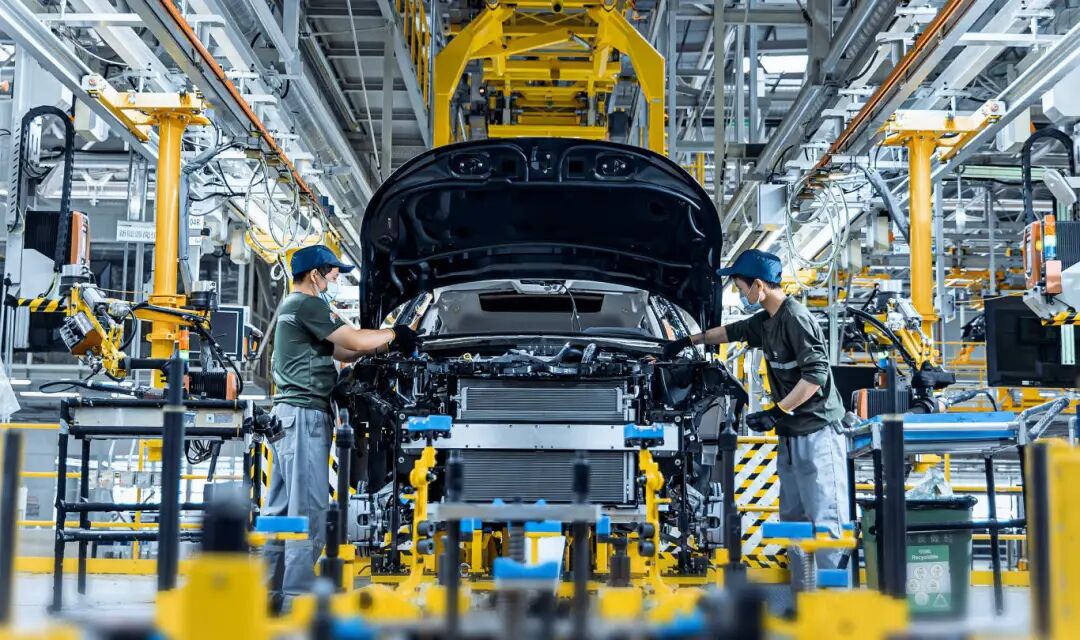
Core Viewpoint - The automotive industry is facing a severe crisis due to skyrocketing prices of automotive-grade memory chips, particularly DRAM and DDR5, which have surged over 300% since the second half of 2025, significantly impacting production costs without a corresponding increase in vehicle prices [1][3]. Group 1: Price Surge and Cost Impact - Automotive-grade memory prices have dramatically increased, with DRAM prices rising over 300% and automotive-grade DDR5 memory exceeding 300%, leading to an increase of approximately 1,000 yuan in the cost of each vehicle [1][3]. - Despite the rising costs, vehicle prices have remained stable, with industry leaders indicating that the pressure from memory price increases has not yet been passed on to end consumers [1][3]. Group 2: Supply Chain Challenges - The memory shortage has begun to affect production schedules for some automakers, with concerns about supply interruptions leading companies to deploy personnel to monitor supplies and develop alternative sourcing strategies [3][4]. - The automotive industry is facing a significant challenge in securing memory supplies, as the demand from the AI sector is siphoning off production capacity, with AI data centers expected to consume over 70% of high-end memory chips by 2026 [4][6]. Group 3: Market Dynamics and Competition - The automotive memory market is highly concentrated, with Samsung, SK Hynix, and Micron controlling over 90% of the market, leaving automakers with little bargaining power during the supply crisis [7][9]. - The shift in production focus towards AI-related memory products, which offer significantly higher profit margins, has led to a reduction in the availability of automotive-grade memory, exacerbating the supply issues faced by car manufacturers [4][6]. Group 4: Strategic Responses from Automakers - In response to the memory shortage, automakers are adopting strategies such as direct supply agreements with memory manufacturers and establishing strategic safety stock to mitigate the risks of supply disruptions [10][12]. - The competition in the automotive sector is increasingly centered around "smart driving" capabilities, with memory being a critical component that influences the performance and features of intelligent vehicles [10][12]. Group 5: Future Outlook and Industry Trends - The memory shortage is expected to persist until at least 2028, with new chip manufacturing facilities taking 3-5 years to establish, indicating a prolonged period of supply constraints for the automotive industry [9]. - The automotive sector is witnessing a shift towards self-developed technologies, with a significant portion of the market being dominated by domestic brands that are focusing on in-house development of smart driving features [17][18].




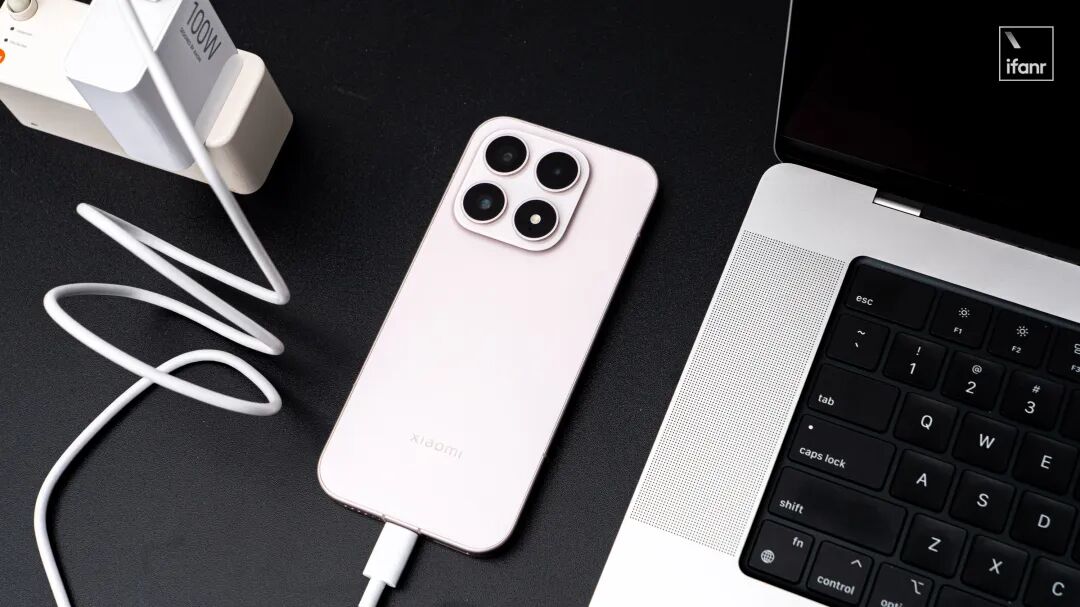
2026 年,手机厂商是时候拥抱公有快充协议了
3 6 Ke· 2026-01-30 00:31
Core Viewpoint - The article discusses the evolution of fast charging protocols in smartphones, highlighting the shift towards public protocols like PPS (Programmable Power Supply) and their advantages over proprietary charging solutions, particularly in terms of efficiency, cost, and compatibility with various devices. Group 1: Industry Trends - The year 2025 is anticipated to be a significant milestone for smartphone battery technology, with advancements in silicon-carbon anodes and increased battery capacities [1] - More manufacturers are expanding support for public fast charging protocols such as PPS and UFCS, indicating a potential shift away from proprietary protocols [3][5] - Xiaomi has set a new benchmark for domestic smartphones by demonstrating that public fast charging protocols can match the efficiency of proprietary solutions [5] Group 2: Advantages of PPS - PPS offers benefits such as faster charging, reduced heat generation, and lower costs compared to proprietary protocols [6][14] - The flexibility of PPS allows for dynamic voltage adjustments based on the battery's needs, improving charging efficiency and reducing energy loss [10][12] - The recent technological advancements have enabled PPS to achieve power levels of up to 100W, overcoming previous limitations [12] Group 3: Performance and Consumer Impact - Real-world testing of devices like the Redmi Turbo 5 Max shows that PPS can deliver charging speeds comparable to proprietary solutions, with only minor differences in total charging time [18][25] - The compatibility of PPS with existing USB PD standards allows consumers to use a single charger for multiple devices, enhancing convenience [30] - The adoption of PPS by manufacturers is seen as a strategic move to improve consumer satisfaction and brand loyalty in a competitive market [32]
智通港股沽空统计|1月30日
智通财经网· 2026-01-30 00:22
Group 1 - The core viewpoint of the articles highlights the short-selling activities of various companies, with specific focus on the short-selling ratios and amounts for leading firms in the market [1][2]. Group 2 - The top three companies by short-selling ratio are BYD Company Limited (95.08%), Lenovo Group Limited (85.25%), and Baidu Group (76.60%) [1]. - The highest short-selling amounts are recorded for China Ping An (1.88 billion), Xiaomi Group (1.086 billion), and Alibaba Group (1.062 billion) [2]. - The top three companies with the highest deviation values, indicating significant short-selling activity compared to their historical averages, are Baidu Group (39.38%), BYD Company Limited (35.91%), and Fuhong Hanlin (27.27%) [1][2].


智通ADR统计 | 1月30日
智通财经网· 2026-01-29 22:41
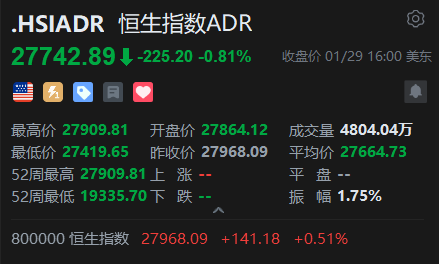
Market Overview - The Hang Seng Index (HSI) closed at 27,742.89, down by 225.20 points or 0.81% as of January 29, 16:00 Eastern Time [1] - The index reached a high of 27,909.81 and a low of 27,419.65 during the trading session, with an average price of 27,664.73 [1] - The 52-week high for the index is 27,909.81, while the 52-week low is 19,335.70 [1] Blue-Chip Stocks Performance - Most large-cap stocks experienced declines, with HSBC Holdings closing at HKD 138.219, up 0.45% compared to the Hong Kong close [2] - Tencent Holdings closed at HKD 619.286, down 0.44% from the Hong Kong close [2] Individual Stock Movements - Tencent Holdings (00700) latest price is HKD 622.000, with a slight increase of 1.000 or 0.16% [3] - Alibaba Group (09988) latest price is HKD 173.300, down by 0.200 or 0.12% [3] - HSBC Holdings (00005) latest price is HKD 137.600, up by 0.100 or 0.07% [3] - China Construction Bank (00939) latest price is HKD 8.160, up by 0.130 or 1.62% [3] - AIA Group (01299) latest price is HKD 90.950, up by 2.100 or 2.36% [3] - Xiaomi Group (01810) latest price is HKD 36.620, up by 0.300 or 0.83% [3] - NetEase (099999) latest price is HKD 206.600, down by 5.400 or 2.55% [3] - Meituan (03690) latest price is HKD 98.600, up by 0.250 or 0.25% [3] - Industrial and Commercial Bank of China (01398) latest price is HKD 6.640, up by 0.050 or 0.76% [3] - Hong Kong Exchanges and Clearing (00388) latest price is HKD 444.200, up by 5.000 or 1.14% [3] - Ping An Insurance (02318) latest price is HKD 73.300, up by 2.350 or 3.31% [3] - Baidu Group (09888) latest price is HKD 155.500, down by 0.600 or 0.38% [3] - China Bank (03988) latest price is HKD 4.760, up by 0.090 or 1.93% [3] - BYD Company (01211) latest price is HKD 101.800, down by 1.000 or 0.97% [3] - JD.com (09618) latest price is HKD 114.600, down by 1.700 or 1.46% [3] - Ctrip Group (09961) latest price is HKD 482.200, down by 13.200 or 2.66% [3]


小米砸10亿补贴新机 Turbo 5大内存版直降200元
Nan Fang Du Shi Bao· 2026-01-29 14:20
Core Insights - Redmi launched two new models, Turbo 5 and Turbo 5 Max, during a product release event on January 29, emphasizing a significant investment of 1 billion yuan to subsidize memory costs, particularly for the 512GB versions [2] - The company aims to initiate a "512GB popularization storm" by reducing prices by 200 yuan for large memory versions and an additional 300 yuan during the initial sales period [2] Pricing Strategy - From January 29 to March 3, during the initial sales period, Turbo 5 Max models will see a price reduction of 300 yuan: - 12GB + 256GB priced at 2199 yuan - 16GB + 256GB priced at 2499 yuan - 12GB + 512GB priced at 2499 yuan - 16GB + 512GB priced at 2799 yuan [4] - Turbo 5 models will also have a 300 yuan price drop during the initial sales: - 12GB + 256GB priced at 1999 yuan - 16GB + 256GB priced at 2299 yuan - 12GB + 512GB priced at 2299 yuan - 16GB + 512GB priced at 2599 yuan [4][5] Product Positioning - The Turbo 5 Max is positioned as a new product above the Pro line, featuring the world's first Dimensity 9500s flagship processor and a 9000mAh battery, promising over 2.3 days of battery life [5] - The Turbo 5 is aimed at the mid-range market, equipped with the Dimensity 8500-Ultra chip and a 7560mAh battery [5] Market Trends - Xiaomi's president, Lu Weibing, indicated that AI technology is expected to experience explosive growth from the end of 2022 to 2025, with a forecasted increase in memory costs impacting mobile manufacturing significantly [7] - The company has secured supply agreements for 2026 to mitigate supply chain disruptions and may adjust product pricing and upgrade structures to alleviate cost pressures [7]
REDMI Pad 2 Pro平板电脑正式发布,哈利·波特联名版售价2599元
Bei Jing Shang Bao· 2026-01-29 13:48
北京商报讯(记者 陶凤 王天逸)1月29日,REDMI在新品发布会上正式推出REDMI Pad 2 Pro平板电 脑。 新品提供深灰、银、紫三色及哈利·波特联名版,存储配置涵盖8GB+128GB、8GB+256GB与 12GB+256GB(柔光屏版),官方售价分别为1799元、1999元、2499元,哈利·波特联名版 (8GB+256GB)售价2599元,即日起全平台开售。 ...
徕卡10亿欧元卖身,为什么小米一定不能买?
36氪· 2026-01-29 13:31
Core Viewpoint - Leica is considering selling its shares, with an estimated valuation of approximately €1 billion, despite its current success in the luxury camera market, raising questions about the timing of the sale [5][12][26]. Group 1: Current Situation of Leica - Leica's ownership structure consists of 55% held by the Kaufmann family and 45% by Blackstone Group, which is now looking to sell its stake [9][10]. - The decision to sell is driven by the belief that Leica is at its peak, as private equity firms typically aim to sell at high points rather than low [12][13]. - Blackstone acquired its stake in Leica for €130 million in 2011 and has seen significant returns, making this an opportune time to exit [12][14]. Group 2: Historical Context and Brand Transformation - Andreas Kaufmann played a crucial role in Leica's turnaround by shifting its focus from mass-market cameras to luxury products, thus redefining its brand identity [18][19]. - The introduction of the digital M series and the establishment of Leitz Park have solidified Leica's status as a luxury brand, akin to Rolex in the camera industry [26][27]. - The brand's transformation has been marked by a strategic pivot to selling brand prestige rather than just products, which has proven successful in the luxury market [26][27]. Group 3: Potential Buyers and Market Dynamics - Potential buyers mentioned include private equity firms like Altor Equity Partners and tech companies like Xiaomi, which has a strong cash reserve [29][32]. - However, acquiring Leica could be detrimental for Xiaomi, as it may dilute the brand's luxury status and disrupt the successful partnership that has been built on mutual benefit [35][40]. - The article argues that Leica's ideal future ownership would be with investors who appreciate its heritage and allow it to maintain its brand integrity, rather than being absorbed by a tech giant [48][49].
智通港股通活跃成交|1月29日




智通财经网· 2026-01-29 13:25
Group 1 - On January 29, 2026, Alibaba-W (09988), CNOOC (00883), and SMIC (00981) were the top three companies by trading volume in the Southbound Stock Connect, with transaction amounts of 3.175 billion, 2.764 billion, and 2.555 billion respectively [1] - In the Southbound Stock Connect, Alibaba-W (09988), Tencent Holdings (00700), and CNOOC (00883) were the top three companies by trading volume in the Shenzhen-Hong Kong Stock Connect, with transaction amounts of 1.847 billion, 1.779 billion, and 1.669 billion respectively [1] Group 2 - The top active companies in the Southbound Stock Connect included Alibaba-W (09988) with a transaction amount of 3.175 billion and a net buy of -248 million, CNOOC (00883) with a transaction amount of 2.764 billion and a net buy of -686 million, and SMIC (00981) with a transaction amount of 2.555 billion and a net buy of -81.725 million [2] - In the Shenzhen-Hong Kong Stock Connect, the top active companies included Alibaba-W (09988) with a transaction amount of 1.847 billion and a net buy of -82.154 million, Tencent Holdings (00700) with a transaction amount of 1.779 billion and a net buy of 296 million, and CNOOC (00883) with a transaction amount of 1.669 billion and a net buy of 572 million [2]