
XIAOMI(01810)

Search documents
小米取得提升指纹解锁效率的专利
Jin Rong Jie· 2026-01-23 12:11
Group 1 - The core point of the article is that Beijing Xiaomi Mobile Software Co., Ltd. has obtained a patent for a "fingerprint unlocking method and device, terminal equipment," with the authorization announcement number CN115880733B, and the application date was December 2022 [1] - Beijing Xiaomi Mobile Software Co., Ltd. was established in 2012 and is located in Beijing, primarily engaged in software and information technology services [1] - The registered capital of Beijing Xiaomi Mobile Software Co., Ltd. is 148.8 million RMB [1] Group 2 - The company has made investments in 4 enterprises and has participated in 150 bidding projects [1] - The company holds a total of 5000 patent information and has 123 administrative licenses [1]

小米取得上行PUSCH开环功率控制专利
Jin Rong Jie· 2026-01-23 12:11
Group 1 - The core point of the article is that Beijing Xiaomi Mobile Software Co., Ltd. has obtained a patent for a method, device, and storage medium related to open-loop power control for uplink PUSCH, with the patent granted under announcement number CN115943681B and the application date being August 2021 [1] Group 2 - Beijing Xiaomi Mobile Software Co., Ltd. was established in 2012 and is located in Beijing, primarily engaged in software and information technology services [1] - The company has a registered capital of 148.8 million RMB [1] - According to data analysis from Tianyancha, the company has invested in 4 enterprises, participated in 150 bidding projects, and holds 5000 patent records, in addition to having 123 administrative licenses [1]
智通港股通活跃成交|1月23日





智通财经网· 2026-01-23 11:01
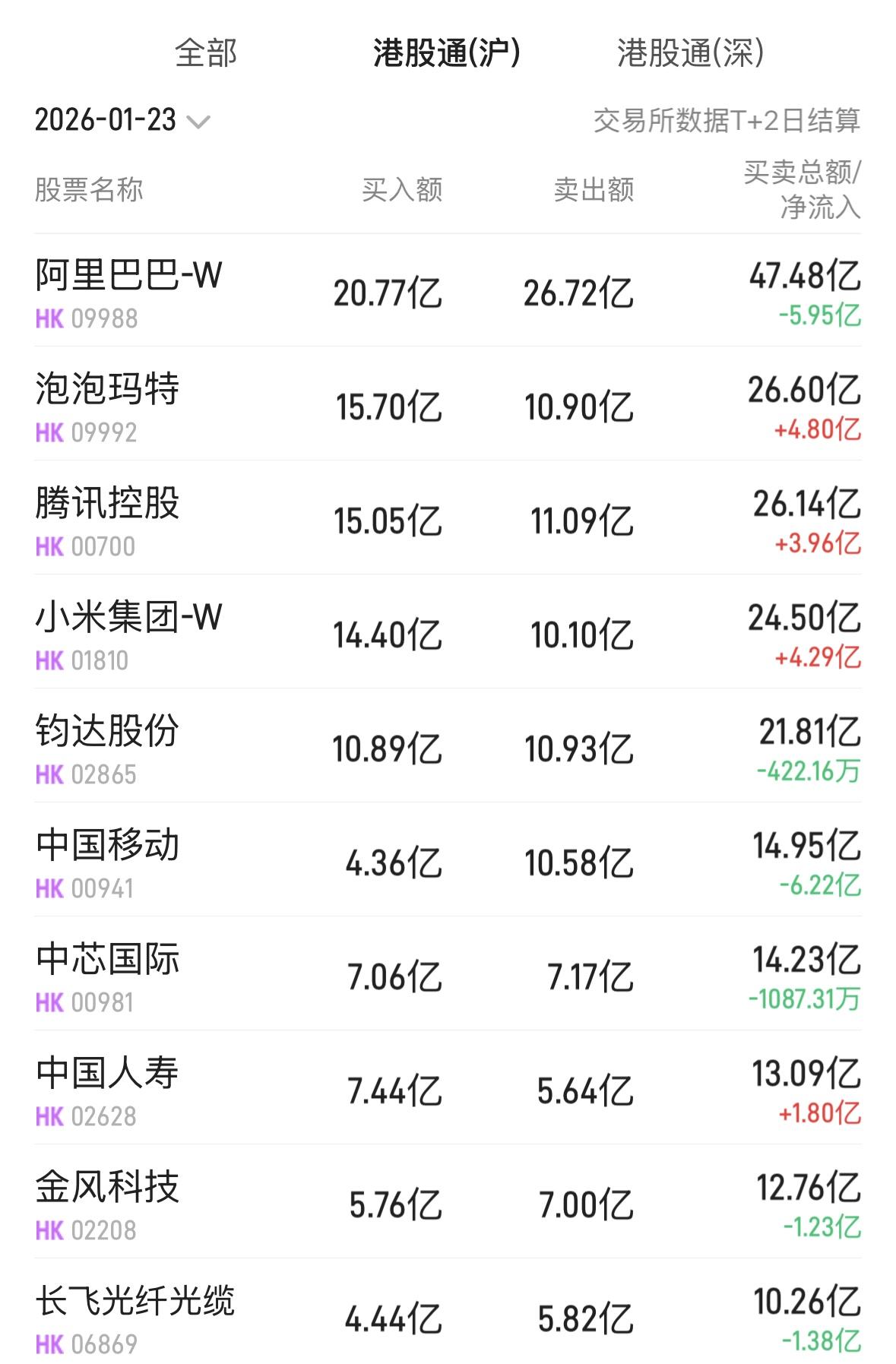
Group 1 - On January 23, 2026, Alibaba-W (09988), Pop Mart (09992), and Tencent Holdings (00700) ranked as the top three companies by trading volume in the Southbound Stock Connect, with transaction amounts of 4.748 billion, 2.660 billion, and 2.614 billion respectively [1] - In the Southbound Stock Connect for the Shenzhen-Hong Kong Stock Connect, Alibaba-W (09988), Tencent Holdings (00700), and Pop Mart (09992) also held the top three positions, with transaction amounts of 3.322 billion, 1.798 billion, and 1.370 billion respectively [1] Group 2 - In the Southbound Stock Connect, the top active trading companies included Alibaba-W (09988) with a net buy amount of -0.595 billion, Pop Mart (09992) with a net buy amount of +0.480 billion, and Tencent Holdings (00700) with a net buy amount of +0.396 billion [2] - In the Shenzhen-Hong Kong Stock Connect, Alibaba-W (09988) had a net buy amount of -0.895 billion, Tencent Holdings (00700) had a net buy amount of -0.156 billion, while Pop Mart (09992) recorded a net buy amount of +0.268 billion [2]
北水动向|北水成交净卖出16.01亿 泡泡玛特(09992)新品爆火获抢筹超7亿港元 阿里(09988)遭卖出近15亿
智通财经网· 2026-01-23 10:06
Core Viewpoint - The Hong Kong stock market experienced significant net selling from northbound capital, totaling HKD 16.01 billion on January 23, with notable net selling in Alibaba, China Mobile, and Changfei Optical Fiber Cable, while Pop Mart, Xiaomi, and Tencent saw net buying [1][2]. Group 1: Northbound Capital Activity - Northbound capital recorded a net selling of HKD 16.01 billion, with HKD 5.6 billion from Shanghai Stock Connect and HKD 10.41 billion from Shenzhen Stock Connect [1]. - The most net bought stocks included Pop Mart (HKD 7.47 billion), Xiaomi (HKD 6.08 billion), and Tencent (HKD 2.4 billion) [4][5]. - The most net sold stocks were Alibaba (HKD 14.9 billion), China Mobile (HKD 6.22 billion), and Changfei Optical Fiber Cable (HKD 1.38 billion) [7][8]. Group 2: Individual Company Insights - Pop Mart (09992) reported a net buying of HKD 7.47 billion, driven by the successful launch of its Valentine's Day limited edition blind box and recent share buybacks totaling over HKD 300 million, indicating confidence in long-term growth [4]. - Xiaomi Group (01810) saw a net buying of HKD 6.08 billion, with plans to repurchase up to HKD 25 billion of its B shares, reflecting confidence in its business outlook [5]. - Tencent Holdings (00700) had a net buying of HKD 2.4 billion, supported by positive analyst reports highlighting resilience in its core business and AI developments [5]. - Alibaba (09988) faced a net selling of HKD 14.9 billion, as it prepares for the potential IPO of its AI chip subsidiary, T-Head, although the timeline remains uncertain [7]. - China Mobile (00941) experienced a net selling of HKD 6.22 billion, indicating market concerns [8].

从长线重仓股看2025Q4基金权益配置变化
GF SECURITIES· 2026-01-23 09:28
- The report defines long-term heavy positions as stocks that appear in the top ten holdings of a fund for four or more consecutive reporting periods[9] - The report provides a list of stocks heavily held by funds in Q4 2025, including CATL, Tencent Holdings, Zijin Mining, Kweichow Moutai, and Midea Group[9][10] - The report calculates the termination ratio of long-term heavy positions for Q4 2025 using the formula: $$ \text{Termination Ratio} = \frac{\text{Number of funds terminating long-term heavy positions in Q4 2025}}{\text{Number of funds holding long-term heavy positions in Q3 2025}} $$[14] - The report identifies stocks with the highest and lowest termination ratios in Q4 2025, such as Xiaomi Group and Poly Developments with high termination ratios, and Baili Tianheng and Zijin Mining with low termination ratios[14][18] - The report also analyzes the termination ratios of long-term heavy positions by industry, noting that the media, food and beverage, and electrical equipment industries have relatively low termination ratios, indicating fund managers' optimism about these sectors[20][22]




港股收评:恒指涨0.45%!商业航天、光伏板块爆发,航空股低迷
Ge Long Hui· 2026-01-23 08:55
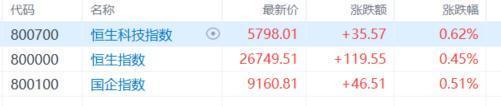
Market Overview - The Hong Kong stock market indices collectively rose on January 23, with the Hang Seng Index increasing by 0.45% to 26,749 points, the Hang Seng China Enterprises Index up by 0.51%, and the Hang Seng Tech Index rising by 0.62% [1][2]. Key Stock Movements - Major tech stocks saw gains, with Xiaomi Group and Kuaishou both rising nearly 3%, Alibaba up over 2%, and JD.com and Meituan also showing increases [2][4]. - The commercial aerospace sector experienced significant gains, with JunDa shares soaring over 51% following the launch of six platforms related to commercial aerospace in Beijing [6]. - Brain-computer interface stocks were active, with Lens Technology rising over 9% [7]. - Gold stocks continued to strengthen, with Zijin Mining International increasing by over 8% as gold prices reached new highs [9]. - Solar energy stocks surged, with Keyuan New Energy rising over 14% and several others following suit [10]. Sector Performance - The commercial aerospace sector led the market with notable gains, driven by the launch of new platforms aimed at enhancing the industry [6]. - The brain-computer interface sector showed strong activity, supported by advancements in flexible chip technology [7]. - Gold stocks benefited from rising gold prices, which reached a historical high of $4,940.78 per ounce [9]. - The solar energy sector was buoyed by positive remarks from Tesla's CEO regarding solar capacity expansion [10]. Individual Stock Highlights - JunDa shares rose by 51.40% to 39.00, while other aerospace-related stocks also saw significant increases [6]. - Lens Technology increased by 9.36% to 31.78, reflecting strong interest in brain-computer interface technologies [8]. - Zijin Mining International rose by 8.43% to 205.80, benefiting from the surge in gold prices [9]. - Keyuan New Energy saw a rise of 14.44% to 4.36, reflecting optimism in the solar energy market [11]. Future Outlook - The Hong Kong stock market is expected to see a recovery in profit growth by mid-2026, with a slowdown in competition among internet platforms and a reduction in the drag from non-essential consumer spending [26].



一图看懂公募2025持仓变迁
天天基金网· 2026-01-23 08:52
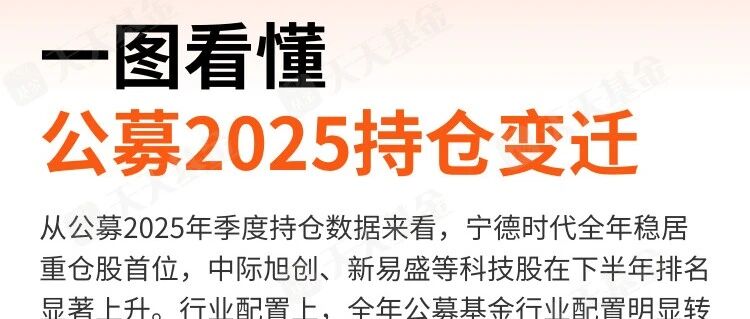
Core Viewpoint - The public fund holdings in 2025 show a significant shift towards technology growth sectors, moving away from traditional consumer and financial sectors [9][10]. Group 1: Changes in Top Holdings - Ningde Times consistently ranked as the top holding throughout 2025, with a market value of 146.8 billion in Q1, 142.7 billion in Q2, 207.1 billion in Q3, and 181.9 billion in Q4 [3]. - Guizhou Moutai, a traditional consumer staple, saw a decline in its ranking and market value, dropping from second place at the beginning of the year to fifth by Q4 [10]. - Tencent Holdings maintained a relatively stable position, fluctuating between second and fourth place [10]. - Notable rises in rankings were observed for Zhongji Xuchuang and Xinyi Sheng, both of which entered the top ten in Q3 and continued to rise in Q4, indicating a strong interest in AI-related stocks [10]. Group 2: Changes in Industry Holdings - The electronics sector remained the top industry for public fund holdings across all four quarters of 2025, with investment values increasing from 518.9 billion in Q1 to 774.5 billion in Q4 [6]. - The food and beverage sector declined from second place in Q1 to seventh place by Q4, reflecting a shift in investor preference [12]. - The medical and biological sector, which ranked high in the first three quarters, was overtaken by the electric equipment and communication sectors in Q4 [12]. - The electric equipment sector improved its ranking from fourth to second place by Q4, while the communication sector rose from outside the top ten to third place [12]. - Non-bank financial and banking sectors experienced an overall decline in rankings, while the non-ferrous metals sector entered the top six in Q4 [13].


港股收盘|恒指涨0.45% 商业航天概念股活跃
Di Yi Cai Jing· 2026-01-23 08:26
Core Viewpoint - The Hang Seng Index closed at 26,749.51 points, up 0.45%, while the Hang Seng Tech Index closed at 5,798.01 points, up 0.62% [1] Group 1: Stock Performance - Gold stocks led the gains, with Zijin Mining International rising over 8% and Chifeng Jilong Gold Mining increasing over 7% [1] - Commercial aerospace concept stocks were active, with Junda Co., Ltd. surging over 51% and Asia-Pacific Satellite rising over 14% [1] - Most technology stocks saw increases, with Xiaomi Group up 2.84%, Alibaba up 2.25%, and JD Group up 0.79% [1]


果然财经 | 小米二手车一年跌十万?业内人士:正常
Qi Lu Wan Bao· 2026-01-23 08:14
Core Viewpoint - Recent discussions about the significant drop in the price of Xiaomi's used cars have sparked considerable debate, with Xiaomi's CEO Lei Jun stating that the company's used car retention rate is 80.1%, which is among the industry's top levels [1]. Group 1 - There are widespread concerns regarding the depreciation of Xiaomi's used cars, with reports suggesting a drop of 100,000 yuan over the past year [1]. - Lei Jun's response highlights the company's confidence in its used car market performance, emphasizing the 80.1% retention rate as a positive indicator [1]. - The first batch of YU7 car owners is experiencing mixed feelings as they transition from order confirmation to actual vehicle delivery, reflecting the complexities of consumer sentiment in the market [1].

小米取得用于接收MBS的CFR确定方法专利
Jin Rong Jie· 2026-01-23 07:23
Group 1 - The core point of the article is that Beijing Xiaomi Mobile Software Co., Ltd. has obtained a patent for a method and device related to CFR, with the patent number CN114009111B, applied for on September 2021 [1] - Beijing Xiaomi Mobile Software Co., Ltd. was established in 2012 and is primarily engaged in software and information technology services, with a registered capital of 148.8 million RMB [1] - The company has made investments in 4 enterprises, participated in 150 bidding projects, and holds 5000 patent information records, along with 123 administrative licenses [1]