
XIAOMI(01810)

Search documents
汽车行业年度策略报告:汽车行业2026年十大趋势及投资策略-20260105
Guoyuan Securities· 2026-01-05 13:43
Core Insights - The report highlights that the Chinese automotive industry is entering the mid-to-late stage of the electric and intelligent transformation, characterized by the coexistence of traditional fuel vehicles, electric intelligent vehicles, and future industries represented by autonomous driving. This necessitates a layered and structured investment approach based on the different stages of these industry curves [2][3]. Trend Summaries Trend 1: Scrap Gap Provides Long-term Space, Trade-in Policies Expected to Normalize - The Chinese automotive market has stabilized at an annual sales level of 31 million units, with a substantial vehicle ownership base of 350 million units, laying the groundwork for future updates. The annual scrappage volume is still significantly lower than new car sales, leading to an expanding replacement gap. The "trade-in" policy is expected to evolve from a temporary stimulus to a normalized tool, enhancing the precision of policies to support domestic demand and industrial production [2][13][27]. Trend 2: New Forces Drive China's Automotive Exports to a New Structural Upgrade Stage - China's automotive exports have entered a high-growth phase, achieving several-fold growth over four years. The export structure has undergone profound changes, with a significant increase in the penetration of new energy vehicles. New force car manufacturers are enhancing China's brand premium and technological image in the global market through high-value product exports [2][30][34]. Trend 3: "Mass Market Pure Electric + High-end Range Extender" Trend Continues to Deepen - With the penetration rate of new energy vehicles surpassing 50%, market demand is showing structural differentiation. In the mass market under 200,000 yuan, the 800V high-voltage platform significantly improves charging efficiency, driving pure electric growth to outpace plug-in hybrids and range extenders. In the high-end market above 300,000 yuan, the "large battery long-range range extender" remains the mainstream solution for full-size SUVs/MPVs [2][3]. Trend 4: The "Late Mass Market" Phase Will Continue to Strengthen the Matthew Effect - The industry is transitioning from the "early mass market" to the "late mass market" phase, where consumers prioritize brand endorsement, after-sales support, and residual value certainty. This pragmatic user base favors mature brands and ecosystem capabilities, leading to a concentration of market resources towards leading technology firms [2][3]. Trend 5: Focus on State-owned Enterprises for Opportunities Around "Certainty + Cost-effectiveness" - Regulatory bodies are intensifying the separate assessment and market value management of state-owned enterprises' new energy businesses, driving resources towards electric intelligence. Major automotive groups are restructuring to shorten development cycles, accelerating the integration of intelligent configurations into mainstream price segments [2][3]. Trend 6: Growth of New Energy Heavy and Light Trucks Enters Acceleration Phase - The electrification of commercial vehicles has crossed a critical point, entering a self-driven growth phase. The total cost of ownership (TCO) for heavy trucks has dropped to a recovery period of 1.5-2 years, accelerating the replacement of fuel vehicles. The light truck sector is also maturing, with urban delivery electrification fully established [3][6]. Trend 7: High-perception Intelligent Cockpit Configurations Will Reshape Purchase Decisions - Intelligent cockpits have become a default configuration in new energy vehicles, with the importance of intelligent features in purchase decisions rising to the forefront. Consumers are focusing on visual and perceptible components, making HUDs, large LCD screens, and intelligent seating core differentiation battlegrounds [3][6]. Trend 8: Intelligent Driving Accelerates Along "End-to-End" and "Equal Rights" Paths - The intelligent driving architecture is transitioning to an "end-to-end" model, enhancing efficiency across the perception and decision-making chain. The continued acceleration of L3 policies provides opportunities for leading manufacturers to compete and iterate rapidly in high-level intelligent driving [3][6]. Trend 9: Three Major Autonomous Driving Commercialization Scenarios Approaching Explosive Growth - Robotaxi, mining autonomous driving, and unmanned logistics vehicles are moving from pilot projects to mass production. The cost advantages of unmanned logistics vehicles are becoming increasingly evident, with sales curves showing signs of exponential growth [3][6]. Trend 10: Embodied Intelligence Enters Pre-production Phase, Releasing a Second Growth Curve for the Automotive Manufacturing Industry - Humanoid robots are transitioning from hardware-driven to intelligent dual-core driven, with the automotive supply chain naturally adapting to this field. The synergy between embodied intelligence and the automotive industry is expected to create dual dividends in performance and valuation [3][6].


2025年港股市场再融资规模小幅超越IPO募资规模
Zheng Quan Ri Bao Zhi Sheng· 2026-01-05 13:13
Core Insights - The Hong Kong stock market's refinancing activity surged in 2025, with a total of approximately HKD 325.32 billion raised through various methods, significantly exceeding the previous year's figures [1] - Placement became the dominant method for refinancing, with 345 companies initiating 463 placements, raising HKD 289.62 billion, slightly surpassing the HKD 285.69 billion raised through IPOs [1] - Leading companies like BYD and Xiaomi spearheaded large-scale refinancing efforts, focusing on industry integration and technological development [2] Group 1: Refinancing Trends - In 2025, the refinancing market in Hong Kong was notably active, with a total of HKD 325.32 billion raised, primarily through placements [1] - Placement emerged as the main refinancing method, with 345 companies conducting 463 placements, raising HKD 289.62 billion, which slightly exceeded the IPO fundraising of HKD 285.69 billion [1] - The stability of rights issues and consideration issues was noted, with rights issues raising approximately HKD 8.14 billion and consideration issues raising about HKD 27.57 billion [1] Group 2: Leading Companies - Major companies like BYD, Xiaomi, and China Hongqiao led the refinancing efforts, with BYD raising HKD 43.51 billion and Xiaomi raising HKD 42.6 billion [2] - The refinancing focus for these leading firms included investments in AI and automotive technology for BYD and business line expansion for Xiaomi [2] - NIO and Horizon Robotics also participated significantly, with NIO raising a total of HKD 11.91 billion through two placements [2] Group 3: Multiple Financing Rounds - Some companies engaged in multiple rounds of refinancing, with firms like China Ruoyi and China Jinshi conducting more than two rounds in 2025 [4] - SenseTime, a leading AI company, completed two rounds of financing in July and December, raising HKD 2.5 billion and HKD 3.15 billion respectively [4] - The trend of frequent refinancing reflects the ongoing financial pressures faced by companies, particularly in the new energy vehicle sector [4] Group 4: Efficient Financing Mechanisms - The "old before new" placement model was utilized by companies like China Hongqiao and Derin Holdings, allowing for significant financing while maintaining market stability [5] - This model enables companies to quickly complete fundraising through the transfer of existing shares followed by the issuance of new shares, significantly shortening the financing cycle [5] - The typical discount for placements ranges from 5% to 12%, effectively attracting institutional investors [5] Group 5: New Listings and Market Expansion - New companies listed on the Hong Kong stock market accelerated their refinancing activities post-IPO, leveraging stock price advantages [6] - Companies like Boreton and Jiangsu Hongxin quickly initiated refinancing after their listings, while Yujian Technology conducted two rounds of financing in 2025 [6] - The trend of "going global" was noted, with many companies pursuing IPOs in Hong Kong to expand their international presence, although compliance with local regulations remains a critical consideration [6]
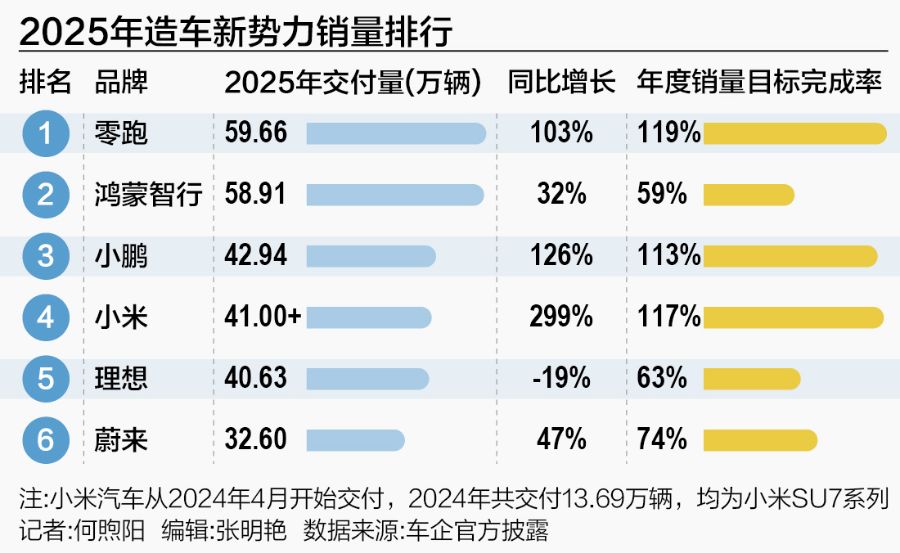
2025新势力生死局:“鸿零米”颠覆格局,“复活者”困战绝境
2 1 Shi Ji Jing Ji Bao Dao· 2026-01-05 12:27
Core Insights - The 2025 new energy vehicle market has shown a stark polarization, with new players like "Honglingmi" (Hongmeng Zhixing, Leap Motor, Xiaomi) rapidly gaining market share while established companies face significant challenges [1][21] - The competition has intensified, leading to a survival battle among companies, with some thriving in the growing market while others struggle in the existing market [1] Group 1: Performance of New Players - "Honglingmi" has collectively disrupted the previous market structure dominated by "Weilai, Xiaopeng, and Ideal," reshaping the competitive landscape [2] - Leap Motor emerged as the biggest dark horse, achieving a delivery volume of 596,600 units in 2025, setting a new record for new energy vehicle sales [2][3] - Xiaomi's automotive division delivered over 410,000 units in its first full year, exceeding its annual target by 117% [4] Group 2: Strategies and Challenges - Leap Motor's success is attributed to its long-term commitment to in-house research and development, achieving a gross margin of 14%-15% while maintaining affordable pricing [3] - Xiaomi's strategy leverages its consumer electronics user base and aims to create an integrated ecosystem, although it faces challenges related to brand perception and safety incidents [6] - Leap Motor plans to achieve a sales target of 4 million vehicles by 2026, marking a significant ambition for future growth [3] Group 3: Struggles of Established Players - The former "big three" of new energy vehicles, "Weilai, Xiaopeng, and Ideal," are undergoing painful transformations, with Weilai and Ideal failing to meet their annual sales targets [7][13] - Xiaopeng has shown resilience, achieving a sales volume of 429,400 units in 2025, becoming the only one among the three to meet its annual target [8] - Weilai has shifted its focus back to core automotive operations, successfully launching popular models like the L90 and ES8 [12] Group 4: Market Exit and Revival Attempts - Neta Auto has faced severe challenges, entering bankruptcy restructuring due to operational failures and market competition [16][17] - WM Motor has announced a five-year restructuring plan but faces skepticism regarding its financial stability and ability to execute its revival strategy [18] - High-end brands like HiPhi and Jidu are struggling with funding and operational challenges, with their revival efforts facing significant obstacles [19][20] Group 5: Future Outlook - The competition in the new energy vehicle market is expected to intensify, with a focus on systemic capabilities becoming crucial for survival [21] - Companies that can balance technology development, product iteration, financial reserves, and operational efficiency will be better positioned in this competitive landscape [21]


雷军徐洁云评论区被冲,米系KOL破防,只因小米投放了大熊?
Sou Hu Cai Jing· 2026-01-05 12:25
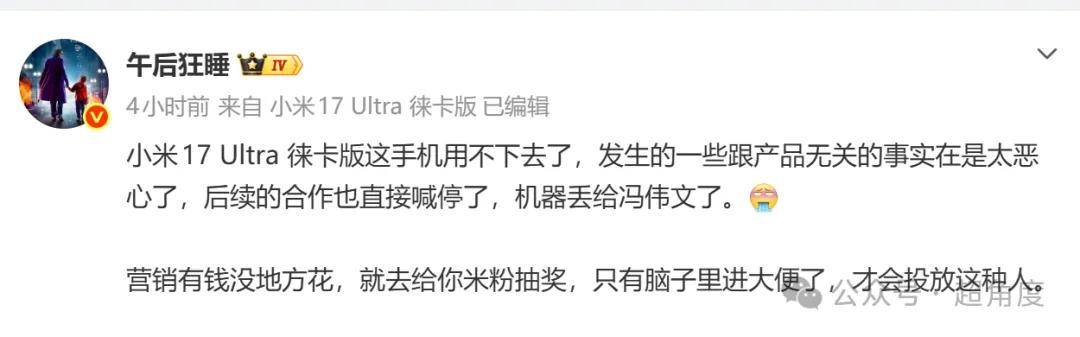
Core Viewpoint - The recent controversy surrounding Xiaomi's collaboration with influencer "万能的大熊" has led to significant backlash from its loyal fanbase, resulting in a potential shift in brand perception and loyalty among its users [10][20]. Group 1: Fan Reactions - Influencer "午后狂睡" expressed dissatisfaction with Xiaomi's marketing decisions, stating that the collaboration with "万能的大熊" was unacceptable and has led to a halt in his use of Xiaomi products [2][8]. - Many fans, particularly those identifying as "米粉," have voiced their disappointment and threatened to stop supporting the brand due to its association with influencers perceived as critical of Xiaomi [14][19]. - The backlash has resulted in trending topics on social media, indicating a strong emotional response from the fanbase, with calls for accountability from Xiaomi's leadership [13][17]. Group 2: Marketing Strategy Implications - The incident highlights a conflict between Xiaomi's strategy of engaging various influencers and the emotional loyalty of its core fans, who feel betrayed by the brand's choices [20][21]. - Xiaomi's public relations team is reportedly aware of the negative sentiment and is attempting to manage the situation, indicating a need for better alignment between marketing strategies and fan expectations [10][18]. - The brand's approach to influencer partnerships may require reevaluation to avoid alienating its dedicated customer base, as the emotional ties between fans and the brand are significant [21].
小米17 5G手机限时直降500元
Xin Lang Cai Jing· 2026-01-05 11:45
小米17 5G手机搭载第五代骁龙8至尊版处理器,性能强 劲流畅,轻松应对多任务处理与大型游戏运行,带来极 致使用体验。采用高刷新率OLED屏幕,显示清晰色彩 细腻,配合立体声双扬声器和旗舰级散热系统,视听与 握持感受全面升级。支持超快闪充与长续航电池组合, 满足全天候使用需求。影像系统表现同样出色,配备高 清主摄和智能拍摄算法,随手一拍即是大片。 小米17 5G手机搭载第五代骁龙8至尊版处理器,性能强劲流畅,轻松应对多任务处理与大型游戏运行, 带来极致使用体验。采用高刷新率OLED屏幕,显示清晰色彩细腻,配合立体声双扬声器和旗舰级散热 系统,视听与握持感受全面升级。支持超快闪充与长续航电池组合,满足全天候使用需求。影像系统表 现同样出色,配备高清主摄和智能拍摄算法,随手一拍即是大片。 目前该机在天猫精选开启限时优惠,活动售价4499元,叠加国补直降500元,下单1件实付仅3999元,较 原价直降500元,性价比出众,机会难得不容错过。 目前该机在天猫精选开启限时优惠,活动售价4499元, 叠加国补直降500元,下单1件实付仅3999元,较原价直 降500元,性价比出众,机会难得不容错过。 ...
港交所文件显示:小米集团(01810.HK)1月5日于回购了380万股B类股份,耗资1.493亿港元。
Jin Rong Jie· 2026-01-05 11:22
本文源自:金融界AI电报 港交所文件显示:小米集团(01810.HK)1月5日于回购了380万股B类股份,耗资1.493亿港元。 ...
小米集团-W1月5日斥资1.49亿港元回购380万股
Zhi Tong Cai Jing· 2026-01-05 11:12
小米集团-W(01810)发布公告,于2026年1月5日,该公司斥资1.49亿港元回购380万股。 ...
CES2026前瞻:关注AI端侧的升级与创新突破
Orient Securities· 2026-01-05 11:10
Investment Rating - The industry investment rating is maintained as "Positive" [5] Core Insights - The report emphasizes the importance of advancements and innovations in edge AI, predicting accelerated integration into various hardware products and industrial applications by 2026 [9][10] - Key players in the edge AI sector include chip manufacturers, terminal product manufacturers, and core component manufacturers, with specific companies highlighted for investment opportunities [3][10] Summary by Sections Investment Recommendations and Targets - Focus on the upgrade and innovation breakthroughs in edge AI, with recommended stocks including: - Edge AI main control chip manufacturers: Amlogic, Aojie Technology, Hengxuan Technology, Espressif Technology, Starshine Technology, Rockchip [3][10] - Terminal product manufacturers: Lenovo Group, Xiaomi Group, Luxshare Precision, Linying Intelligent Manufacturing, BYD Electronics, Lens Technology, Ezviz, Innosilicon [3][10] - Core component manufacturers: Huanxu Electronics, Sunny Optical Technology, Orbbec, SUTENG, STMicroelectronics, OmniVision, and Pegatron [3][10]


小米集团-W(01810.HK)1月5日耗资1.49亿港元回购380万股
Ge Long Hui· 2026-01-05 11:09
格隆汇1月5日丨小米集团-W(01810.HK)发布公告,2026年1月5日耗资1.49亿港元回购380万股,回购价 格每股39.22-39.32港元。 ...
小米集团-W(01810)1月5日斥资1.49亿港元回购380万股
智通财经网· 2026-01-05 11:09
智通财经APP讯,小米集团-W(01810)发布公告,于2026年1月5日,该公司斥资1.49亿港元回购380万 股。 ...