XIAOMI(01810)

Search documents
氪星晚报|MOVA TPEAK宣布签订亿元订单;韩国SK集团董事长密集会晤硅谷巨头,布局AI半导体生态;小米汽车累计交付量已超60万台
3 6 Ke· 2026-02-13 09:45
Group 1 - SK Group's Chairman Choi Tae-won is meeting with major tech CEOs in Silicon Valley, including Nvidia, Google, Microsoft, Broadcom, and Meta, to establish partnerships in AI semiconductor and data center ecosystems [1] - The meetings aim to integrate SK Group's AI solutions and expand its AI ecosystem, positioning the company as a leader in the artificial intelligence business [1] Group 2 - MOVA TPEAK announced a significant order for its Clip Pro open-ear headphones, valued at over 100 million yuan, leveraging an AI architecture for enhanced interaction speed [3] - The AI assistant's response time is improved by ten times, providing an "instant question and answer" experience [3] Group 3 - Yuanqi Forest has maintained double-digit growth for three consecutive years, with projections for continued profitability and improved growth quality by 2025 [4] - Vitamin water is the fastest-growing product, expected to increase by 128% year-on-year in 2025, followed by iced tea at 56% [4] Group 4 - The robot rental platform Qingtian has received over 5,000 orders during the Spring Festival period, with a projected GMV growth of approximately 80% [5] - Qingtian is launching a national city partner recruitment strategy to expand its operations [5] Group 5 - Xiaomi has surpassed 600,000 cumulative vehicle deliveries since April 3, 2024, indicating strong market performance [6] Group 6 - Stark Defence, a German drone manufacturing startup, has raised new funding, increasing its valuation to over 1 billion euros (approximately 1.2 billion USD) [9] - The funding round included significant investments from Peter Thiel's Founders Fund and other European investors [9] Group 7 - Lanrui Optoelectronics has completed a multi-hundred million yuan Series C financing round, aimed at expanding production capacity and upgrading its R&D center [10]

这些芯片,太难了
半导体芯闻· 2026-02-13 09:35
Core Viewpoint - The surge in storage chip prices is forcing major global electronics companies to face three challenging options: raise product prices, absorb costs, or adjust product configurations [1][2]. Group 1: Impact on Electronics Manufacturers - The AI boom is significantly impacting the supply chain, as AI requires extensive data center support, leading to a shortage of storage chips for manufacturers of smartphones, PCs, and gaming consoles [1][2]. - Dell Technologies has raised prices of some commercial laptops by up to 30%, while Acer has reduced the multitasking storage space in its budget PCs [1][3]. - Xiaomi has halted production of low-memory versions of new mid-range devices and increased prices, while LG Electronics has a dim outlook for TV sales this year due to rising storage chip prices [1][2]. Group 2: Market Trends and Predictions - The shortage of storage chips is expected to worsen for the smartphone, PC, and gaming console industries, with anticipated declines in shipment volumes [2][4]. - According to TrendForce, contract prices for DRAM and NAND flash have increased to approximately seven times their previous levels over the past 12 months [2][3]. - Analysts predict that supply will remain tight until the end of 2028, with little chance of price drops in the short term due to ongoing AI infrastructure investments [2][3]. Group 3: Financial Implications for Companies - The rising cost of storage chips, which accounts for 30% of total costs in PCs, is expected to suppress demand in the personal computer and smartphone sectors, although price increases may offset this decline [3][4]. - Apple CEO Tim Cook noted that while the impact of rising storage chip prices was minimal in the last fiscal quarter, a more significant effect is expected in the current quarter [3][4]. - Qualcomm's CEO expressed a desire for more storage chips, indicating that the supply constraints are affecting even companies not directly involved in consumer electronics [4].



雷军官宣小米SU7停产,一个时代结束了
商业洞察· 2026-02-13 09:21
Core Viewpoint - The discontinuation of the first-generation Xiaomi SU7 marks a significant transition for Xiaomi from a "newcomer" in the automotive industry to a serious player, reflecting a strategic decision by Lei Jun to pivot towards future developments in electric vehicles [2][12]. Group 1: Discontinuation of the First-Generation SU7 - The first-generation SU7 has exceeded its mission, achieving impressive sales of 381,000 units within less than two years since its launch in April 2024 [8][11]. - The decision to stop production is strategic, as the initial model's features have become outdated in the rapidly evolving electric vehicle market, allowing Xiaomi to make way for the next generation [10][12]. - The SU7 has successfully established Xiaomi's credibility in the automotive sector, proving that the company can manufacture and sell vehicles effectively [12]. Group 2: New Generation SU7 and Future Ambitions - The new generation SU7 is positioned as a key player in Xiaomi's broader strategy, with Lei Jun emphasizing improvements based on user feedback, such as the design of door handles to meet new national standards [18][20]. - Xiaomi plans to diversify its product line beyond a single model, introducing various types of vehicles including SUVs and performance cars to mitigate risks [23]. - The new SU7 will feature advanced safety technologies, including standard laser radar and high-strength steel, with a maximum range of 902 kilometers, showcasing Xiaomi's commitment to safety and performance [23]. Group 3: Challenges and Public Perception - Despite high sales, Xiaomi faces significant public criticism, particularly following safety incidents involving the SU7, which have raised questions about the company's commitment to safety [30][35]. - The backlash stems from a combination of jealousy and self-inflicted issues, as Xiaomi's marketing strategies have sometimes backfired, leading to negative public perception [33][40]. - The company must address core concerns regarding safety and transparency, as failure to do so could hinder its aspirations to become a major player in the automotive industry [42][44].

雷军:第一代SU7停产,小米汽车交付破60万辆
2 1 Shi Ji Jing Ji Bao Dao· 2026-02-13 09:21
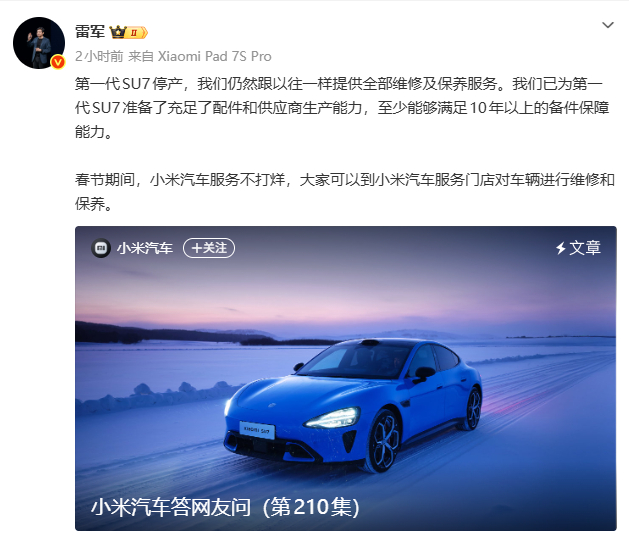
Group 1 - Xiaomi Group's founder and CEO Lei Jun announced the discontinuation of the first-generation SU7, while ensuring that maintenance and repair services will continue to be provided for over 10 years with sufficient spare parts and supplier production capacity [1] - As of April 3, 2024, Xiaomi has delivered over 600,000 vehicles, with the new generation SU7 display vehicles already available in stores [3] - In January, the Xiaomi YU7 achieved sales of 37,869 units, ranking first in the national passenger car retail sales chart, despite a month-on-month decline compared to December [3] Group 2 - According to the China Passenger Car Association, the wholesale sales of the Xiaomi YU7 in January were 37,869 units, placing it among the top models in the market [4] - The overall retail sales of passenger cars in January reached 1.544 million units, representing a year-on-year decline of 13.9%, with domestic brands experiencing a 18% drop [4] - The market is expected to face challenges in February, with predictions indicating it may reach an absolute low point for the year due to limited effective production and sales time [4]
雷军:第一代SU7停产,小米汽车交付破60万辆
21世纪经济报道· 2026-02-13 08:54
Group 1 - Xiaomi's founder Lei Jun announced the discontinuation of the first-generation SU7, but the company will continue to provide maintenance and repair services for it, ensuring at least 10 years of parts availability [1] - As of April 3, 2024, Xiaomi has delivered over 600,000 vehicles, with the new generation SU7 display models now available in stores [4] - In January, Xiaomi's YU7 model sold 37,869 units, ranking first in the national retail sales of passenger vehicles, despite a month-on-month decline compared to December [4] Group 2 - In January, the overall retail sales of passenger vehicles in China reached 1.544 million units, a year-on-year decrease of 13.9%, with domestic brands experiencing an 18% decline [7] - The wholesale sales data for January indicated that 17 models exceeded 20,000 units, with BYD Song leading at 42,227 units, followed closely by other brands including Xiaomi's YU7 [7] - The market is expected to face challenges in February, with predictions indicating it may reach an absolute low point for the year due to limited effective production and sales time [7]

计算机行业月报:中国AI超级周开启,算力呈现提价趋势-20260213
Zhongyuan Securities· 2026-02-13 08:11
Investment Rating - The report maintains an "Outperform" rating for the industry, indicating a positive outlook compared to the broader market [3]. Core Insights - The AI application landscape is rapidly evolving, with significant advancements expected in 2026, which will impact traditional sectors such as software, film, and media [6]. - Domestic AI models are increasingly competitive with international counterparts, particularly in terms of performance and cost, suggesting a potential shift in the global AI model competition [6]. - The demand for AI inference is rising sharply, leading to increased pricing actions from model and cloud service providers, which benefits companies within the industry [6]. Industry Data Summary 1. Industry Data - The software industry in 2025 is projected to generate revenues of 15.48 trillion yuan, reflecting a year-on-year growth of 13.2% [12]. - The IC design sector is expected to grow by 18.9% in 2025, while cloud computing and big data services are anticipated to grow by 13.6% [19]. - The information technology service revenue is expected to increase by 14.7%, further solidifying its share of the overall software business revenue to 68.7% [27]. 2. AI Developments - Major AI models are being released, with significant competition expected in the market, particularly with the upcoming launches of models like DeepSeek-V4 and others in February 2026 [33]. - The pricing of domestic models is significantly lower than that of international models, enhancing their attractiveness for various applications [39]. - The user engagement for AI applications is increasing, with notable growth in active users for platforms like Gemini and ChatGPT [44]. 3. Domestic Market Dynamics - Domestic chip manufacturers are expected to benefit from restrictions on foreign competitors, with companies like Huawei and Dawning making significant advancements in AI computing capabilities [6]. - The report highlights the increasing capital expenditures from overseas tech firms, raising concerns about market dynamics [6]. - The MaaS (Model as a Service) market is projected to grow rapidly, with significant contributions from companies like ByteDance and Alibaba [56].



小米YU7领跑1月中国汽车市场,销量达Model Y两倍
Huan Qiu Wang· 2026-02-13 07:40
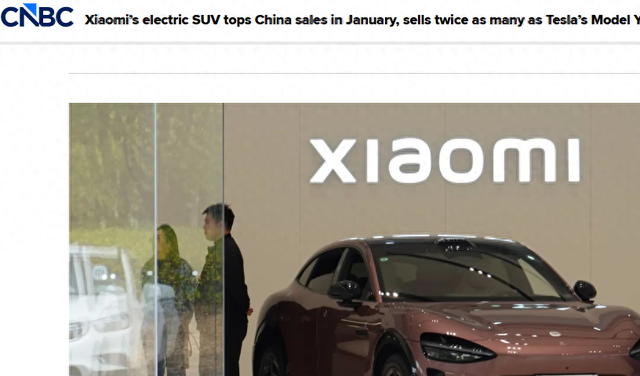
Group 1 - The core point of the article is that Xiaomi's electric SUV model YU7 topped the sales chart in China for January, selling 37,869 units, which is double the sales of Tesla's Model Y, marking a significant shift in the market dynamics [1][4] - YU7 is positioned as a direct competitor to Tesla's Model Y, with a starting price that is 10,000 yuan (approximately 1,450 USD) lower than that of the Model Y [4] - Tesla's Model Y saw a significant drop in sales in January, with only 16,845 units sold, ranking 20th, compared to 65,874 units sold in December of the previous year [4] Group 2 - Xiaomi is actively pursuing overseas expansion, with plans to enter the European market by 2027, currently testing in Spain and establishing a research center in Germany [4] - The company aims to increase the number of its stores in the UK to 150 over the next four years, leveraging its global layout through Xiaomi Home [4]

通信行业月报:北美云厂商资本开支强劲,CPO商业化应用拐点临近-20260213
Zhongyuan Securities· 2026-02-13 07:38
Investment Rating - The report maintains an "Outperform" investment rating for the communication industry [4][7]. Core Insights - In January 2026, the communication industry index increased by 5.47%, outperforming the Shanghai Composite Index (+3.76%), CSI 300 Index (+1.65%), Shenzhen Component Index (+5.03%), and ChiNext Index (+4.47%) [3][13]. - The capital expenditure of the four major North American cloud providers is expected to grow significantly, with a projected increase of over 60% in 2026 [6][24]. - The procurement results for special optical cables by China Mobile indicate that eight manufacturers, including Tongding Interconnection and Yangtze Optical Fibre and Cable, have been selected, highlighting the focus on key sectors such as industrial manufacturing and digital government [6][7]. Summary by Sections Industry Performance - The communication industry index showed a strong performance in January 2026, with a 5.47% increase, outperforming major indices [3][13]. - Sub-sectors within the communication industry saw varied performance, with cable, other communication equipment, and system equipment rising by 19.70%, 10.72%, and 7.85% respectively [16]. Telecommunications Sector - In 2025, the telecommunications business revenue reached CNY 1.75 trillion, a year-on-year increase of 0.7% [6][45]. - By December 2025, 5G mobile phone users accounted for 65.9% of total mobile phone users, with a monthly data usage (DOU) of 23.04GB per user, reflecting a 17.0% year-on-year increase [6][45]. Cloud Infrastructure Investment - The combined capital expenditure of the four major North American cloud providers in Q4 2025 was USD 126 billion, marking a 62.0% year-on-year increase [24][25]. - For 2026, the total capital expenditure guidance for these providers exceeds USD 660 billion, with an expected growth of 61.0% [24][25]. AI and Smartphone Market - The retail sales of communication equipment in China increased by 20.9% year-on-year in December 2025, driven by the demand for smartphones [44]. - The global smartphone shipment is projected to grow by 2% in 2025, reaching 1.25 billion units, with AI smartphones expected to penetrate 34% of the market by 2025 [6][44]. Investment Recommendations - The report suggests focusing on companies involved in optical devices, optical chips, optical modules, and AI smartphones, including Tianfu Communication, ZTE, and China Mobile [7][6].



2025年中国平板电脑出货量排名:华为稳居第一 苹果、小米紧随
Ju Chao Zi Xun· 2026-02-13 07:30
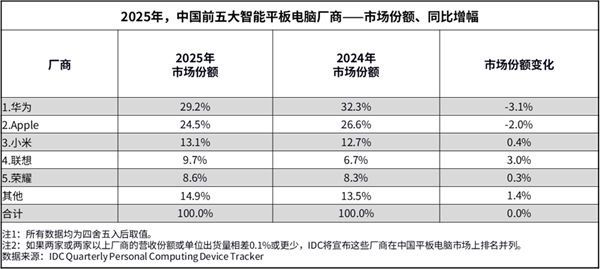
Core Insights - The Chinese tablet market is projected to reach a shipment volume of 33.76 million units in Q4 2025, reflecting a year-on-year growth of 13.1%, with a 7.2% increase in Q4 alone [1] - The "National Subsidy" policy has positively influenced consumer confidence and purchasing decisions, leading to an improved willingness to upgrade devices [1] - Market growth is transitioning from being policy-driven to being driven by product features and consumer demand as the "National Subsidy" policy begins to tighten in some regions [1] Market Performance - In Q4 2025, the Chinese tablet market experienced a year-on-year shipment growth of 7.2%, supported by an ongoing device upgrade cycle and continuous product feature enhancements by manufacturers [1] - Huawei maintained its leading position with a market share of 29.2%, despite a decline of 3.1% from the previous year [2] - Apple ranked second with a market share of 24.5%, showing a year-on-year increase in shipment volume [3] Manufacturer Analysis - Xiaomi held the third position with a market share of 13.1%, achieving double-digit growth in annual shipments [3] - Lenovo and Honor ranked fourth and fifth, with market shares of 9.7% and 8.6% respectively, with Lenovo experiencing a notable increase of 3.0% year-on-year [2] - Huawei's new product, the MatePad Edge, integrates PC-level systems and enhances the tablet's positioning for office and multi-scenario use, maintaining high market attention [2] Future Outlook - The expansion of the user base provides a solid foundation for device upgrades, although rising costs are increasing market uncertainties [3] - There is an urgent need for deeper exploration of AI and scenario-based upgrade paths in the industry [3]

Xiaomi electric SUV overtakes Tesla Model Y in China sales battle
Invezz· 2026-02-13 07:30
Core Insights - China's electric vehicle market experienced a significant shift in January, with Xiaomi's latest electric SUV surpassing Tesla's Model Y to become the best-selling vehicle in the country [1] Company Summary - Xiaomi's new electric SUV has achieved the status of the best-selling vehicle in China, indicating a strong competitive position against established players like Tesla [1] - Tesla's Model Y, previously a market leader, has been overtaken, highlighting the increasing competition in the electric vehicle sector [1] Industry Summary - The shift in sales dynamics reflects a broader trend in the Chinese electric vehicle market, where local manufacturers are gaining ground against international brands [1] - This development may signal changing consumer preferences and increased demand for domestic electric vehicles [1]