
LI AUTO-W(02015)

Search documents
港股新消费概念股持续下挫





Mei Ri Jing Ji Xin Wen· 2025-11-18 06:20
Core Viewpoint - The new consumption concept stocks in Hong Kong continue to decline, with significant drops observed in several companies [1] Group 1: Stock Performance - Xiaopeng Motors (09868.HK) experienced a decline of over 10% [1] - Hou Shang A Yi (02589.HK) fell nearly 4% [1] - Other companies such as Leap Motor (09863.HK), Laopu Gold (06181.HK), Li Auto (02015.HK), and Pop Mart (09992.HK) all saw declines exceeding 3% [1]
热门中概股收盘多数下跌 小鹏跌超10%
Xin Lang Cai Jing· 2025-11-17 22:33
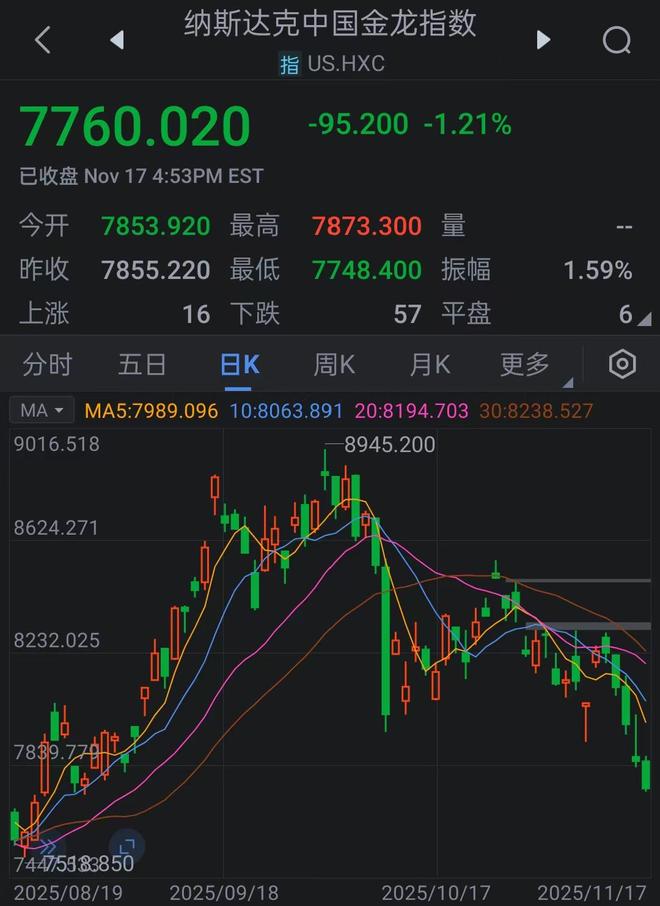
Group 1 - The majority of popular Chinese stocks closed lower on Monday, with the Nasdaq Golden Dragon China Index falling by 1.21% [1] - Alibaba saw an increase of over 2%, while Pinduoduo, NetEase, Ctrip, and Baidu experienced declines of over 1% [1] - Xpeng dropped by over 10%, Li Auto fell by over 4%, Manbang decreased by over 11%, and New Oriental declined by over 1% [1]


理想汽车:10月新开21家门店
Zheng Quan Shi Bao Wang· 2025-11-17 09:28
Core Insights - Li Auto plans to open 21 new stores by October 2025, expanding its retail presence significantly [1] - As of October 31, 2025, Li Auto will have a total of 551 retail centers, 165 delivery centers, and 554 service centers (including authorized body and paint shops) across 227 cities [1] Group 1 - Li Auto's expansion strategy includes the opening of 21 new stores by October 2025 [1] - The total number of retail centers will reach 551, enhancing the company's market coverage [1] - The company will also have 165 delivery centers and 554 service centers, indicating a robust service network [1]
恒生科技指数收跌近1%,携程联想领跌超3%



Cai Jing Wang· 2025-11-17 08:38
Core Viewpoint - The Hang Seng Index closed down approximately 0.71%, while the Hang Seng Tech Index fell by about 0.96%, indicating a negative trend in the Hong Kong stock market [1] Group 1: Company Performance - Lenovo Group and Trip.com Group both experienced declines of over 3% [1] - Baidu Group and Li Auto saw declines exceeding 2% [1] - Bilibili and Tongcheng Travel dropped by more than 1% [1] - Semiconductor Manufacturing International Corporation (SMIC) and Tencent Holdings had slight decreases [1] - Hua Hong Semiconductor and Meituan experienced slight increases [1]
数据解放生产力——琰究摩托车数据系列(2025年10月)【民生汽车 崔琰团队】
汽车琰究· 2025-11-17 07:26
Core Insights - The article provides an update on the motorcycle industry data for October 2025, highlighting sales trends and market share changes among key players in the sector [2][4]. Motorcycle Sales Data - In October 2025, sales of motorcycles with displacement over 250cc reached 61,000 units, showing a year-on-year decrease of 0.2% and a month-on-month decline of 29.7%. Cumulative sales from January to October totaled 822,000 units, reflecting a year-on-year increase of 29.7% [2]. - For motorcycles with displacement between 250ml and 400ml, October sales were 36,000 units, down 8.5% year-on-year and 31.5% month-on-month, with cumulative sales of 445,000 units, up 26.7% year-on-year [3]. - Motorcycles with displacement between 400ml and 500ml sold 10,000 units in October, a decrease of 7.2% year-on-year and 33.5% month-on-month, with cumulative sales of 196,000 units, down 2.2% year-on-year [3]. - Sales of motorcycles with displacement between 500ml and 800ml reached 13,000 units in October, an increase of 33.2% year-on-year but a decrease of 24.1% month-on-month, with cumulative sales of 161,000 units, up 128.7% year-on-year [3]. - For motorcycles with displacement over 800cc, October sales were 2,000 units, up 98.1% year-on-year and 12.2% month-on-month, with cumulative sales of 20,000 units, up 70.5% year-on-year [3]. Market Share Analysis - Chuanfeng Power achieved sales of 11,000 units in October for motorcycles over 250cc, a year-on-year increase of 27.8%, capturing a market share of 18.8%, up 4.1 percentage points month-on-month. The cumulative market share for January to October stands at 20.2%, an increase of 0.4 percentage points compared to the full year of 2024 [4]. - Longxin General sold 11,000 units in October, marking a year-on-year increase of 62.7% and a market share of 18.2%, up 7.0 percentage points month-on-month. The cumulative market share for January to October is 14.5%, an increase of 0.2 percentage points compared to the full year of 2024 [4]. - Qianjiang Motorcycle's sales in October were 4,000 units, down 47.9% year-on-year, with a market share of 6.7%, down 6.1 percentage points month-on-month. The cumulative market share for January to October is 12.8%, a decrease of 3.9 percentage points compared to the full year of 2024 [4]. Investment Recommendations - The article suggests focusing on key players in the motorcycle industry, specifically recommending Chuanfeng Power and Longxin General as leading companies in the mid-to-large displacement segment [8].





20万元预算别急着买新车 热门新能源平替车型解析
Bei Ke Cai Jing· 2025-11-17 04:57
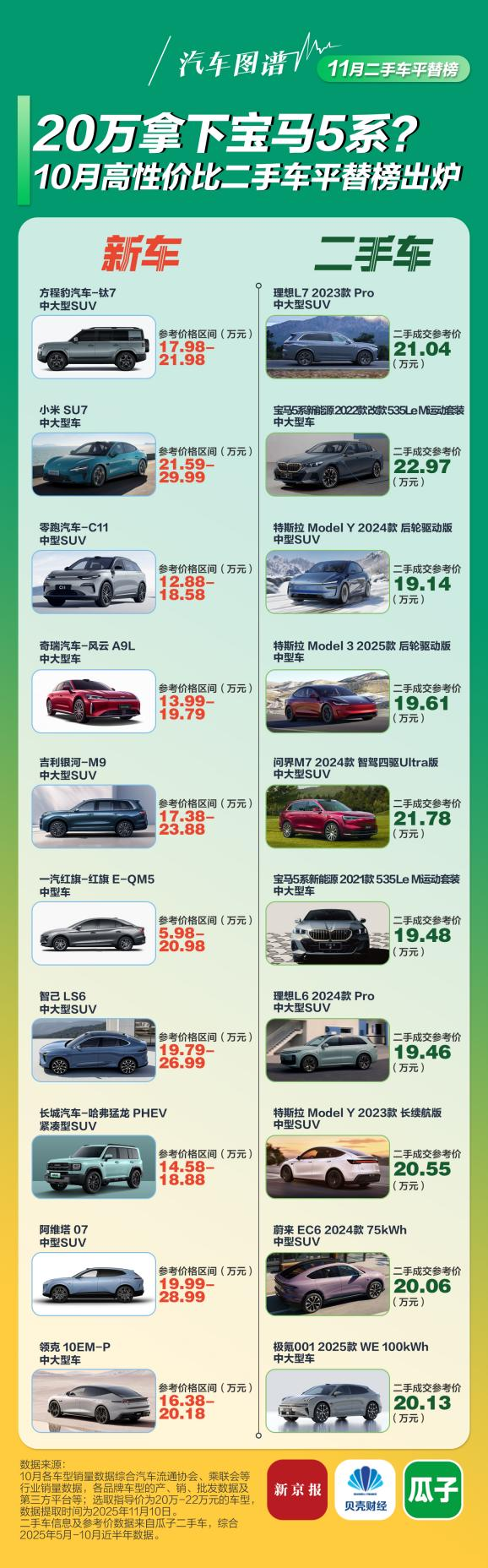
Core Insights - The penetration rate of new energy vehicles (NEVs) in China surpassed 50% for the first time in October 2025, marking a significant shift towards electric vehicles as the dominant market force [1] - In October, the production and sales of NEVs reached 1.772 million and 1.715 million units respectively, with year-on-year growth exceeding 20%, setting new historical records for the month [1] - Cumulative sales for the first ten months of the year approached 13 million units, indicating a sustained increase in market enthusiasm for NEVs [1] Market Dynamics - The price range of 200,000 to 220,000 yuan has emerged as a critical threshold for consumers when choosing between new and used vehicles, as it encompasses both mainstream new energy vehicles and high-end used models [1] - Used cars in this price range offer advantages in terms of intelligent features, vehicle size, and driving experience compared to new cars [1] Competitive Landscape - The top-selling new models in the 200,000 to 220,000 yuan range for October included the Fangchengbao Titanium 7, Xiaomi SU7, and Leap Motor C11, all of which have high-value alternatives in the used car market [1] - For instance, the 2023 model of Li Auto L7 Pro offers superior range and comfort compared to its new counterparts, while the BMW 5 Series New Energy 535Le, originally priced around 500,000 yuan, is available for approximately 230,000 yuan in the used market [1] Consumer Behavior - The trend towards purchasing used NEVs is increasingly viewed as a smart and pragmatic choice rather than a compromise, as the technology stabilizes and the depreciation rates of used vehicles decline [2] - Consumers are encouraged to focus on thorough research and verification when selecting used NEVs, emphasizing the importance of asking questions, inspecting details, and ensuring guarantees [3][5] Recommendations for Purchasing Used NEVs - Utilize reputable platforms like Guazi Second-hand Cars for better pricing and direct sourcing [5] - Engage with AI tools to clarify needs and compare options before purchase [5] - Conduct detailed inspections of vehicle conditions through video checks and ensure comprehensive support during the pickup process [5] - Pay special attention to battery health and consider warranties that provide dual protection [5]

金十数据全球财经早餐 | 2025年11月17日
Jin Shi Shu Ju· 2025-11-16 23:05
Core Viewpoint - The financial markets are experiencing volatility due to mixed signals from the Federal Reserve regarding interest rate policies, geopolitical tensions, and sector-specific performance in both U.S. and international markets [3][4][11]. Market Performance - U.S. stock indices showed mixed results with the Dow Jones down 0.65%, S&P 500 down 0.05%, and Nasdaq up 0.13% [4][8]. - European indices faced declines, with Germany's DAX30 down 0.69%, UK's FTSE 100 down 1.11%, and the Euro Stoxx 50 down 0.85% [4][8]. - Hong Kong's Hang Seng Index fell 1.85%, closing at 26,572.46 points, with significant declines in technology stocks [5][8]. - A-shares also declined, with the Shanghai Composite Index down 0.97%, closing below 4,000 points [6][9]. Commodity Prices - WTI crude oil prices rose by 2.13%, closing at $59.82 per barrel, while Brent crude increased by 0.22% to $63.95 per barrel [4][8]. - Gold prices fell by 2.2%, ending at $4,079.58 per ounce, and silver dropped by 3.4% to $50.56 per ounce [8][9]. Federal Reserve Signals - Federal Reserve officials, including Logan and Schmidt, issued strong hawkish signals, indicating that further rate cuts may not be appropriate at this time [11]. - The market is reacting to these signals, with expectations of interest rate stability impacting various asset classes [11]. Corporate Developments - Berkshire Hathaway disclosed a rare technology stock position, having built a stake in Alphabet, Google's parent company, during Q3 [11]. - Huawei is expected to announce breakthrough technologies in the AI sector, which could enhance computational resource efficiency [17].


锂电产业链保持高景气度,多环节价格上行
Huaxin Securities· 2025-11-16 10:03
Core Insights - The report highlights the robust demand in the lithium battery supply chain, with significant year-on-year growth in China's new energy vehicle production and sales, reaching 177.2 million units and 171.5 million units in October, respectively, marking increases of 21.1% and 20% [3][78] - The supply side is seeing continuous innovation from battery and main engine manufacturers, with policies actively supporting the industry, leading to an improved supply-demand balance and stabilization of prices after a period of decline [3][78] - The report maintains a positive outlook on high-quality companies within the lithium battery supply chain, particularly in segments like solid-state batteries and liquid cooling technologies, while recommending a "buy" rating for several key players [4][78] Market Tracking - The report notes that the new energy vehicle index, lithium battery index, and energy storage index have shown strong performance, with year-to-date increases of 49.80%, 77.57%, and 65.75%, respectively [22] - Individual stock performance highlights include significant gains for companies like Huasheng Lithium and Haike New Energy, which saw increases of 79.6% and 71.4% respectively, while companies like XWANDA and Kecuan Technology experienced declines of 12.1% and 11.5% [5][26] Lithium Battery Supply Chain Price Tracking - Key materials in the lithium battery supply chain have shown price fluctuations, with lithium carbonate prices rising to 85,200 RMB/ton, a 6.0% increase from the previous week, and lithium hexafluorophosphate seeing a substantial increase of 24.7% [6][34][38] - The report indicates that the prices of lithium hydroxide and cobalt have also increased, reflecting a tightening supply and strong demand in the market [6][34] Production and Sales Data Tracking - Cumulative production and sales of new energy vehicles in China reached 13.015 million and 12.943 million units from January to October, with year-on-year growth of 33.1% and 32.7% respectively [3][47] - The report emphasizes the leading position of new energy vehicles in the overall automotive market, with significant monthly production and sales figures [47] Industry Dynamics - The report discusses upcoming changes in the new energy vehicle purchase tax policy, which is expected to stimulate market demand and shift the industry focus from price competition to value competition [68] - It also highlights advancements in robotics and autonomous driving technologies, indicating a broader trend towards automation and innovation within the industry [68][70] Key Company Announcements - Haike New Energy has signed a strategic cooperation agreement with Kunlun New Materials for the supply of electrolyte solvents, indicating a commitment to securing raw materials for future production [73] - Shangtai Technology has approved an investment agreement for a new project to produce 200,000 tons of lithium-ion battery anode materials, reflecting ongoing expansion efforts in the sector [73] Industry Rating and Investment Strategy - The report maintains a "recommended" rating for the new energy vehicle industry, emphasizing the potential for price recovery and the importance of high-quality companies in the supply chain [4][78] - It suggests focusing on companies that are expected to deliver excess returns, particularly in emerging areas such as solid-state batteries and liquid cooling technologies [4][78]




对理想所有非共识本质是四点非共识
理想TOP2· 2025-11-16 09:27
Core Viewpoints - The article discusses four main areas of non-consensus regarding Li Auto, including perceptions of Li Xiang's capabilities, reasons for the company's poor sales this year, the direction and ultimate goals of smart vehicles, and the prospects of physical AI [1][2]. Group 1: Non-Consensus Areas - The first area of non-consensus revolves around how to evaluate Li Xiang's abilities and the implications of leadership errors [1]. - The second area focuses on differing opinions regarding the reasons behind Li Auto's disappointing sales performance this year [1]. - The third area addresses the advanced directions and ultimate goals of smart vehicles, highlighting two main schools of thought: one prioritizing high sales models and the other focusing on end goals [3][4]. - The fourth area concerns the future of physical AI, including its exploration necessity and potential pathways for realization [1]. Group 2: Bayesian Reasoning - The article emphasizes that differing beliefs about the future stem from individuals' Bayesian reasoning, where the strength of prior beliefs and the likelihood of new evidence vary among people [1]. - Those who "believe it to see it" tend to have strong priors that may lead to a higher tolerance for errors, while those who "see it to believe it" have weaker priors, making them more responsive to new evidence [2]. Group 3: Smart Vehicle Directions - Two main factions exist regarding the direction of smart vehicles: one that focuses on high sales models and another that starts with the end goal in mind [3][4]. - The "high sales model" faction emphasizes current successful vehicle features, while the "end goal" faction believes in a future defined by AI and automated driving [5]. Group 4: Evaluation of Li Auto's Strategy - The article notes that perceptions of Li Auto's long-term strategy and capabilities vary significantly, with some believing in the company's potential for recovery through iterative improvements, while others doubt Li Xiang's abilities due to repeated errors [6]. - The evaluation of Li Auto's products and strategies is influenced by whether individuals focus on immediate performance or the foundational principles guiding the company's design [5][6].

汽车和汽车零部件行业周报20251116:宇树科技完成上市辅导,关注国产机器人IPO进程-20251116
Minsheng Securities· 2025-11-16 05:42
Investment Rating - The report maintains a positive investment outlook for the automotive and automotive parts industry, particularly focusing on companies involved in intelligent driving and electric vehicles [3][4]. Core Insights - The automotive sector has shown weaker performance compared to the market, with a decline of 1.7% in the A-share automotive sector from November 10 to November 16, 2025, ranking 27th among sub-industries [29]. - Key companies to watch include Geely, Xpeng Motors, BYD, Xiaomi Group, Li Auto, Berteli, Top Group, New Spring, Hu Guang, and Chunfeng Power, as they are expected to benefit from the ongoing transformation in the automotive industry [9][10]. - The report highlights the importance of Tesla's production progress and technological iterations as a core theme, alongside the upcoming IPOs of domestic robot manufacturers like Yushu Technology, which could serve as strong catalysts for the industry [10][16]. Summary by Sections 1. Weekly Insights - Yushu Technology has completed its IPO guidance and plans to submit its IPO application between October and December 2025, with a post-investment valuation exceeding 12 billion yuan [10]. - The report emphasizes the significance of Tesla's advancements and the upcoming IPOs of domestic robot manufacturers as key drivers for the market [10][16]. 1.1 Passenger Vehicles - The report recommends focusing on high-quality domestic brands that are accelerating in intelligence and globalization, specifically naming Geely, Xpeng, BYD, Xiaomi, Li Auto, and Seres [13]. 1.2 Intelligent Electric Vehicles - The report anticipates long-term growth acceleration in the intelligent electric vehicle sector, highlighting the importance of intelligent driving technologies and the increasing market share of domestic brands [14][15]. 1.3 Robotics - The report notes that leading companies are accelerating their entry into the robotics sector, marking the beginning of a new era in embodied intelligence, with significant developments expected in 2026 [15][17]. 1.4 Liquid Cooling - The report discusses the rising demand for liquid cooling solutions driven by AI technology, predicting a compound annual growth rate of 27.6% from 2024 to 2030, with the market expected to reach 21.3 billion USD by 2030 [20][21]. 1.5 Motorcycles - The report highlights the rapid expansion of the large-displacement motorcycle market, with sales showing significant year-on-year growth, particularly in the 500cc to 800cc segment [22][24]. 1.6 Heavy Trucks - The report indicates that the expansion of the old-for-new subsidy policy will stimulate demand for heavy trucks, with a notable increase in sales observed in October 2025 [24][25]. 1.7 Tires - The report emphasizes the ongoing globalization of the tire industry, recommending leading companies that are well-positioned for growth and have strong manufacturing capabilities [26][27].
