LI AUTO-W(02015)

Search documents
“卖爆了”!新能源车数据来了
中国基金报· 2025-11-02 03:01
Core Insights - The article highlights the significant growth in the delivery volumes of new energy vehicle (NEV) companies in China for October, with many companies achieving record highs in their monthly sales figures [2][3]. Group 1: Performance of Major NEV Companies - BYD achieved a monthly sales volume of 441,706 units in October, marking an 11.47% increase month-on-month but a 12.13% decrease year-on-year [5][9]. - Geely's NEV sales reached 177,882 units in October, showing a remarkable year-on-year growth of 63.61% and a month-on-month increase of 7.68% [11]. - Chery's NEV sales surpassed 110,000 units for the first time, totaling 110,346 units, with a year-on-year increase of 54.70% and a month-on-month increase of 20.48% [14][15]. Group 2: New Entrants and Emerging Players - Leap Motor reported a record monthly delivery of 70,289 units in October, marking an 84.11% year-on-year increase [4][18]. - Xiaopeng Motors achieved a new high with 42,013 units delivered, reflecting a year-on-year growth of 75.66% [20]. - NIO also saw significant growth, with a delivery volume of 40,397 units, representing a 92.59% year-on-year increase [22][25]. Group 3: State-Owned Enterprises in NEV Sector - State-owned NEV companies collectively reported over 30% year-on-year growth in October, with BAIC New Energy leading with a 112.02% increase [27]. - The Changan brand's Deep Blue achieved sales of 36,792 units, ranking first among state-owned NEV companies [28]. - Lantu, another state-owned brand, recorded sales of 17,218 units, with a year-on-year growth of 69.52% [30][34]. Group 4: Challenges for Established Players - Li Auto, once a leader among new car manufacturers, faced a decline in deliveries, with 31,767 units sold in October, down 38.25% year-on-year [37][41]. - The article notes that the competition among NEV companies is intensifying, making it difficult to determine a clear winner in the market [4][22]. - The article emphasizes the importance of sustained efforts and systemic capabilities for companies to maintain competitive advantages in the long run [44].





China EV Heat Check: Nio, Li Auto, XPeng on Fire China EV Heat Check: Nio, Li Auto, XPeng on Fire - Carbon Collective Climate Solutions U.S. Equity ETF (NASDAQ:CCSO), Roundhill ETF Trust Roundhill Hum
Benzinga· 2025-11-01 19:28
Core Insights - China's electric vehicle (EV) manufacturers, including Nio, Li Auto, and XPeng, reported record deliveries in October, indicating strong demand and competitive growth in the EV market [1] Nio - Nio achieved a record delivery of 40,397 vehicles in October, marking a 92.6% increase year over year [2] - Cumulative deliveries reached 913,182 vehicles by October 31, with the ONVO L90 model being a significant contributor, surpassing 10,000 units for three consecutive months [3] - Nio's stock has increased over 42% in the past year [4] Li Auto - Li Auto reported 31,767 deliveries in October, bringing total lifetime deliveries to 1,462,788 vehicles [5] - The Li i6 model has received over 70,000 orders since its launch, with efforts to ramp up deliveries to meet demand [5] - Li Auto opened its first authorized store in Uzbekistan and plans to expand into Kazakhstan, focusing on growth in Central Asia, the Middle East, Europe, and the Asia-Pacific [5][6] - Li Auto operates 551 retail locations and 3,508 fast-charging stations across China, but its stock has decreased over 16% in the past year [6] XPeng - XPeng recorded 42,013 deliveries in October, a 76% increase year over year, marking the second consecutive month with deliveries above 40,000 [7][8] - Total shipments for the first ten months of 2025 reached 355,209 units, reflecting a 190% year-over-year increase [8] - XPeng is expanding its global presence, entering seven new markets in Europe, Asia, and Africa, and reported strong usage of its advanced driver-assistance system, XNGP [8] - XPeng's stock has surged over 103% in the past year, and the company is set to host its annual AI Day on November 5 to discuss advancements in autonomous technology [9]


10月汽车新势力“黑马”成群
Jing Ji Guan Cha Wang· 2025-11-01 16:21
Core Insights - The Chinese automotive market continues to show strong performance in October, particularly in the new energy vehicle (NEV) segment, indicating a shift in industry dynamics and growth logic [2][6] NEV Market Performance - NEVs are becoming the primary growth driver, with companies like Chery achieving over 110,000 NEV sales, Geely experiencing eight consecutive months of growth, and Great Wall Motors reporting a 44% year-on-year increase [2] - BYD remains the leader with over 440,000 units sold, although its growth momentum has slowed, showing a 12% decline compared to October last year [2][3] New Entrants and Competition - New entrants in the market are gaining traction, with Leap Motor surpassing 70,000 units, Xiaopeng achieving 42,000 units in sales, and NIO returning to growth with a monthly sales figure of 40,000 units [3][4] - The competition among new players has shifted from a focus on technology to one centered on production capacity, distribution channels, and after-sales service [4] Traditional Automakers' Strategies - Traditional automakers are experiencing a clear divide, with Geely and Great Wall Motors showing robust growth through diversified brand strategies and product lines [4][5] - SAIC's Roewe and MG brands have seen a 59% increase in NEV retail sales, but overall sales growth remains modest at 3% [4] Export Growth and Challenges - Exports are emerging as a new growth engine for automakers, with Great Wall's overseas sales reaching 57,000 units, a 28% increase year-on-year [5] - However, the risks associated with localization and profit dilution are significant as companies expand internationally [6] Industry Trends and Future Outlook - The industry is approaching a critical juncture, with NEV penetration nearing 60% and a normalization of price competition leading to declining average gross margins [6][7] - The focus is shifting from rapid growth to quality and operational efficiency, as companies must balance efficiency and profitability to succeed in the evolving market landscape [7]


购置税新规将近,新势力们抢占窗口期
Xin Lang Cai Jing· 2025-11-01 12:16
Core Viewpoint - The new policy regarding the purchase tax for electric vehicles (EVs) in China marks a significant shift, transitioning from full exemption to a 50% reduction starting in 2026, which indicates a gradual reduction in government support for the EV sector after a decade of incentives [1][4]. Policy Changes - The Ministry of Industry and Information Technology, the Ministry of Finance, and the State Taxation Administration announced that from 2026, the purchase tax for EVs will be halved, with a maximum tax reduction of 15,000 yuan per vehicle [1]. - This change signifies the end of the full exemption policy that has been in place since 2014, reflecting a broader trend of decreasing government support for the EV industry [1][4]. Market Performance - In the first nine months of this year, China's retail sales of new energy vehicles grew by 24.4%, with a retail penetration rate reaching 57.8% in September [2]. - The data indicates that the EV industry has crossed the critical threshold of market cultivation and is entering a period of mainstream consumer adoption [4]. Company Strategies - In anticipation of the new tax policy, over ten car manufacturers, including Xiaomi, NIO, and Li Auto, have announced plans to cover the tax difference for customers to retain users during this transition period [4][6]. - Xiaomi has committed to fully covering the tax difference for orders placed by November 30, 2025, if delivery is delayed due to the company’s reasons, with a maximum subsidy of 15,000 yuan [6][7]. Competitive Landscape - The competition among new energy vehicle manufacturers remains intense, with companies like Li Auto and NIO also introducing tax subsidy policies for their new models launched in September [7][8]. - The introduction of tax subsidies for new models is seen as a strategy to maintain competitiveness and build market presence ahead of the upcoming sales season [8][9]. Production and Delivery Challenges - Many manufacturers are facing production ramp-up challenges, particularly for new models launched recently, which necessitates the implementation of tax subsidies to secure customer orders [9][10]. - Companies like Xiaomi are experiencing long delivery times, with some customers needing to wait until 2026 for their vehicles, prompting the need for subsidies to alleviate customer concerns about increased costs [9][10]. Future Outlook - As the policy support diminishes, new energy vehicle manufacturers will need to enhance their competitiveness through core technology, product excellence, and efficient cost control to thrive in the evolving market landscape [13][14]. - The industry is expected to shift from being policy-driven to market-driven, with a focus on technological innovation and service quality becoming critical for long-term success [13][16].
新势力最新销量数据公布
财联社· 2025-11-01 12:13
Core Viewpoint - The new energy vehicle market is experiencing a delivery surge in October, with several new car manufacturers reporting record sales figures during the peak sales season [1]. Group 1: Delivery Performance - Leap Motor achieved a delivery volume of 70,289 units in October, setting a new monthly sales record for new car manufacturers and leading the delivery rankings for eight consecutive months [3]. - Xpeng Motors delivered 42,013 vehicles in October, marking a historical high and maintaining over 40,000 deliveries for two consecutive months [3]. - NIO delivered 40,397 vehicles in October, a year-on-year increase of 92.59%, with significant contributions from its various brands [4]. - Li Auto delivered 31,367 vehicles in October, experiencing a year-on-year decline of approximately 38.25% [2][4]. Group 2: Year-to-Date Performance - Leap Motor's cumulative deliveries reached 465,805 units, reflecting a year-on-year increase of 120.72% [2]. - Xpeng Motors' cumulative deliveries stood at 355,209 units, showing a remarkable year-on-year growth of 190.02% [2]. - NIO's cumulative deliveries reached 241,618 units, with a year-on-year increase of 41.91% [2]. - Li Auto's cumulative deliveries were 328,516 units, indicating a year-on-year decline of 16.36% [2]. Group 3: Product Developments - Leap Motor is actively expanding its product lineup, with the flagship D19 SUV recently unveiled and the A10 model set to debut at the 2025 Guangzhou Auto Show [3]. - Xpeng Motors plans to launch the new X9 super range extender model, which features advanced battery technology and impressive range capabilities [3]. - NIO's new ES8 model has reached 10,000 units in deliveries, with plans for increased production capacity in November [4]. - Li Auto is addressing production capacity issues to meet the high demand for its i6 model, which has received over 70,000 orders [4].
卖爆了!小米汽车10月交付超4万台,小鹏创纪录!理想也卖疯了,“i6销售太火爆,远超预期”
Mei Ri Jing Ji Xin Wen· 2025-11-01 07:31
Core Insights - Multiple automotive brands, including Xiaomi, Li Auto, and Xpeng, reported their October delivery figures, showcasing significant growth in the electric vehicle market [1] Group 1: Xiaomi Automotive - Xiaomi Automotive announced that by October 2025, its delivery volume will consistently exceed 40,000 units [2] Group 2: Li Auto - Li Auto delivered 31,767 vehicles in October 2025, with a total cumulative delivery of 1,462,788 vehicles as of October 31, 2025 [3][4] - The launch of the Li i6 has exceeded expectations with over 70,000 orders, prompting the company to address capacity issues and accelerate delivery [4] - Li Auto is expanding its international presence, opening its first overseas retail center in Uzbekistan and planning further expansions in Central Asia, the Middle East, Europe, and the Asia-Pacific region [4] - As of October 31, 2025, Li Auto has 551 retail centers across 157 cities and 3,508 charging stations with 19,417 charging piles [4] Group 3: Other Automotive Brands - Zhiji Automotive reported sales of 13,159 units in October [6] - Lantu Automotive delivered 17,218 vehicles in October 2025, with a year-to-date cumulative growth of 82% [8] - Leap Motor announced total deliveries of 70,289 units in October, representing a year-on-year growth of over 84% [10] - Xpeng delivered 42,013 vehicles in October 2025, marking a historical monthly high and maintaining a strong sales performance in the mid-to-large pure electric sedan segment [12] - The Xpeng P7+ has accumulated over 80,000 deliveries, and the Xpeng G6 has surpassed 65,000 deliveries year-to-date, showing a nearly 60% year-on-year growth [12] - Xpeng's upcoming model, the X9 Super Range Extender, is set to be unveiled, featuring significant advancements in battery technology and range [12] Group 4: Market Overview - From October 1 to 26, 2025, the national retail market for passenger vehicles saw a decline of 7% year-on-year, with total retail sales for the year reaching 18.621 million units, a growth of 8% [15] - During the same period, wholesale figures for passenger vehicles decreased by 1% year-on-year, with a cumulative growth of 12% for the year [15]
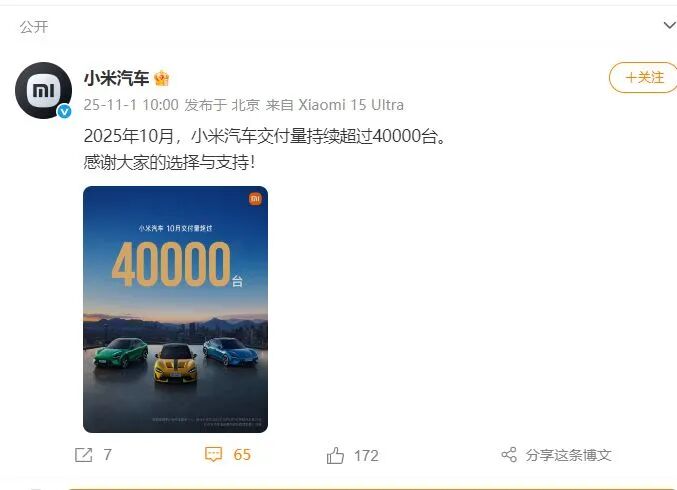
炸裂!小鹏汽车、小米汽车、零跑......10月交付量最新出炉
Zheng Quan Shi Bao· 2025-11-01 06:05
Group 1: New Energy Vehicle Sales Data - Xpeng Motors reported a record high delivery of 42,013 vehicles in October 2025, marking the second consecutive month of over 40,000 deliveries. Cumulative deliveries from January to October reached 355,209 units, a year-on-year increase of 190% [1] - Li Auto announced deliveries of 31,767 vehicles in October 2025, while Xiaomi Motors also reported consistent deliveries exceeding 40,000 units in the same month [1] - Leap Motor achieved total deliveries of 70,289 vehicles in October, reflecting a year-on-year growth of over 84% [1] - Zhiqi Automotive announced sales of 13,159 vehicles in October, with the flagship model Zhiqi LS9 set to debut globally on November 4 [1] Group 2: Financial Performance of Companies - Seres reported a revenue of 110.534 billion yuan and a net profit of 5.312 billion yuan for the first three quarters of 2025, representing a year-on-year growth of 31.56%. Cumulative sales of Seres' new energy vehicles reached 304,629 units [3] - The cumulative delivery of the Wanjie series exceeded 800,000 units, with the Wanjie M9 achieving over 250,000 deliveries in 21 months, setting a new record for 500,000-level models [3] Group 3: Industry Trends and Challenges - The automotive industry faces increasing complexity and challenges due to unilateralism and protectionism, impacting the stability of the automotive supply chain. The domestic economic recovery remains fragile, with insufficient effective demand and chaotic market competition posing ongoing challenges [4] - The implementation of vehicle replacement subsidy policies has significantly boosted the automotive market in 2025, leading to an upward adjustment of retail volume growth expectations for the domestic market [4] - The industry anticipates significant pressure in 2026, with calls for long-term supportive policies to stimulate vehicle purchases and promote economic growth [4] Group 4: Robotaxi Development - Yuanrong Qixing announced a partnership with the Wuxi government to establish a testing and R&D base for Robotaxi services, aiming to launch consumer-grade mass-produced Robotaxi vehicles by the end of the year [5] - Yuanrong Qixing's approach utilizes consumer-grade mass-produced vehicles without the need for additional customized sensors, resulting in lower deployment costs and enhanced system stability [5] - The Robotaxi market in China is projected to experience a compound annual growth rate of 140.7% from 2025 to 2030, indicating significant development potential and commercial value [5]
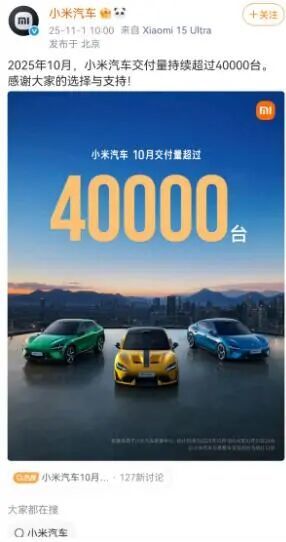
理想汽车10月交付新车超3万辆
Bei Jing Shang Bao· 2025-11-01 03:53
Core Insights - Li Auto delivered 31,800 new vehicles in the first ten months of this year [1] Company Summary - Li Auto's vehicle delivery performance indicates a strong market presence and growth trajectory in the electric vehicle sector [1]
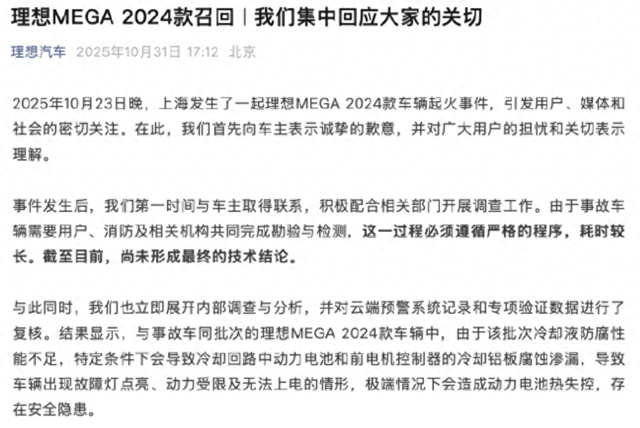
理想汽车回应MEGA 2024款车辆起火事件:尚未形成最终技术结论
Huan Qiu Wang· 2025-11-01 03:30
Core Points - On October 31, Li Auto announced a fire incident involving its MEGA 2024 model vehicles that occurred on October 23, 2025, in Shanghai, which has drawn significant attention from users, media, and the public [1] - The company expressed sincere apologies to the vehicle owner and acknowledged the concerns of users, stating that they are cooperating with relevant departments for an investigation [1] - The investigation process is lengthy due to the need for joint inspections and testing by the user, fire department, and related institutions, and a final technical conclusion has not yet been reached [1] Recall Announcement - Prior to the company's announcement, the State Administration for Market Regulation released a notice stating that Li Auto had proactively filed a recall plan in accordance with the regulations on defective automotive products [3] - The recall, numbered S2025M0174V, will commence on November 7, 2025, affecting a total of 11,411 vehicles produced between February 18, 2024, and December 27, 2024 [3] - The recall is due to insufficient corrosion resistance of the coolant in this batch, which under specific conditions may lead to corrosion and leakage of the cooling aluminum plates for the power battery and front motor controller, potentially causing warning lights to illuminate, power limitations, and in extreme cases, thermal runaway of the power battery, posing safety risks [3]
小米汽车官宣:10月交付量超40000台!理想汽车、小鹏汽车、智己汽车、岚图汽车、零跑汽车也公布了
Mei Ri Jing Ji Xin Wen· 2025-11-01 03:16
Group 1: Company Deliveries - Xiaomi Auto announced a delivery volume exceeding 40,000 units in October 2025 [1] - Li Auto delivered 31,767 vehicles in October 2025, with a cumulative delivery of 1,462,788 units as of October 31, 2025 [3] - Lantu Auto reported a delivery of 17,218 vehicles in October 2025, with a year-to-date cumulative growth of 82% [6] - Leap Motor achieved total deliveries of 70,289 units in October, marking a year-on-year growth of over 84% [8] - Xpeng Motors delivered 42,013 vehicles in October 2025, setting a new monthly delivery record and maintaining a strong sales performance in the mid-to-large electric sedan segment [10] Group 2: Market Trends - From October 1 to 26, 2025, the national retail market for passenger vehicles saw a decline of 7% year-on-year, with total retail sales of 1.613 million units [11] - The wholesale volume for passenger vehicles during the same period was 1.871 million units, reflecting a year-on-year decrease of 1% [11]