LI AUTO-W(02015)

Search documents
理想汽车上周销量0.57万辆 新增订单破2.3万
Feng Huang Wang· 2025-10-10 09:54
Group 1 - The core point of the article is that Li Auto has shown significant growth in vehicle deliveries and orders, indicating a strong market position in the high-end SUV segment [1][2] Group 2 - In the week of September 29 to October 5, 2025, Li Auto's sales reached 5,700 units [1] - Li Auto received over 23,000 new orders in the previous week [2] - In September 2025, Li Auto delivered 33,951 vehicles, a 19% increase from August's 28,529 units [2] - The total deliveries for the third quarter of 2025 reached 93,211 units [2] - As of September 30, 2025, Li Auto's cumulative delivery volume surpassed 1.43 million units, totaling 1,431,021 vehicles [2] - Li Auto maintains a strong position in the SUV market priced above 200,000 yuan, surpassing Tesla in cumulative sales in this segment this year [2] - The Li MEGA model achieved the highest sales in the market for pure electric vehicles and MPVs priced above 500,000 yuan during the third quarter [2]

【新能源周报】新能源汽车行业信息周报(2025年9月29日-10月5日)
乘联分会· 2025-10-10 09:43
Industry Information - National Grid will explore issuing highway charging coupons during the National Day and Mid-Autumn Festival holidays to guide users to avoid long-duration trickle charging [9] - CATL plans to build 100 chocolate battery swap stations in Hainan over the next three years, significantly enhancing the coverage of battery swap networks across the island [10] - The Ministry of Industry and Information Technology will further deepen cooperation in the automotive industry, supporting collaboration in capital, technology, management, and talent [10] - The electric vehicle and battery industry has become a new hotspot for cooperation between China and Nordic countries, with trade between China and the five Nordic countries reaching $53.17 billion in 2024, an increase of 8.5% [11] - The World New Energy Vehicle Development Organization has been established to promote the green and intelligent transformation of the automotive industry [12] - China's fuel cell vehicle demonstration scale has exceeded 20,000 units, with 200 hydrogen stations built, marking the initial commercialization of fuel cell vehicles [13] - During the National Day and Mid-Autumn Festival holidays in 2025, the charging volume for new energy vehicles reached a historical high, with a 51.33% year-on-year increase in charging volume on highways [20] Policy Information - Shenzhen is soliciting opinions on a work plan to promote stable growth in the new energy vehicle industry by 2025 [23] - Chengdu has issued implementation measures for central energy-saving and emission reduction subsidy funds for charging infrastructure [27] - Hebei's Cangzhou has released a three-year action plan for public charging infrastructure construction [30] - Gansu's Lanzhou has published a plan for the construction of new energy vehicle charging infrastructure from 2023 to 2025 [31] - Hangzhou has announced the suspension of the automobile replacement subsidy policy starting from October 9, 2025 [33] - Shanxi has suspended the automobile replacement and electric bicycle trade-in subsidies starting from October 9, 2025 [35] - Hainan has also suspended the automobile replacement subsidy policy starting from October 6, 2025 [37] Company Information - NIO has achieved battery swap coverage in over 1,200 districts and counties across multiple provinces [39] - Xiaomi's charging map now covers over 1.5 million charging piles, including 120,000 supercharging piles [39] - Seres has completed the payment for the acquisition of a 10% stake in Shenzhen Yiwang Intelligent Technology Co., Ltd. from Huawei, totaling 11.5 billion yuan [40] - Xiaomi has opened 32 new stores in September, bringing the total to 402 stores across 119 cities [40] - Seres' stock price has surged over 8%, reaching a market capitalization of 280 billion yuan, driven by strong sales of its models [40] - Beijing Hyundai has named its first pure electric platform SUV "EO Yiou" [40] - XPeng Motors has signed strategic cooperation agreements with leading dealers in Morocco and Tunisia, expanding its presence in Africa [40] - Li Auto has launched a "safety net" plan for users affected by the upcoming changes in the new energy vehicle purchase tax policy [40] - Great Wall Motors plans to unveil its first supercar by the end of 2026 [40]






鲁大师Q3季报:全新坦克500刷新流畅纪录,理想问界稳居语音榜首
Jiang Nan Shi Bao· 2025-10-10 06:30
Core Insights - The Q3 report from Lu Master highlights significant advancements in the automotive sector, particularly in user experience dimensions such as cockpit system smoothness and voice AI recognition rates [2][18] - The new Tank 500 has emerged as a surprising leader in cockpit system smoothness, breaking the stereotype that off-road vehicles lag in technology [4][18] - Ideal and Wenjie continue to dominate the voice AI recognition rankings, while new entrants like Tengshi and Fangchengbao show strong competitive potential [15][18] Cockpit System Smoothness Rankings - The new Tank 500 achieved a remarkable smoothness index of 1288.6ms, setting a new record and challenging the perception of off-road vehicles [4][18] - Ideal's models, L8 and L7, maintained their strong positions in the rankings, showcasing consistent performance across various functionalities [6][18] - New players like Leida L90 entered the rankings with a solid performance of 1428.9ms, indicating effective system tuning and user interaction [8][18] - The mid-tier segment is competitive, with models like Lantu Dreamer and ZEEKR 007 showing similar performance around the 1500ms mark, though some features lag behind [12][18] Voice AI Recognition Rankings - Ideal L6 and Wenjie M8 topped the voice recognition rankings with a recognition rate of 64.79%, demonstrating advanced voice interaction capabilities [15][18] - New contenders like Tengshi Z9GT EV and Fangchengbao 8 are making significant strides, with recognition rates of 64.08% and 63.38% respectively [15][18] - The overall competition in voice AI recognition is tightening, with only a small gap between the top and bottom performers, indicating a shift towards detail-oriented improvements [17][18]

零跑汽车“拔头筹”月交付首破6万辆 理想汽车销量跌36.8%仅列新势力第六
Chang Jiang Shang Bao· 2025-10-10 01:57
Core Insights - The new energy vehicle market in China is experiencing a mixed performance, with Leap Motor achieving significant growth while Li Auto faces challenges in meeting its delivery targets [1][9][12]. Group 1: Leap Motor Performance - Leap Motor delivered 66,700 vehicles in September, marking a year-on-year increase of over 97%, setting a new monthly sales record for new energy vehicle startups in China [1][3]. - For the first nine months of 2025, Leap Motor's total deliveries reached 395,500 units, representing a year-on-year growth of 128.8% [4]. - The company celebrated the production of its one-millionth vehicle in September 2025, highlighting its rapid growth trajectory [4]. Group 2: Li Auto Challenges - Li Auto's September deliveries were 34,000 units, a year-on-year decline of 36.8%, placing it sixth among new energy vehicle startups [11]. - Cumulatively, Li Auto delivered 297,100 vehicles in the first nine months of 2025, down 13.07% year-on-year, and only achieved 46.42% of its revised annual target of 640,000 units [12][14]. - The company has adjusted its sales target from an initial 700,000 units to 640,000 units for 2025, indicating difficulties in meeting market expectations [14]. Group 3: Other Competitors - NIO reported a 64% increase in September deliveries, totaling 34,700 vehicles, with cumulative deliveries reaching 872,800 units [8]. - Xpeng Motors delivered 41,600 vehicles in September, achieving a year-on-year growth of approximately 95%, with a total of 313,200 units delivered in the first nine months of 2025, up about 218% [7]. - Hongmeng Zhixing delivered 52,900 vehicles in September, with a total of over 950,000 units delivered, and reported a record high of over 110,000 new car orders in September [6].

港股异动 | 汽车股集体走低 三部门发布新能源汽车购置税减免新规 购置税减免技术门槛提高
智通财经网· 2025-10-10 01:44
Core Viewpoint - The automotive stocks have collectively declined, with significant drops observed in companies like Xpeng Motors, Li Auto, and Great Wall Motors, amidst new government policies regarding tax exemptions for new energy vehicles [1] Group 1: Stock Performance - Xpeng Motors-W (09868) fell by 4.51%, trading at HKD 86.75 [1] - Li Auto-W (02015) decreased by 2.91%, trading at HKD 91.85 [1] - Brilliance China (01114) dropped by 3.12%, trading at HKD 4.04 [1] - Great Wall Motors (02333) saw a slight decline of 0.42%, trading at HKD 16.65 [1] Group 2: Government Policy Impact - On October 9, the Ministry of Industry and Information Technology, Ministry of Finance, and State Taxation Administration jointly announced new technical standards for the exemption of vehicle purchase tax for new energy vehicles for 2026-2027 [1] - The new policy specifies updated technical requirements for pure electric passenger vehicles and plug-in hybrid passenger vehicles, particularly highlighting that plug-in hybrid vehicles must have an electric range of no less than 100 kilometers [1] Group 3: Market Outlook - According to a recent report by Shenwan Hongyuan, the fourth batch of "trade-in" funds has been allocated, indicating that automotive subsidies are nearing their end [1] - Starting next year, the exemption policy for new energy vehicles will be replaced by a 50% tax reduction, resulting in an additional tax cost of up to 15,000 yuan per vehicle for consumers purchasing models priced over 300,000 yuan, which may lead to a surge in market demand in the fourth quarter as consumers rush to purchase before the policy change [1]
曝库克将让位CEO,苹果硬件工程高级副总裁有望接任;蔚来回应智驾多位核心高管离职:主动调整组织架构;阿里组建机器人和具身智能团队
雷峰网· 2025-10-10 00:26
Group 1 - The most profitable business for Yingshi Juifeng is e-commerce, with a single T-shirt selling 200,000 units this year, shifting focus from traditional video production and content creation [3][5] - The revenue share from TVC advertising has decreased to around 10% from being the most profitable segment previously [3] - Tim Pan Tianhong, the founder, emphasizes the significant scale effect in e-commerce, where user-driven product promotion leads to high sales [3] Group 2 - Xiaopeng Motors has appointed Liu Xianming, head of the world base model, as the new leader of its autonomous driving center, replacing Li Liyun [8] - OPPO has made personnel adjustments, with Liu Zuohua overseeing overseas markets and Duan Yaohui managing the headquarters marketing team [9] - Alibaba has entered the embodied intelligence sector, forming a team led by the head of its Qwen large language model technology [10] Group 3 - The U.S. Walmart has listed the Yushu G1 humanoid robot at a price of $21,600, reflecting a 55% premium compared to its price in China [10][13] - The G1 robot is becoming a preferred experimental platform for AI and robotics developers due to its competitive pricing and performance [13] - Yushu Technology is preparing for a potential IPO, aiming to expand its sales channels and developer ecosystem [13] Group 4 - Li Auto's MEGA model delivered 3,271 units in September, accounting for nearly 10% of the brand's total deliveries for the month [21][22] - The overall delivery of Li Auto vehicles reached 33,951 units in September, with a total of 143,102 units delivered historically [21][22] Group 5 - Xiaopeng Motors plans to announce significant breakthroughs in physical AI at its upcoming AI Technology Day, focusing on advancements in its world base model [23] - The company has been developing its physical AI base model for over a year, aiming to enhance its capabilities in autonomous driving [23] Group 6 - Apple CEO Tim Cook is reportedly stepping down, with John Ternus, the senior vice president of hardware engineering, being the leading candidate for succession [26][27] - Volkswagen is restructuring its software department, with the Cariad team nearly disbanded, aiming to enhance its competitiveness against Tesla and Chinese EV makers [27] Group 7 - Google has tightened its remote work policy, limiting employees to a maximum of four weeks of remote work per year, with any remote work day counting as a full week [28] - Microsoft is migrating GitHub's infrastructure to its Azure cloud platform over the next two years, aiming to address capacity challenges and support AI growth [29]


Critical Mineral Resource at Falchani Exceeds 400,000 t Cesium (M+Ind) Within Existing Lithium Resource
Globenewswire· 2025-10-09 11:00
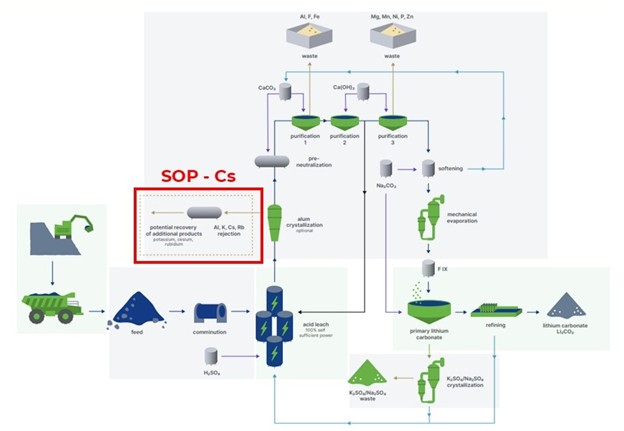
Core Insights - American Lithium Corp. has highlighted the significant cesium resource within the Falchani Lithium deposit and announced recent optimization results for the processing flowsheet, including potential cesium recovery [1][2][4] Group 1: Cesium Resource and Importance - Cesium is recognized as a critical mineral in the U.S. and Canada due to its rarity and strategic importance, with the U.S. entirely reliant on imports [2] - The Falchani deposit is positioned as one of the world's largest cesium resources, which could enhance North American supply chains [2] Group 2: Processing and Optimization - Test work conducted at ANSTO laboratories in Australia and ongoing equipment testing in Peru are paving the way for the pilot plant phase [3] - The Falchani mineralization supports a straightforward processing flowsheet that produces high-purity lithium carbonate and a saleable mixed cesium sulfate product, with strong recoveries at low additional costs [4][5] - Future work aims to increase the cesium content of the sulfate by-product above 18% [4] Group 3: Resource Estimates - As of October 30, 2023, the Falchani deposit contains significant measured and indicated resources of cesium, with 43,539 tonnes in the measured category and 392,742 tonnes in the indicated category [6][5] - The deposit also includes inferred resources of 393,668 tonnes of cesium [6] Group 4: Economic and Technical Advancements - The company has demonstrated the ability to process Falchani's lithium rocks into battery-grade lithium carbonate, cesium sulfate, and sulfate of potash (SOP), indicating extensive technical progress [5] - Cost improvements include reduced sulfuric acid use and lower reagent demand, which enhance project economics [6]
理想汽车:2025年第40周上线105座理想超充站
Zheng Quan Shi Bao Wang· 2025-10-09 08:25
Core Insights - Li Auto announced the launch of 105 new Li Supercharging stations in the 40th week of 2025, bringing the total number of stations to over 3,400 [1] - As of October 5, 2023, Li Supercharging has established a presence in 269 cities across the country [1]
美股中概股盘前多数下跌,哔哩哔哩涨6%
Xin Lang Cai Jing· 2025-10-09 08:13
Core Viewpoint - The majority of Chinese concept stocks in the US pre-market are experiencing declines, with notable exceptions such as Bilibili which is up by 6% [1] Company Performance - Bilibili is showing a positive performance with a 6% increase [1] - JD.com is slightly down by 0.2% [1] - NIO has decreased by 0.5% [1] - Li Auto and Alibaba both fell by 1% [1] - Xpeng Motors is down by 3% [1] - BeiGene has seen a decline of 4% [1]


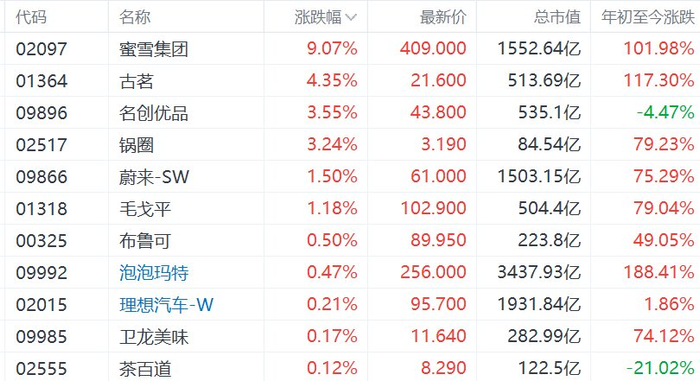
港股新消费股走强,蜜雪集团涨超9%


Ge Long Hui A P P· 2025-10-09 06:12
Core Viewpoint - The Hong Kong stock market is witnessing a strong performance in new consumer stocks, with significant gains observed in several companies [1] Group 1: Company Performance - Mixue Group saw a rise of 9.07%, reaching a latest price of 409.000 and a total market capitalization of 155.264 billion, with a year-to-date increase of 101.98% [2] - Gu Ming experienced a 4.35% increase, with a latest price of 21.600 and a market cap of 51.369 billion, marking a year-to-date rise of 117.30% [2] - Miniso recorded a 3.55% gain, with a latest price of 43.800 and a market cap of 53.51 billion, although it has seen a year-to-date decline of 4.47% [2] - Guoquan increased by 3.24%, with a latest price of 3.190 and a market cap of 8.454 billion, reflecting a year-to-date rise of 79.23% [2] Group 2: Other Notable Companies - NIO-SW rose by 1.50%, with a latest price of 61.000 and a market cap of 150.315 billion, showing a year-to-date increase of 75.29% [2] - Mao Geping saw a 1.18% increase, with a latest price of 102.900 and a market cap of 50.447 billion, reflecting a year-to-date rise of 79.04% [2] - Bubble Mart experienced a slight increase of 0.47%, with a latest price of 256.000 and a market cap of 343.793 billion, showing a significant year-to-date increase of 188.41% [2]