
GWMOTOR(02333)

Search documents
乘联分会:1月份皮卡市场销售4.9万辆 同比增长22.5% 处于近5年的同期高位水平
智通财经网· 2026-02-13 09:14
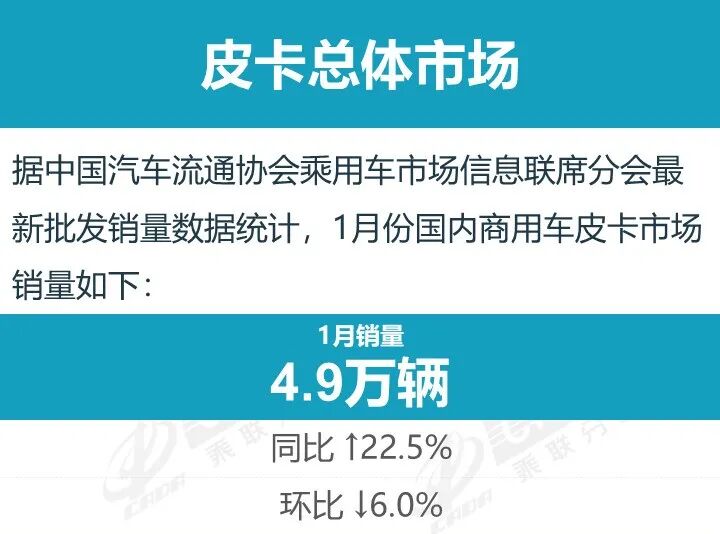
Group 1: Overall Market Performance - In January 2026, the pickup truck market in China saw strong growth, with sales reaching 49,000 units, a year-on-year increase of 22.5%, marking a high point for the same period in the last five years [1] - Pickup truck production in January 2026 was 52,000 units, reflecting a year-on-year growth of 29.3% [1] - The export of pickup trucks in January 2026 was 28,000 units, representing a year-on-year increase of 12% but a month-on-month decrease of 13% [1] Group 2: Leading Companies - Great Wall Motors maintained its leading position in the pickup truck market, with strong performance both domestically and internationally [1] - Other notable companies included SAIC Maxus, JAC Motors, Changan Automobile, and Zhengzhou Nissan, which showed strong performance driven by continuous export growth [1] - In the domestic retail market, the top performers were Great Wall pickups, JMC, Zhengzhou Nissan, Radar Auto, and Jiangxi Isuzu, maintaining a "one strong, many strong" market structure [1] Group 3: Export Trends - The export share of pickup trucks is projected to reach 45% of total sales in 2024, 50% in 2025, and 54% in January 2026, indicating a significant growth trend for Chinese pickup brands in international markets [1] - The strong growth of new Chinese pickup brands is largely driven by exports, contributing positively to the overall export performance of Chinese pickups [1] Group 4: New Energy Pickup Trucks - In January 2026, sales of new energy pickup trucks reached 6,000 units, a year-on-year increase of 18% and a month-on-month increase of 6%, outperforming the overall pickup growth rate [2] - Major contributors to new energy pickup sales included BYD with 3,150 units, Geely Radar with 1,241 units, Zhengzhou Nissan with 785 units, and Changan with 410 units [2] - The market for new energy pickups is expected to grow rapidly to meet both domestic and international demand as the market develops [2]


【月度排名】2026年1月皮卡厂商批发销量排名快报
乘联分会· 2026-02-13 08:47
Group 1: Core Insights - The pickup truck market is experiencing strong growth, with sales reaching 49,000 units in January 2026, a year-on-year increase of 22.5%, marking a high level for the same period in the past five years [2] - Production of pickup trucks in January 2026 was 52,000 units, reflecting a year-on-year growth of 29.3% [2] - Great Wall Motors continues to lead the pickup truck market, with strong performance both domestically and internationally, supported by consistent export growth [2] Group 2: Export Performance - In January 2026, the total export of pickup trucks reached 28,000 units, a year-on-year increase of 12%, although it saw a month-on-month decline of 13% [2] - The export share of pickup trucks is projected to reach 45% of total sales in 2024, 50% in 2025, and 54% in January 2026, indicating a robust growth trajectory for Chinese pickup truck brands in international markets [2] Group 3: New Energy Pickup Trucks - Sales of new energy pickup trucks in January 2026 were 6,000 units, showing an 18% year-on-year increase and a 6% month-on-month increase, outpacing the overall growth rate of the pickup truck market [3] - Major contributors to new energy pickup sales include BYD with 3,150 units, Geely Radar with 1,241 units, and Zhengzhou Nissan with 785 units, among others [3] - The development of electric vehicles is seen as a key factor for commercial vehicles to gain road rights, with expectations for rapid growth in the Chinese pickup market to meet both domestic and international demand [3] Group 4: Manufacturer Sales Rankings - In January 2026, the top manufacturers by sales volume were: - Great Wall Motors: 15,350 units, up 24.6% year-on-year - SAIC Maxus: 5,924 units, up 25.8% year-on-year - Jianghuai Automobile: 5,401 units, up 23.8% year-on-year - Zhengzhou Nissan: 4,053 units, up 145.6% year-on-year - JMC: 3,930 units, up 19.5% year-on-year [7]

太豪横!影石公司年会送出5套房,员工:获奖房者均90后、无高管;DeepSeek更新后被指变冷淡!网友:快调回来;荣耀前CEO赵明加入千里科技
雷峰网· 2026-02-13 00:27
Key Points - Insta360 held its annual meeting where it awarded five sets of properties and several cars to employees, all of whom were born in the 1990s, emphasizing the importance of material incentives alongside recognition [5][6] - The company reported that 2025 was its highest revenue year, with a significant increase in R&D investment, surpassing the total of the previous three years [6] - DeepSeek's recent update has faced backlash from users who feel the model has become less engaging, despite a significant increase in context window capacity [11][12] - AWS has completed layoffs in its Greater China region, affecting approximately 150 employees, primarily in second-tier departments [14][15] - Zhao Ming, former CEO of Honor, has joined Qianli Technology, focusing on AI business models [16] - BMW announced a global recall of multiple models due to a defect in the starter motor that poses a fire risk [56] - Xiaomi's YU7 became the best-selling car in China for January 2026, with a total of 37,869 units sold, significantly outpacing competitors [35][36] - Chery employees expressed dissatisfaction with the company's strict leave policies during the Spring Festival, which limited vacation days [23] - Great Wall Motors announced that its average year-end bonus for 2025 would exceed 50,000 yuan per employee, with a total bonus pool potentially exceeding 42.45 billion yuan [25][26] - Huawei's new vehicle, the Zun Jie S800, will appear on the CCTV Spring Festival Gala, highlighting its market presence [45]





长城汽车:全力支持《汽车行业价格行为合规指南》,维护国内市场秩序
Xin Lang Cai Jing· 2026-02-12 12:12
Group 1 - Great Wall Motors expresses full support for the "Automotive Industry Price Behavior Compliance Guidelines" [1] - The company emphasizes its commitment to long-termism and adherence to legal compliance [1] - Great Wall Motors is dedicated to maintaining integrity in operations and actively safeguarding the order of the domestic market [1]
传比亚迪、吉利等多家国产车企竞购日产奔驰墨西哥汽车工厂,官方暂无回应
Xin Lang Ke Ji· 2026-02-12 12:07
Group 1 - BYD and Geely are reportedly bidding for the Nissan-Benz automotive plant in Mexico, with Chery and Great Wall Motors also expressing interest in the acquisition [1] - The plant is scheduled to close in May 2026, and BYD has been identified as a leading potential buyer since late last year [1] - The acquisition could leverage the benefits of the USMCA agreement, allowing localized production to avoid high tariffs in the US [1]


长城汽车:全力支持《汽车行业价格行为合规指南》 反对无底线价格战
Jin Rong Jie· 2026-02-12 11:45
Core Viewpoint - Great Wall Motors expresses full support for the "Guidelines for Compliance in Automotive Industry Pricing Behavior," emphasizing a commitment to long-termism, legal compliance, and integrity in operations [1] Group 1: Company Position - The company firmly opposes unethical practices such as bottomless price wars, price fraud, and false promotions that severely harm consumer rights and industry development [1] - Great Wall Motors will continue to adhere to legal compliance and integrity in all aspects of vehicle and parts production, pricing, and sales [1]
长城汽车凭什么成为2025年中国车企经营质量标杆?
Sou Hu Cai Jing· 2026-02-12 06:21
Core Viewpoint - The Chinese automotive market is currently characterized by intense price wars, but Great Wall Motors stands out as a model of high-quality management, focusing on solid technology and genuine sales rather than gimmicky marketing or low prices [1][13]. Group 1: Sales and Revenue Performance - In 2025, Great Wall Motors sold 1.3237 million vehicles, which, while not the highest in the industry, reflects real market demand [3]. - The company's revenue reached 222.79 billion yuan, a year-on-year increase of 10.19%, with revenue per vehicle rising to 168,300 yuan, an increase of 4,500 yuan from the previous year [3]. Group 2: Technological Strength - Great Wall Motors emphasizes a comprehensive power solution, offering fuel, hybrid, electric, and hydrogen options, showcasing its commitment to diverse consumer needs [5]. - The Hi4 hybrid technology, recognized with a top award from the China Automotive Engineering Society, exemplifies the company's technical prowess, enabling both performance and fuel efficiency [5]. Group 3: Market Positioning and Brand Strategy - Great Wall Motors focuses on technology rather than price competition, achieving significant sales in the high-end MPV and luxury SUV markets, with models like the Wei brand achieving national sales leadership [7]. - The company maintains a strong market presence in niche segments, such as the pickup market, where it has been the sales leader for 28 consecutive years [7]. Group 4: Global Expansion Strategy - Great Wall Motors adopts an "ecological export" strategy, establishing a factory in Brazil and achieving over 2 million cumulative sales overseas, focusing on high-end products rather than cheap vehicles [9]. - The company’s approach to global markets emphasizes technological exports, positioning itself to capture high-end market segments internationally [9]. Group 5: Long-term Vision and Principles - The core of Great Wall Motors' success lies in its commitment to long-termism, avoiding short-term profit pursuits and excessive marketing, instead investing in research and development [11]. - The company’s strategy includes self-research across the entire supply chain, creating a technological moat that is difficult for competitors to replicate [11][13].
【月度分析】2026年1月份全国乘用车市场分析
乘联分会· 2026-02-12 06:06
Overall Market - In January 2026, the retail sales of passenger cars reached 1.544 million units, a year-on-year decrease of 13.9% [14] - The decline in retail sales is attributed to complex market factors and a historical pattern of fluctuating sales in January [14] - The end of the new energy vehicle purchase tax exemption in December 2025 has led to a recovery period for the new energy vehicle market, with some consumers having made purchases in December to take advantage of the policy [14] - January 2026 saw a significant increase in exports, with passenger car exports reaching 576,000 units, a year-on-year increase of 52.0% [16] - The production of passenger cars in January 2026 was 2.003 million units, a year-on-year decrease of 4.4% [16] - The wholesale volume for January 2026 was 1.973 million units, a year-on-year decrease of 6.2% [17] New Energy Market - In January 2026, retail sales of new energy vehicles (NEVs) totaled 596,000 units, down 20.0% year-on-year [18] - The penetration rate of NEVs in the domestic market was 38.6%, while the export penetration rate was 49.6% [15] - The production of NEVs reached 938,000 units, a slight decrease of 0.6% year-on-year [18] - The wholesale volume of NEVs was 864,000 units, down 3.3% year-on-year [18] - The export of NEVs reached 286,000 units, a significant increase of 103.6% year-on-year, accounting for 49.6% of total passenger car exports [22] Company Performance - BYD, Geely, and Chery are leading in the new energy vehicle market, with BYD's sales reaching 205,518 units in January 2026 [24] - The market share of domestic brands in the new energy sector is increasing, with a notable rise in the export of new energy vehicles to Europe and Southeast Asia [15][22] - The new energy vehicle market is characterized by a shift towards higher quality products, with an increase in the proportion of high-end NEVs [15] Market Outlook - February 2026 is expected to see lower sales due to the shorter working days caused by the extended Spring Festival holiday [27] - The market is anticipated to stabilize post-holiday, with potential recovery in the entry-level electric vehicle segment [28] - The overall sentiment in the consumer market remains cautious, influenced by high costs and economic factors [28]


众捷汽车:已经与全球新能源汽车龙头比亚迪、长城汽车、上汽集团等建立了直接的业务合作关系
Ge Long Hui· 2026-02-11 14:37
Core Viewpoint - The company, Zhongjie Automotive, has established significant relationships with major multinational automotive parts suppliers and is actively expanding its presence in the domestic new energy vehicle market [1] Group 1: Major Clients - The company's primary clients include well-known multinational Tier 1 automotive parts suppliers such as Mahle, Modine, Hanon, Marelli, and ContiTech [1] - The products supplied by the company cover a wide range of international automotive brands, including Mercedes-Benz, BMW, Audi, Porsche, Volkswagen, Skoda, Ferrari, Maserati, Fiat, Tesla, Rivian, Canoo, Ford, General Motors, Chrysler, Dodge, Renault, Citroën, Volvo, Jaguar, Land Rover, Toyota, Subaru, Honda, Nissan, Mazda, Suzuki, Hyundai, Kia, MAN, DAF, Scania, and Iveco [1] Group 2: Domestic Market Expansion - The company is actively expanding into the domestic new energy vehicle market and has established direct business cooperation with leading global new energy vehicle manufacturers such as BYD, Great Wall Motors, and SAIC Motor [1]

又是长城哪些车?贾跃亭旗下FF与桥梁伙伴签署协议,开发3款新车
Xin Lang Cai Jing· 2026-02-11 10:32
Core Viewpoint - Faraday Future has signed a series of new agreements with Hebei Huanzhou Automobile Sales Co., Ltd. as part of the "China-US Automotive Industry Bridge Strategy," which involves assembling Chinese car parts in the US and selling them under the FX brand, including potential models like FX 4 [1][2][3] Group 1 - The "China-US Automotive Industry Bridge Strategy" was introduced by Jia Yueting in 2024, aiming to assemble Chinese vehicles in the US and market them under the FX brand, with FX Super One as a notable example [1][2] - Faraday Future's recent agreements with Hebei Huanzhou include collaboration on three potential models, including FX 4, indicating a strategic expansion in the US market [1][2] - Hebei Huanzhou was established on January 15, 2026, and shares a registration address with Great Wall Motors in Baoding, raising speculation about the origins of the upcoming FX models [1][3] Group 2 - Great Wall Motors has not publicly responded to inquiries regarding the FX Super One or the new agreements, maintaining a vague stance on the matter [2][3] - The sensitivity of US-China relations may limit Great Wall Motors' ability to comment further on the situation, leaving questions about the potential connection between FX's new models and Great Wall's vehicles unanswered until the actual cars are revealed [2][3]