CITIC Securities Co., Ltd.(06030)

Search documents
中信证券(600030):越秀资本拟减持中信证券1%股份,实际影响相对有限
Soochow Securities· 2026-01-18 04:13
Investment Rating - The investment rating for CITIC Securities is "Buy" (maintained) [1] Core Views - The report indicates that the impact of Yuexiu Capital's plan to reduce its stake in CITIC Securities by 1% is relatively limited. The actual reduction is expected to be minor, and the company maintains a strong market position with robust profitability [1][9] - The report maintains previous profit forecasts, expecting CITIC Securities' net profit attributable to shareholders to reach 30.1 billion, 31.8 billion, and 33.4 billion yuan for 2025, 2026, and 2027, respectively, representing year-on-year growth of 38%, 6%, and 5% [1][9] Financial Forecasts - Total revenue projections for CITIC Securities are as follows: - 2023: 60,068 million yuan - 2024: 63,789 million yuan - 2025: 74,811 million yuan - 2026: 77,788 million yuan - 2027: 80,400 million yuan - Year-on-year growth rates for total revenue are projected at -7.74%, 6.20%, 17.28%, 3.98%, and 3.36% for the respective years [1] - Net profit attributable to shareholders is forecasted as follows: - 2023: 19,721 million yuan - 2024: 21,704 million yuan - 2025: 30,055 million yuan - 2026: 31,764 million yuan - 2027: 33,442 million yuan - Year-on-year growth rates for net profit are projected at -7.49%, 10.06%, 38.48%, 5.69%, and 5.28% for the respective years [1] Valuation Metrics - The report provides the following earnings per share (EPS) estimates: - 2023: 1.30 yuan - 2024: 1.41 yuan - 2025: 2.03 yuan - 2026: 2.14 yuan - 2027: 2.26 yuan - The price-to-earnings (P/E) ratios are projected as follows: - 2023: 21.60 - 2024: 19.91 - 2025: 13.85 - 2026: 13.10 - 2027: 12.44 [1]

2025年香港IPO中介机构排行榜
Sou Hu Cai Jing· 2026-01-17 14:33
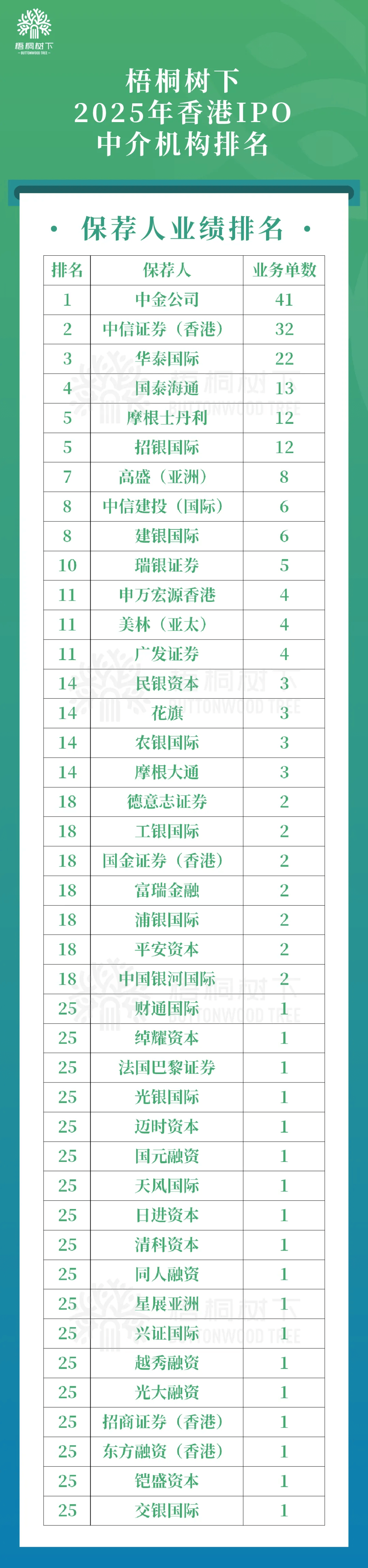
Group 1: IPO Overview - In 2025, a total of 119 companies listed on the Hong Kong Stock Exchange, with 114 through IPOs and 5 through other methods [1] - The IPO intermediaries included 42 brokerage firms, 39 Hong Kong legal advisors, 33 Chinese legal advisors, and 9 accounting firms [1] Group 2: Sponsor Performance Rankings - The top five sponsors for the 114 Hong Kong IPOs were: 1. CICC with 41 deals 2. CITIC Securities (Hong Kong) with 32 deals 3. Huatai International with 22 deals 4. Guotai Junan with 13 deals 5. Morgan Stanley and China Merchants International, both with 12 deals [2][3] Group 3: Hong Kong Legal Advisors Rankings - The leading Hong Kong legal advisors for the IPOs were: 1. Davis Polk and Highbury with 16 deals each 2. K&L Gates with 9 deals 3. Several firms including Farrer & Co, King & Wood Mallesons, and others with 5 deals each [7][8] Group 4: Chinese Legal Advisors Rankings - The top Chinese legal advisors for the IPOs were: 1. Tongshang with 19 deals 2. Jingtian & Gongcheng with 17 deals 3. Zhong Lun with 10 deals [10][11] Group 5: Accounting Firms Rankings - The leading accounting firms for the IPOs were: 1. Ernst & Young with 41 deals 2. KPMG with 25 deals 3. Deloitte with 21 deals 4. PwC with 13 deals [14][15]


中信证券,第二大股东拟减持1%股份
2 1 Shi Ji Jing Ji Bao Dao· 2026-01-17 09:50
Group 1 - Yuexiu Capital announced the approval of a proposal to sell up to 1% of its shares in CITIC Securities, which is approximately 4 billion yuan based on CITIC Securities' market capitalization of about 400 billion yuan [1] - After the sale, Yuexiu Capital will still hold over 5% of CITIC Securities, maintaining shareholder rights and continuing to account for the remaining shares using the equity method [2] - CITIC Securities reported a revenue of 74.83 billion yuan for 2025, a 28.75% increase from 2024, and a net profit of 30.05 billion yuan, up 38.46% from the previous year [2] Group 2 - Yuexiu Capital plans to invest up to 1 billion yuan to increase its stake in Beijing Enterprises Holdings through the Hong Kong Stock Connect [4] - As of September 30, 2025, Guangzhou Asset Management, a subsidiary of Yuexiu Capital, had acquired 52.07 million shares of Beijing Enterprises, representing 4.14% of its total share capital [5] - The investment in Beijing Enterprises will be classified as a long-term equity investment, and the company expects this move to enhance asset value and generate good investment returns [5]


中信证券:26年台积电Capex指引超预期 先进制程国产替代开启国产设备成长大周期
Zhi Tong Cai Jing· 2026-01-17 07:33
Core Viewpoint - TSMC is expected to significantly increase its capital expenditure to $52-56 billion in 2026, exceeding market expectations, which indicates an early start to the 2nm process mass production cycle [1][3]. Group 1: Financial Performance - In 2025, TSMC is projected to achieve record revenue of $122 billion, a year-on-year increase of 35.9%, driven by strong demand in AI and HPC, with a gross margin nearing 60% [2]. - The revenue contribution from advanced processes (7nm and below) is expected to reach 77%, with 3nm and 5nm processes contributing 63% of wafer sales [2]. - TSMC's net profit attributable to the parent company is forecasted to reach NT$1.72 trillion, representing over a 30% year-on-year growth, marking a historical high [2]. Group 2: Capital Expenditure - TSMC's capital expenditure for 2025 is set at $40.9 billion, with a more aggressive guidance for 2026 at $52-56 billion, significantly above the previous market expectation of $45-48 billion [1][3]. - Approximately 70%-80% of the 2026 capital expenditure will be allocated to advanced processes, while 10%-20% will be directed towards advanced packaging, testing, and mask manufacturing [3]. Group 3: Market Demand and Supply - The global semiconductor market is projected to grow from $680 billion in 2025 to $1.741 trillion by 2035, with a CAGR of 9.9%, driven by demand from servers, data centers, and storage [4]. - Advanced logic capacity (7nm and below) is expected to grow at a CAGR of approximately 15% from 2025 to 2035, fueled by AI demand [5]. - The domestic semiconductor demand in China accounts for about 35% of the global market, while its production capacity for advanced logic processes is currently less than 5% [6]. Group 4: Domestic Market Dynamics - The domestic semiconductor industry is experiencing a dual drive of "high growth in AI computing power" and "domestic substitution of advanced processes," with a significant capacity gap of over 1 million wafers per month [6]. - The domestic semiconductor equipment localization rate is currently around 30%, with expectations to increase to 60%-70% in the future, indicating substantial growth potential [7]. Group 5: Investment Recommendations - The ongoing large-scale investments in China to fill the advanced capacity gap are expected to create a long-term growth period for domestic equipment manufacturers, independent of global semiconductor cycles [8]. - Focus is recommended on leading companies that have achieved technological breakthroughs in core equipment areas such as etching, thin film deposition, cleaning, and CMP, and have validated their capabilities with major clients [8].

中信证券:26年台积电(TSM.US)Capex指引超预期 先进制程国产替代开启国产设备成长大周期
智通财经网· 2026-01-17 07:32
Core Viewpoint - TSMC is expected to significantly increase its capital expenditure to $52-56 billion in 2026, exceeding market expectations, which indicates an early start to the 2nm process mass production cycle [1][3]. Group 1: Financial Performance - In 2025, TSMC is projected to achieve record revenue of $122 billion, a year-on-year increase of 35.9%, driven by strong demand in AI and HPC, with a gross margin nearing 60% [2]. - The revenue contribution from advanced processes (7nm and below) is expected to reach 77%, with 3nm and 5nm processes contributing 63% of wafer sales [2]. - The net profit attributable to the parent company is forecasted to reach NT$1.72 trillion, marking a growth of over 30% year-on-year, setting a historical high [2]. Group 2: Capital Expenditure Insights - TSMC's capital expenditure for 2025 is set at $40.9 billion, with a more aggressive guidance for 2026 at $52-56 billion, with 70%-80% allocated to advanced processes and 10%-20% for advanced packaging, testing, and mask manufacturing [3]. - This increased investment reflects TSMC's strategic commitment to expanding production capacity in response to the growing demand for AI computing chips [3]. Group 3: Semiconductor Market Trends - The global semiconductor market is projected to grow from $680 billion in 2025 to $1.741 trillion by 2035, with a CAGR of 9.9%, driven by demand from servers, data centers, and storage [4]. - Advanced logic capacity (7nm and below) is expected to grow at a CAGR of approximately 15% from 2025 to 2035, fueled by AI demand [5]. Group 4: Domestic Market Dynamics - China's semiconductor demand accounts for about 35% of the global market, while its production capacity for 7nm and below is less than 5%, indicating a significant potential for capacity expansion [6]. - The domestic semiconductor industry is expected to fill the capacity gap, leading to a market for equipment investments worth hundreds of billions of dollars [6]. Group 5: Equipment Supply Chain and Localization - Domestic wafer fabs are actively building a "non-US" equipment supply chain, providing a growth window for local equipment manufacturers [7]. - The localization rate of semiconductor equipment is expected to increase from 30% to 60%-70% in the coming years, driven by the domestic production of DRAM and 3D NAND [7]. Group 6: Investment Recommendations - The dual drivers of AI demand and domestic substitution are expected to lead to sustained large-scale investments in advanced capacity in China [8]. - Focus is recommended on leading companies that have achieved technological breakthroughs in core equipment areas such as etching, deposition, cleaning, and CMP, which have validated their capabilities with major clients [8].
中信证券,第二大股东拟减持
Zheng Quan Shi Bao Wang· 2026-01-17 05:17
Core Viewpoint - Yuexiu Capital has approved a plan to sell up to 1% of its shares in CITIC Securities, which is expected to generate approximately 4 billion yuan in investment returns and optimize the company's asset structure for high-quality development [1][2]. Group 1: Shareholding and Transactions - Yuexiu Capital and its subsidiaries completed the acquisition of 100% of Guangzhou Securities (now CITIC Securities South China) on January 10, 2020, receiving 810 million A-shares, which represented 6.26% of CITIC Securities' total share capital at that time [2]. - As of January 16, 2026, Yuexiu Capital holds a total of 1.266 billion shares in CITIC Securities, accounting for 8.54% of the total share capital, with 903 million A-shares (6.09%) and 363 million H-shares (2.45%) [2][3]. - After the sale of shares, Yuexiu Capital will still be a shareholder with over 5% ownership in CITIC Securities, maintaining shareholder rights and accounting for remaining shares using the equity method [3]. Group 2: Financial Performance - CITIC Securities reported a revenue of 74.83 billion yuan for 2025, a 28.75% increase from the adjusted 58.12 billion yuan in 2024, and a net profit of 30.05 billion yuan, up 38.46% from 21.70 billion yuan in 2024 [3]. - Yuexiu Capital's total assets were 212.24 billion yuan, with a net asset value of 31.90 billion yuan as of June 30, 2025, and reported a revenue of 5.54 billion yuan and a net profit of 1.56 billion yuan for the first half of 2025 [3]. Group 3: Investment in Beijing Enterprises - Concurrently, Yuexiu Capital has approved a plan to increase its stake in Beijing Enterprises by using up to 1 billion yuan to purchase shares in the secondary market [4]. - As of January 16, 2026, Yuexiu Capital holds 55.91 million shares of Beijing Enterprises, representing 4.44% of its total share capital, and has transitioned its investment from trading financial assets to long-term equity investments [5]. - The company aims to enhance its asset allocation structure and increase the long-term value of its assets through this investment, expecting good returns from the increased stake in Beijing Enterprises [5].
中信证券,第二大股东拟减持
券商中国· 2026-01-17 04:58
Core Viewpoint - Yuexiu Capital plans to sell up to 1% of its shares in CITIC Securities, which is expected to generate approximately 4 billion yuan in investment returns and optimize the company's asset structure for high-quality development [1][4]. Group 1: Shareholding and Transactions - Yuexiu Capital and its subsidiaries completed the acquisition of 100% of Guangzhou Securities (now CITIC Securities South) on January 10, 2020, receiving 810 million A-shares, which represented 6.26% of CITIC Securities' total share capital at that time [3]. - As of January 16, 2026, Yuexiu Capital holds a total of 1.266 billion shares in CITIC Securities, accounting for 8.54% of the total share capital, with 903 million A-shares (6.09%) and 363 million H-shares (2.45%) [3]. - After the sale of shares, Yuexiu Capital will still hold over 5% of CITIC Securities, maintaining shareholder rights and continuing to account for investment income using the equity method [4]. Group 2: Financial Performance - CITIC Securities reported a revenue of 74.83 billion yuan for 2025, a 28.75% increase from the adjusted 58.12 billion yuan in 2024, and a net profit of 30.05 billion yuan, up 38.46% from 21.70 billion yuan in 2024 [4]. - Yuexiu Capital's total assets were 212.24 billion yuan, with a net asset value of 31.90 billion yuan as of June 30, 2025, and reported a revenue of 5.54 billion yuan and a net profit of 1.56 billion yuan for the first half of 2025 [4]. Group 3: Investment in Beijing Enterprises - On January 16, Yuexiu Capital approved a plan to increase its stake in Beijing Enterprises by using up to 1 billion yuan of its own funds to purchase shares in the secondary market [7]. - As of September 30, 2025, Yuexiu Capital's subsidiary, Guangzhou Asset Management, had acquired 52.07 million shares of Beijing Enterprises, representing 4.14% of its total share capital [7]. - The investment in Beijing Enterprises is aimed at enhancing business synergy and obtaining stable investment returns, with the company not seeking control over Beijing Enterprises [8].

净利300亿,中信证券走出寒冬
Xin Lang Cai Jing· 2026-01-17 03:44
Core Insights - The first annual performance report for 2025 from CITIC Securities shows a significant increase in revenue and net profit, driven by a bullish domestic capital market [1][2]. Financial Performance - CITIC Securities reported a revenue of 748.3 billion yuan for 2025, a 28.75% increase from the adjusted 581.19 billion yuan in 2024 [1]. - The net profit attributable to shareholders reached 300.51 billion yuan, marking a 38.46% year-on-year growth, which is a historical first for domestic brokerages [1]. - In the first three quarters of 2025, the company achieved a revenue of 558.15 billion yuan and a net profit of 231.59 billion yuan, with year-on-year growth rates of 32.7% and 37.86% respectively [3][5]. Market Context - The overall market conditions have been favorable, with the Shanghai Composite Index rising from 2,700 points to 4,000 points, resulting in an 18.41% increase for the year and a record trading volume exceeding 170 trillion yuan [1]. - The performance of CITIC Securities is part of a broader trend among 42 listed brokerages, which collectively reported a revenue of 4,196 billion yuan, a 43% increase, and a net profit of 1,690 billion yuan, a 62% increase [3]. Business Segments - The proprietary trading segment has been a key driver of growth, contributing 316.03 billion yuan in revenue, accounting for 57% of total revenue [4]. - Investment banking remains strong, with equity underwriting reaching 2,721 billion yuan, capturing a 24.5% market share [5]. - The brokerage business generated a net income of 109.39 billion yuan, leading among listed brokerages, but its growth rate of 52.9% lags behind the industry average of over 70% [5]. Management Changes - There are notable management transitions within CITIC Securities, with the chairman, Zhang Youjun, reaching retirement age and potential changes in leadership being discussed [6][7]. - The board's term is set to be extended due to ongoing preparations for the election of new board members, ensuring continuity in governance [7].
中信证券:看好半导体设备的投资机遇 建议关注具备平台化能力的领军企业及高弹性细分龙头
Xin Lang Cai Jing· 2026-01-17 02:58
Core Viewpoint - TSMC's 2025 performance is expected to set a record, with a significant increase in capital expenditure for 2026, indicating ongoing benefits from AI computing power and advanced processes. The domestic wafer fabs are entering an expansion phase to address a million-unit capacity gap, creating a multi-billion dollar opportunity for the equipment market, with a potential doubling of domestic equipment localization rates [1][2][3]. Group 1: TSMC's Performance and Capital Expenditure - TSMC is projected to achieve a revenue of $122 billion in 2025, a year-on-year increase of 35.9%, with a gross margin nearing 60% [2][10]. - The company's capital expenditure for 2025 is set at $40.9 billion, with an aggressive forecast for 2026, estimating capital expenditure to rise to $52-56 billion, exceeding market expectations of $45-48 billion [2][10]. - 70-80% of the 2026 capital expenditure will be directed towards advanced processes, while 10-20% will be allocated for advanced packaging, testing, and mask manufacturing [2][10]. Group 2: Global Semiconductor Market Outlook - The global semiconductor sales are expected to grow from $68 billion in 2025 to $174.1 billion by 2035, with a CAGR of 9.9% [3][11]. - Demand for semiconductors in servers, data centers, and storage is projected to increase from $15.6 billion in 2025 to $82.6 billion by 2035, with a CAGR of 18.6% [3][11]. - Global semiconductor manufacturing capacity is anticipated to rise from 11.2 million wafers per month in 2025 to 19 million wafers per month by 2035, with a CAGR of 5.4% [3][11]. Group 3: Domestic Semiconductor Industry Dynamics - The domestic semiconductor industry is experiencing a dual drive of "high growth in AI computing power" and "advanced process localization," with a capacity gap exceeding one million wafers [4][12]. - Currently, domestic production of advanced logic processes (7nm and below) accounts for less than 5% of global capacity, while China's semiconductor demand represents about 35% of the global market [4][12]. - The localization rate of semiconductor equipment is currently around 30%, with expectations to double in the future, driven by increased domestic production and technological advancements [5][13]. Group 4: Investment Strategy - The ongoing AI wave and the push for localization are expected to lead to sustained, large-scale investments in China to fill the advanced capacity gap of over one million wafers [7][16]. - Focus is recommended on leading companies that have achieved technological breakthroughs in core equipment areas such as etching, thin film deposition, cleaning, and CMP, as well as those with flexible localization rates [7][16]. - Companies that can leverage this historical industry opportunity are likely to emerge as internationally competitive domestic manufacturers in the global semiconductor equipment market [7][16].

中信证券明明 王楠茜:债市启明|美国12月CPI数据如何解读?
Xin Lang Cai Jing· 2026-01-17 02:42
Core Insights - The U.S. December CPI year-on-year growth rate decreased to 2.7%, aligning with market expectations, while the core CPI year-on-year growth rate was 2.6%, slightly below the expected 2.7% [1][10] - The core CPI month-on-month growth rate was 0.2%, lower than the expected 0.3% [1][10] - Overall, despite short-term disturbances in food and energy inflation, the pressure for further inflation in the U.S. is expected to be manageable due to weak employment and declining tariff impacts [1][10] CPI Overview - The unadjusted CPI year-on-year growth rate for December remained steady at 2.7%, consistent with November's figure [2][11] - The unadjusted core CPI year-on-year growth rate was 2.6%, matching November's value but below the expected 2.7% [2][11] - The CPI month-on-month growth was 0.3%, consistent with September's value and market expectations, while the core CPI month-on-month growth was 0.2%, lower than the expected 0.3% [2][11] Food Inflation - December food inflation month-on-month growth was 0.7%, up from 0.3% in September, driven by tariffs and supply shortages [3][12] - Specific food categories, such as grains, meats, dairy, and fresh fruits, experienced higher month-on-month growth rates [3][12] - The USDA predicts that food inflation growth in 2026 will be lower than in 2025, with an expected increase of 2.7% for all food prices [3][12] Energy Inflation - December energy inflation month-on-month growth was 0.3%, with a year-on-year growth of 2.3% [4][13] - Global oil supply is currently sufficient, but geopolitical tensions have led to fluctuations in oil prices [4][13] - Future geopolitical risks may lead to temporary increases in oil prices, although significant long-term price increases are unlikely due to weak global demand [4][13] Core Goods and Services Inflation - Core goods inflation recorded a month-on-month growth of 0%, the lowest since May 2025 [5][13] - Factors such as reduced electric vehicle subsidies and high interest rates have weakened consumer purchasing power, limiting growth in vehicle-related inflation [5][13] - Core services inflation month-on-month growth rose to 0.3%, with persistent inflation mainly in housing and healthcare sectors [6][14] Future Inflation Outlook - The overall inflation pressure in the U.S. is expected to remain manageable, with food inflation growth projected to decline in 2026 compared to 2025 [7][15] - While tariff policies may exert upward pressure on core goods inflation, weakening consumer demand is likely to suppress price increases [7][15] - The risk of further increases in core services inflation is considered manageable, although its persistence is expected to continue [7][15]