BABA(09988)

Search documents
Kimi估值突破100亿美元,阿里腾讯等领投超7亿美元融资
Cai Jing Wang· 2026-02-17 08:40
Group 1 - Kimi is set to complete a new financing round of over $700 million, following a previous $500 million round just over a month ago [1] - The latest financing round is led by existing shareholders including Alibaba, Tencent, Wuyuan, and Jiua [1] - Kimi's valuation has doubled to exceed $10 billion, with the total amount raised in the last two rounds reaching over $1.2 billion, marking the highest financing amount in the large model industry in the past year [1]




1.3亿人春节首次体验AI购物 AI买电影票订单环比增长372倍
天天基金网· 2026-02-17 07:30
Group 1 - The core viewpoint of the article highlights the significant rise of the AI shopping assistant "Qianwen" during the Spring Festival, with over 130 million people experiencing it for the first time and making 5 billion requests for assistance [2] - The article notes a remarkable increase in AI-driven ticket purchases, with orders for movie tickets rising by 372 times and those from third and fourth-tier cities surging by 782 times, indicating a shift in user behavior towards AI services [2] - The integration of Qianwen with Alibaba's ecosystem, including platforms like Taobao and Alipay, allows it to serve a wide range of user needs, with plans for future functionalities such as AI ride-hailing and mobile top-ups [2] Group 2 - Data from QuestMobile shows that on February 7, Qianwen's daily active users (DAU) reached 73.52 million, nearly matching the 78.71 million of its competitor, indicating a rapid shift in user habits towards AI task execution rather than just chat interactions [3] - Alibaba's release of the new model Qwen 3.5-Plus, which competes with Gemini 3 Pro, signifies a dual breakthrough for Alibaba's AI capabilities during the Spring Festival, both in terms of model performance and application usage [3]

Diamond Hill International Strategy Q4 2025 Portfolio Review
Seeking Alpha· 2026-02-17 07:14
Group 1 - The article does not provide any relevant content regarding company or industry insights [1]

中国人工智能初创企业月之暗面寻求 100 亿美元估值
Xin Lang Cai Jing· 2026-02-17 05:37
Core Viewpoint - Moonshot is seeking a target valuation of $10 billion in a financing round, capitalizing on investor interest in Chinese AI model startups [1] Group 1: Financing Details - Moonshot, the developer of the Kimi chatbot, initiated discussions for additional financing in late January to meet investor demand [1] - Approximately one month prior, the company completed a $500 million financing round at a valuation of $4.3 billion [1] - Existing investors, including Alibaba, Tencent, and Five Sources Capital, have committed over $700 million in the initial phase of the latest financing round [1]
以小胜大高性价比,千问春节档真正的杀手锏来了
新浪财经· 2026-02-17 05:14
Core Viewpoint - Alibaba has launched the Qwen3.5-Plus model, which is positioned as the strongest open-source model globally, outperforming top closed-source models like Gemini-3-pro and GPT-5.2, while offering a significantly lower API price of 0.8 yuan per million tokens, which is only 1/18 of Gemini-3-pro's cost [2][8]. Group 1: Technical Innovations - The Qwen3.5-Plus model features a total of 397 billion parameters, with only 17 billion activated during inference, allowing it to utilize less than 5% of the computational power while accessing its full knowledge base [5]. - The introduction of a mixed attention mechanism enables the model to allocate attention resources dynamically based on the importance of information, optimizing computational efficiency [4]. - The model has transitioned from a pure text model to a native multimodal model, significantly enhancing its capabilities in reasoning, programming, and various assessments, surpassing some benchmarks of Gemini 3 Pro and GPT-5.2 [5]. Group 2: Business Logic Behind Open Source - The efficiency achieved through architectural innovation allows Qwen3.5 to be both powerful and cost-effective, making advanced AI capabilities accessible to individual developers, startups, and small enterprises [7]. - Since its open-source launch in 2023, Alibaba has released over 400 Qwen models, achieving over 1 billion downloads, and has become the leading open-source model recognized for its developer-friendly approach [7]. - The Qwen model continues to evolve, now supporting 201 languages and expanding its vocabulary size from 150,000 to 250,000, which can enhance encoding efficiency for less common languages by up to 60% [7]. Group 3: Market Position and Growth - According to Omdia, Alibaba Cloud's market share in China's cloud market increased from 34% to 36% in Q3 2025, maintaining its position as the market leader [9]. - AI has become a major driver of new demand for cloud infrastructure services, with Alibaba Cloud's AI-related product revenue experiencing triple-digit year-on-year growth for nine consecutive quarters [9]. Group 4: Agent Capabilities - The Qwen3.5 model has achieved breakthroughs in agent applications, enabling it to autonomously operate mobile and computer tasks, significantly improving operational efficiency [11]. - The Qwen App has launched the world's first consumer-grade AI shopping agent, which successfully processed 120 million orders in just six days during the Spring Festival, demonstrating its commercial viability [11]. - Developers can access the new Qwen3.5-Plus model through platforms like HuggingFace and Alibaba Cloud, with plans for further releases of different model sizes and functionalities [11].

千万发布数据:1.3亿人春节首次体验AI购物
Huan Qiu Wang· 2026-02-17 05:00
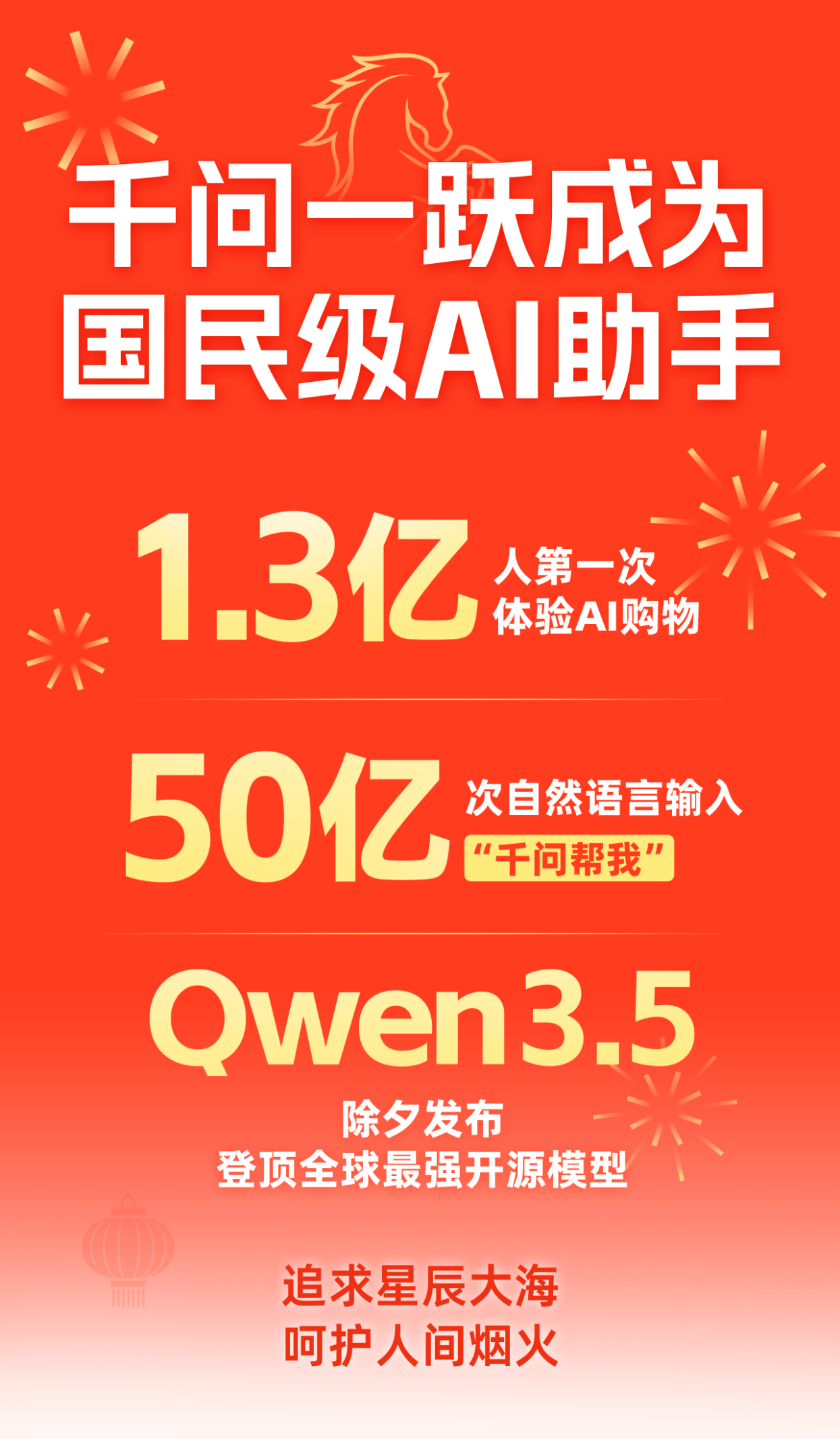
Group 1 - During the Spring Festival, over 130 million people experienced AI shopping for the first time, making 5 billion requests using "Qianwen help me" [1] - Orders for AI ticket purchases increased by 22 times, while AI bookings for flights and other transportation tickets grew over 7 times; movie ticket orders surged by 372 times, particularly from third and fourth-tier cities, which saw an increase of 782 times [1] - Nearly half of all AI orders originated from county-level cities, with around 4 million users aged 60 and above engaging in AI shopping [1] Group 2 - Alibaba launched the new generation open-source model Qwen 3.5-Plus on New Year's Eve, which is comparable in performance to Gemini 3 Pro, making it the strongest open-source model globally [2][4] - The AI application saw significant growth during the Spring Festival, indicating a dual explosion in both open-source model capabilities and app usage [2]
上新!阿里Qwen3.5发布,AI技术与应用双线进击
Zhong Guo Zheng Quan Bao - Zhong Zheng Wang· 2026-02-17 04:15
Core Insights - Alibaba has launched its new AI model Qwen3.5-Plus, which features a total of 397 billion parameters and significantly outperforms the previous Qwen3-Max model with a 60% reduction in deployment memory usage and up to 19 times improvement in inference efficiency [1][4][7]. Model Performance and Features - Qwen3.5-Plus is now one of the strongest open-source models globally, competing directly with proprietary models like Gemini 3 Pro, and has achieved superior results in several benchmark tests [4][5]. - The model has transitioned from a pure text model to a native multimodal model, enhancing its capabilities in visual understanding and reasoning across various tasks [4][6]. - The API pricing for Qwen3.5-Plus is notably competitive at 0.8 yuan per million tokens, which is only 1/18th of the cost of Gemini 3 Pro, making AI technology more accessible for both enterprise and consumer markets [1][7]. Application and Market Impact - During the "Qianwen Please Guest" event, over 1.3 billion transactions were completed using the Qwen app, demonstrating the model's practical application in real-world scenarios [3][9]. - The Qwen app has achieved a daily active user count of 73.52 million, indicating strong market engagement and the potential for further growth as the model's capabilities are enhanced [9]. Strategic Positioning and Ecosystem - Alibaba's AI strategy is built on a decade of investment in foundational technologies, including the development of proprietary AI chips and a comprehensive cloud infrastructure, positioning the company as a leader in the AI space [10][11]. - The integration of AI technology with Alibaba's extensive e-commerce ecosystem allows for seamless execution of AI applications, enhancing the overall user experience and driving continuous model optimization [12].
机器人上春晚,卖爆了
盐财经· 2026-02-17 04:07
Core Viewpoint - The 2026 Spring Festival Gala showcased a high concentration of robots from four Chinese companies, marking a significant moment for the commercialization of humanoid robots and AI technology in China [2][5][25]. Group 1: Robot Companies and Performances - Four companies, Songyan Power, Yushu Technology, Magic Atom, and Galaxy General, presented their robots at the Spring Festival Gala, providing a technology-rich experience for the audience [12][15]. - Songyan Power's robots were featured in a skit with famous comedian Cai Ming, emphasizing their affordability and accessibility, with many models priced below 10,000 yuan [18][15]. - Yushu Technology, a returning participant, showcased a martial arts performance, highlighting their advanced motion control capabilities [20][22]. - Galaxy General, valued at $3 billion, presented a touching microfilm featuring their robots, which can interact naturally with humans [22][24]. - Magic Atom demonstrated their high-dynamic bipedal robots in a musical performance, showcasing their extensive self-research capabilities [22][24]. Group 2: Commercialization and Market Impact - The participation of robots in the Spring Festival Gala serves as a critical endorsement, addressing public concerns about safety and reliability, and opening up B2B and B2C market opportunities [14][26]. - The cost of advertising during the gala ranges from 16.99 million to 44 million yuan, with individual robot performances costing over 100 million yuan, indicating the high stakes involved [12][13]. - The event is seen as a significant milestone for humanoid robots, potentially marking 2026 as a pivotal year for their commercialization [25]. Group 3: AI Integration and Competition - The integration of AI models, such as the Volcano Engine's Doubao model, into robots signifies a deep collaboration between hardware and AI, enhancing the robots' capabilities [28][31]. - Major tech companies like ByteDance and Alibaba are heavily investing in AI, with ByteDance planning to invest over 150 billion yuan and Alibaba 380 billion yuan in the next three years, indicating a fierce competition for AI dominance [57][58]. - The marketing strategies employed by these companies during the gala reflect their ambitions to establish a strong foothold in the AI ecosystem, with a focus on user engagement and long-term brand loyalty [62][64].

AI春节档最强杀手锏来了!千问3.5除夕强势亮相,开源SOTA、性价比之王
雷峰网· 2026-02-17 03:32
Core Viewpoint - The article discusses the emergence of a new era in AI with the introduction of the Qwen3.5-Plus model by Alibaba, which is positioned as a leading open-source model with significant performance and efficiency improvements compared to existing models [2][19]. Group 1: Model Performance and Innovations - The Qwen3.5-Plus model has a total of 397 billion parameters, with only 17 billion activated during operation, achieving performance that surpasses models with over a trillion parameters [2][5]. - In various benchmark tests, Qwen3.5 achieved scores of 87.8 in MMLU-Pro, 88.4 in GPQA, and 76.5 in IFBench, outperforming competitors like GPT-5.2 and Claude 4.5 [3][12]. - The model introduces a mixed attention mechanism that reduces computational costs for long texts while maintaining processing accuracy [7][9]. - The architecture employs a sparse mixture of experts (MoE) approach, activating only a small fraction of parameters based on task requirements, significantly reducing computational waste [8][9]. - Qwen3.5-Plus features native multi-token prediction, allowing for faster response times in generating long texts and multi-turn dialogues [8][11]. Group 2: Cost Efficiency and Accessibility - The API pricing for Qwen3.5-Plus is set at 0.8 yuan per million tokens, making it 1/18 the cost of Gemini-3-pro, thus addressing affordability issues for small businesses and developers [5][14]. - The model's development benefits from Alibaba's integrated innovations in AI infrastructure, which enhance both training and inference efficiency [15][17]. - Qwen3.5 is open-sourced for global developers, with over 400 models already available, promoting widespread adoption across various industries [17][19]. Group 3: Market Impact and Future Outlook - The advancements in Qwen3.5 are expected to drive Alibaba Cloud's growth, with projections indicating a market share increase to 36% in the Chinese AI cloud market by mid-2025 [19]. - The article highlights the synergy between Alibaba's cloud services, chip technology, and model development as a key factor in achieving superior performance and cost-effectiveness [19].

Alibaba Group unveils Qwen3.5 as China's chatbot race shifts to AI agents
CNBC· 2026-02-17 03:11
Core Insights - Alibaba has launched its latest AI model series, Qwen3, which integrates traditional large language model capabilities with advanced dynamic reasoning to enhance its competitive edge in the Chinese AI market [1] Model Features - The Qwen3.5 AI model is available in an open-weight version for users to download, run, fine-tune, and deploy on their own infrastructure, alongside a hosted version on Alibaba's servers [2] - Qwen3.5 features improvements in performance and cost, with native multimodal capabilities that allow it to process text, images, and video simultaneously [3] - The model supports new coding and agentic capabilities, compatible with popular open-source AI agents like those from OpenClaw [3] Competitive Landscape - Local competitors such as ByteDance and Zhipu AI have also released upgraded models aimed at enhancing agent capabilities [5] - Qwen3.5 has 397 billion parameters, which is fewer than its predecessor, but it has shown significant performance improvements based on self-reported benchmarks [5] - Benchmark tests indicate that Qwen3.5's performance is comparable to leading models from OpenAI, Anthropic, and Google DeepMind, although these comparisons are self-reported [6] Language Support and Future Developments - The new Qwen3.5 models support 201 languages and dialects, an increase from the previous generation's 82 [7] - Alibaba is expected to release more open-weight models during the Chinese New Year, as indicated by the technical lead of Alibaba Cloud's Qwen team [7] Industry Trends - The release of Anthropic's Claude AI agent tools has prompted other American AI companies to accelerate the development of agentic capabilities [8] - Industry leaders, including OpenAI and Google DeepMind, acknowledge that Chinese AI models are rapidly advancing and are only months behind their Western counterparts [8]