PDH(600048)

Search documents
中国城市运行周期跟踪(2025.Q2):量价回落,波动加剧
GUOTAI HAITONG SECURITIES· 2025-07-25 08:28
Investment Rating - The report assigns an "Accumulate" rating for the real estate industry [5]. Core Insights - The overall market in Q2 2025 shows weak transaction volumes, stable prices lacking trends, and increasing inventory with heightened de-stocking pressure [3]. - Only 19% of the 27 cities analyzed exhibit signs of market bottoming, indicating a general trend of "volume contraction, price stagnation, and inventory pressure" [12]. - The new housing market is experiencing a downturn, with first-tier cities showing a significant slowdown in sales growth, while the second-hand housing market demonstrates relative resilience but with increasing regional disparities [12][13]. Summary by Sections 1. Transaction Decline and Lengthening De-stocking - The report highlights that the real estate cycle varies significantly across cities due to localized policies and differing reliance on land finance [8]. - A comprehensive scoring model based on seven core indicators is used to assess the real estate cycle of each city, categorizing them into four stages: bottoming, rising, topping, and declining [8][9]. 2. Price Trends: Q2 New and Second-hand Housing Prices Decline - In Q2 2025, new housing prices experienced a slight decline after a period of stabilization, with 85% of cities unable to sustain price increases for more than two months [17]. - Second-hand housing prices also fell, with 78% of cities still in a downward trend by June [17][19]. 3. Transaction Volume: Weak Recovery and Increased Volatility - First-tier cities maintained an upward trend in new housing transactions until June, where a decline of 12% was noted [22]. - Second-tier cities saw a 15% year-on-year drop in new housing transactions in Q2, reflecting greater inventory pressure and declining buyer confidence [22][27]. 4. Demand Entering a Tug-of-War Phase Leading to Rising Inventory Cycles - The de-stocking cycle for first-tier cities increased to 20 months by June 2025, indicating intensified market supply-demand conflicts [29]. - Second-tier cities faced even longer de-stocking cycles, reaching 23 months, highlighting structural issues such as declining population attraction and excess land supply [29]. 5. Company Profit Forecasts - The report includes profit forecasts for key companies, with several companies rated as "Accumulate" based on their projected earnings per share (EPS) and price-to-earnings (PE) ratios [32].






房地产行业2025年6月楼市、地市、政策、房企全扫描
2025-07-25 00:52
Summary of Real Estate Industry Conference Call Industry Overview - The conference call focuses on the **real estate industry** in China, specifically analyzing the market conditions as of June 2025 and the first half of the year [1][2][3]. Key Points and Arguments New Housing Market Performance - In June 2025, the new housing transaction area increased by **12% month-on-month** but decreased by **9% year-on-year** [1][2]. - Among first-tier cities, **Beijing** showed a strong performance with a **13% year-on-year increase** and a **23% month-on-month increase**; however, **Shenzhen** experienced a **35% year-on-year decline** [1][2]. - Second-tier cities saw a **16% month-on-month increase** but a **9% year-on-year decline** in new housing transactions [4]. Second-Hand Housing Market - In the first half of 2025, the second-hand housing market in 18 monitored cities saw a **15% year-on-year increase** in transaction area, but June marked the first month of negative growth since June 2024, with a **4% year-on-year decline** [5]. Inventory and Depletion Cycle - As of June 2025, the inventory of new residential properties in 12 major cities decreased by **17% year-on-year**, but the overall depletion cycle increased to **17.2 months** [6]. Land Auction Market - The land auction market showed a decline in heat compared to the previous year, with a **7.8% average premium rate** in the first half of 2025, up **4.3 percentage points year-on-year** [3][8]. - The average floor price increased by **50% month-on-month** and **17% year-on-year** [7]. Real Estate Companies' Performance - The top 100 real estate companies reported a **22% year-on-year decline** in sales in June, with a cumulative sales amount of **1.8 trillion yuan**, down **11% year-on-year** [9]. - However, land acquisition amounts significantly increased by **57% year-on-year** in June, reaching **140.4 billion yuan** [9]. Financing Conditions - The financing scale for the real estate industry decreased by **10% year-on-year** in the first half of 2025, but June saw a **16% year-on-year increase** in bond issuance [10][11]. Government Policies - The government has implemented various measures to stabilize the real estate market, including optimizing housing fund policies and providing financial support for urban renewal [12][14]. Debt Maturity Outlook - From July 2025 to June 2026, the expected maturity scale of domestic and foreign bonds in the real estate sector is **743.7 billion yuan**, with a notable peak in March and April 2026 [13]. Market Performance and Future Outlook - The overall real estate sector's absolute return in June was **0.9%**, underperforming the CSI 300 index by **1.6 percentage points** [15]. - The Central Urban Work Conference held on July 15, 2025, is expected to enhance policy support for urban renewal, crucial for the market's transition from growth to stability [16]. Additional Insights - Companies to watch include those with stable fundamentals in first and second-tier cities, smaller firms with significant breakthroughs, and real estate brokerage firms benefiting from the recovery in the second-hand housing market [17][18].

上半年12家房企扭亏为盈
Nan Fang Du Shi Bao· 2025-07-24 23:07
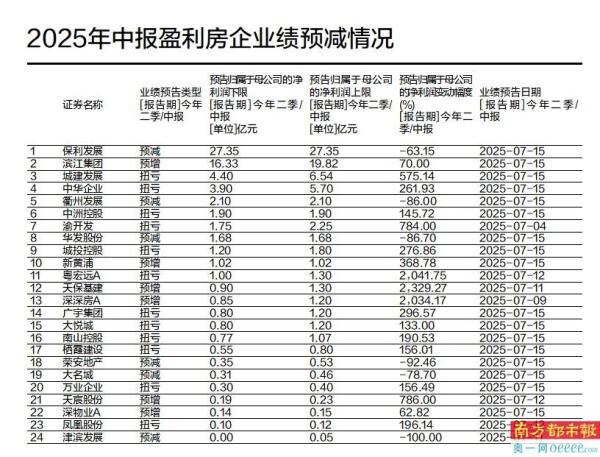
Core Viewpoint - The real estate industry is facing significant challenges, with a notable divergence in performance among listed companies as they release their mid-year earnings forecasts for 2025, indicating a trend of declining profits and increasing losses for many firms [1][2][8]. Group 1: Earnings Forecasts - As of July 17, 2025, 61 real estate companies have disclosed their mid-year earnings forecasts, with a total expected loss ranging from 342.56 billion to 464.97 billion [2]. - Among these, 24 companies anticipate profits while 37 expect losses, indicating that 60% of the firms are projected to report losses [2]. - The overall trend shows a decline in performance, with companies like Jin Di Group and Huashang City experiencing significant losses, while some firms like Dayue City and Chengjian Development have managed to turn losses into profits [2][3]. Group 2: Profitability Analysis - In the group of 24 companies expecting profits, only Poly Developments and Binjiang Group are projected to earn over 1 billion, with Poly's profit expected to drop by 63.15% year-on-year [3][4]. - Binjiang Group's profit is expected to increase by 40% to 70%, attributed to a higher volume of delivered properties compared to the previous year [3]. - Chengjian Development is expected to achieve a profit of 4.4 billion to 6.54 billion, marking a year-on-year growth of up to 575.14% due to successful project deliveries [4]. Group 3: Losses and First-Time Losses - Among the 37 companies forecasting losses, 13 are expected to report their first-ever losses, including Shahe Shares and Xijiang Holdings, with some firms projecting losses exceeding 10 billion [5][7]. - Vanke is anticipated to incur the highest loss, estimated between 100 billion and 120 billion, due to a significant decline in project settlement scale and low gross margins [6][7]. - Greenland Holdings and Xinda Real Estate are also expected to report substantial losses, with estimates of 30 billion to 35 billion [7]. Group 4: Market Outlook - The overall performance of real estate companies reflects the ongoing downward trend in the market, with sales volume and price indicators weakening [8][9]. - However, there are indications of potential recovery in the second half of the year, with expectations of a turning point as market conditions improve [8]. - The top 100 real estate companies reported a total sales volume of 18,364.1 billion, a year-on-year decline of 11.8%, but the rate of decline is slowing [9].


最高溢价率30%,上海5宗地块185.3亿元成交!这家房企斥资上百亿拿下2宗
券商中国· 2025-07-24 14:28
Core Viewpoint - The recent land auction in Shanghai indicates a sustained heat in the real estate market, with significant participation from major developers, suggesting ongoing stability in the market supported by quality new housing supply [3][9]. Group 1: Auction Results - On July 24, Shanghai conducted its sixth batch of land auctions for 2025, selling 5 plots of land for a total of 185.3 billion yuan, with 4 plots sold at a premium and 1 at the base price [1][4]. - The highest premium rate was observed in the Minhang District at 30%, while the mixed-use land in Jing'an District and the multi-purpose land in Putuo District were acquired by China Overseas with premium rates of 10.1% and 14.17%, respectively, totaling 118.88 billion yuan [2][7]. Group 2: Land Details - The Minhang District residential land had a sale area of 26,232.04 square meters and a planned construction area of 65,580.1 square meters, with a starting price of 28.38 billion yuan. It attracted 4 bidders and was ultimately won by Anhui Expressway Real Estate Group for 36.89 billion yuan, resulting in a floor price of 56,247 yuan per square meter [5]. - The Jing'an District mixed-use land had a sale area of 16,809.38 square meters and a planned construction area of 59,337.11 square meters, with a starting price of 48.71 billion yuan. It was won by China Overseas for 53.63 billion yuan, resulting in a floor price of 90,390 yuan per square meter [6][7]. - The multi-purpose land in Putuo District, comprising residential and commercial plots, had a total sale area of 47,199.11 square meters and a starting price of 57.15 billion yuan. It was acquired by China Overseas for 65.25 billion yuan, with a comprehensive floor price of 58,823 yuan per square meter [7]. - The residential land in Fengxian District had a sale area of 25,690.6 square meters and a planned construction area of 30,828.72 square meters, with a starting price of 6.78 billion yuan. It was won by a joint venture of Guomao and Xiangyu for 7.58 billion yuan, resulting in a floor price of 24,595 yuan per square meter [8]. - The multi-purpose land in Qingpu District, with a total sale area of 70,377.23 square meters and a starting price of 21.948 billion yuan, was acquired at the base price by Shanghai Lianhong Real Estate Development [8]. Group 3: Market Insights - Industry experts note that the sustained heat in Shanghai's land auction market reflects strong real estate investment attractiveness due to the city's economic scale, infrastructure, and resource availability. This trend is expected to support the stability of the real estate market as quality new housing supply increases [3][9].


最高溢价率30%!上海5宗地块185.3亿成交
证券时报· 2025-07-24 13:31
Core Viewpoint - The recent land auction in Shanghai on July 24, 2023, demonstrated sustained market enthusiasm, with a total of 5 plots sold for 18.53 billion yuan, indicating a stable trend in the real estate market supported by increased supply of quality new homes [1][2][6]. Summary by Sections Auction Results - On July 24, Shanghai auctioned 5 plots across various districts, resulting in 4 plots sold at a premium and 1 at the base price, totaling 18.53 billion yuan [3][6]. - The highest premium rate was observed in Minhang District at 30%, while mixed-use land in Jing'an and multi-purpose land in Putuo were acquired by China Overseas with premium rates of 10.1% and 14.17%, respectively, totaling 11.888 billion yuan [1][4]. Detailed Plot Information - Minhang District: Land area of 26,232.04 m², planning area of 65,580.1 m², starting price of 2.838 billion yuan, sold for 3.689 billion yuan with a floor price of 56,247 yuan/m² and a premium rate of 30% [4]. - Jing'an District: Land area of 16,809.38 m², planning area of 59,337.11 m², starting price of 4.871 billion yuan, sold for 5.363 billion yuan with a floor price of 90,390 yuan/m² and a premium rate of 10.1% [4]. - Putuo District: Total land area of 47,199.11 m², starting price of 5.715 billion yuan, sold for 6.525 billion yuan with a comprehensive floor price of 58,823 yuan/m² and a premium rate of 14.17% [4]. - Fengxian District: Land area of 25,690.6 m², starting price of 678 million yuan, sold for 758 million yuan with a floor price of 24,595 yuan/m² and a premium rate of 11.8% [5]. - Qingpu District: Multi-purpose land with a total area of 70,377.23 m², sold at the base price of 2.1948 billion yuan with a comprehensive floor price of 14,925 yuan/m² [5]. Market Analysis - The auction attracted 11 companies, including 4 central enterprises and 7 state-owned enterprises, indicating strong interest in high-quality land [7]. - The sustained enthusiasm in the Shanghai land auction reflects the city's robust economic scale, infrastructure, and talent resources, which continue to attract real estate investment [7]. - The ongoing heat in the land auction market, combined with the accelerated supply of quality new homes, is expected to support the stability of the Shanghai real estate market [7].

地产持仓延续低配,龙头房企迎投资良机
Guolian Minsheng Securities· 2025-07-24 09:50
Investment Rating - Investment recommendation: Outperform the market (maintained) [9] Core Viewpoints - The real estate sector continues to see low allocation, with leading real estate companies presenting good investment opportunities. The total market value of heavy holdings in the real estate sector among public funds was 25.67 billion yuan in Q2 2025, a decrease of 11.3% quarter-on-quarter, with a holding ratio of 0.83%, which is 0.37 percentage points lower than the industry standard [4][10][17]. Summary by Sections Industry: Fund Holdings Decline, Low Allocation Trend Continues - In Q2 2025, the total market value of heavy holdings in the real estate sector among sample funds was 25.67 billion yuan, down 11.3% quarter-on-quarter. The holding ratio was 0.83%, a decrease of 0.12 percentage points, indicating a relative underweight of 0.37 percentage points compared to the industry standard [10][17]. Sector: Development and Service Sectors See Decline - In Q2 2025, the heavy holding ratios for the real estate development and service sectors were 0.74% and 0.09%, respectively, both showing a quarter-on-quarter decline of 0.11 and 0.02 percentage points [11][22]. Individual Stocks: Focus on State-Owned Enterprises and Commercial Real Estate - The top five heavy holdings in the real estate development sector were Poly Developments (4.902 billion yuan), China Merchants Shekou (3.193 billion yuan), and others. Notably, New Town Holdings and China Resources Land saw increases in holdings of 466 million yuan and 202 million yuan, respectively [12][24]. Funds: Northbound Funds Increase Holdings in Poly, Southbound Funds Add to Beike, Longfor, and Greentown - In Q2 2025, the top five companies with increased northbound fund holdings included Poly Developments (+1.37 percentage points) and others. Southbound funds increased holdings in Beike-W (+2.15 percentage points) and Longfor Group (+2.04 percentage points) [13][35]. Investment Recommendations: Continue to Recommend Leading State-Owned Enterprises and Improvement-Oriented Real Estate Companies - The real estate sector's valuation remains at historical lows, with policies supporting market stabilization. The report suggests focusing on leading state-owned enterprises and improvement-oriented real estate companies with strong land acquisition capabilities and high-quality products, such as Jianfa International Group and Greentown China [14][38].

楼市“半年考”| 55家房企上半年交房超50万套背后:交付高峰期已过,企业“保交付”压力持续减轻
Mei Ri Jing Ji Xin Wen· 2025-07-24 09:27
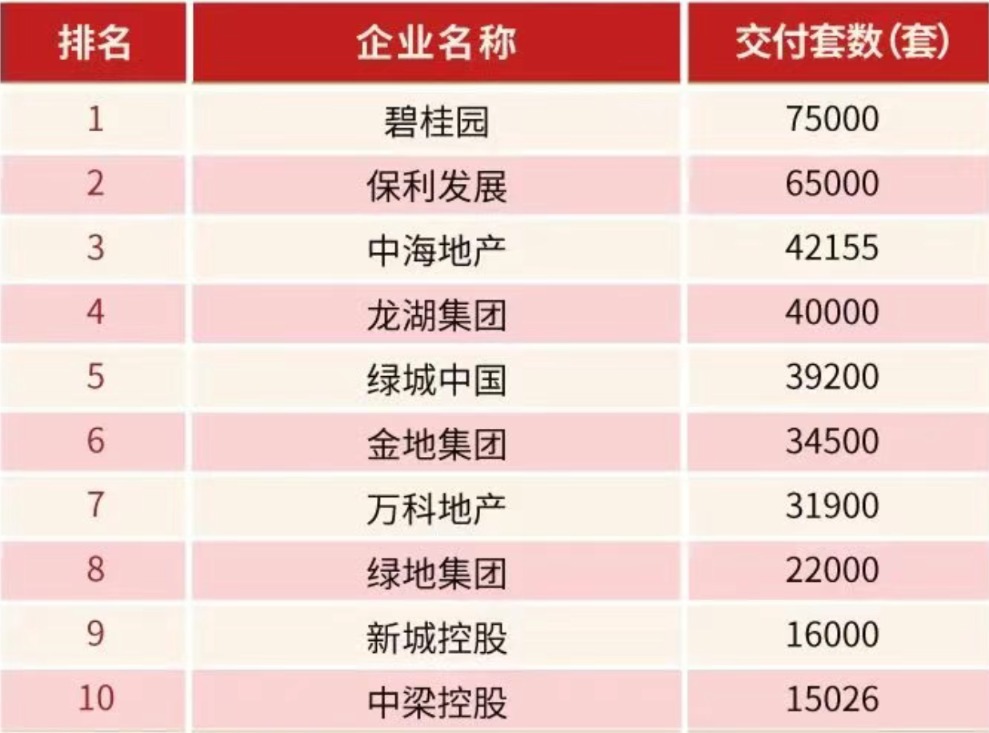
Core Viewpoint - The delivery of residential properties remains a crucial task for the real estate market in 2025, with a notable decline in delivery volumes compared to the previous year, indicating a shift in focus for companies from "guaranteeing delivery" to seeking development opportunities [1][9]. Delivery Performance - In the first half of 2025, 55 real estate companies delivered over 500,000 units, with 15 companies delivering more than 10,000 units each [1]. - Major companies like Greenland Group, Sunac China, and Jianye Group saw delivery declines exceeding 50% compared to the same period last year [1]. - The top three companies in terms of delivery volume were Country Garden (75,000 units), Poly Developments (65,000 units), and China Overseas Property (42,155 units), with the top ten companies accounting for 56.46% of total deliveries [2][1]. Industry Trends - The pressure to ensure delivery is easing as the peak delivery period has passed, allowing companies to shift their focus towards development and operational strategies [1][9]. - Companies like Country Garden and Sunac China are actively working on completing their delivery commitments while also restructuring their financing to align with current market conditions [3][4]. Innovations in Delivery - Some companies have begun implementing innovative delivery methods, such as "delivery and certificate issuance" on-site, enhancing customer experience and operational efficiency [10]. - The focus on improving delivery quality includes better communication with homeowners and offering personalized services during the delivery process [10]. Strategic Shifts - The industry is witnessing a strategic shift where companies are prioritizing product quality, operational efficiency, and asset management over mere scale [11][12]. - Companies are categorizing their strategies into three main types: product-focused, light-asset models, and asset operation, reflecting a more nuanced approach to market challenges [11].


2025年二季度主动基金重仓股追踪
ZHONGTAI SECURITIES· 2025-07-24 04:52
1. Report Industry Investment Rating - The report does not explicitly mention the overall industry investment rating 2. Core Viewpoints of the Report - In Q2 2025, the overall market value of A - share holdings of active equity - oriented funds decreased, while that of H - share holdings increased. The industry concentration of the top heavy - stock holdings of equity - oriented funds decreased. The communication, non - bank finance, and media industries saw significant increases in allocation ratios, while the steel, food and beverage, and coal industries had large reduction ratios [4][6]. - The structure of the top heavy - stocks of active equity - oriented funds changed. The overall number of large - market - cap leaders decreased, and the holdings of sub - industry leaders increased. The new high - growth technology stocks related to AI emerged, while traditional large - cap white - horse stocks were significantly reduced [4]. - In terms of industry leaders, the communication, non - bank finance, media, agriculture, forestry, animal husbandry, and beauty care industries were significantly increased, while the steel, coal, real estate, social services, and food and beverage industries were significantly reduced [21]. - The report suggests focusing on four investment themes: communication and hardware upstream under AI diffusion, non - bank finance, new consumption in the Hong Kong stock market, and national defense and military industry [26] 3. Summary by Relevant Catalogs 3.1 2025Q2 Active Fund Heavy - Stock Holding Structure Overview - **A - share and H - share holdings changes**: In Q2 2025, the total market value of active equity - oriented fund heavy - stock holdings was 1736.2 billion yuan, a 1.66% QoQ decrease. A - share holdings decreased by 2.79% QoQ to 1394.8 billion yuan, while H - share holdings increased by 3.20% QoQ to 341.3 billion yuan. Due to the complex macro - economic environment and market volatility, funds faced redemption pressure and tended to reduce large - cap stocks with poor liquidity [6]. - **Industry concentration decline**: From Q1 to Q2 2025, the industry concentration of the heavy - stock holdings of equity - oriented funds decreased. CR3 decreased by 0.56 percentage points to 38.37%, and CR5 decreased by 4.18 percentage points to 51.18%. The top five industries in terms of holding market value remained the same, but the proportion of the electronics industry increased, while the other four industries decreased [4][7]. - **Structural adjustment of industry holdings**: In Q2 2025, 12 industries saw an increase in the total market value of holdings. The communication, non - bank finance, and media industries had large increases in allocation ratios, rising by 75.88%, 64.62%, and 38.37% respectively. The steel, food and beverage, and coal industries had large reduction ratios, decreasing by 46.32%, 26.16%, and 23.99% respectively [9] 3.2 Q2 Active Fund Top Heavy - Stock Tracking - **Change in the structure of top heavy - stocks**: In Q2 2025, the structure of the top 20 heavy - stocks of active equity - oriented funds changed. The large - market - cap leaders decreased, and the sub - industry leaders increased. The market value of the top 20 heavy - stocks accounted for 20.72% of all heavy - stocks, a 2% decrease from Q1 [12]. - **Changes in the top five heavy - stocks**: The top five heavy - stocks remained the same, but the overall holdings decreased. New high - growth technology stocks such as New Fiber Optic Technology and Inphi Corporation quickly rose in the rankings, while traditional large - cap white - horse stocks such as Luxshare Precision Industry, Midea Group, and Contemporary Amperex Technology were significantly reduced [4]. - **Hong Kong stock market adjustment**: In the Hong Kong stock market, AI and Internet media leaders were reduced, while the pharmaceutical and new consumption sectors that performed well in Q2 were significantly increased [18] 3.3 Q2 Industry Leader Heavy - Stock Tracking - **Industry leader allocation changes**: In Q2 2025, the communication, non - bank finance, media, agriculture, forestry, animal husbandry, and beauty care industries were significantly increased, while the steel, coal, real estate, social services, and food and beverage industries were significantly reduced [21]. - **Communication industry focus**: Driven by the booming demand for AI hardware, the communication industry became the focus of funds. The optical module sector, which benefits from the expansion of AI capital expenditure, was the main area for increasing communication heavy - stocks. The profitability of communication equipment is expected to continue to improve in the second half of the year [22]. - **Non - bank finance sector highlights**: The leaders of the non - bank finance sector attracted attention. The holdings of Ping An Insurance and CPIC increased by 55% and 41% respectively, and securities leaders such as Citic Securities and Huatai Securities also saw over 30% increases. The brokerage sector's performance is expected to continue to improve [23] 3.4 Investment Recommendations - **AI diffusion - related communication and hardware upstream**: The significant increase in the holdings of optical module leaders reflects that funds are extending from AI software to computing infrastructure. AI capital expenditure is expected to drive the performance of upstream sectors in the second half of the year [26]. - **Non - bank finance sector**: The concentrated increase in holdings of leaders such as Citic Securities and Ping An Insurance reflects the positive expectations of the market for the profitability improvement of the brokerage and insurance sectors. The non - bank finance sector is expected to achieve a resonance of valuation repair and performance recovery [26]. - **Hong Kong stock new consumption theme**: After the correction in the AI sector, funds refocused on consumption structure highlights, especially in the Hong Kong stock market. Sub - sectors such as pets, toys, and emotional consumption have become important directions for heavy - stock allocation [26]. - **National defense and military industry safety theme**: The significant increase in the holdings of core military stocks reflects the high attention of institutions to the "national security + high - end manufacturing" theme. The military industry has policy support, order growth, and mid - report performance improvement expectations, with medium - term allocation value [27]





上半年A股超10家房企扭亏 保利、滨江利润规模领先
Xin Jing Bao· 2025-07-24 00:23
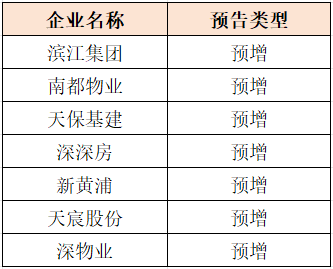
Core Viewpoint - The real estate industry in China is experiencing mixed results in the first half of 2025, with some companies reporting profit increases while others continue to face significant losses [1][10]. Group 1: Profit Increases - Among the listed real estate companies, Poly Developments and Binjiang Group are leading with profit increases, with Binjiang Group expecting a net profit of 1.632 billion to 1.982 billion yuan, marking a growth of 40%-70% due to increased project deliveries [3][2]. - Other companies achieving profit increases include Nandu Property, New Huangpu, Tianchen Shares, Tianbao Infrastructure, Deep Deep Property, and Shen Property [4][5]. Group 2: Profit Turnarounds - Fourteen companies, including Chengjian Development and Daxin City, have successfully turned losses into profits, with Chengjian Development expecting a net profit of 440 million to 654 million yuan [8][9]. - Daxin City anticipates a turnaround with a net profit of 8 million to 12 million yuan, compared to a loss of 364 million yuan in the previous year [8]. Group 3: Continued Losses - Vanke and Huaxia Happiness are among the companies still facing substantial losses, with Vanke projecting a net loss of 10 billion to 12 billion yuan due to decreased project settlements and high financial costs [10][11]. - Huaxia Happiness expects a net loss of 5.5 billion to 7.5 billion yuan, an increase from a loss of 4.849 billion yuan in the same period last year [11]. - Other companies like Jindi Group and Greenland Holdings are also forecasting significant losses, with Jindi expecting a net loss of 4.2 billion to 3.4 billion yuan [11].

消失的房企区域公司
21世纪经济报道· 2025-07-23 15:00
Core Viewpoint - The restructuring of regional companies in the real estate sector is a strategic move by leading firms to enhance efficiency and adapt to changing market conditions, focusing on high-potential cities and reducing management layers [2][6][10]. Group 1: Restructuring of Regional Companies - Several state-owned enterprises have begun to eliminate regional companies, shifting to a two-tier management model where headquarters directly manage city companies [2][4]. - China Resources Land and Vanke are among the firms that have adjusted their management structures to streamline operations and improve efficiency [5][6]. - The trend started with Jinmao, which dissolved five regional companies and restructured into 14 regional companies, indicating a broader industry shift [4][6]. Group 2: Focus on Core Cities - Leading real estate firms are concentrating their investments in first-tier and strong second-tier cities, with a focus on around ten key cities [6][10]. - Jinmao's investment strategy shows that 94.7% of its new saleable area is concentrated in first and second-tier cities, with Beijing and Shanghai being primary targets [6][8]. - Similarly, China Overseas Land's sales in major cities like Beijing and Shanghai accounted for over half of its total sales, highlighting the trend of focusing on core urban markets [7][8]. Group 3: Implications of Organizational Changes - The reduction of regional companies is seen as a defensive measure rather than a sign of stagnation, as these firms remain among the top performers in the industry [6][10]. - The shift to a two-tier management model is viewed as a rational response to the current market environment, where many firms are adopting similar structures to enhance operational efficiency [10][11]. - Analysts suggest that while streamlining operations, firms must balance centralized control with local market sensitivity to maintain competitiveness [11].